

Time:2026-08-10
In modern healthcare technology and medical device manufacturing, engineering teams and procurement managers frequently encounter the term BLE. When searching for the BLE abbreviation medical definition, engineers are looking far beyond a simple acronym lookup. They need a comprehensive understanding of how Bluetooth Low Energy (BLE) operates as a foundational wireless protocol for medical-grade hardware, remote patient monitoring (RPM) devices, smart hospital infrastructure, and clinical IoT networks.
As hospitals transition from wired equipment to wireless diagnostic ecosystems, understanding BLE architecture, protocol stacks, regulatory compliance, and hardware integration is essential for original equipment manufacturers (OEMs). This technical guide breaks down the BLE abbreviation in medical contexts, examines core data profiles, compares wireless protocols, and provides a roadmap for factory OEMs building smart medical devices.
In healthcare engineering and medical device taxonomy, BLE stands for Bluetooth Low Energy. First introduced by the Bluetooth Special Interest Group (SIG) under the Bluetooth 4.0 specification (and continuously upgraded through Bluetooth 5.0, 5.1, 5.2, 5.3, and 5.4), BLE is an ultra-low-power wireless Personal Area Network (PAN) technology operating in the 2.4 GHz ISM (Industrial, Scientific, and Medical) radio frequency band.
Unlike traditional Bluetooth Classic (Basic Rate/Enhanced Data Rate or BR/EDR), which was designed for continuous high-throughput data streams like audio streaming, BLE was engineered specifically for duty-cycled data transmission. It allows medical devices to remain in deep sleep modes for long periods, waking up in milliseconds to transmit small packets of vital sign data before instantly returning to sleep.
Operating Frequency: 2.400 GHz to 2.4835 GHz across 40 RF channels (3 advertising channels for device discovery, 37 data channels for secure communication).
Modulation: Gaussian Frequency Shift Keying (GFSK).
Power Consumption: Peak currents below 10 mA to 15 mA during active transmission; idle sleep currents as low as 0.5 µA to 1.5 µA.
Latency: Ultra-fast connection setups under 6 ms, allowing instant transmission of vital alerts.
Security: AES-128 bit hardware-level encryption and LE Secure Connections (LESC) featuring Elliptic Curve Diffie-Hellman (ECDH) key exchange.
The core reason BLE has become the universal standard for medical wireless monitoring is the implementation of GATT (Generic Attribute Profile) architecture. The Bluetooth SIG established standardized medical profiles that define how diagnostic hardware formats and transmits biometric payload data. This standardization ensures interoperability between OEM sensors, hospital gateways, iOS, and Android central applications.
| Bluetooth SIG Profile | Abbreviation | Underlying GATT Services | Typical Medical & Clinical Use Case |
| Heart Rate Profile | HRP | Heart Rate Service (0x180D) | Continuous cardiac monitoring, ECG patches, telemetry vests |
| Blood Pressure Profile | BPP | Blood Pressure Service (0x1810) | Automated clinical NIBP cuffs, ambulatory pressure loggers |
| Pulse Oximeter Profile | PLXP | Pulse Oximeter Service (0x1822) | SpO2 finger sensors, respiratory monitoring clips |
| Health Thermometer Profile | HTP | Health Thermometer Service (0x1809) | Continuous fever monitoring patches, core temp sensors |
| Glucose Profile | GLP | Glucose Service (0x1808) | Continuous Glucose Monitors (CGM), blood test meters |
| Weight Scale Profile | WSP | Weight Scale Service (0x181D) | Patient fluid retention scales, bariatric monitoring beds |
| Body Composition Profile | BCP | Body Composition Service (0x181B) | Clinical impedance analyzers, metabolic research tools |
| Current Time Profile | CTP | Current Time Service (0x1805) | Timestamping medical event logs for audit trails |
By utilizing these standard profile IDs, OEM engineers ensure that a custom-built medical sensor can instantly communicate with certified hospital gateways and electronic health record (EHR) systems without needing custom client drivers.
When designing wireless medical hardware, factory engineering teams must evaluate multiple radio protocols against strict clinical parameters: power draw, range, throughput, interference tolerance, and infrastructure cost.
| Parameter | BLE (Bluetooth Low Energy) | Wi-Fi 6 (802.11ax) | Zigbee 3.0 / Thread | Sub-1GHz (LoRaWAN) |
| Peak Data Rate | 1 Mbps to 2 Mbps (2M PHY) | Up to 9.6 Gbps | 250 kbps | 0.3 kbps to 50 kbps |
| Power Consumption | Ultra-Low (Years on coin cell) | High (Requires rechargeable battery) | Low (Months to years) | Ultra-Low (Years on battery) |
| Typical Range | 10m – 100m (Coded PHY: 400m+) | 30m – 50m indoors | 10m – 30m indoors | 2km – 15km line of sight |
| Topology Support | Point-to-Point, Mesh, Broadcast | Star | Mesh | Star of Stars |
| Smartphone Native | Yes (100% of modern phones) | Yes | No (Requires gateway) | No (Requires gateway) |
| Interference Avoidance | Adaptive Frequency Hopping | OFDMA / Channel Selection | Static Channel | Chirp Spread Spectrum |
| Primary Healthcare Use | Wearables, RPM, RTLS, Smart Lighting | High-bandwidth Imaging, Video | Asset Sensors, HVAC | Building Perimeter Tracking |
While Wi-Fi is necessary for transmitting high-bandwidth diagnostic data like 12-lead ECG raw waveforms or high-resolution endoscopy video, BLE remains the undisputed leader for wearable sensors, clinical asset tracking, and point-of-care equipment.
For factory-type manufacturers and OEM hardware developers, integrating BLE modules into medical products provides distinct competitive and manufacturing advantages:
Medical sensors like disposable temperature patches or surgical equipment tags must operate continuously without bulky batteries. A standard CR2032 coin cell battery (225 mAh) paired with an optimized BLE SoC (such as the Nordic nRF52 series or Texas Instruments CC2640R2F) consuming 2 µA in sleep mode can operate for 2 to 5 years, depending on transmission intervals.
Hospitals are notorious RF environments filled with competing Wi-Fi networks, electrosurgical units, microwave equipment, and X-ray machines. BLE mitigates interference by dynamically hopping across 37 data channels up to 1,600 times per second. If a channel experiences high packet loss due to Wi-Fi traffic, the Link Layer marks that channel as polluted and routes packets across clean frequencies automatically.
With BLE, OEM devices communicate directly with tablet computers, smartphones, and smart bedside displays without external hardware adapters or proprietary dongles. This direct link simplifies patient setup in remote patient monitoring programs and reduces manufacturing BOM (Bill of Materials) costs.
Using Angle of Arrival (AoA) and Angle of Departure (AoD) technology introduced in Bluetooth 5.1, medical facilities can pinpoint the location of BLE-tagged assets—such as infusion pumps, crash carts, ultrasound machines, and wheelchair fleets—down to sub-meter accuracy (under 50 cm).
To design a medical-grade BLE device capable of passing FDA 510(k), EU MDR, and ISO 13485 audits, OEM design engineers must structure the physical hardware stackup with extreme precision.
For biosignal acquisition (ECG, PPG, SpO2, EMG), the AFE filters minute microvolt-level physiological signals away from electrical noise before feeding digitized data via SPI or I2C into the primary processing unit.
Modern medical designs utilize dual-core SoCs (such as an ARM Cortex-M33 for application code and an ARM Cortex-M4 dedicated entirely to the BLE network stack). Isolating the network stack on a dedicated core prevents timing jitter during real-time sensor processing.
Antenna tuning inside small medical enclosures is critical. Human body tissue absorbs 2.4 GHz RF radiation rapidly due to high water content. OEM engineers must choose between:
Printed Circuit Board (PCB) Trace Antennas: Low cost, but require larger PCB area (e.g., Meandered Inverted-F Antenna / MIFA).
Multilayer Ceramic Chip Antennas: Compact footprint, highly resilient to proximity detuning caused by hand contact or skin placement.
Custom Flexible Antennas: Ideal for curved wearable biosensor housings.
Medical electronics require ultra-low quiescent current regulators. Suppressing voltage ripple is essential to prevent power supply noise from distorting sensitive biopotential readings.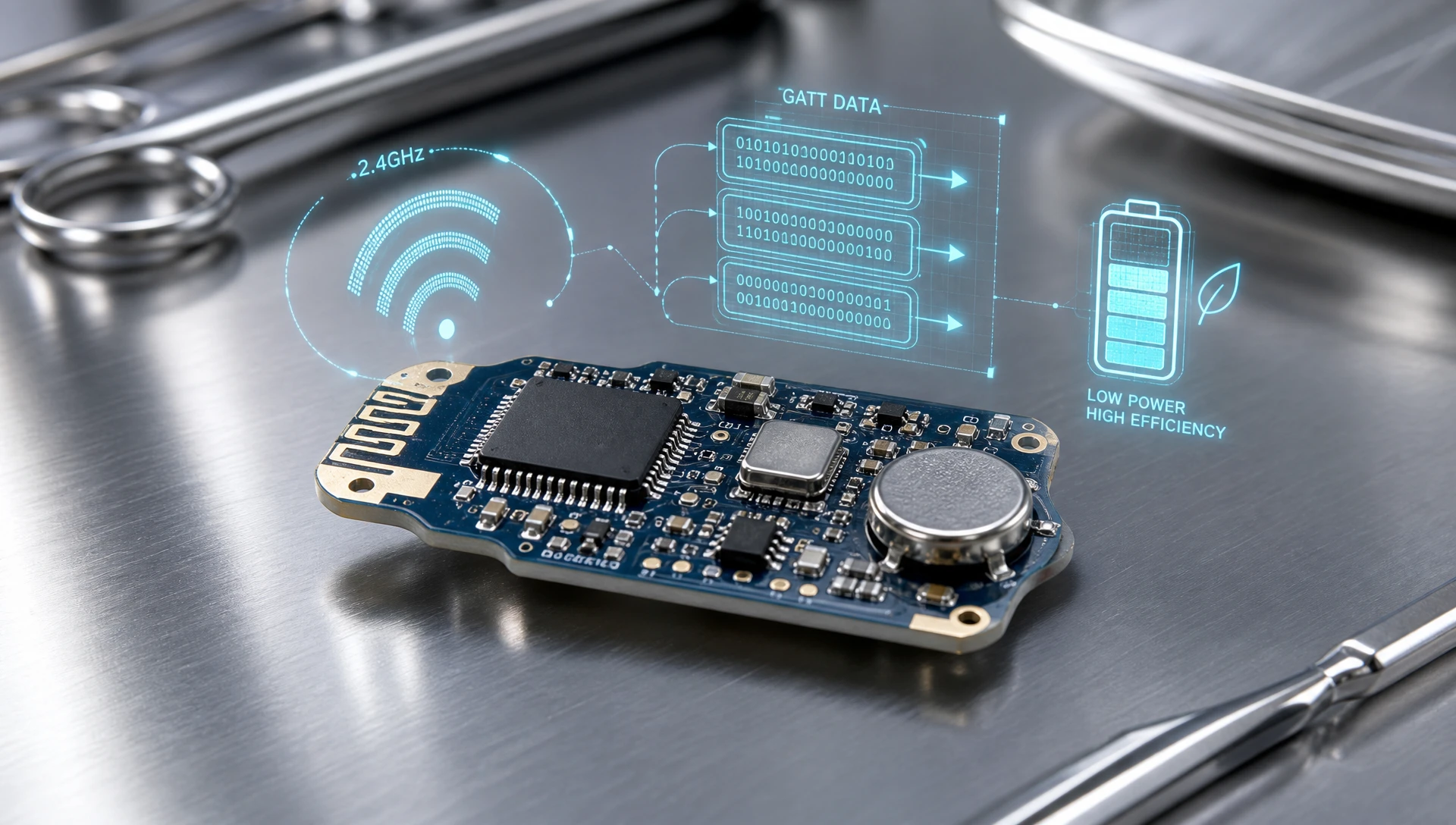
Deploying wireless hardware into clinical settings requires strict compliance with international medical safety and data privacy frameworks:
Medical BLE equipment must undergo rigorous EMC testing. It must withstand electrostatic discharge (ESD) up to 15 kV, radiated radio frequency immunity up to 10 V/m or 30 V/m in critical care settings, and magnetic field exposure without resetting or dropping critical patient data packets.
Factory production lines producing BLE medical sub-assemblies must maintain certified Quality Management Systems (QMS). Complete component lot traceability, automated optical inspection (AOI), and recorded calibration logs are mandatory for every PCB assembly (PCBA).
Medical BLE data transmissions containing Protected Health Information (PHI) must be encrypted end-to-end:
LE Secure Connections (LESC): Uses ECDH key pairing to prevent eavesdropping during the initial connection phase.
Passkey Entry & Out-of-Band (OOB) Pairing: Eliminates Man-In-The-Middle (MITM) attacks by requiring physical verification (e.g., scanning an encrypted QR code printed on the physical device housing).
AES-128 Hardware Encryption: Scrambles payload bytes at the Link Layer before transmission over the air.
Building custom medical BLE hardware from initial concept to commercial volume production follows a strict 5-phase engineering methodology:
Define signal throughput, battery life targets, operating temperature ranges, and payload packet structures. Decide whether standard Bluetooth SIG GATT profiles apply or if custom GATT services are required.
Select certified SoC modules or chip-down designs. Perform RF impedance matching (50 Ohm trace tuning) using network analyzers. Isolate analog sensor lines from digital RF switching traces using ground planes and guard rings.
Write firmware application layers over vendor-supplied BLE protocol stacks (e.g., Nordic SoftDevice or TI SimpleLink). Secure QDID (Qualified Design Identification) numbers from the Bluetooth SIG to legally display the Bluetooth trademark on commercial medical products.
Test transmitter power output, spurious harmonics, and receiver sensitivity inside calibrated anechoic chambers. Conduct ESD surge tests and verify mechanical durability across sterilization cycles (autoclave, ETO gas, or chemical wipe-down).
Execute automated flash programming, custom MAC address assignment, crystal oscillator calibration, and end-of-line (EOL) RF output testing at the factory using automated RF shielding boxes.
To see how BLE transforms healthcare delivery, let's examine major commercial and clinical deployment scenarios:
Wearable ECG patches equipped with BLE monitors continuously track cardiac rhythm, skin temperature, and motion. Data streams to a bedside gateway or patient smartphone, automatically transmitting abnormalities to cloud telemetry platforms.
Modern IV infusion pumps use BLE connectivity to cross-reference drug library settings, verify patient wristband IDs, and send real-time fluid delivery alarms back to central nursing stations.
Smart shipping containers lined with BLE temperature logging beacons maintain continuous audit logs during transport. Loggers store data locally and offload temperature charts wirelessly to hospital receiving terminals upon delivery.
BLE-enabled smart lighting fixtures double as an indoor positioning infrastructure. By mounting BLE receivers directly into ceiling luminaires, hospitals establish a high-density RTLS mesh capable of tracking medical equipment, doctors, and patients in real time across multi-floor facilities.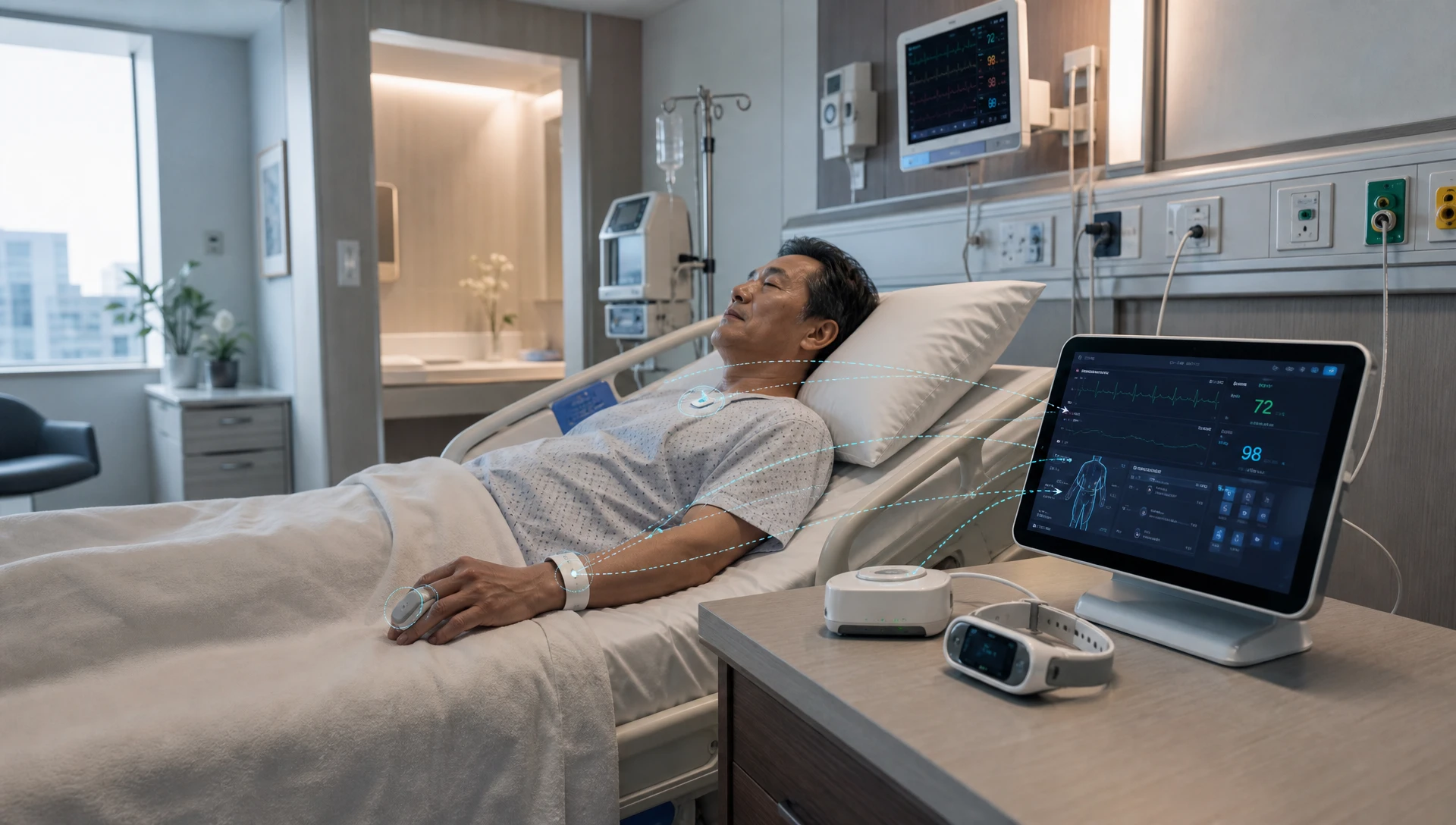
Engineering teams implementing BLE into medical products frequently face technical hurdles during initial field trials:
| Technical Challenge | Root Cause Analysis | Engineering Solution |
| RF Attenuation by Human Tissue | 2.4 GHz signal absorbed by body water content | Utilize Coded PHY (Long Range mode), optimize antenna placement away from skin backing |
| High Packet Drop Rate in Surgery Rooms | Severe co-channel interference from Wi-Fi video transmitters | Enable Adaptive Frequency Hopping (AFH), shorten BLE packet size, increase transmission power to +4 dBm |
| Inconsistent Battery Life | Unoptimized MCU wake-up timers, excessive logging | Implement interrupt-driven direct memory access (DMA), optimize sleep timers, adjust advertising intervals |
| Connection Loss During OTA Updates | Memory corruption during wireless firmware flashes | Design dual-bank Flash architecture for fail-safe Over-the-Air (OTA) updates with automatic rollback |
| ESD Failure During Sterilization | Electrostatic discharge jumping through enclosure seams | Seal housings with ultrasonic welding, add TVS diode protection arrays across exposed metal pins |
When selecting an OEM/ODM manufacturing partner for custom medical BLE hardware or smart sensor-integrated controls, procurement managers should evaluate suppliers against these key criteria:
Understanding the BLE abbreviation in medical technology reveals a versatile, highly reliable, and energy-efficient wireless protocol powering next-generation healthcare ecosystems. From low-power biometric wearable sensors to facility-wide smart lighting asset tracking networks, Bluetooth Low Energy provides the technical bridge connecting physical medical hardware to digital cloud intelligence.
For original equipment manufacturers, selecting a qualified hardware manufacturing partner is the critical step in bringing compliant medical BLE systems to market smoothly.
Ready to engineer certified, high-reliability wireless hardware or smart sensor control infrastructure for your healthcare projects? Contact our engineering team today through the official
A1: In medical device engineering, BLE stands for Bluetooth Low Energy. It is an ultra-low-power 2.4 GHz wireless communication protocol standardized by the Bluetooth SIG, specifically engineered to transmit diagnostic sensor payloads and telemetry data using minimal battery consumption.
A2: BLE requires significantly less power than Wi-Fi, allowing small wearable sensors to operate for months or years on a single coin-cell battery. Additionally, BLE offers lower connection latency, native compatibility with smartphones, smaller hardware footprints, and lower manufacturing costs.
A3: Yes. LumiEasy provides complete OEM/ODM development services, including hardware schematic design, custom RF antenna stackups, firmware programming, pre-compliance testing, and ISO-certified volume manufacturing tailored to your exact smart control and sensor requirements.


)
)
)
)

+86 15899791249

+86 755 2955 3313


Address: Huafeng No.1 Science and Technology Park, Sanwei, Bao'an District, Shenzhen, Guangdong, China.
