

Time:2026-10-19
📌 Key Takeaways for Luminaire Manufacturers & Lighting Controls Engineers:
Decentralized Bluetooth Mesh Ecosystem: Industrial-grade ble sensors operate without a single point of failure, enabling luminaire-level lighting control (LLLC) with ultra-low latency response times (<20ms).
Universal Controller Interoperability: Utilizing universal controller compatible sensors guarantees seamless integration across 0-10V, DALI-2, and Zhaga Book 18 socket standards for global OEM fixture lines.
Silvair Ecosystem Qualification: Selecting a silvair-compatible sensor ensures instant interoperability with qualified Bluetooth Mesh firmware stacks, accelerating DLC NLC 5.1 certification for North American markets.
Multi-Sensor Data Fusion: Modern wireless ble sensors combine PIR/PIR-Microwave occupancy sensing with ambient daylight harvesting and environmental telemetry over a unified radio node.
For commercial lighting OEMs, electrical contractors, and luminaire factories, integrating smart sensing controls into fixture lines is no longer optional. Global building energy codes—such as ASHRAE 90.1, IECC, and California Title 24—mandate granular occupancy sensing and automatic daylight harvesting across commercial and industrial real estate.
Traditional hardwired sensor architectures add labor complexity and expensive control cabling to fixture production. Deploying industrial ble sensors solves these manufacturing roadblocks by embedding wireless Bluetooth Low Energy mesh nodes directly into luminaires. This technical guide outlines the engineering specifications, protocol selection, and factory integration protocols for high-performance ble sensor solutions.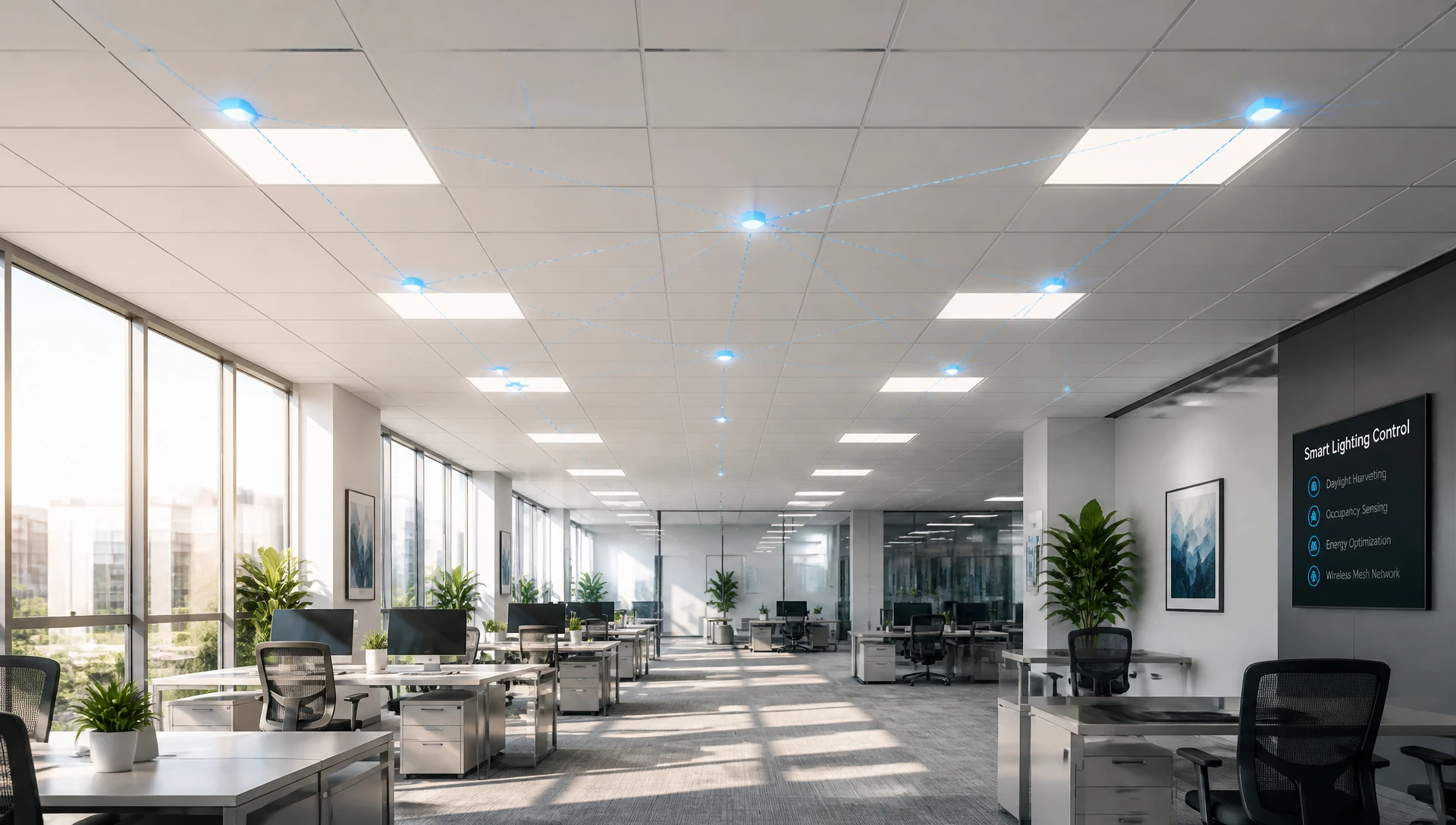
Unlike legacy master-slave sensor configurations, modern wireless ble sensors participate directly in a decentralized Bluetooth Mesh topology. Each node integrates multi-mode optical elements alongside a 2.4 GHz RF transceiver:
Dual-Technology Motion Detection: Combines Passive Infrared (PIR) and Microwave radar to detect micro-movements (office desk typing) and macro-movements (forklift traffic) without false triggers from HVAC airflow.
Closed-Loop Daylight Harvesting: A calibrated photodiode continuously measures ambient light levels, issuing dynamic dimming commands to the fixture driver to maintain constant task-plane illuminance.
Multi-Protocol Firmware Integration: Incorporating an advanced ble sensor with standardized firmware guarantees full alignment with Bluetooth SIG Mesh standards, simplifying field commissioning via mobile applications.
For a detailed breakdown of qualified hardware modules and initial configuration setups, explore our technical breakdown on
Selecting the optimal ble sensor solutions for commercial fixture manufacturing depends on installation cost, commissioning speed, and ecosystem interoperability:
| Engineering Parameter | Wireless BLE Sensors (Bluetooth Mesh) | Zigbee 3.0 RF Sensors | Traditional 0-10V Wired Sensors |
| Networking Architecture | Decentralized Bluetooth Mesh | Coordinator-Based Mesh | Hardwired Point-to-Point |
| Commissioning Tool | Smartphone App (Bluetooth LE) | Dedicated Gateway / Handheld RF | Physical Dip Switches / Knobs |
| Firmware Ecosystem | Silvair / Bluetooth SIG Qualified | Zigbee Alliance Profile | Analog Voltage (No Firmware) |
| Wiring Requirements | Zero Extra Control Cabling | Zero Extra Control Cabling | 2-Wire Control Bus Required |
| Ecosystem Interoperability | High (Universal Controller Compatible Sensors) | Medium (Vendor-Specific Profiles) | Universal (Pure Analog) |
| Data Telemetry Capability | Occupancy, Lux, Power, Temperature | Occupancy, Lux | None (Analog Signal Only) |
| DLC NLC 5.1 Eligibility | Fully Eligible (LLLC Ready) | Fully Eligible | Ineligible (Requires Module) |
Factory luminaire engineers select mechanical interfaces based on target application environments and physical enclosure constraints:
For outdoor streetlights, area lights, and high-bay industrial fixtures, the Zhaga Book 18 press-and-twist socket is the industry standard. A universal controller compatible sensors module utilizing Zhaga interface layers includes:
UV-Stabilized Polycarbonate Outer Dome: IP66/IP67 weatherproof and IK08+ impact-resistant protection.
Integrated Mesh Radio & Multi-Sensor Optics: Houses the 2.4 GHz radio transceiver, PIR/Microwave lenses, and photodiode elements.
4-Pin DC Twist-Lock Receptacle: Interfaces with driver-supplied 24V DC aux power (Pin 1), DALI-2/0-10V control signal (Pin 2), DC Ground (Pin 3), and reserved aux data (Pin 4).
For indoor commercial troffers, linear architectural slots, and downlights, compact ble sensor units mount directly into standard 1/2-inch knockouts, connecting to LED drivers via low-voltage wiring harnesses.
To review outdoor-grade housing options and IP-rated sensor specs, consult our product showcase for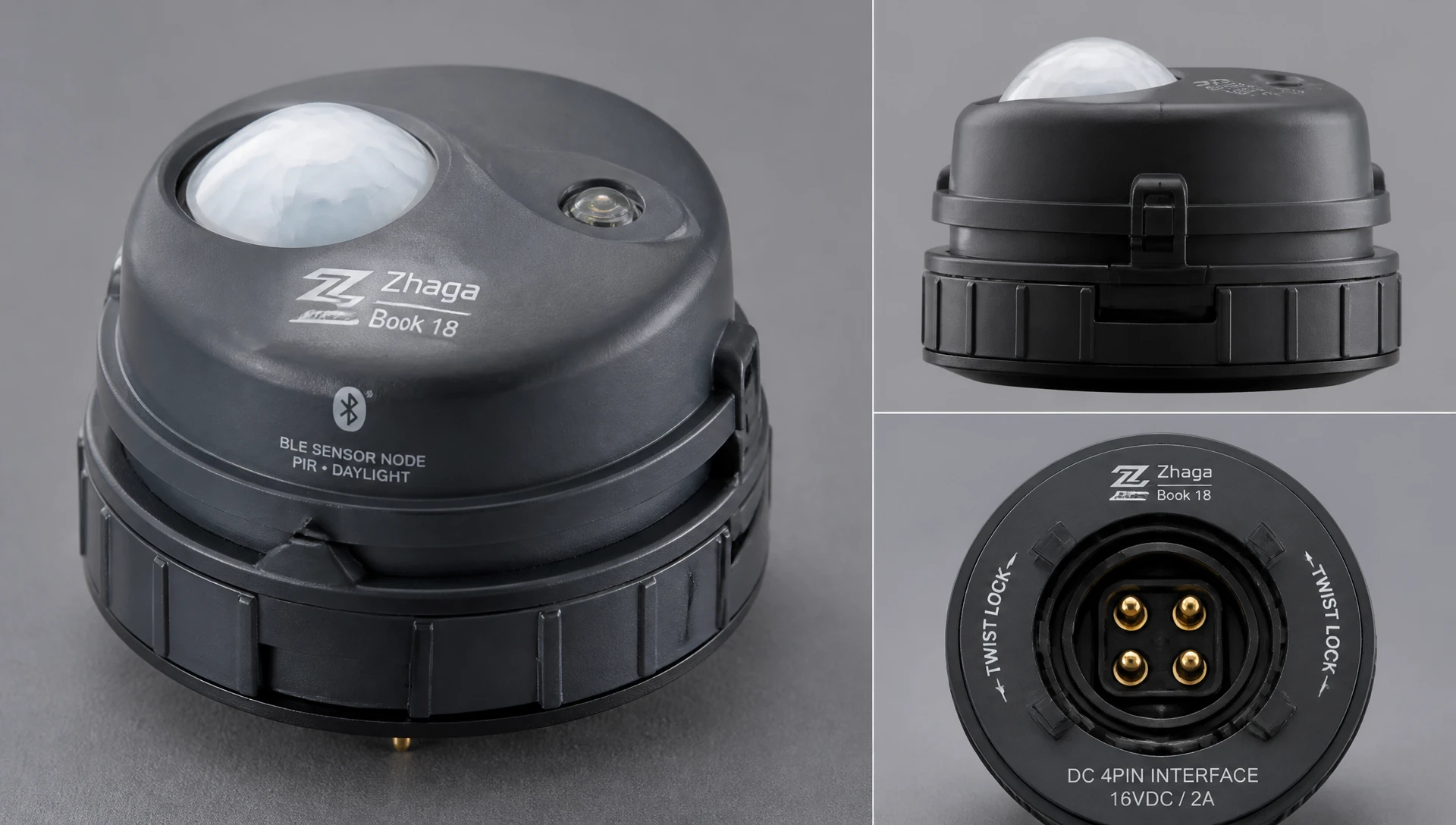
Achieving DesignLights Consortium (DLC) Networked Lighting Controls (NLC) 5.1 listing is critical for utility rebate eligibility in North America. A compliant ble sensor fulfills five core requirements:
LLLC Standalone Operation: Enables independent luminaire sensing and control without single-point gateway dependencies.
Continuous Stepless Dimming: Delivers smooth 0-10V/DALI-2 dimming profiles calibrated dynamically to ambient daylight.
Energy Monitoring & Telemetry: Captures driver voltage, power consumption, operating hours, and temperature for cloud reporting.
Cybersecurity Verification: Enforces PSA Certified Level 1 hardware safety and 128-bit AES end-to-end packet encryption.
Qualified Bluetooth Stack: Incorporating a verified silvair-compatible sensor guarantees native cross-brand interoperability and simplified smartphone pairing. OEM engineers can review our verified
For full technical details on qualifying control nodes, read our in-depth analysis on
To guarantee zero-defect manufacturing when installing ble sensors on luminaire assembly lines, OEM factories enforce a 4-step QA workflow:
| QA Stage | Test Name | Key Engineering Verification Standard |
| Step 1 | Automated Optical Lux & PIR Detection | Validates detection coverage, sensitivity thresholds, and daylight harvesting dimming curves inside an automated dark chamber. |
| Step 2 | 2.4 GHz RF Signal & RSSI Verification | Measures transmit power (+4 to +8 dBm) and receiver sensitivity (-96 dBm) via spectrum analyzers to ensure stable RF propagation. |
| Step 3 | Electrical Isolation & Surge Withstand | Tests high-voltage AC surge protection and driver inrush current withstand to prevent grid-transient field failures. |
| Step 4 | Factory Default Reset & Provisioning | Clears test setups, verifies unique MAC address QR code generation, and checks Bluetooth keys for secure site commissioning. |
In open-air industrial environments, commercial wireless ble sensors achieve a line-of-sight RF transmission range of up to 100 meters. In indoor commercial spaces with drywall and glass partitions, a reliable node-to-node distance is 15 to 30 meters. Because every mains-powered sensor acts as a relay node, the effective network coverage spans entire multi-story facilities.
Selecting a silvair-compatible sensor ensures that your luminaire utilizes a globally qualified Bluetooth Mesh software stack. This provides seamless interoperability with third-party Bluetooth Mesh wall switches, gateways, and software platforms, while significantly accelerating DLC NLC 5.1 listing and utility rebate approvals for North American projects.
Yes. Through Bluetooth Mesh group binding, a single ble sensor can wirelessly control dozens of luminaires within a designated zone. When motion is detected or ambient daylight shifts, the sensor broadcasts local mesh commands simultaneously to all assigned LED drivers with sub-20ms latency.
Integrating high-precision ble sensor solutions into your commercial lighting fixture lines elevates product performance, ensures energy code compliance, and simplifies field commissioning for your contractor customers.
To request product datasheets, order sample evaluation kits, or consult with our OEM engineering team on custom sensor integration,




+86 15899791249

+86 755 2955 3313


Address: Huafeng No.1 Science and Technology Park, Sanwei, Bao'an District, Shenzhen, Guangdong, China.
