

Time:2026-06-04
In 2026, facilities must cut high overhead and meet strict zero-emission laws. Traditional AC lighting relies on siloed switches, causing massive electricity waste and constant maintenance headaches.
The ultimate fix is moving away from isolated local hardware. Instead, modern operators adopt advanced, unified central lighting management software paired with Power over Ethernet (PoE) network hubs. This smart system delivers safe DC power and fast bidirectional data through a single category cable. It eliminates conversion losses and transforms standard building utilities into an intelligent, data-driven cloud ecosystem.
For decades, Information Technology (IT) and Operational Technology (OT) within a building existed as separate, isolated silos. Lighting belonged to the high-voltage electrical grid.
Licensed contractors managed these systems by running thick metal conduits and circuit breakers. Computer networking belonged to IT. Those systems were contained entirely within specialized server rooms.
Power over Ethernet lighting bridges this historic gap cleanly. It converges these power backbones into a single unified low-voltage infrastructure.
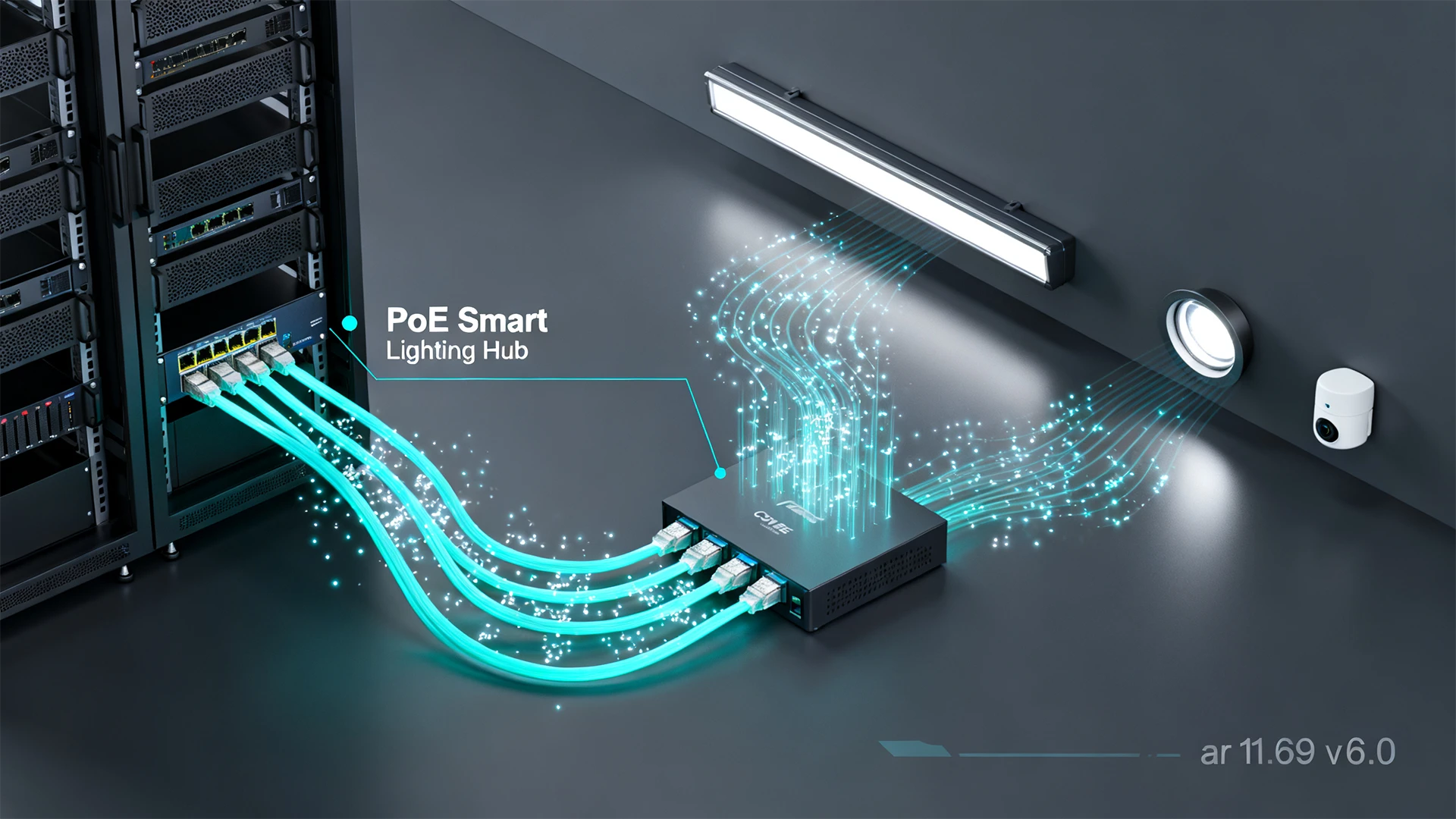
At the foundation of this setup sits the enterprise headend conversion point. This station feeds smart, low-voltage PoE edge hubs deployed throughout a facility. These hubs distribute power and data directly to driverless LED luminaires, wall switches, environmental sensors, and IP security cameras. The system uses standard Cat6 network wiring for all connections.
PoE lighting relies on safe-to-touch low-voltage DC power below 60V. Because the voltage is low, it eliminates high-voltage shock and fire risks completely. This safety profile dramatically streamlines initial construction. It also makes future facility remodels much easier and faster.
The real intelligence comes from the central lighting management software running across these network switches. Rather than tuning individual bulbs, an energy manager controls the entire building grid from a unified dashboard. Every single category cable connected to a low-voltage fixture acts as a two-way data highway.
The central software continually talks to every light node on the network. It monitors power metrics, ambient environments, and operational health profiles across the entire commercial enterprise.
Finance teams and operations directors want to see results. A smart building project must deliver clear financial proof to get fast approval. Traditional AC-powered LED lights contain small, individual internal drivers. These components convert alternating current down to low-voltage direct current.
This localized conversion is highly inefficient. It loses approximately 10% to 15% of all incoming power as wasted ambient heat right at the ceiling level.
PoE lighting layouts avoid this structural conversion loss entirely. Centralized power systems handle conversion cleanly at the main low-voltage hub. This means the system delivers native DC electricity straight to driverless LED panels.
Pair your system with a central lighting management software controller. This setup helps corporate users lock in deep utility savings across three core financial areas:
Traditional smart lightbulbs maintain a continuous wireless connection even when turned completely off. This draw creates a hidden "phantom power" leak across thousands of fixtures. Enterprise PoE systems operate with true zero standby loss. They achieve this by shutting down hub power rails completely during vacancy periods.
Siloed commercial offices often leave perimeter window lights burning at full brightness on sunny afternoons. Centralized software maps real-time data from low-voltage photocell nodes. It automatically dims specific window-facing light rows by 40% to 60%. This choice relies on free natural sunlight while maintaining consistent target workspace lux levels.
Standard commercial fixtures out of the box operate at full 100% power capacity. This setup is often brighter than necessary for standard desk tasks. Via the central web management interface, facility directors can apply a permanent maximum power limit of 75% or 80% across entire building levels simultaneously. This adjustment saves 20% in energy costs instantly, and the human eye cannot even detect the difference in brightness.
Modern corporate office spaces require deep insight into daily staff movement. Having this data helps managers optimize real estate costs and building performance. Low-voltage LED luminaires are everywhere on a facility's ceiling. This even layout makes them the perfect spot to house embedded smart sensors.
Standalone cloud motion detectors and environment nodes connect to a low-voltage network switch. Then, they pass anonymous presence data back to the platform. They send these updates every single second. This structural design forms the foundation of powerful space utilization data collection workflows.
Do not rely on rough monthly averages. Facility managers can check accurate, real-time visual heatmaps of their physical layout instead. The central software highlights exactly which executive boardrooms sit empty all week. It can also spot which collaborative zones face constant layout bottlenecks and which lounge desks are fully occupied.
This design allows the platform to pass real-time space utilization metrics and occupancy logs. It sends this data straight to your current third-party building automation system.
The setup uses open industrial communication rules like BACnet to pass data. Imagine a department leaves for an offsite meeting. The lighting software flags the empty floor instantly.
Then, the central software tells the HVAC system to scale back airflow and temperature controls to maximize building efficiency. This automated coordination drastically lowers monthly commercial utility costs.
The operational benefits of deploying software across low-voltage PoE networks vary across distinct commercial settings. The system offers targeted functional value for different architectural layouts:
Data centers are complex layouts that require high-performance infrastructure, maximum uptime, and specialized operational intelligence. Server hallways are often vacant for extended periods. Because of this, keeping whole rooms fully lit wastes money and adds heat.
Centralized management software solves this challenge by pairing with granular smart datacenter lighting tracking arrays. It brings light loads up to 100% intensity only in the specific rack row where an IT technician is actively working.
Neighboring corridors remain safely dimmed. This keeps power usage effectiveness (PUE) metrics low. Furthermore, reducing driverless LED wattage decreases internal heat dissipation, directly reducing the cooling load on heavy computer room air conditioning (CRAC) units.
Professional recording studios require precise, flicker-free dimming controls. They also need consistent color temperature (CCT) tuning to prevent video artifact distortion during filming.
By utilizing central PoE network switches, studio control teams can adjust light values from 0% to 100% smooth output. This method prevents high-frequency electrical hum or camera banding. Production crews can program and store custom lighting profiles.
An easy app interface lets them trigger these looks for separate broadcast segments instantly. This flexibility removes the need for bulky, expensive external dimming panels and heavy high-voltage supply lines.
Massive shipping hubs feature high ceilings and vast storage aisles that introduce serious layout visibility risks. Central software networks address this by linking directly with standalone, rugged IP65-rated outdoor and indoor cloud sensors.
Imagine a forklift approaches an exterior loading dock at night. Perimeter sensors spot the movement instantly. The central controller overrides normal night settings immediately. It floods that loading zone with full-intensity light so security cameras can record in high-resolution color.
Some facility managers run large logistics hubs or commercial office portfolios. For them, maintaining thousands of legacy light bulbs is an expensive challenge. Traditional teams follow a slow, manual process. They must wait for a tenant to complain about a dark space.
Alternatively, they have to send workers down every single aisle on tall ladders just to find dead lamps.
Transitioning your low-voltage infrastructure to a software architecture modernizes this workflow by introducing automated predictive maintenance:
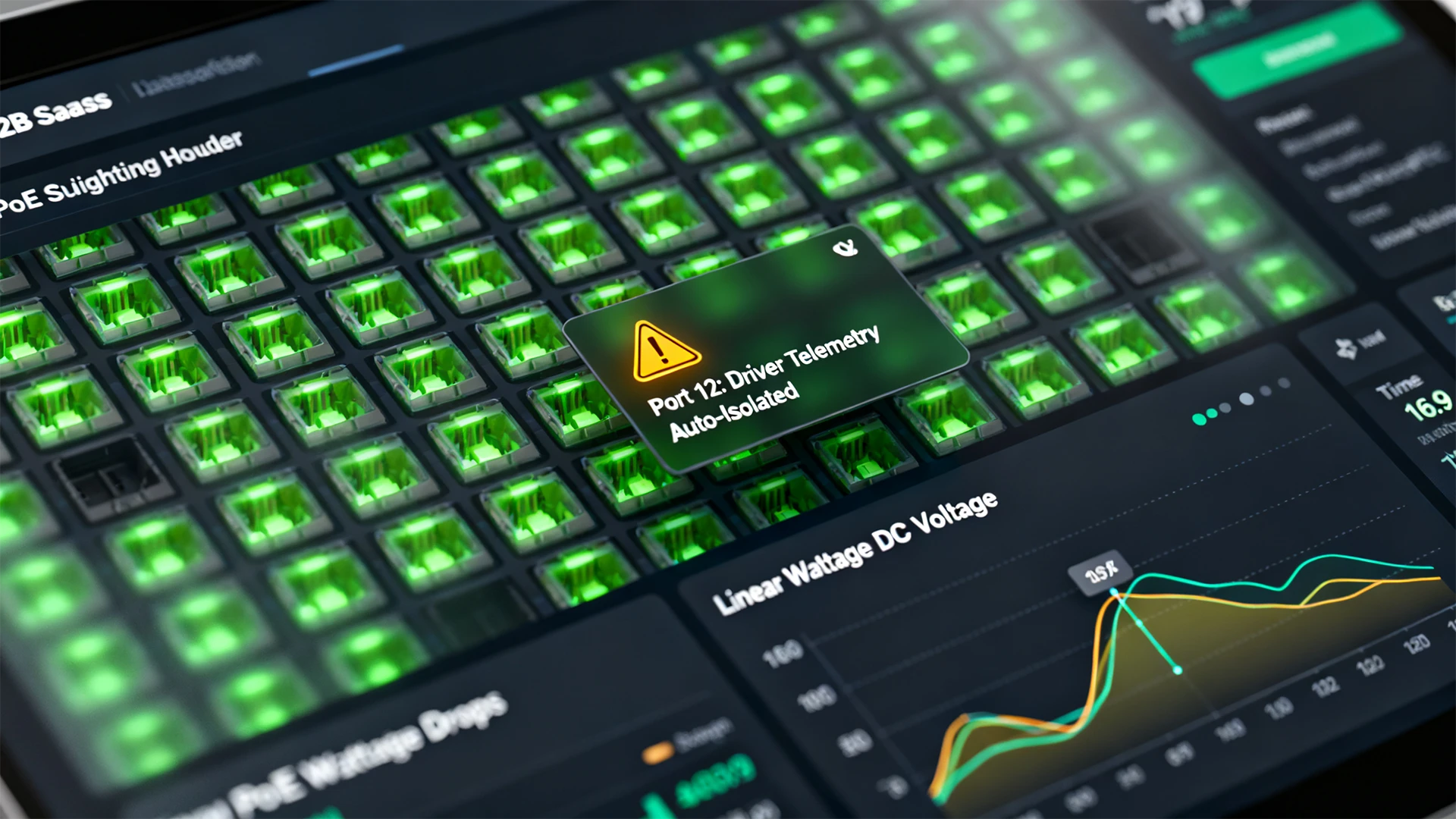
Instant Digital Diagnostics: Every cable running to a light fixture handles both power delivery and data communication. Because of this, the central network knows the status of every bulb. When a fixture fails, the data stream stops instantly. The central dashboard flags the failure immediately and sends an automated alert to your maintenance team.
Exact Layout Coordinate Routing: The software does not just tell you that a bulb is dead. It displays the precise room number, row placement, and floor grid coordinate on a live digital layout. This visual guide lets your crew skip the guesswork entirely.
Proactive Component Lifespan Analytics: This data lets you order bulk factory replacements early. You can schedule swap-outs during routine facility shutdowns to prevent sudden operational downtime.
International green building compliance frameworks demand empirical proof of environmental stewardship. Corporate enterprises cannot rely on rough estimates anymore. Vague utility invoice projections are not enough to meet modern energy consumption reduction targets.
Deploy a dedicated software framework today. It gives your sustainability team the precise data needed to back up corporate claims and earn valuable green credentials:
The software records real-time watt-hour consumption metrics. It tracks individual cubicle zones, factory assembly lines, and outdoor building signs. An energy manager can export certified, audit-ready energy usage logs with a single click. This file provides concrete proof for international green compliance reviews.
Earning top-tier building certifications requires rigorous verification of automated control strategies. Sourcing an enterprise-grade central software suite that automates daylight harvesting, task tuning, and occupant scheduling secures crucial points. These points help you lock in advanced building honors like LEED or WELL status.
Modern regional building codes demand smart lighting control features on all new commercial building projects. Sourcing a certified, central software platform guarantees absolute compliance with international energy conservation codes. This protection shields your corporate investment from expensive compliance fines.
Executing a commercial low-voltage upgrade requires a calculated approach to upfront component sourcing. Choose an open power over ethernet framework. This choice slashes your material expenses, speeds up construction schedules, and maximizes your long-term system ROI. Savvy corporate procurement managers avoid closed, single-vendor ecosystems that lock buyers into proprietary hardware.
Move away from traditional high-voltage AC electrical lines. Standardizing on intelligent power over ethernet networks protects your project timeline and unlocks major construction advantages:
remove of Expensive Conduits: Safe, low-voltage category wiring can be run open through drop ceilings or cable trays. This installation method completely removes the need for rigid metal conduit or heavy steel junction boxes.
Drastic Labor Overhead Savings: Low-voltage DC power lines carry zero shock or fire hazards. Because of this safety profile, general data communication technicians can safely handle the entire physical installation. This reduces the need for expensive, licensed electrical contractor labor hours.
Ultimate Long-Term Flex Layouts: Imagine an office layout changes during a future remodel. Repositioning a low-voltage plug-and-play sensor or led fixture takes minutes. It eliminates days of noisy conduit demolition and electrical rewiring.
Choosing an open PoE framework slashes your material expenses, accelerates construction schedules, streamlines your iot lighting control architecture, and maximizes your corporate long-term system ROI.
Achieving true energy efficiency requires an integrated approach. It pairs rugged low-voltage hardware with flexible, cloud-configured control software. Moving away from traditional high-voltage AC electrical lines and standardizing on intelligent Power over Ethernet networks protects your project timeline. It also maximizes your long-term corporate ROI.
Are you ready to eliminate manual maintenance headaches? Do you want to drop your monthly utility bills and build an intelligent, data-driven facility layout? Do not let supply chain delays or uncertified white-label components compromise your engineering standards. Partner with an industry-tested manufacturing expert. This partnership secures high-quality, factory-direct smart devices tailored to your exact architectural needs.
Do you need comprehensive product catalogs or engineering data sheets? Do you want an exact project price quote? Please visit our official B2B portal. You can submit your technical blueprint requirements directly to our team through our
A: Yes, absolutely. Our premium central lighting management software is built on open API structures and standard industrial communication protocols like BACnet. This design allows the platform to pass real-time space utilization metrics and occupancy logs.
It sends this data straight to your current third-party building automation system. You can control heating, ventilation, and power metrics across your entire facility. A unified dashboard handles this without needing custom software patches.
A: Yes. Every single connected sensor, wall switch, and LED luminaire links back to the cloud network through your low-voltage PoE edge switches. An energy manager can log into the central web dashboard or mobile app.
From there, they can adjust motion hold times, change lux thresholds, and rewrite daylight harvesting schedules instantly. This remote configuration removes the need to use tall ladders. It stops crews from disrupting active workplace operations for basic calibration checks.
A: System safety and reliability are our top priorities. Imagine your building loses its external internet connection. Our low-voltage poe hubs and lighting control systems switch automatically to an offline local fail-safe mode. Do not worry about downtime.
All automated motion sensors, wall dimmers, and safety schedules continue running locally inside the building network without lag. The connection will come back online eventually. The system automatically syncs its data logs back to the cloud right away to ensure zero operational downtime.


)
)
)
)

+86 15899791249

+86 755 2955 3313


Address: Huafeng No.1 Science and Technology Park, Sanwei, Bao'an District, Shenzhen, Guangdong, China.
