

Time:2026-07-28
In modern heavy manufacturing facilities, automotive assembly plants, and global distribution centers, upgrading legacy high-bay lighting to intelligent networked lighting controls (NLC) represents one of the most effective strategies for reducing facility energy consumption. Modernizing industrial lighting grids can yield energy savings between 50% and 80%. However, the capital expenditure required to procure high-bay LED luminaires, wireless sensor nodes, edge gateways, and centralized control software can be substantial.
To accelerate industrial decarbonization, electric utilities across North America offer massive financial incentive programs. These utility rebates routinely subsidize 30% to 70% of total project capital costs. However, securing these lucrative cash incentives hinges on a single mandatory prerequisite: verifying that the installed lighting control platform is listed on the DesignLights Consortium (DLC) Networked Lighting Controls (NLC) Qualified Products List (QPL).
For plant managers, electrical contractors, and OEM lighting specifiers, navigating the dlc network lighting compliance verification process is critical. Failing to comply with DLC V5.1 testing protocols, cybersecurity benchmarks, or submission workflows can result in complete rejection of utility rebate applications, exposing facility owners to unexpected capital liabilities.
This technical guide provides a comprehensive overview of the DLC NLC compliance ecosystem, detailing testing standards, laboratory validation workflows, cybersecurity mandates, and strategies for defending utility rebate audits in heavy industrial environments.
The DesignLights Consortium (DLC) is a non-profit organization that establishes performance, energy efficiency, and quality standards for commercial and industrial lighting. The DLC Networked Lighting Controls (NLC) Technical Requirements Version 5.1 serve as the definitive benchmark for commercial smart lighting systems across North America.
To earn a spot on the DLC QPL, an industrial lighting control platform must demonstrate compliance across mandatory functional criteria:
Occupancy Sensing: Automated reduction or total shutoff of luminaire power when industrial aisles or storage bays are unoccupied.
Daylight Harvesting: Continuous, linear dimming of perimeter luminaire rows in response to incoming natural light through factory skylights or windows.
High-End Trim (Task Tuning): Establishing maximum light output caps across specific manufacturing zones to prevent lumen over-provisioning without sacrificing task visibility.
Zoning and Grouping: Reconfigurable digital grouping of luminaires via software without requiring physical rewiring of electrical circuits.
Continuous Dimming: Smooth, flicker-free light level reduction down to 10% or lower of full rated power.
Cybersecurity Defense: Mandatory verification against recognized international cybersecurity frameworks to prevent unauthorized access to facility Operational Technology (OT) networks.
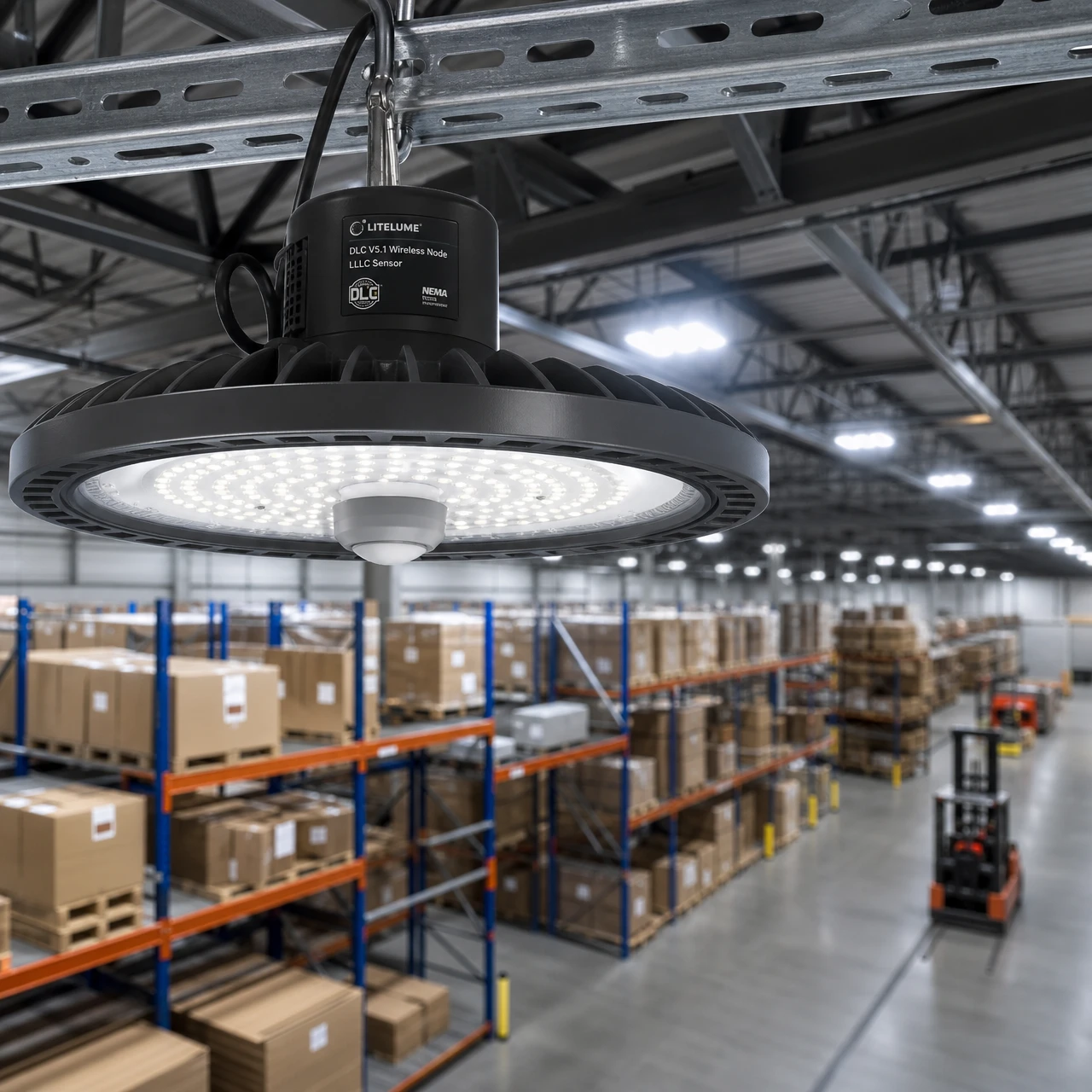
Achieving DLC QPL listing requires a rigorous, multi-stage evaluation process combining internal product engineering, independent laboratory testing, third-party cybersecurity audits, and formal DLC technical reviews.
Before submitting hardware to third-party test facilities, the manufacturer conducts an internal engineering audit. The control system's software suite, edge gateways, and sensor hardware are evaluated against the DLC V5.1 matrix. Engineers verify that all required control algorithms—such as occupancy time-delay parameters, daylight harvesting response curves, and high-end trim caps—function reliably across maximum network scale (up to 10,000 nodes).
All physical hardware components must undergo rigorous empirical testing at independent laboratories accredited under ISO/IEC 17025 and recognized by the National Voluntary Laboratory Accreditation Program (NVLAP):
Photometric & Electrical Performance (IES LM-79-19): Verifies driver efficacy, power factor (PF > 0.90), and Total Harmonic Distortion (THD < 20%) across full dimming ranges.
Electromagnetic Compatibility (FCC Part 15 Class A): Ensures that wireless sensor nodes and gateways operating in high-noise factory environments resist electromagnetic interference (EMI) caused by variable frequency drives (VFDs) and heavy machinery.
Safety Isolation (UL 916 / UL 1598): Confirms thermal endurance and electrical shock protection under continuous high-ambient temperature exposure typical of industrial ceilings (up to 50°C to 65°C).
To satisfy DLC V5.1 requirements, manufacturers must submit documentation proving that their hardware and software platform adheres to accredited cybersecurity standards. This involves third-party penetration testing and threat modeling to verify that wireless mesh networks cannot be exploited to gain unauthorized access to an enterprise's corporate IT network.
Once laboratory testing and cybersecurity evaluations are complete, the manufacturer compiles a comprehensive submission package containing test reports, architectural network diagrams, commissioning user manuals, and warranty documentation. DLC technical reviewers evaluate the package to verify full compliance before granting formal QPL status.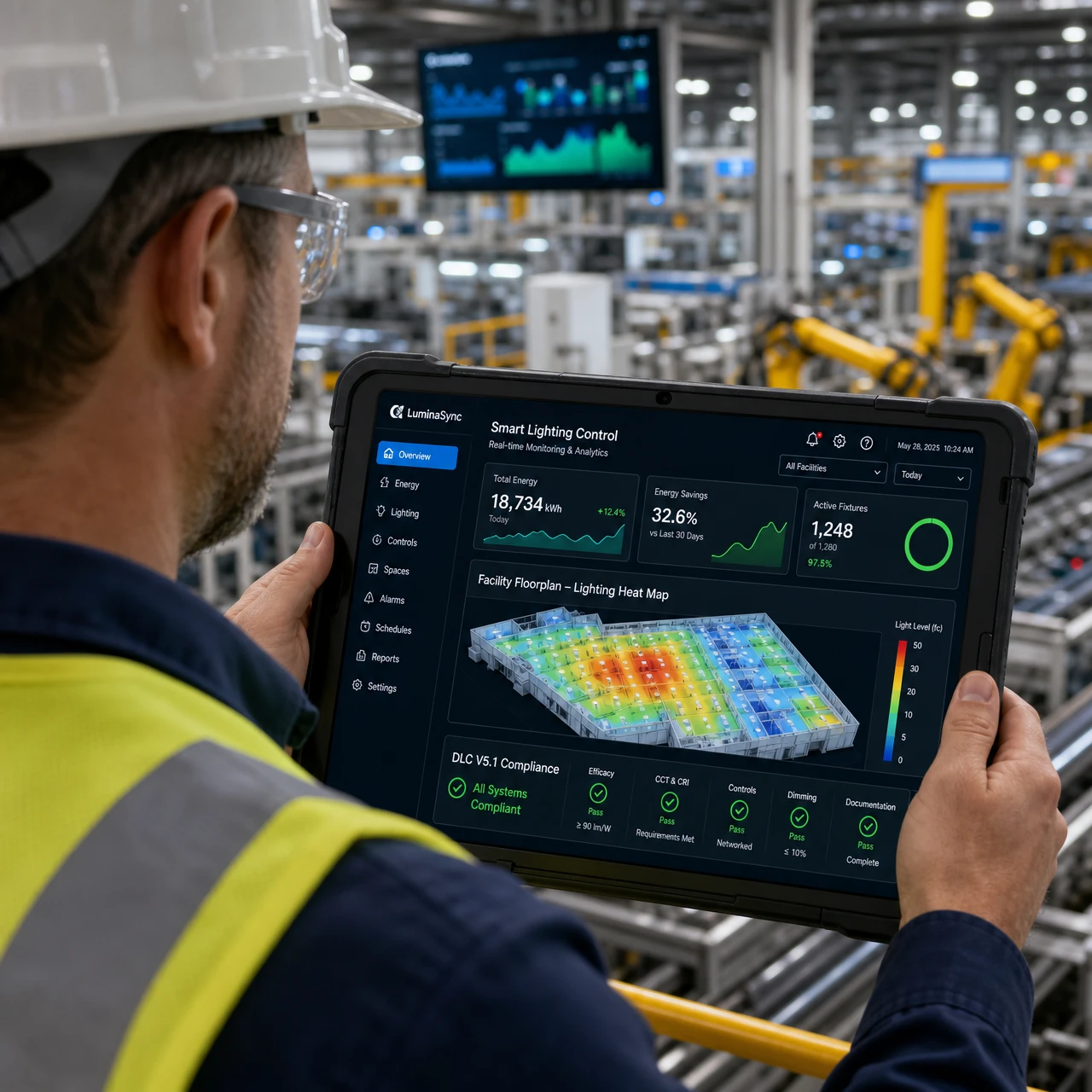
When evaluating networked lighting controls for factory retrofits, facility managers must choose between traditional System-Level NLC and Luminaire Level Lighting Control (LLLC). Understanding the technical divergence between these two approaches is essential, as DLC enforces distinct verification criteria for each.
In a System-Level NLC deployment, external motion and daylight sensors are mounted periodically along factory ceiling trusses or wall partitions. These sensors transmit control signals to a central gateway or local group of luminaires.
To achieve DLC verification for System-Level NLC, the manufacturer must prove that the centralized control software can configure multi-zone groupings, execute complex time-of-day schedules, and collect energy telemetry from external power meters or smart drivers.
Luminaire Level Lighting Control (LLLC) represents the highest tier of networked lighting control. In an LLLC architecture, every high-bay fixture is manufactured with an integrated occupancy sensor, daylight sensor, and wireless radio node built directly into the luminaire housing.
To achieve DLC LLLC listing, the system must satisfy strict autonomous operation criteria:
Out-of-the-Box Autonomous Operation: Every fixture must function independently using its factory-default motion and daylight harvesting algorithms immediately upon receiving AC power, even if wireless gateway communication is not yet established.
Granular Spatial Control: Because every fixture contains its own sensing hardware, LLLC systems enable individual fixture dimming. In high-density industrial logistics hubs, an LLLC luminaire directly above an active forklift aisle can illuminate to 100% while adjacent luminaires in idle aisles remain trimmed at 20%, maximizing energy savings.
Because LLLC platforms deliver superior energy savings and installation flexibility, utility companies frequently offer significantly higher rebate tiers for DLC-qualified LLLC systems (often 20% to 40% higher per fixture than standard NLC installations).
To assist procurement teams and plant engineering leads in specifying certified hardware, the following matrix compares technical capabilities across DLC qualification tiers:
| Technical Metric / Feature | DLC NLC V5.1 Standard | DLC NLC V5.1 LLLC Qualified | Advanced Cybersecurity & Energy Tier |
| Sensor Topology | External Group Sensors | Integrated per Luminaire | Multi-Sensor Fusion Grid |
| Utility Rebate Weight | Standard Rebate Tier | Maximum Rebate Tier (+20–40%) | Maximum Rebate + Bonus Incentives |
| Occupancy & Daylight Control | Mandatory (Group Level) | Mandatory (Individual Fixture) | Mandatory (Continuous Dynamic Adjustment) |
| High-End Trim Resolution | Zone Level | Luminaire Level | Sub-Zone Granular Software Trim |
| Energy Monitoring Accuracy | Estimated / Calculated | Measured (DALI Part 252) | Real-Time Telemetry (±2% Accuracy) |
| Cybersecurity Standard | Basic Statement / Self-Cert | Verified Test Report | ISA/IEC 62443 / UL 2900-1 Certified |
| BACnet / BMS Integration | Optional Add-on | Optional Add-on | Native Bi-Directional BACnet/IP |
| Autonomous Operation | Requires Active Gateway | Fully Autonomous | Autonomous with Cloud Failover |
Historically, industrial lighting controls were isolated systems with no connectivity to external networks. However, modern smart lighting systems rely on cloud connectivity, remote mobile app commissioning, and enterprise Building Management System (BMS) integration over BACnet/IP or MQTT protocols. This connectivity introduces potential cyber attack vectors if proper security controls are omitted.
To protect industrial enterprise infrastructure, DLC V5.1 mandates verification against recognized cybersecurity frameworks. DLC accepts certification or formal test documentation from four primary standards:
ANSI/UL 2900-1 (Software Cybersecurity for Network-Connectable Products): Evaluates software vulnerabilities, malware risks, structural weakness, and cryptographic strength in network-connected hardware.
ISA/IEC 62443 Series (Security for Industrial Automation and Control Systems): The international benchmark for industrial cybersecurity. Compliance verifies that lighting gateways incorporate secure development lifecycles (Part 4-1) and robust technical security requirements (Part 4-2).
ETSI EN 303 645: The European cyber standard for consumer and commercial Internet of Things (IoT) hardware, focusing on password security, software update integrity, and personal data protection.
PSA Certified Level 1 / Level 2: A chip-level security framework that verifies hardware-enforced isolation, secure boot, and cryptographic key storage within wireless microcontrollers.
By enforcing these cybersecurity benchmarks, the DLC verification process ensures that installing a smart lighting system will not create backdoor vulnerabilities in an enterprise's corporate network.
Achieving QPL listing is only the first step in capturing utility incentives. Following project installation, electric utilities frequently conduct field audits to verify that the physical installation matches the approved rebate application.
During a post-installation site audit, utility inspectors physically inspect the plant floor to verify three core compliance parameters:
Model Number Consistency: Inspectors verify that the physical model numbers stamped on installed luminaires, sensors, and gateways match the DLC QPL listed part numbers listed on the rebate application. Substituted hardware can trigger immediate application hold or rejection.
Functional Parameter Verification: Auditors test motion sensor timeout thresholds and verify that daylight harvesting sensors actively dim luminaires in response to ambient light.
High-End Trim Enforcement: If the rebate application claimed energy savings based on a 20% high-end trim cap, the inspector will verify within the management software that maximum power output is permanently capped at 80%.
To ensure your facility remains fully compliant during utility verification, review our detailed guide on
Failing a utility audit can result in total forfeiture of rebate funds or clawback demands for pre-paid incentives. Operating a fully certified, DLC QPL listed lighting control platform protects plant managers against these financial risks, ensuring predictable project paybacks and ongoing operational energy savings.
To ensure a smooth lighting retrofit and secure maximum utility rebates, facility managers should follow a structured five-phase deployment roadmap:
Phase 1: Pre-Audit and Utility Incentive Pre-Approval
Before issuing purchase orders, conduct an onsite energy audit. Work with your local electric utility or rebate aggregator to submit a pre-approval application detailing existing fixture wattages, proposed DLC QPL listed replacements, and estimated operating hours.
Phase 2: DLC QPL Spec-In and Bill of Materials Validation
Cross-reference every line item on the project Bill of Materials (BOM) against the active DLC Networked Lighting Controls Qualified Products List. Confirm that all selected sensor nodes, wireless gateways, and high-bay fixtures carry active DLC V5.1 listings.
Phase 3: Mechanical Installation and Network Commissioning
Install hardware according to manufacturer guidelines. Electrical contractors map fixture physical locations to software floorplans, establish wireless mesh networks, and configure primary lighting zones across production bays and warehouse aisles.
Phase 4: Sensor Parameter Calibration and High-End Trim Setup
Calibrate occupancy sensor time-delays (typically 5 to 15 minutes for industrial spaces) and configure daylight harvesting threshold setpoints. Apply high-end trim power caps across all zones to lock in baseline energy reduction.
Phase 5: Final Rebate Documentation and Audit Sign-Off
Compile final manufacturer specification sheets, DLC QPL listing certificates, paid invoices, and post-commissioning software configuration reports. Submit the completed rebate package to the utility provider for final audit sign-off and incentive check disbursement.
A1: Electric utilities require independent verification that lighting control platforms deliver real, quantifiable energy savings and meet strict cybersecurity standards before paying out incentive funds. The DLC V5.1 QPL serves as the industry gold standard, assuring utilities that listed systems meet rigorous functional, energy efficiency, and security requirements.
A2: DLC Standard NLC covers systems that use external group sensors to control multiple fixtures simultaneously. Luminaire Level Lighting Control (LLLC) requires individual occupancy sensors, daylight sensors, and wireless nodes integrated directly into every luminaire. LLLC systems provide superior spatial control and typically qualify for higher utility rebate incentive tiers.
A3: LumiEasy provides fully certified DLC V5.1 QPL listed wireless controllers, LLLC sensor nodes, and enterprise management software engineered for industrial environments. LumiEasy assists facility managers with pre-approval paperwork, specification cross-referencing, pre-configured energy telemetry software, and post-commissioning audit defense documentation to ensure seamless rebate approval.
Modernizing industrial lighting infrastructure with smart networked controls offers a compelling combination of energy reduction, operational agility, and improved workplace safety. However, capturing the full financial value of your upgrade requires specifying hardware that complies with rigorous industry standards.
LumiEasy is a global leader in advanced commercial and industrial smart lighting control solutions. Our complete ecosystem of wireless controllers, LLLC sensor modules, and enterprise software suites is engineered to meet and exceed DLC V5.1 NLC specifications, ensuring seamless compliance and maximum utility rebate qualification.
Eliminate rebate risk and maximize project return on investment. Contact our team of industrial lighting control specialists today to review your facility blueprints, verify DLC listing options, or request a custom deployment quotation. Visit the official


)
)
)
)

+86 15899791249

+86 755 2955 3313


Address: Huafeng No.1 Science and Technology Park, Sanwei, Bao'an District, Shenzhen, Guangdong, China.
