

Time:2026-06-11
Managing indoor spaces requires strict control over utility costs across high-rise towers, retail centers, and factories. Indoor illumination keeps work zones safe, boosts employee focus, and maintains property values. Even so, managing thousands of individual lighting fixtures across sprawling floors drives up your daily operating costs. Maintenance crews must walk through every corridor with ladders just to find flickering lamps or dead units. Traditional non-connected systems give no early warning when an internal component is under stress, trapping your business in a reactive repair loop. Without active tools, finding a single failure takes too long and wastes valuable technician hours.
Implementing intelligent, data-driven system feedback at the network edge solves this facility challenge completely. Running a professional dali d4i diagnostic data collection framework automates your daily building checks. This smart communication setup streams live operational updates straight to your desktop control panels. It helps your maintenance team optimize their daily labor. It also monitors hardware health in real time and lowers corporate maintenance overhead instantly. Shifting to dali d4i led driver assets lets your business track detailed power use. You can catch early equipment wear and build a highly responsive, automated property management grid.
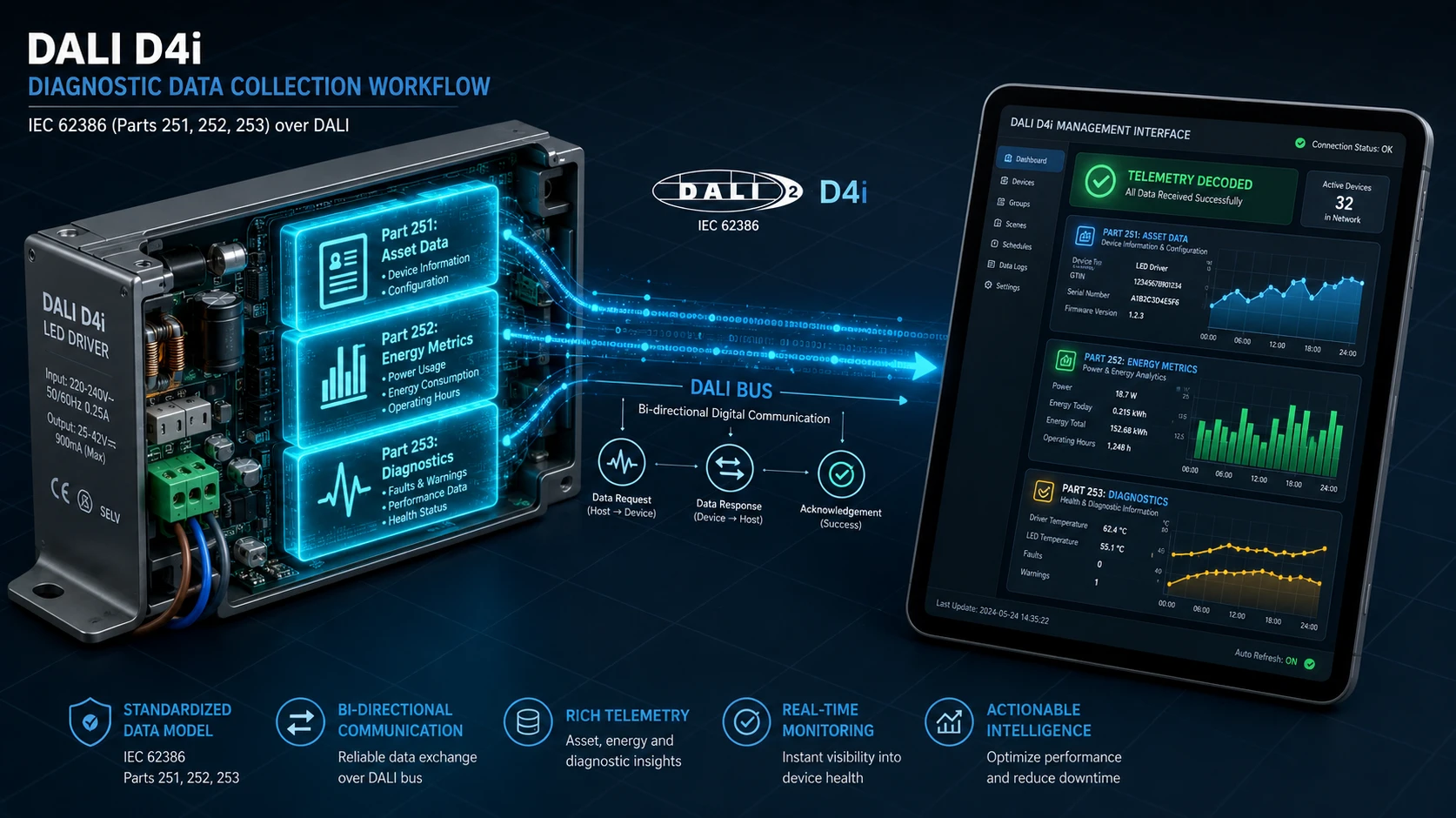
Building a reliable smart network requires a clear look at a dali d4i diagnostic setup. D4i is the newest standard from the DALI-2 protocol. It was designed specifically to bring indoor lighting into the Internet of Things (IoT). Older communication models only send basic instructions like turn on, turn off, or dim. A modern DALI lighting control system transforms every luminaire into an intelligent, two-way data node. It extracts detailed performance metrics straight from the microprocessor inside the fixture.
This intelligent data ecosystem relies on specialized, internationally standardized memory banks to categorize information:
Asset Tracking (DALI Part 251): This ledger stores vital factory data directly inside the driver chip. It keeps track of unique hardware IDs and exact wattage specifications.
Energy Accounting (DALI Part 252): This ledger records live power consumption and grid voltage stability. It tracks active energy metrics with extreme accuracy.
Smart Diagnostics (DALI Part 253): This ledger tracks total running hours and internal driver temperatures continuously. It records precise failure codes for every connected lamp module.
Extracting these details through organized network paths helps your building operators. They can audit every ceiling asset without opening physical junction boxes or disturbing active work spaces.
Smart corporate data networks require hardware that satisfies strict international communication and tracking rules. The grid below details the key performance ratings and engineering protocols. Operations managers should look for the official Dali specification to secure seamless system communication:
Protocol Foundation (IEC 62386): Guarantees perfect plug-and-play matches across multi-brand corporate hardware grids.
Data Part 251 Storage (Read/Write): Enables instant, automated system building and digital asset mapping on day one.
Data Part 252 Accuracy (<1% Error): Provides precise utility tracking data for carbon footprint tallies and green building audits.
Data Part 253 Monitoring (Real-time Logs): Identifies hardware stress early to prevent sudden system breakdowns completely and eliminate unplanned downtime.
Integrated Bus Power (250mA): Minimizes hardware installation fees by eliminating external bus power boxes.
Hardware Interface (Zhaga Book 18/20): Plugs directly into a compact indoor dali d4i controller for fast, tool-free installation.
Choosing hardware that matches these clean data rules shields your automated system from software bugs and early performance drops.
Let us review a real-world digital asset upgrade completed for a major financial headquarters and R&D hub. This case highlights the rapid financial benefits of automated data tracking.
The corporate hub managed thousands of active interior lighting assets across an expansive office campus footprint. The facility relied on manual walkthrough tests to find broken lights. This outdated method created a continuous backlog of maintenance tasks. Technicians spent roughly 24 hours every single week just hunting down failed fixtures. They had to check driver types and log model numbers by hand, adding massive numbers to their yearly operating costs. Even worse, voltage spikes during summer storms often fried unmonitored ballasts. This caused wide lighting outages and unexpected unplanned downtime across active engineering spaces.
The corporate site engineering team modernized the entire property by deploying a systematic dali d4i diagnostic data collection platform. They swapped out their legacy drivers for a smart dali d4i led driver grid tied to a central network manager. The new design focused on three clean operations rules:
Automated Inventory Mapping: The main server used DALI Part 251 to pull every fixture's exact hardware profile automatically. It built a complete digital layout in seconds.
Predictive Failure Alerts: The central dashboard watched DALI Part 253 log files daily. It flagged any driver running an unusual internal temperature before it could short out.
Targeted Repair Workflows: When a bulb reached its wear limit, the system emailed an automated ticket to your maintenance team. This alert specified the exact room number, floor level, and driver model needed for the replacement.
We measured the efficiency gains during the first twelve months after launching the automated D4i data tracking platform. The data highlights massive savings across all key operations:
Routine Maintenance Labor Hours: Dropped by 76% because the system ended manual walkthrough checks completely.
Fixture Replacement Downtime: Slashed by 68% since crews knew the exact replacement parts needed before heading to the site.
Unplanned Office Outages: Reduced by 91% through early temperature warnings and surge tracking.
Annual Building Power Bills: Saved an extra 18% by utilizing granular, real-time energy tracking software. This data helped teams optimize active light levels.
Corporate asset buyers, commercial developers, and facility engineering boards do not choose automation hardware based on cheap prices alone. Modern industrial procurement requires clear proof of deep industry experience, technical mastery, and structural reliability. Design your indoor environments with intelligent, network-ready smart building automation. This choice shows a strong commitment to quality work, field-tested expertise, and good asset management.
Your property's interior electrical networks must follow trusted safety codes. These include UL standards, CE markings, or RoHS rules. Following them proves your team's engineering skills in modern industrial design.
Show the world that your facilities achieve a permanent operational cost reduction during working hours. This path helps protect the environment and cuts your carbon footprint. It also marks your company as a trusted leader in green corporate operations.
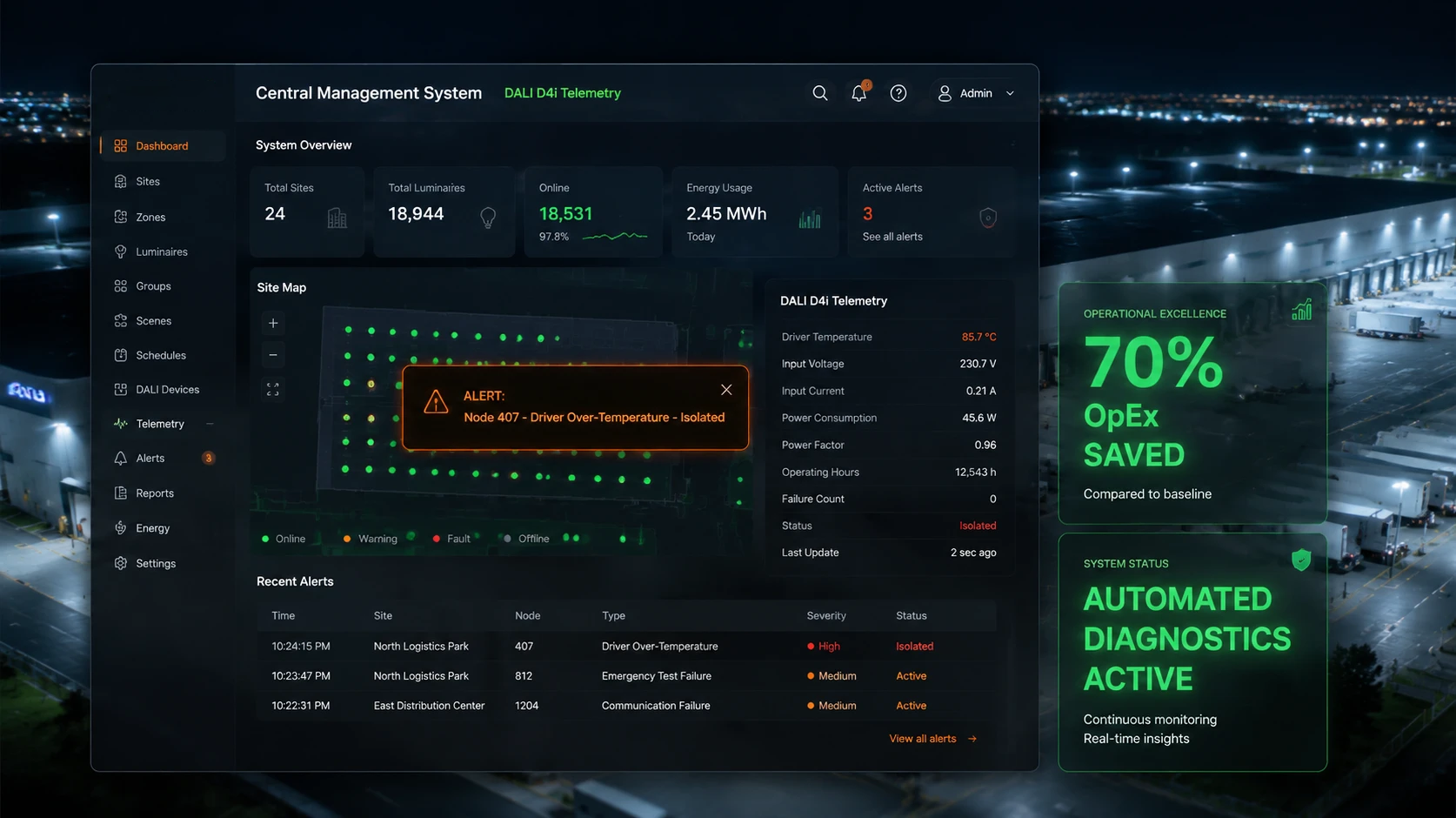
For facility engineering networks and IT deployment crews, setting up an intelligent DALI lighting control system loop requires smart wire management. Poor physical layout choices can cause data drops, electrical noise, or signal corruption. These technical bugs disrupt your central dali d4i controller, leading to missing asset logs, inaccurate energy readouts, and broken system schedules.
Adhering to these clean physical installation guidelines protects your digital data pathways:
Isolating High-Voltage Interference: Never route delicate DALI bus communication lines through the same tight conduit path as high-current machinery wires or heavy-duty HVAC power cables. High-voltage inductive coupling can easily distort digital packets, causing your management console to lose touch with distant driver groups entirely.
Enforcing Maximum Bus Cable Limits: Always limit your total network bus wire run to less than 300 meters according to the official Dali specification. Make sure to use proper copper gauges, as excessive distance drops line voltage and stops drivers from uploading data.
Securing Clean Bus Connections: Verify that every wire termination point is tight and clean. Some indoor areas are exposed to variable climate changes, like indoor loading docks, damp basements, or high-humidity processing zones. In these spots, use high-quality electrical sealing tape and moisture-proof junction boxes to prevent corrosion from causing line faults, short circuits, or ground loops.
Investing in advanced D4i connectivity yields a rapid return on investment (ROI). It achieves this by slashing routine manual labor and cutting out unnecessary site testing steps. This layout works well for large commercial office environments or high-density logistics buildings. The initial capital spent on updating to smart data tracking is often fully recovered within the first 24 months.
Weekly Inspection Time: Drops from 24 manual walkthrough hours down to 0 hours thanks to instant, automated screen alerts.
Active Repair Speed: Cuts repair times by over 60%. Your maintenance team receives a direct notification stating the exact driver model needed.
Asset Tracking Methods: Replaces error-prone paper checklists with real-time energy tracking software and cloud synchronization.
System Component Longevity: Lowers driver thermal strain by adjusting local output levels based on live energy metrics. This baseline extends overall network life.
This data-driven setup eliminates the need for expensive structural overhauls or constant parts replacement. It stabilizes your monthly building maintenance budgets, reduces overhead, and keeps your commercial spaces running smoothly without unexpected unplanned downtime.
Integrating a new digital infrastructure upgrade requires balancing upfront development and hardware costs against long-term operational flexibility. Smart facilities managers look for the best possible return on investment. They avoid rigid, single-brand systems that lock properties into custom wiring lines or closed code.
Instead, they choose open, modular control setups. These tools hook up smoothly with modern smart building automation and centralized software paths.
An open-standard automated lighting blueprint offers distinct business advantages:
Eliminating Proprietary Connection Fees: Standardized Zhaga socket pins connect directly to open-protocol corporate control boards. This choice means you never have to pay for custom vendor software bridges.
Minimizing On-Site Technician Demands: Because D4i utilizes unified, industry-standard digital commands, your in-house maintenance team can update device groupings via software dashboards without altering physical wiring.
Streamlined Enterprise Expansion: Adding extra lighting zones takes just minutes when your company expands its floor plan or adds more workstations. The new nodes integrate into your data stream instantly without system resets.
Lowering your daily operating costs while keeping your property safe requires a smart, unified approach. It demands pairing rugged, energy-saving lighting controls with durable, intelligent hardware components. Upgrading to a professional dali d4i diagnostic data collection setup protects your long-term budget, satisfies safety codes, and ensures reliable lighting.
Are you ready to stop manual check waste, eliminate emergency maintenance callouts, and bring reliable, automated efficiency to your commercial properties? Do not let drifting timers or unmonitored systems inflate your operating costs and drain your maintenance funds. Partner with an industry-tested commercial automation and lighting leader. We will help you deploy high-efficiency, network-tested sensor frameworks built to your exact site needs.
Do you need deep technical code sheets, product catalog updates, or an exact price quote for your next facility upgrade? Connect with our specialized engineering advisory desk directly through our
A: Yes. All Econley and partner-brand D4i networks are built to integrate smoothly. They link directly into your current smart building automation or IoT framework. Our dali d4i led driver data flows use standard open APIs and industrial gateways. This ensures your engineering teams can track live status logs, fault updates, and energy usage metrics directly inside your main dashboard panel.
A: Yes, absolutely. The D4i framework handles data across all linked components smoothly. When using certified smart extensions, the internal system monitors the hardware directly. It tracks the power status and functional health of connected sensors or wireless radios. This lets your maintenance team spot communication drops across any asset layer instantly and avoid unplanned downtime.
A: System uptime and data protection are core pillars of our engineering strategy. Every driver built to the Dali specification features non-volatile local memory nodes. If your central server connection drops, the internal chips keep logging power metrics, fault codes, and runtime details locally. The moment your network line restores, the dali d4i controller pushes the saved files up to your dashboard without losing a single line.


)
)
)
)

+86 15899791249

+86 755 2955 3313


Address: Huafeng No.1 Science and Technology Park, Sanwei, Bao'an District, Shenzhen, Guangdong, China.
