

Time:2026-09-17
Global residential, commercial, and hospitality developments are undergoing a major shift toward smart infrastructure and energy-efficient building automation. Within this evolving market, home automation lighting control has transitioned from a high-end luxury feature to a standard manufacturing requirement for luminaire producers, original equipment manufacturers (OEMs), and system integrators. Modern factory buyers, electrical engineers, and product managers are no longer looking for standalone smart switches; they require scalable, industrial-grade control modules, unified communication protocols, and reliable supply chains that can be seamlessly integrated into high-volume luminaire assembly lines.
Market research indicates that the global smart home automation lighting control market is expanding at a Compound Annual Growth Rate (CAGR) exceeding 18.2%. Driven by rising electricity costs, stringent government building efficiency regulations, and consumer demand for unified smart home ecosystems, luminaire manufacturers are under intense pressure to integrate smart control capabilities directly into their production lines.
Legacy Standalone Switches: High wiring complexity -> Limited interoperability -> No centralized energy telemetry.
Integrated OEM Smart Modules: Plug-and-play PCBAs -> Multi-protocol wireless connectivity -> Automated dimming and sensor integration.
Traditional residential lighting installations relied heavily on wall-mounted mechanical switches and manual phase-cut dimmers. However, these systems lack energy feedback, require extensive field wiring, and cannot communicate with broader home management platforms. By embedding smart microcontrollers and wireless control modules directly into the fixture drive housing, lighting factories can deliver intelligent luminaires that connect automatically to Matter, Zigbee, Wi-Fi 6, or Bluetooth Mesh networks right out of the box.
Selecting the best home automation lighting control system topology requires a deep understanding of protocol compatibility and hardware interoperability:
Matter over Thread: The emerging global standard for consumer smart homes, enabling cross-brand interoperability between Apple Home, Google Home, Amazon Alexa, and Samsung SmartThings without relying on proprietary cloud bridges.
Zigbee 3.0 & Bluetooth Mesh: Low-power, self-healing wireless mesh topologies ideal for dense residential complexes and hospitality projects where reliable node-to-node routing is critical.
DALI-2 & D4i Digital Buses: Standardized wired digital protocols widely adopted in luxury residential and light-commercial applications, providing intra-luminaire power diagnostics, energy reporting, and precise log-curve dimming.
KNX & Modbus: Industrial-grade wired fieldbuses preferred for centralized panel installations in high-end luxury estates and multi-dwelling units (MDUs).
For a deeper analysis of global wireless protocols and factory integration strategies, explore our comprehensive guide on
When designing smart luminaires for global export, factory engineers must address severe electrical and environmental challenges, including voltage surges, thermal dissipation, and electromagnetic interference (EMI).
| Engineering Parameter | Standard Commercial Light Switch | LumiEasy Industrial-Grade OEM Module |
| Input Voltage Range | 120V AC or 230V AC (Single region) | 85V - 305V AC Universal Global Input |
| Transient Surge Protection | 1kV - 2kV Basic MOV | 4kV - 10kV Industrial Surge (ANSI C136.2) |
| Operating Temperature | -10°C to +40°C | -40°C to +85°C Extended Industrial Rating |
| Dimming Topology | Basic Triac / Leading Edge | Universal Triac, 0-10V, PWM, DALI-2, D4i |
| Wireless Protocols | Proprietary 2.4GHz RF | Matter over Thread, Zigbee 3.0, BLE Mesh, Wi-Fi 6 |
| Standby Power Consumption | Less than 1.0 Watt | Less than 0.2 Watt (Ultra-Low Power ErP) |
| Hardware Encryption | Software-based software keys | Hardware Security Module (HSM) AES-128/256 |
Factory buyers must select control modules that deliver smooth, flicker-free dimming across all light output ranges:
Universal Phase-Cut (Leading & Trailing Edge): Essential for retrofitting existing residential wiring. Auto-detecting circuits dynamically switch between Forward Phase (Triac) and Reverse Phase (ELV) to prevent LED driver buzzing and strobe effects.
Continuous 0-10V & PWM Dimming: Provides linear or logarithmic dimming down to 0.1% light output, ideal for architectural downlights, LED strip channels, and linear office fixtures.
Tunable White & RGBW Color Mixing: Multi-channel PWM control drivers allow users to adjust Correlated Color Temperature (CCT) from warm 2700K to cool 6500K, supporting Human-Centric Lighting (HCL) and circadian rhythm scheduling.
To achieve true home automation, lighting fixtures require embedded sensing technology. While traditional Passive Infrared (PIR) sensors detect major body movements, modern luxury smart homes demand 24GHz and 60GHz Millimeter-Wave (mmWave) radar sensors. mmWave radar can detect micro-movements such as human breathing and pulse, ensuring lights remain illuminated even when occupants are sitting motionless at a desk or reading in bed.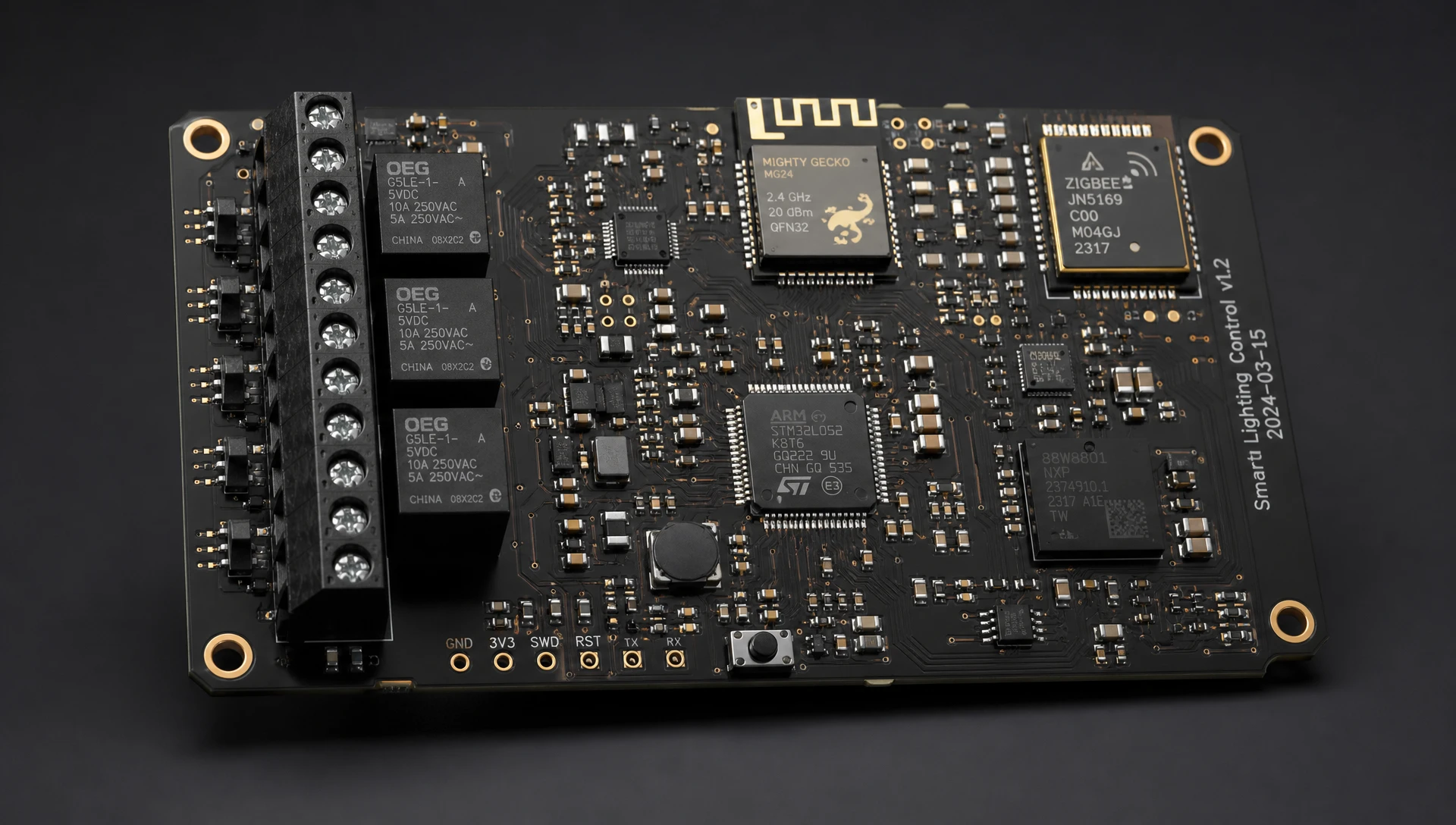
In B2B contract negotiations, providing clear energy reduction models allows luminaire manufacturers and project integrators to justify the higher initial CapEx of smart-enabled fixtures.
The annual electrical power consumed by a smart home lighting network equipped with automated daylight harvesting and occupancy setback is calculated using the following formula:
Energy_Annual = [ N_fixtures * Power_nominal * ( T_active * Factor_active + T_vacant * Factor_standby ) ] / 1000
Where:
Energy_Annual: Total annual electricity consumption (in kW·h/year).
N_fixtures: Total number of installed smart light fixtures in the project.
Power_nominal: Rated electrical power rating per luminaire (in Watts).
T_active: Annual hours when the space is occupied (hours/year).
Factor_active: Average dimming level during occupied periods (e.g., 0.70 for 70% power output under daylight harvesting).
T_vacant: Annual hours when the space is vacant (hours/year).
Factor_standby: Standby power dimming ratio during unoccupied hours (e.g., 0.05 for 5% night-light mode or 0.00 for complete shutoff).
In warm climates, every Watt of lighting power saved reduces the heat load on the residential HVAC cooling system:
Energy_HVAC_Saved = Energy_Lighting_Saved / COP_cooling
Where:
Energy_Lighting_Saved: Direct electrical energy saved by smart dimming controls (in kW·h).
COP_cooling: Coefficient of Performance of the home air-conditioning system (typically 3.0 to 4.0 for inverter heat pumps).
Plant & Project Setup Parameters:
Total Luminaires Installed (N_fixtures): 5,000 smart downlights and linear fixtures
Nominal Fixture Wattage (Power_nominal): 30 Watts per fixture
Total Annual Hours: 8,760 hours/year
Occupancy Profile: Occupied 30% of the time (T_active = 2,628 hours), Vacant 70% of the time (T_standby = 6,132 hours)
Active Dimming Factor (Factor_active): 0.75 (Daylight dimming active)
Standby Dimming Factor (Factor_standby): 0.02 (2% ultra-low standby indicator)
Residential Electricity Tariff: $0.22 per kW·h
HVAC System COP: 3.2
Uncontrolled Baseline Energy Consumption:
Base Energy = (5,000 * 30 * 8,760) / 1000 = 1,314,000 kW·h/year
Base Annual Energy Cost = 1,314,000 * $0.22 = $289,080.00 per year
Controlled Energy Consumption (LumiEasy OEM Smart Control System Installed):
Active Energy = (5,000 * 30 * (2,628 * 0.75)) / 1000 = 295,650 kW·h/year
Standby Energy = (5,000 * 30 * (6,132 * 0.02)) / 1000 = 18,396 kW·h/year
Total Controlled Direct Energy = 295,650 + 18,396 = 314,046 kW·h/year
Financial & Operational Savings Summary:
Direct Lighting Energy Saved = 1,314,000 - 314,046 = 999,954 kW·h/year ($219,989.88 saved)
Indirect HVAC Energy Saved = 999,954 / 3.2 = 312,485.63 kW·h/year ($68,746.84 saved)
Total Combined Annual Savings = $219,989.88 + $68,746.84 = $288,736.72 per year
Energy Reduction Percentage: 76.1% overall reduction in operating lighting overhead.
For factory buyers sourcing smart lighting control components, component quality and international certification are critical to avoid costly product recalls and customs delays.
To export smart home lighting control products globally, OEM factories must ensure their control modules meet strict regional regulatory standards:
North America: FCC Part 15 Class B (Unintentional Radiators), UL 8750 (LED Equipment Safety), ETL Mark, and Title 24 JA8 compliance (California Energy Commission).
European Union: CE-EMC, CE-LVD, RED (Radio Equipment Directive 2014/53/EU), RoHS 3, REACH, and ErP Directive for eco-design standby power limits.
Global Interoperability: Matter Certification from the Connectivity Standards Alliance (CSA), DALI-2 certification from DiiA, and Bluetooth SIG qualification.
To guarantee high field reliability, all LumiEasy smart control modules undergo rigorous testing before shipment:
100% High-Temperature Burn-In Testing: Every control PCBA operates at full electrical load inside a 65°C environmental chamber for 8 hours to eliminate early component failures.
Automated Optical Inspection (AOI) & X-Ray Testing: Verifies solder joint integrity on dense BGA surface-mount microcontrollers and wireless modules.
ESD & Surge Testing: Exposed control terminals are subjected to 8kV contact electrostatic discharge (ESD) and 4kV lightning surge pulses to ensure long-term durability.
EMC Anechoic Chamber Verification: Verifies that RF transceivers operate within strict electromagnetic emission limits without interfering with home Wi-Fi or medical devices.
To assist factory product managers in seamlessly integrating smart control modules into existing manufacturing lines, LumiEasy provides a structured 6-stage engineering roadmap:
Requirements Analysis & Architecture Selection: Define dimming requirements (Phase-cut, 0-10V, or DALI-2), target wireless protocol (Matter, Zigbee, or BLE Mesh), and enclosure dimensions.
PCBA Co-Design & Mechanical Fitting: Embed compact LumiEasy control modules directly onto the main LED driver board or design a custom Zhaga/NEMA socket layout.
Firmware Customization & App Integration: Customize default power-on behaviors, dimming curves, network pairing modes, and white-label mobile app interfaces.
Prototyping & Pre-Compliance Testing: Produce initial sample batches for thermal, electrical, and RF pre-compliance testing in accredited laboratories.
Pilot SMT Production Run: Conduct a 500-unit trial production run to validate SMT assembly yields, automated functional testing fixtures, and laser-marking processes.
Mass Production & Global Delivery: Transition to full-scale automated manufacturing with batch-level traceability, custom packaging, and door-to-door global logistics.
How do LumiEasy home automation control modules ensure cross-platform compatibility?
LumiEasy control modules support native Matter over Thread and Zigbee 3.0 protocols. This allows certified fixtures to connect directly to major smart home ecosystems, including Apple Home, Google Home, Amazon Alexa, and Samsung SmartThings, without requiring proprietary external gateways.
Can LumiEasy smart lighting controllers be customized for specific OEM luminaire housings?
Yes. LumiEasy provides full OEM/ODM engineering services, including custom PCBA layout design, specialized firmware development, custom dimming curves, and tailored pin configurations to fit within ultra-compact downlight, track light, or linear light driver compartments.
What measures are taken to prevent wireless signal drops in dense residential installations?
LumiEasy wireless control modules utilize self-healing mesh networking architectures paired with hardware-level Frequency-Hopping Spread Spectrum (FHSS) technology. If a single wireless channel experiences RF interference, the mesh network automatically reroutes control packets through neighboring nodes in milliseconds.
Integrating robust home automation lighting control technology into your luminaire product lineup reduces manufacturing costs, simplifies field commissioning, elevates energy efficiency, and unlocks higher profit margins for export markets.
To request technical datasheets, order sample evaluation kits, or consult with our OEM engineering team,


)
)
)
)

+86 15899791249

+86 755 2955 3313


Address: Huafeng No.1 Science and Technology Park, Sanwei, Bao'an District, Shenzhen, Guangdong, China.
