

Time:2026-09-09
Industrial manufacturing facilities operate under stringent environmental conditions where airborne dust particulates, moisture mists, chemical vapors, and thermal fluctuations constantly threaten electrical infrastructure. Implementing ip65 industrial smart lighting overcomes these harsh conditions by fusing rugged, ingress-protected hardware enclosures with intelligent edge-processing controls, slashing plant operating overhead by up to 75% while maintaining strict visual ergonomics for facility workers.
Deploying heavy-duty ip65 industrial smart lighting across production plants requires an ingress-resistant structural architecture. The IP65 rating, defined under international standard IEC 60529, certifies that the luminaire housing is entirely dust-tight (level 6) and completely protected against water jets projected from any direction (level 5) at a pressure of 30 kPa from a distance of 3 meters.
[ Structural Die-Cast Alloy Housing ]
          │
          ├──> Continuous High-Elasticity Silicone Gasket Seal (>85% Recovery)
          │
          ├──> ePTFE Hydrophobic Breather Valve (Prevents Internal Vacuum Condensation)
          │
          ├──> Electrophoretic Powder Coating (1,000-Hour ASTM B117 Salt Spray Rated)
          │
          └──> Optical Cover (IK10 Impact-Resistant PC / IK08 Borosilicate Glass)
ADC12 / A380 Die-Cast Aluminum Housing: Engineered with low copper content (<0.1%) to prevent galvanic corrosion in high-humidity or chemical-laden plant atmospheres.
Surface Pre-Treatment: Multistage zinc-phosphate washing followed by electrostatically applied epoxy-polyester powder coating guarantees over 1,000 hours of continuous salt spray testing under ASTM B117 guidelines.
Seamless Silicone Gasketing: Closed-cell continuous silicone O-rings provide sustained sealing integrity, maintaining elastic memory across temperature extremes ranging from -40°C to +85°C.
Integrated Pressure Equalization Vents: An expanded polytetrafluoroethylene (ePTFE) hydrophobic membrane vent allows internal air pressure to equalize during rapid heating and cooling cycles. This prevents internal vacuum creation that otherwise forces humidity past traditional perimeter gaskets.
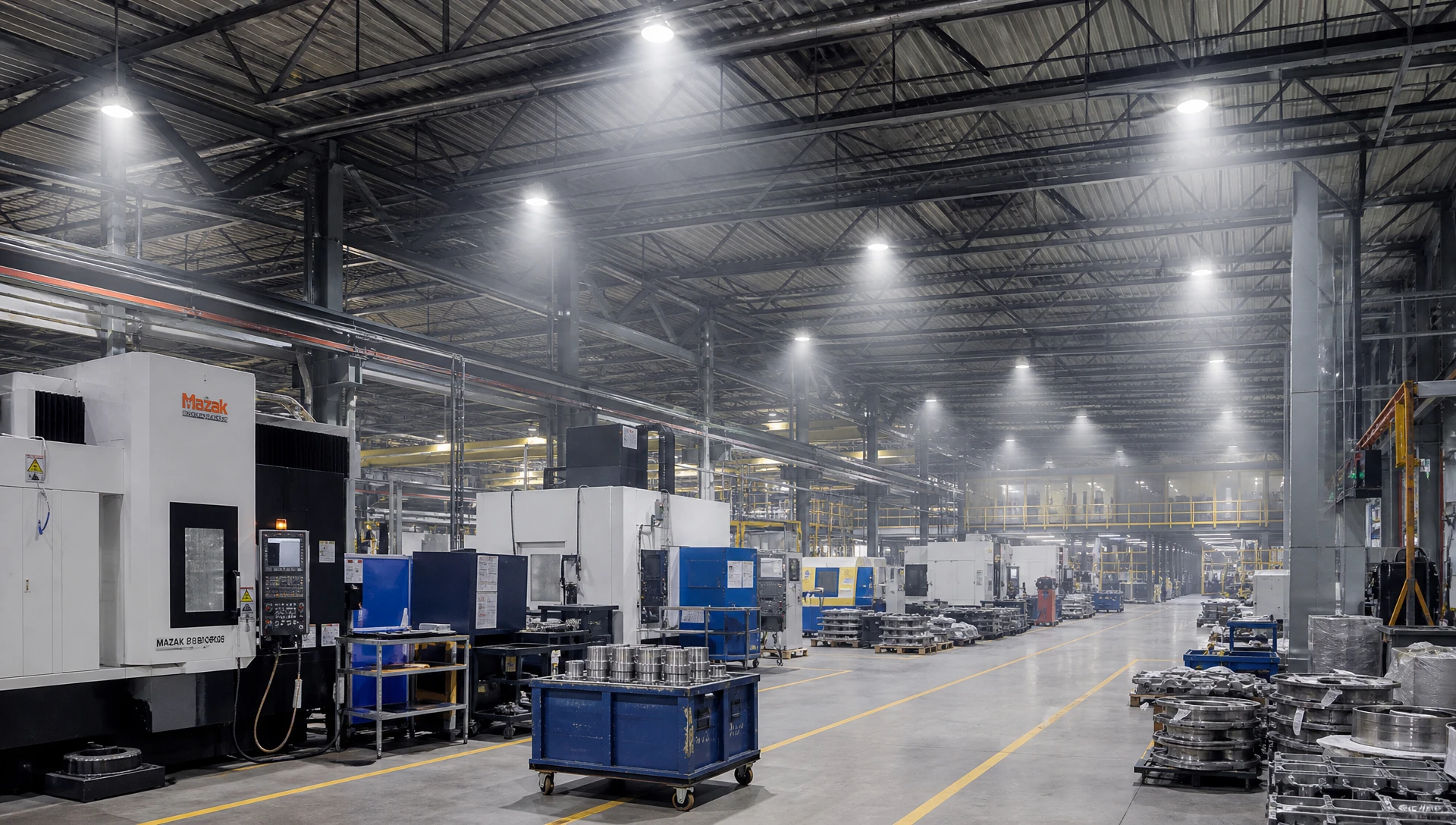
Modern ip65 industrial smart lighting moves beyond static illumination by embedding field sensors, digital dimming drivers, and multi-protocol communications backbones into each sealed luminaire.
[ Environmental Sensors ] ──> [ IP65 Edge Controller ] ──> [ Communication Bus ] ──> [ LED Driver Execution ]
  • IP65 Dual-Tech Sensors       • PID Lux Loop Engine       • DALI-2 (IEC 62386)        • 0.1% CCR/PWM Dimming
  • Optical Photodiodes          • Motion Delay Timers       • Wireless BLE Mesh         • Surge Protection (10kV)
Industrial facilities require reliable communication backbones that remain immune to heavy electromagnetic interference (EMI) generated by variable frequency drives (VFDs) and high-voltage machinery.
| Control Protocol | Signal Type | Transmission Medium | Max Nodes / Segment | Transmission Range | Industrial Suitability |
| DALI-2 (IEC 62386) | Bi-directional Digital | 2-wire polarity-free cable | 64 addresses / loop | Up to 300 meters | High (Immune to EMI noise) |
| Wireless BLE Mesh | Bi-directional Wireless | 2.4 GHz RF (FHSS) | 32,767 nodes | Multi-hop auto-routing | Excellent (Toolless deployment) |
| 0-10V Analog | Uni-directional Analog | 2-wire DC control pair | Channel-based | <30m (Voltage drop risk) | Moderate (Legacy retrofits) |
| BACnet/IP Gateway | Network Protocol | Cat5e / Cat6 Ethernet | Unlimited subnets | Enterprise-wide | High (Central BMS management) |
Combining ip65 industrial smart lighting fixtures into an enterprise control network allows plant managers to implement five complementary energy optimization strategies:
Photodiode sensors positioned near skylights measure real-time daylight ingress. The internal controller automatically adjusts LED driver output to maintain constant target lux levels across the manufacturing floor (e.g., maintaining 500 Lux for machining zones).
High-frequency 5.8 GHz Microwave radar or passive infrared (PIR) sensors detect human movement and forklift traffic through high-bay warehouse aisles. When a zone remains vacant beyond a configured delay, luminaires dim to a standby safety baseline (10%–20%) rather than turning off completely.
Industrial luminaires are typically over-engineered to compensate for long-term diode lumen depreciation. High-end trim caps maximum fixture power at 75%–80% out of the box, instantly saving energy while extending the lifespan of both drivers and LED chips.
Integrated microcontrollers continuously monitor internal LED junction temperatures. If ambient plant temperatures spike during high-heat manufacturing processes, the fixture dynamically throttles power to preserve internal electronic components without causing abrupt lighting shutdowns.
During peak electrical utility pricing windows, the facility control gateway receives automated signals to trim non-critical lighting zones by 20% to 30%, shedding substantial kilowatt load without compromising worker safety.
Accurate financial payback projections and photometric designs for ip65 industrial smart lighting rely on rigorous mathematical modeling.
Total illuminance (E_total) on a plant surface equals natural daylight contribution plus controlled artificial output:
E_total = E_daylight + (P_dim * E_max)
Where:
E_total: Target surface illuminance (in Lux, e.g., 500 Lux).
E_daylight: Real-time daylight illuminance captured by optical photodiodes (in Lux).
P_dim: Controller dimming ratio (ranging from 0.00 to 1.00).
E_max: Maximum illuminance generated by luminaires at 100% full power (in Lux).
To maintain constant target illuminance (E_target), the controller recalculates dimming output in real time:
P_dim = (E_target - E_daylight) / E_max
When E_daylight >= E_target, P_dim drops to 0.00, completely eliminating artificial lighting power consumption during bright daytime hours.
To calculate annual kilowatt-hour (kWh) usage for a plant managed by ip65 industrial smart lighting, apply compounding reduction factors to baseline electrical loads:
Energy_Annual = (P_installed * N_fixtures * F_occupancy * F_daylight * F_trim * T_hours) / 1000
Where:
Energy_Annual: Total annual power consumption (kWh/year).
P_installed: Nominal rating of each luminaire (in Watts).
N_fixtures: Total number of installed high-bay fixtures.
F_occupancy: Occupancy setback ratio (active runtime vs standby, e.g., 0.58).
F_daylight: Daylight harvesting factor (average artificial power ratio, e.g., 0.62).
F_trim: High-end task tuning power cap ratio (e.g., 0.80).
T_hours: Total annual operational hours (e.g., 8,760 hours for 24/7 plants).
Eliminating wasted lighting electrical energy directly reduces the thermal cooling load placed on facility industrial HVAC chillers:
HVAC_Savings_kWh = Lighting_Savings_kWh / COP_cooling
Where:
COP_cooling: Coefficient of Performance of the plant's cooling system (typically 3.0 to 3.8 for industrial chillers).
Facility Parameters:
High-Bay Fixtures (N_fixtures): 1,800 units
Nominal Luminaire Rating (P_installed): 200 Watts per fixture
Operation (T_hours): 8,760 hours/year (Continuous 24/7/365 operation)
Utility Electricity Rate: $0.16 per kWh
HVAC Chiller COP (COP_cooling): 3.5
Baseline Uncontrolled Lighting Cost:
Energy_Base = (200 * 1,800 * 1.0 * 1.0 * 1.0 * 8,760) / 1000 = 3,153,600 kWh/year
Annual Baseline Cost = 3,153,600 kWh * $0.16 = $504,576.00 / year
Controlled Smart Lighting Cost (LumiEasy IP65 System Deployed):
Applying realistic control factors: F_occupancy = 0.58, F_daylight = 0.62, F_trim = 0.80
Combined Control Factor = 0.58 * 0.62 * 0.80 = 0.28768 (71.23% direct energy reduction)
Energy_Controlled = (200 * 1,800 * 0.28768 * 8,760) / 1000 = 907,227.65 kWh/year
Annual Controlled Cost = 907,227.65 kWh * $0.16 = $145,156.42 / year
Direct & Indirect Financial Savings:
Direct Lighting Energy Savings = 3,153,600 - 907,227.65 = 2,246,372.35 kWh/year ($359,419.58)
Indirect HVAC Cooling Savings = 2,246,372.35 / 3.5 = 641,820.67 kWh/year ($102,691.31)
Total Combined Annual Operating Savings = $359,419.58 + $102,691.31 = $462,110.89 / year
Factory spaces present unique environmental stresses. Matching the appropriate mechanical spec to each plant zone ensures long-term operational reliability.
| Plant Industrial Zone | Primary Environmental Stresses | Enclosure & Sealing Specification | Sensor & Optical Lens Technology | Surge & Protocol Protection |
| Heavy CNC Machining | Airborne oil mist, metallic fine dust, vibration | IP65 ADC12 alloy, corrosion coating, ePTFE vent | IP65 Dual-Tech (5.8GHz Microwave + PIR), PC lens | 10kV/10kA surge, DALI-2 / BLE Mesh |
| Food & Beverage Washdown | High-pressure water jets, chemical detergents | IP65/IP66 smooth housing, food-grade silicone seals | High-transmittance tempered glass, wide-angle PIR | Class P driver, 0-10V isolated bus |
| High-Bay Warehousing (12m+) | Dust, extreme mounting height, narrow aisles | IP65 Zhaga Book 18 socket, die-cast aluminum | Long-range narrow-beam optical sensor lens | 6kV/10kV surge, BLE Mesh auto-routing |
| Cold Storage Processing | Low temps (-40°C), thermal shock, frost accumulation | IP65 stainless steel hardware, anti-frost seals | Microwave radar sensor with anti-condensation lens | Low-temp rated driver, BACnet/IP gateway |
| Electronics Cleanrooms | Electrostatic discharge, particle dust limits | IP65 flush-mount panel, anti-static diffuser | Precision digital photodiode array | EMI Class A filter, DALI-2 digital bus |
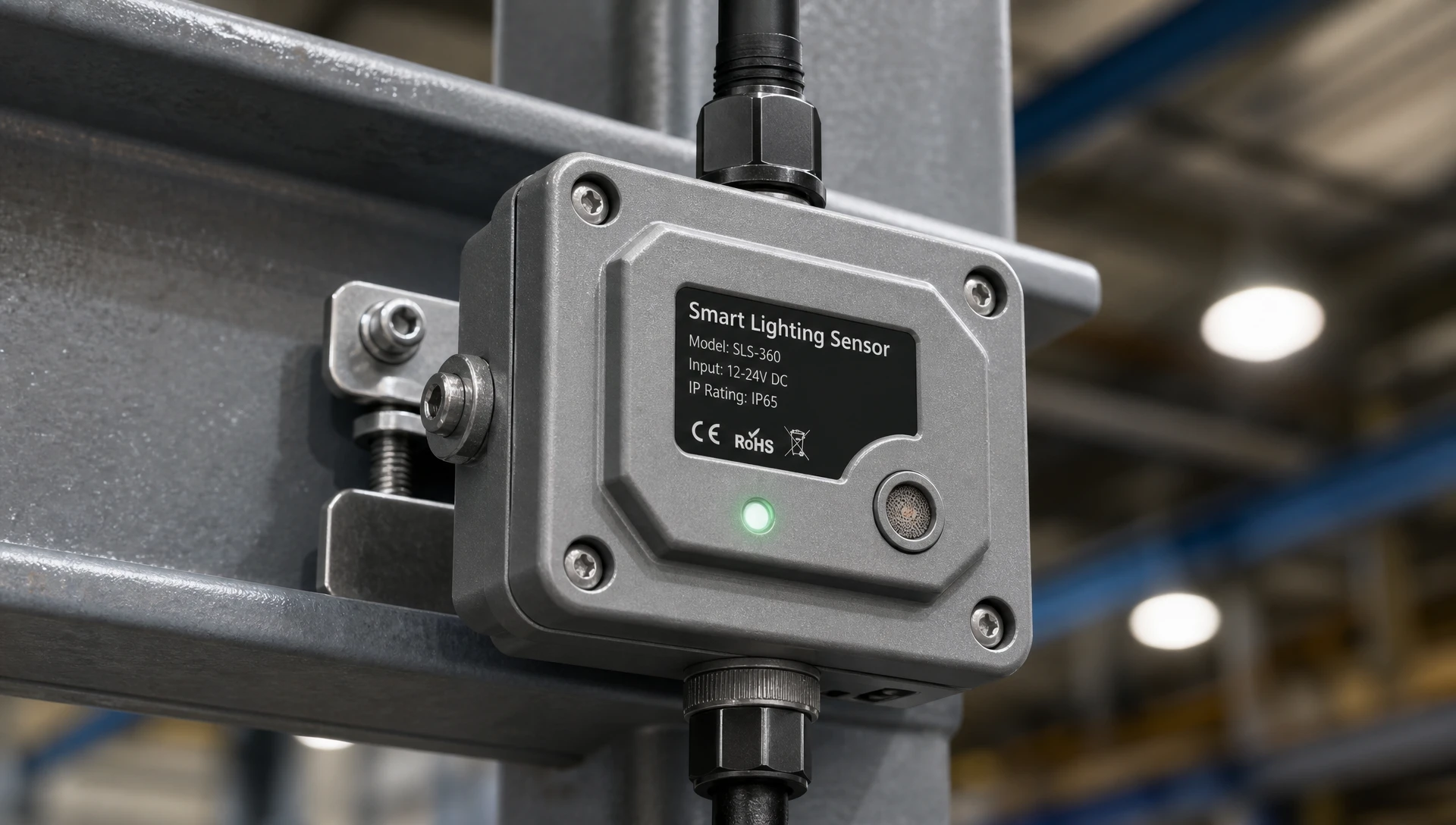
Deploying ip65 industrial smart lighting ensures full compliance with global energy regulations, safety standards, and workplace ergonomic codes.
IEC 60529 / EN 60529: Ingress Protection code certifying complete dust-tight performance (Level 6) and resistance to water jets (Level 5).
IEC 62262 (IK Rating): Impact resistance certification ensuring housing endurance against mechanical impacts up to IK10 (20 Joules impact energy).
UL 1598 / UL 8750 (Damp & Wet Locations): North American safety standard for luminaires installed in wet environments and light-emitting diode equipment.
ASHRAE Standard 90.1 & IECC 2024: Mandates automatic lighting shutoff, occupancy sensing setback, and continuous daylight harvesting across industrial facilities.
California Title 24, Part 6: Requires mandatory multi-level lighting control capabilities and integration with Automatic Demand Response (ADR) systems.
EN 12464-1: European lighting standard defining visual ergonomic thresholds (e.g., minimum 500 Lux maintained for general assembly, UGR < 19 glare control).
Engineers and facility planners can track technological updates, field testing protocols, and compliance updates published across our
Installing and commissioning an ip65 industrial smart lighting system within an active manufacturing plant requires a structured engineering process to prevent operational interruptions.
[ Step 1: Survey ] ─> [ Step 2: Inspection ] ─> [ Step 3: Provisioning ] ─> [ Step 4: Calibration ] ─> [ Step 5: Testing ]
─> [ Step 6: Handover ]
Photometric Audit & Noise Survey: Field engineers perform site surveys to measure existing lux distribution, map ambient daylight entry points, and evaluate high-frequency electrical noise from nearby machinery.
Gasket & Torque Inspection: Prior to mounting, installation technicians verify continuous silicone gasket positioning and apply specified torque to cable gland seals, ensuring moisture integrity.
Wireless Mesh Key Provisioning: Smart lighting nodes undergo auto-discovery via commissioning software. Security cryptographic keys are assigned to build auto-healing BLE Mesh subnets.
Closed-Loop Lux Calibration: Optical daylight sensors are calibrated during nighttime (zero-daylight baseline) and high-noon sunlight hours to set precision PID control loop parameters.
Fail-Safe & Demand Response Validation: System relays are tested to confirm integrated "Fail-Safe On" operation—ensuring luminaires default to 100% output if control signals are interrupted.
BMS Data Integration & Handover: Telemetry gateways are connected via BACnet/IP or Modbus TCP to transmit real-time power consumption, fixture status, and diagnostic alerts to the central facility dashboard.
Evaluating an ip65 industrial smart lighting retrofit against legacy illumination options highlights significant long-term operational savings over a 10-year facility life cycle.
| Financial & Operational Metric | Legacy 400W Metal Halide | Uncontrolled 200W LED High Bay | LumiEasy IP65 Industrial Smart Lighting |
| Connected Load per Luminaire | 440W (with ballast) | 200W | 200W (57.53W effective average) |
| Total Plant Connected Load | 792 kW | 360 kW | 103.55 kW (Effective Average) |
| Annual Electricity Usage | 6,937,920 kWh | 3,153,600 kWh | 907,227 kWh |
| Annual Direct Electricity Cost | $1,110,067 | $504,576 | $145,156 |
| Annual HVAC Cooling Penalty Cost | $317,162 | $144,164 | $41,473 |
| Annual Re-Lamping & Maintenance | $65,000 | $10,000 | $1,500 |
| Total Annual Operating Expenditure | $1,492,229 | $658,740 | $188,129 |
| Initial Hardware & Installation CapEx | Baseline | $270,000 | $350,000 |
| 10-Year Cumulative Operating Cost | $14,922,290 | $6,587,400 | $1,881,290 |
| 10-Year Total Cost of Ownership (TCO) | $14,922,290 | $6,857,400 | $2,231,290 |
| 10-Year Net Savings vs Uncontrolled LED | Baseline | Baseline | $4,626,110 |
Incremental CapEx for Smart IP65 System: $80,000 ($350,000 smart IP65 system vs $270,000 basic LED high bay).
Annual Operational Savings: $470,611 per year reduction compared to uncontrolled LED fixtures.
Simple Payback Period: 2.04 months (0.17 years).
10-Year Return on Investment (ROI): 5,782%.
LumiEasy ip65 industrial smart lighting fixtures utilize continuous high-elasticity silicone gaskets paired with ePTFE hydrophobic pressure equalization vents. This breather vent design allows internal air pressure to adjust during rapid temperature changes, preventing internal vacuum creation that pulls water mists past perimeter seals during high-pressure washdowns.
Yes. LumiEasy IP65 smart sensors combine high-frequency 5.8 GHz Microwave radar with digital filtering software. Unlike mechanical motion detectors, these solid-state sensors filter out background mechanical vibrations from overhead cranes and stamping presses, detecting only true human or machinery movement across factory aisles.
LumiEasy ip65 industrial smart lighting systems support secure Over-The-Air (OTA) firmware updates via encrypted Bluetooth Low Energy (BLE) Mesh networks. Facility managers can deploy system updates, modify dimming schedules, and adjust sensor parameters remotely from a tablet or central gateway without accessing high-ceiling luminaires.
Upgrading your manufacturing facility with an intelligent control infrastructure reduces electrical energy overhead, lowers HVAC cooling loads, complies with global building codes, and extends luminaire operational lifespans.
To review complete hardware data sheets, request photometrical layout simulations, or consult with our automation engineers,


)
)
)
)

+86 15899791249

+86 755 2955 3313


Address: Huafeng No.1 Science and Technology Park, Sanwei, Bao'an District, Shenzhen, Guangdong, China.
