

Time:2026-09-15
Modern manufacturing plants face rising power bills, strict climate rules, and higher operating costs. Because of these challenges, the luminaire lighting control market is growing rapidly. Smart lighting is no longer just about replacing old bulbs with LEDs. Today, factory managers use Luminaire-Level Lighting Control (LLLC) systems to automate energy savings, collect real-time data, and protect plant networks.
Industrial reports show that the global luminaire lighting control market size is growing by more than 15% every year. Factories are moving away from old centralized switch panels and adopting smart, individual light controls.
Traditional Switch Panels: Heavy wiring needed -> Single point of failure -> No energy data per light.
Smart Distributed Controls: Built-in IP67 sensors -> Self-healing wireless network -> Continuous energy tracking.
In traditional factories, one broken control panel can shut down lighting for an entire assembly line. Installing miles of copper wiring through tough factory floors is also slow and expensive. Distributed control systems fix this problem. Each light fixture gets its own smart sensor, allowing lights to dim or turn off automatically when no one is around.
A quick luminaire lighting control market review shows that modern building codes now mandate smart lighting controls:
ASHRAE 90.1 & IECC Standards: Require automatic light dimming, daylight harvesting, and scheduled shutoffs in new and renovated factories.
EU Energy Directives: Force industrial plants to track their power use accurately under ISO 50001 rules.
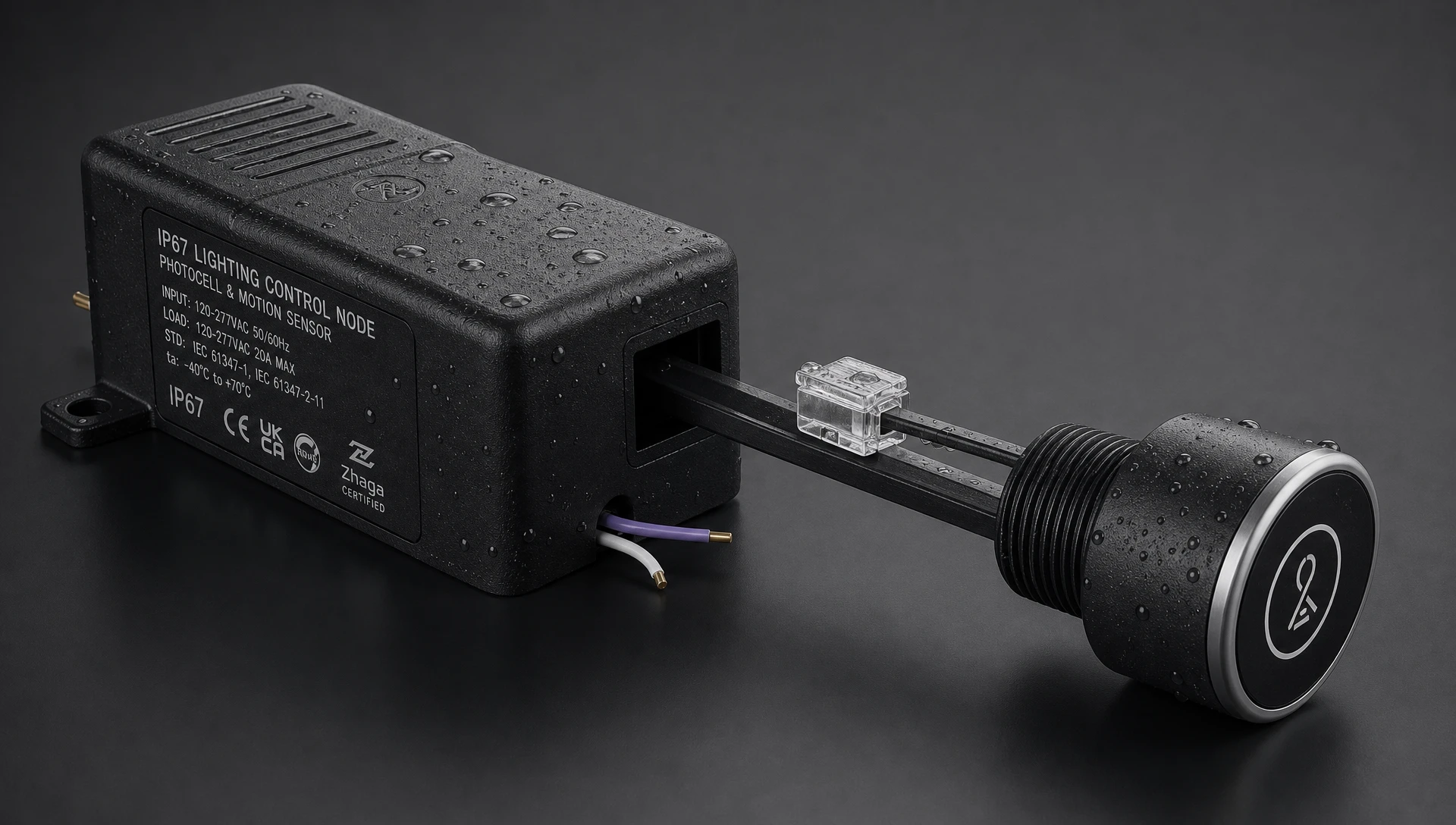
Standardized Connectors: Modern fixtures use twist-lock Zhaga sockets and D4i digital drivers. This lets maintenance teams plug in new smart sensors in seconds without opening the light housing.
To learn more about the latest energy standards and lighting tech, check out our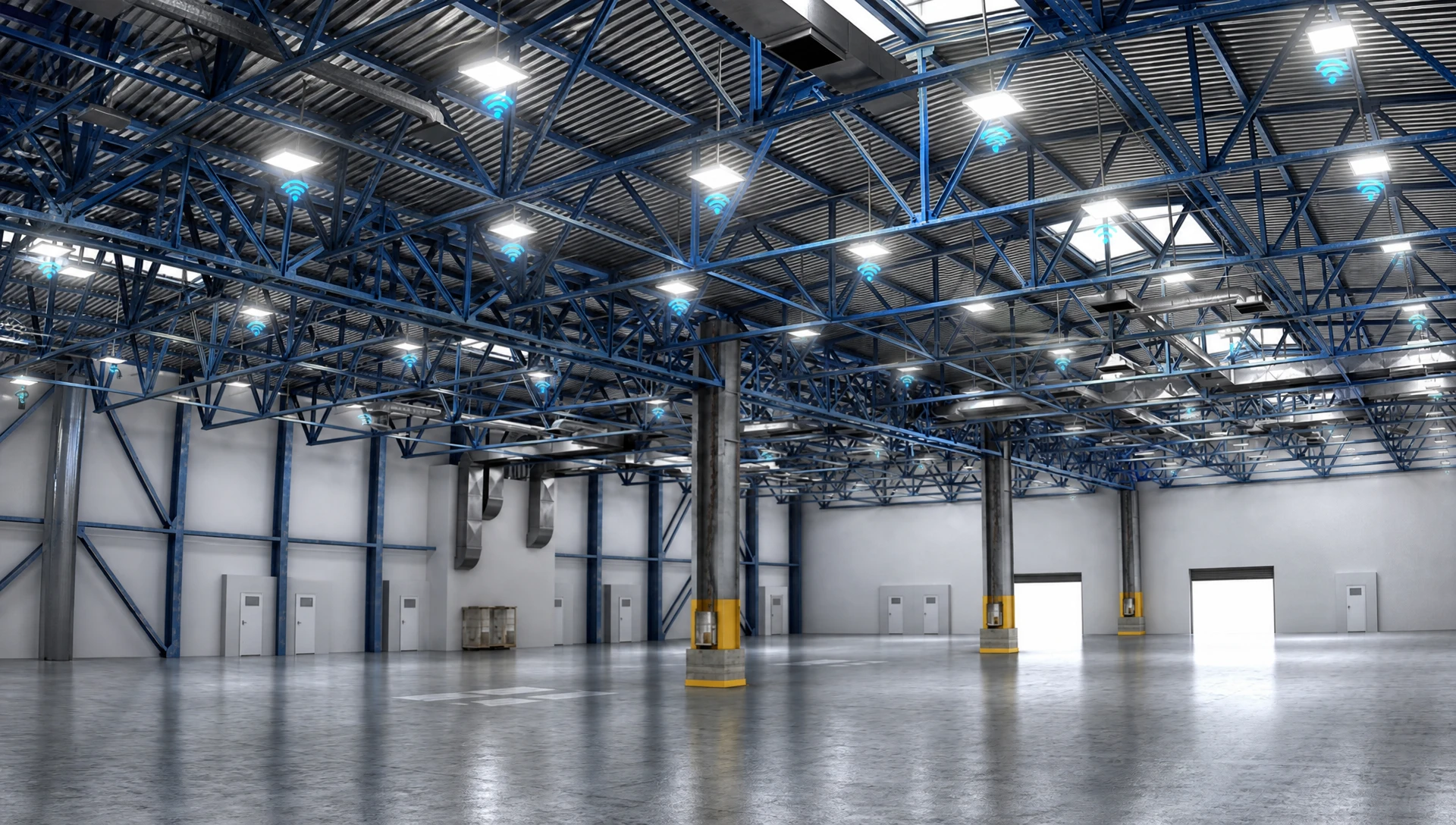
Standard office light sensors fail quickly inside a real factory. Heat, chemical mists, pressure washing, and electrical noise require heavy-duty hardware.
| Factory Operating Area | Main Environmental Stress | Hardened Control Solution |
| Machining & Automotive | Oil mist, metal dust, electrical noise | Aluminum housing, 5.8GHz radar, DSP filtering |
| Cold Storage (-30°C to -40°C) | Freeze conditions, internal moisture | Waterproof breather vent, wide-temp chips |
| Food & Chemical Processing | Hot water washdowns (100 bar / 80°C) | Smooth housing, IP67/IP69K seals |
| High-Bay Warehouses (15m+) | High ceilings, narrow aisle shadows | Long-range optical lens, wireless mesh |
Environmental Stress: Cutting fluids create oily air, metal dust settles on lenses, and heavy machines cause electrical noise.
Hardened Solution: Sensors use strong cast-aluminum housings that resist salt and chemical spray. Instead of basic infrared sensors that get blinded by dust, these systems use 5.8 GHz radar to detect human motion accurately.
Signal Quality: Control signals use isolated wiring and frequency-hopping wireless signals so nearby welding gear will not interrupt communication.
Environmental Stress: Extreme cold makes cheap plastic crack. Opening freezer doors creates vacuum pressure that pulls moisture inside the sensor, creating internal ice.
Hardened Solution: Smart nodes use breathable, waterproof ePTFE membranes. These vents equalize pressure while blocking water. Microchips are built to work down to -40°C.
Bonus Cold Savings: Every kilowatt-hour saved on lighting also reduces heat in the freezer, cutting the load on cooling compressors.
Environmental Stress: Staff wash down walls and equipment daily with high-pressure hot water and strong chemicals.
Hardened Solution: Control nodes have smooth, rounded shapes so dirt cannot hide. Food-grade silicone seals provide full IP67 and IP69K waterproof protection.
Environmental Stress: Ceilings are very high, and narrow rack aisles create dark shadows.
Hardened Solution: Special narrow lenses focus sensor vision directly down to the aisle floor. Wireless mesh networks allow technicians to adjust settings from the ground using a tablet.
You can easily calculate energy savings and financial paybacks for smart factory lighting using simple formulas.
In cold storage, saving lighting energy also saves cooling energy:
E_total_saved = E_lighting_saved * (1 + 1 / COP_refrig)
Where:
E_lighting_saved: Direct electricity saved by dimming lights (in kW·h).
COP_refrig: Efficiency rating of the cooling system (typically 2.5 to 3.0 for industrial freezers).
Annual power used by smart high-bay lights is calculated as:
E_annual = (N_fixtures * P_nominal * (T_active * F_task + T_standby * F_standby)) / 1000
Where:
N_fixtures: Number of installed light fixtures.
P_nominal: Wattage rating per fixture (in Watts).
T_active: Total hours per year the aisle is occupied.
F_task: Light power level when occupied (e.g., 0.80 for 80% power).
T_standby: Total hours per year the aisle is empty.
F_standby: Light power level when empty (e.g., 0.10 for 10% standby dimming).
Factory Setup:
Light Fixtures: 4,000 high-bay lights
Fixture Power: 250 Watts each
Operating Schedule: 24/7 (8,760 hours per year)
Aisle Activity: Busy 20% of the time, empty 80% of the time
Electricity Cost: $0.18 per kW·h
Cooling Efficiency (COP): 2.9
Old Lighting Costs (No Controls):
Base Power Used = (4,000 * 250 * 8,760) / 1000 = 8,760,000 kW·h per year
Annual Power Cost = 8,760,000 * $0.18 = $1,576,800.00 per year
New Lighting Costs (LumiEasy IP67 Smart System Installed):
Active Power = (4,000 * 250 * (1,752 * 0.80)) / 1000 = 1,401,600 kW·h per year
Standby Power = (4,000 * 250 * (7,008 * 0.10)) / 1000 = 700,800 kW·h per year
Total New Power = 1,401,600 + 700,800 = 2,102,400 kW·h per year
Total Annual Money Saved:
Direct Lighting Savings = 8,760,000 - 2,102,400 = 6,657,600 kW·h per year ($1,198,368.00 saved)
Indirect Freezer Cooling Savings = 6,657,600 / 2.9 = 2,295,724.14 kW·h per year ($413,230.34 saved)
Combined Total Saved = $1,198,368.00 + $413,230.34 = $1,611,598.34 every year
The chart below shows why standard commercial controls fail in tough factory spaces.
| Feature | Standard Commercial Controls | LumiEasy Hardened Industrial System |
| Water & Dust Protection | IP20 to IP40 (Dry indoor areas) | IP65 / IP67 / IP69K (Full dust and water washdown) |
| Impact Resistance | Basic plastic (IK04) | Die-cast aluminum housing (IK08 to IK10) |
| Operating Temperature | -10°C to +40°C | -40°C to +65°C |
| Pressure Control | None (Moisture leaks inside) | Breathable ePTFE waterproof membrane |
| Surge Protection | 2kV to 4kV | 10kV / 10kA Heavy Industrial Protection |
| Motion Detection | Standard Infrared (False trips) | 5.8GHz Microwave Radar + Digital Signal Processing |
| Data Encryption | Unencrypted | AES-128 Encrypted Wireless BLE Mesh |
Smart lighting networks connect to plant management systems, so cybersecurity is critical.
Hardware Protection: Gateways use secure hardware chips to store encryption keys safely.
Encrypted Wireless: All wireless sensor messages use AES-128 encryption to stop hackers.
Network Isolation: Lighting data runs on its own isolated VLAN, keeping main factory automation networks safe.
You do not need to pause production to install smart controls:
Protocol Compatibility: Gateways work with older 0-10V dimmers, DALI-2 wiring, and wireless mesh nodes.
Step-by-Step Upgrades: Maintenance teams can upgrade one room or production line at a time during normal weekend shifts.
Comparing total costs over 10 years shows why rugged controls deliver the best financial return.
| Financial Metric | Old Uncontrolled Lighting | Basic Commercial Controls | LumiEasy Hardened IP67 System |
| Average Power Used | 1,000 kW | 450 kW | 240 kW |
| Annual Electricity Cost | $1,576,800 | $709,560 | $378,432 |
| Annual Freezer Cooling Overhead | $543,724 | $244,675 | $130,493 |
| Annual Maintenance Cost | $85,000 | $18,000 | $2,000 |
| Total Annual Operating Cost | $2,205,524 | $972,235 | $510,925 |
| Initial Hardware Equipment Cost | Baseline | $380,000 | $520,000 |
| 10-Year Operating Expenses | $22,055,240 | $9,722,350 | $5,109,250 |
| 10-Year Total Cost of Ownership | $22,055,240 | $10,102,350 | $5,629,250 |
| 10-Year Total Money Saved | Baseline | $11,952,890 | $16,425,990 |
Extra Cost for Rugged Controls: $140,000 ($520,000 total vs. $380,000 basic controls).
Extra Annual Operating Savings: $461,310 additional savings each year.
Payback Period: 3.6 months.
Site Audit: Engineers check factory temperatures, chemical exposure, vibration, and wireless noise.
Pre-Assembly: Sensors, lenses, and sockets are installed on light fixtures before delivery.
Fast Installation: Teams swap fixtures during off-peak hours using quick-connect waterproof cables.
Auto-Discovery: Wireless nodes discover each other automatically upon power-up.
Sensor Tuning: Technicians tune motion and light sensitivity settings on-site to ensure smooth performance.
BMS Connection: Gateways link lighting data directly to the central factory control room.
LumiEasy control modules feature smooth housings and high-grade silicone gaskets. Electronics are fully filled with epoxy resin, preventing water or cleaning chemicals from penetrating the unit even under 100 bar pressure.
Yes. LumiEasy high-bay sensors use targeted optics that direct sensing signals down to floor level from heights up to 18 meters, ensuring fast detection of moving forklifts and staff.
LumiEasy controls run on a Bluetooth Low Energy (BLE) Mesh network with automatic frequency hopping. If machine noise blocks one channel, the system instantly switches to a clear channel to keep lighting signals moving smoothly.
Upgrading to hardened luminaire-level controls slashes factory electricity costs, lowers cooling loads, and satisfies energy codes.
To review technical spec sheets or request a free lighting design for your plant,


)
)
)
)

+86 15899791249

+86 755 2955 3313


Address: Huafeng No.1 Science and Technology Park, Sanwei, Bao'an District, Shenzhen, Guangdong, China.
