

Time:2026-06-23
Commercial facility managers face constant operational friction with legacy security hardware. Standard motion sensors rely on basic infrared triggers that react to any sudden temperature change. When a stray animal, a local pet, or shifting warm air moves across a warehouse floor, the alarm trips. These frequent false alarms trigger heavy municipal fines, drain corporate security budgets, and cause severe alarm fatigue. Security teams start ignoring active alerts, leaving enterprise properties highly vulnerable to real intruders.
Old systems force a hard choice. You must accept constant false alarms or live with huge blind spots. To solve this bottleneck, modern enterprises are upgrading their perimeters. Integrating advanced pet immune pir sensor sensitivity with real-time AI computer vision completely fixes these vulnerabilities. This dual-verification architecture ensures maximum accuracy, protects corporate assets, and keeps building operations seamless.
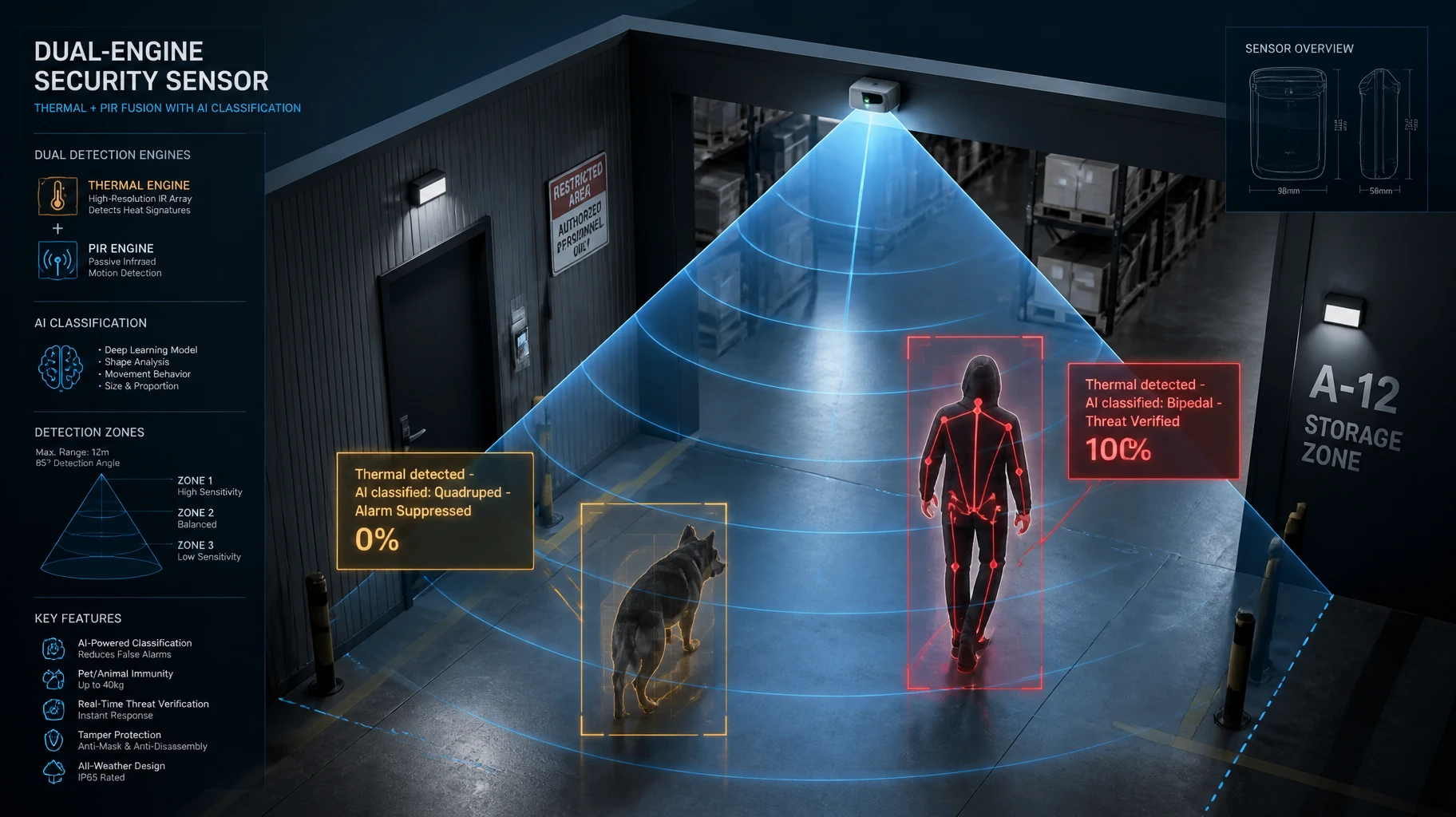
Old security tools cannot tell a large animal from a person. They only measure raw heat. Industrial-grade hardware addresses this limitation by deploying multi-element pyrosensors behind a segmented Fresnel lens. This physical layout splits the monitored room into distinct upper and lower tracking zones.
Because animals generally move close to the ground, they only disturb the lower infrared grids. Advanced pet immune pir sensor sensitivity allows the system to filter out these isolated bottom signals automatically. This setup stops small pets from tripping the alarm. However, it catches human targets instantly.
The real breakthrough happens when you link this thermal grid with computer vision. The moment the infrared sensor registers valid motion detection, it wakes up an adjacent high-definition camera module. The camera feeds a live video stream into a localized neural network.
Within milliseconds, the AI scans the moving shape for human markers like posture and walking gait. A real alert is sent to the central station only if both layers confirm a human presence. This hybrid approach keeps network data paths clear and prevents unnecessary cloud storage use.
To maintain high security, the system does not just look at raw pixels. The built-in computer vision model uses a deep convolutional neural network (CNN) trained on millions of security video clips. When the PIR sensor triggers the camera, the system performs three instant verification steps:
Silhouette Edge Extraction: The AI maps the edges of the moving object. It calculates the height-to-width ratio to differentiate quadrupeds (animals walking on four legs) from bipeds (humans walking on two legs).
Skeletal Vector Tracking: The software places digital joint points on the moving object. It tracks the motion vectors of the head, shoulders, and hips. This allows the system to recognize a human even if they are crawling, crouching, or wearing heavy winter clothing.
Gait Velocity Analysis: Humans move with a specific rhythmic patterns. Animals move with different acceleration curves. The software analyzes these movement speeds over three consecutive frames to ensure total accuracy.
By running this heavy math locally on an edge-AI chip, the sensor does not need a constant internet connection to make a decision. This edge-processing model protects user privacy and guarantees sub-second response times during an active breach.
When evaluating long-term asset investments, corporate procurement teams must look past upfront hardware invoices. The table below outlines how advanced dual-verification networks outperform basic legacy hardware across core operational benchmarks:
| Operational Metric | Standard Legacy PIR Sensors | LumiEasy AI Vision + PIR Systems |
| False Alarms | High (from pets, insects, and shifting shadows) | Zero (uses advanced dual-stage human shape filters) |
| Police Fines | High (wastes annual commercial operating budgets) | None (stops false dispatches to local authorities) |
| Data Use | High (needs constant, expensive cloud streaming) | Low (streams video only during real verified events) |
| Fix Costs | High (requires frequent manual onsite tune-ups) | Low (adapts instantly via remote software updates) |
| Guard Efficiency | Low (guards waste time checking empty rooms) | High (guards handle real facility incidents quickly) |
Upgrading your infrastructure delivers immediate bottom-line savings. Security guards no longer waste hours checking empty corridors after false trips. Instead, teams can focus entirely on real site issues. This automated accuracy optimizes guard shift workflows and cuts building management overhead.
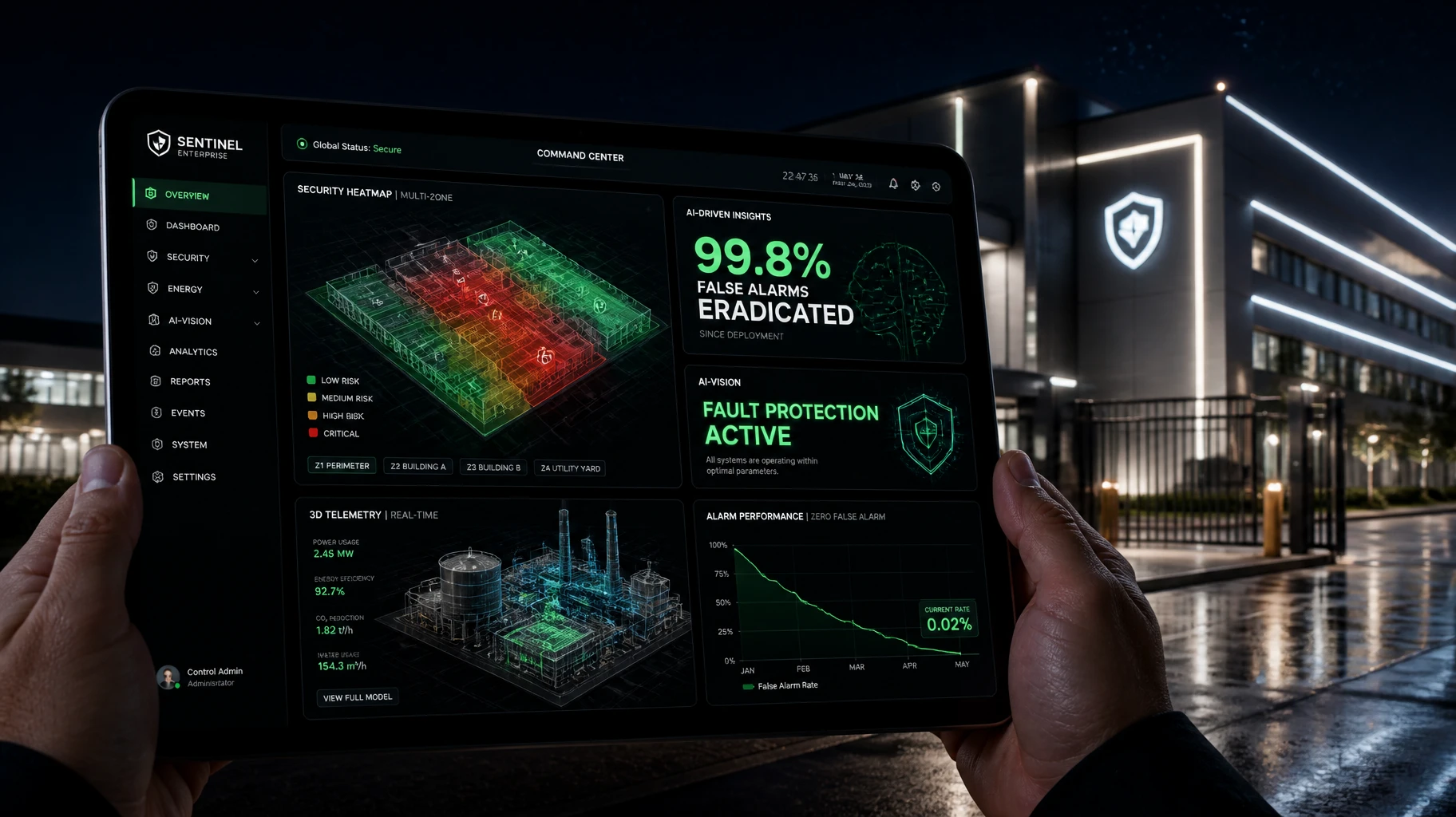
Modern corporate properties require interconnected sub-systems. Isolating your security data creates blind spots for facility management teams. Linking advanced motion detection tools straight to a centralized management system unlocks superior facility control.
When verified sensors are tied into smart building automation networks, they do double duty. During high-alert night shifts, they act as the frontline perimeter defense. During daytime working hours, the same sensor nodes feed occupancy data to heating, ventilation, and lighting controls.
If an aisle stays empty for ten minutes, the system dims lights and cuts airflow automatically. This cross-platform data usage cuts monthly utility bills while maintaining a secure, responsive working environment.
Loading Docks and Logistics Hubs: High ceilings and rolling doors cause severe drafts and bird entry. Traditional sensors fail here daily. Our system ignores the temperature shifts and small animals entirely, protecting the perimeter without false trips.
Corporate Offices and Corridors: Shifting sunlight through large windows often blinds standard sensors. The LumiEasy dual-tech system uses digital white-light immunity and AI verification to stay functional even in direct sunlight.
Data Centers and Restricted Server Rooms: These zones need high-sensitivity settings. Our hardware allows you to crank up the PIR sensitivity to the max. The AI layer acts as the final guard, keeping security tight without causing accidental system shutdowns.
Achieving high-accuracy protection depends heavily on correct field placement. Even the most advanced computer vision model will fail if the underlying hardware is poorly positioned. Engineering crews must follow strict layout rules to ensure optimal pet immune pir sensor sensitivity performance:
Mounting Height: Fix the sensor between 2.1 and 2.4 meters high. This keep the correct angle for pet immunity.
Traffic Paths: Aim the lens so intruders walk across the active fields instead of straight toward it.
Avoid Heat Sources: Keep the sensor away from air vents and bright windows. This stops rapid temperature shifts from breaking your data.
Clear the Camera Field of View: Ensure no hanging signs, structural pillars, or storage racks block the camera lens. The AI model needs a clean view of the entire target path to verify human shapes.
Procurement managers must look beyond basic commercial data sheets. High-quality production lines follow strict engineering protocols to ensure parts perform well under harsh weather conditions. When choosing a factory supplier, prioritize these engineering marks:
Anti-Masking and Tamper Protection: Industrial sensors must include active anti-masking technology. If an intruder sprays paint on the lens or covers it with cardboard, the sensor sends an immediate sabotage alert to the central system.
White Light Immunity Ratings: Look for sensors rated up to 10,000 Lux of white-light immunity. This stops high-power vehicle headlights or heavy flashes from creating false system triggers.
Weatherproof Ratings: For outdoor loading bays or damp warehouse rooms, ensure the housing carries a verified IP65 or IP66 rating to seal out dust and moisture.
Securing modern corporate properties requires a balanced approach to data accuracy and infrastructure efficiency. Using smart pet-safe sensors stops false alerts. It protects your assets and lowers daily building fees. These smart digital tools keep your facility secure while integrating smoothly with broader smart building automation systems.
Do not let basic motion sensors or frequent false alerts drain your operational budgets and distract your guards. Do you want to lower costs, stop false alarm fines, and bring reliable AI vision to your site?
For datasheets, bulk pricing, or custom layout advice, contact our engineering desk. Visit our
A: Our system uses advanced digital threshold tuning managed straight from your central software dashboard. By combining multi-zone lens layouts with live AI shape verification, LumiEasy filters out heavy animals easily. The system keeps tracking limits tight. It catches human threats even when animals move through the exact same zone.
A: Yes. LumiEasy hardware uses open API architectures and standard communication protocols. Our sensors connect cleanly with your existing video platforms and legacy alarm setups. This integration lets our sensors turn on smart lights and start custom camera recordings across your site easily.
A: Cheap retail sensors cause constant false alarms from pets and moving shadows, leading to heavy city fines and wasted guard hours. This dual system removes false alerts completely. It lowers site upkeep fees and saves you money for years.


)
)
)
)

+86 15899791249

+86 755 2955 3313


Address: Huafeng No.1 Science and Technology Park, Sanwei, Bao'an District, Shenzhen, Guangdong, China.
