Time:2026-10-12
📌 Key Takeaways for Luminaire Manufacturers & Industrial Lighting Engineers:
Standardization vs. Drift: Traditional CdS (Cadmium Sulfide) sensors suffer from degradation and thermal sensitivity. Modern industrial outdoor fixtures require silicon photodiode tech to pass RoHS, CE, and UL certifications.
False Tripping Mitigation: Transient optical spikes from lightning strikes, passing vehicle headlights, and overcast cloud cover require 3–10 second time-delay filtering to prevent fixture oscillation.
Surge Protection Standards: Outdoor commercial luminaires demand integrated 10kV / 20kV MOV surge protection to prevent field failures from lightning strikes.
Interface Modularity: Choosing between NEMA ANSI C136.10/C136.41 twist-lock receptacles and Zhaga Book 18 sockets defines fixture adaptability for next-generation smart city and IoT lighting networks.
For commercial lighting OEMs, municipal contractors, and industrial luminaire factories, long-term field reliability is the ultimate metric of product quality. Outdoor luminaire field returns are rarely caused by LED chip failure; rather, they stem from faulty auxiliary light-sensing controls. When a commercial streetlight flashes rapidly during a rainstorm or fails to illuminate at dusk, high warranty claims and bucket-truck maintenance costs degrade brand trust.
Mastering photocell dusk dawn operation requires going beyond simple light detection. It demands an engineering-grade understanding of spectral response matching, ambient lux calibration, surge suppression topology, and mechanical socket standardization.
At its core, photocell dusk dawn operation relies on ambient illuminance thresholds to automate luminaire switching. However, replicating human visual perception using solid-state electronics presents distinct optical engineering challenges.
                    +------------------------------------------+
                    | Sunlight / Outdoor Ambient Lux Spectrum  |
                    +--------------------+---------------------+
                                         |
                                         v
                    +------------------------------------------+
                    |  Infrared-Cut Silicon Photodiode Sensor  |
                    | (Filtered to V-Lambda Human Eye Spectrum)|
                    +--------------------+---------------------+
                                         |
                                         v
                    +------------------------------------------+
                    | Anti-False Tripping Time-Delay Circuit   |
                    | (3 - 10 Seconds Digital Signal Filter)   |
                    +--------------------+---------------------+
                                         |
                                         v
                    +------------------------------------------+
                    | Heavy-Duty Relay / Solid-State Switch    |
                    | (AC Line Load / 10kV MOV Surge Protection)|
                    +------------------------------------------+
In outdoor commercial applications, daylight transitions follow logarithmic lux decay curves. A standard industrial photocell control is calibrated to specific operational setpoints:
Turn-ON Lux Threshold: 10 Lux to 20 Lux (Twilight / Dusk)
Turn-OFF Lux Threshold: 30 Lux to 60 Lux (Dawn)
Hysteresis Ratio: Typically calibrated between 1:3 and 1:5
Hysteresis is critical. If a sensor turns ON at 15 Lux and immediately turns OFF at 16 Lux, natural ambient fluctuations will cause rapid cycle toggling—commonly known as "chattering." By maintaining a higher Turn-OFF lux setpoint, the internal switching logic ensures the fixture remains illuminated until morning daylight is fully established.
For deeper technical breakdowns on ambient light sensing architectures, explore our detailed analysis on photocell dusk dawn operation reliability testing.
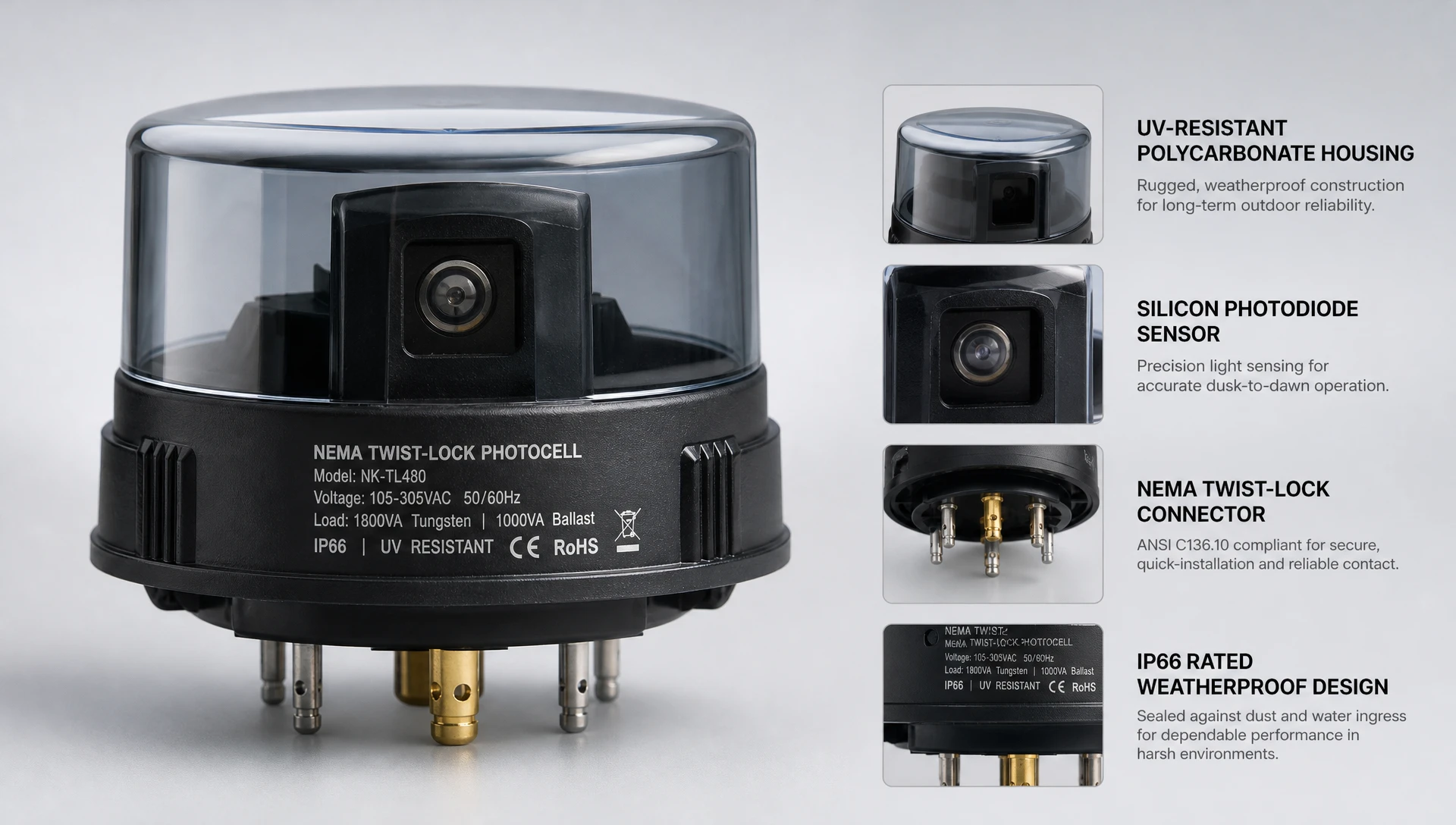
Historically, fixture factories relied on Cadmium Sulfide (CdS) photoresistors due to low unit costs. However, CdS technology presents major compliance and operational risks for industrial OEMs.
| Engineering Parameter | Traditional Cadmium Sulfide (CdS) Sensor | LumiEasy Industrial Silicon Photodiode Sensor |
| Sensing Technology | Photoresistor (Contains Heavy Metals) | Silicon Photodiode (RoHS Compliant) |
| False-Trigger Protection | None or Minimal | 3–10 Sec Built-in Time-Delay Filter |
| Surge Immunity | Standard (1kV – 2kV) | Heavy-Duty 10kV / 20kV MOV Protection |
| Spectral Response | Unfiltered (Sensitive to Infrared/Heat) | V-Lambda Filtered (Human Eye Matching) |
| Operating Temperature | -20°C to +50°C | Industrial Grade: -40°C to +70°C |
RoHS Compliance & Heavy Metal Bans: CdS sensors contain cadmium, a restricted heavy metal under European RoHS and REACH environmental regulations. Global luminaire manufacturers targeting EU or North American markets must utilize silicon photodiodes.
Spectral Sensitivity: CdS resistors react strongly to invisible near-infrared (NIR) thermal radiation. Consequently, a hot engine block or infrared security camera can cause false triggering. Modern silicon photodiode sensors feature built-in IR-cut filters matching the CIE V-Lambda standard, ensuring the photocell responds exclusively to visual spectrum lux.
Multi-Year Drift and Aging: CdS material degrades under continuous outdoor UV exposure, shifting operational lux thresholds by up to 15% annually. Silicon photodiodes maintain optical sensitivity drift under 1% over a 10-year service life.
When evaluating photocell dusk dawn operation, industrial buyers must address the two main causes of field returns:
In commercial parking lots, highways, and industrial yards, transient optical spikes are inevitable. Passing vehicle headlights, cloud cover, or lightning flashes can temporarily spike ambient light readings. Without intelligent signal filtering, the sensor triggers an unwanted shutdown.
LumiEasy industrial photocell controllers implement a physical or digital 3-to-10 second time-delay algorithm. Brief optical spikes below 10 seconds are ignored, keeping the lighting circuit closed until a permanent ambient lux change occurs.
Outdoor luminaires are directly exposed to lightning-induced grid transients and voltage surges. A low-cost consumer photocell switch lacks adequate Metal Oxide Varistors (MOVs), causing circuit board burnouts during thunderstorm seasons.
LumiEasy industrial controls integrate heavy-duty 10kV / 20kV surge protection components directly into the photocell control board. This shields both internal sensor electronics and the connected LED driver, reducing field failure rates in high-lightning geographical regions.
To inspect specialized product specifications for factory-installed dusk-to-dawn sensors, review the official LumiEasy photocell light sensor documentation.
Industrial fixture designers must select an appropriate mechanical interface based on project requirements and smart city network compatibility.
| Engineering Parameter | ANSI C136.10 (3-Pin NEMA) | ANSI C136.41 (7-Pin NEMA) | Zhaga Book 18 (4-Pin DC) |
| Operating Voltage | 105–305V AC Line Voltage | 105–305V AC + Control wiring | 24V DC Low Voltage |
| Dimming Capabilities | ON / OFF Switching Only | 0-10V / DALI-2 Dimming | DALI-2 / Digital UART |
| Form Factor / Size | Large Twist-Lock Dome | Large Twist-Lock Dome | Compact Push-and-Twist Module |
| Ingress Protection | IP65 / IP66 Weatherproof | IP65 / IP66 Weatherproof | IP66 / IP67 High Waterproofing |
| Target Application | Standard Highway / Parking Lot | Municipal Smart Streetlights | Modern Architectural & IoT Luminaires |
To guarantee 10+ years of maintenance-free service life, factory luminaire suppliers validate photocell controls through rigorous environmental and electrical stress testing:
+--------------------------------------------------------------------------+
|                     Industrial Reliability Testing Suite                 |
+--------------------------------------------------------------------------+
  |-- Thermal Shock Cycling (-40°C to +80°C across 1,000 continuous hours)
  |-- UV Material Degradation Testing (ASTM G154 Accelerated Weathering)
  |-- Electrical Inrush Current Endurance (100,000+ switching operations)
  |-- High-Voltage Surge Withstand (IEEE C62.41 10kV / 20kV Combo Wave)
  |-- Ingress Protection Validation (IP66 / IP67 Water Jet Testing)
+--------------------------------------------------------------------------+
Accelerated Weathering (ASTM G154): Exposes housing materials to intense ultraviolet (UV) radiation and condensation cycles to prevent casing yellowing, cracking, or optical lens clouding.
Electrical Inrush Current Endurance: Industrial LED drivers generate high AC inrush current spikes during initial startup. Sensor switching relays must feature silver-tin-oxide (AgSnO2) contacts rated for 100,000+ mechanical cycles without contact welding.
Ingress Protection (IP66 / IP67): Gasket seals are subjected to continuous high-pressure water jets and thermal expansion cycles to verify zero moisture intrusion.
Photocell chattering is caused by insufficient hysteresis offset or a lack of anti-false tripping time delay. If ambient light reflects off nearby surfaces back into the sensor lens, or if the Turn-OFF lux threshold is set too close to the Turn-ON threshold, the controller toggles rapidly between open and closed circuit states.
Silicon photodiodes with integrated V-lambda optical filters match human visual spectrum sensitivity, filtering out invisible infrared heat rays. Unlike legacy cadmium sulfide (CdS) photoresistors, silicon photodiodes contain zero hazardous heavy metals (RoHS compliant) and experience less than 1% optical degradation over a decade of continuous operation.
NEMA 7-pin receptacles operate on high-voltage AC power (105–305V AC) and feature additional physical contacts for 0-10V or DALI dimming protocols. Zhaga Book 18 receptacles operate on low-voltage DC power (typically 24V DC) supplied by an auxiliary LED driver output, resulting in a much smaller, IP67-sealed form factor suited for modern IoT streetlights.
Equipping outdoor commercial luminaires with hardened, high-precision control components reduces warranty liabilities, ensures international regulatory compliance, and extends fixture service life.
To request detailed product datasheets, order photometrical sample kits, or consult directly with our optical engineering team, Contact the LumiEasy Technical Support Team.


)
)
)
)

+86 15899791249

+86 755 2955 3313


Address: Huafeng No.1 Science and Technology Park, Sanwei, Bao'an District, Shenzhen, Guangdong, China.