

Time:2025-11-18
ATEX certified hazardous area lighting systems are critical safety assets for industries operating in explosive atmospheres—where flammable gases, vapors, dust, or fibers present inherent fire and explosion risks. Unlike standard lighting, these systems undergo rigorous testing to meet EU ATEX directives (2014/34/EU) and global equivalents, ensuring they prevent ignition sources in high-risk environments. From oil refineries and chemical plants to mining sites and grain silos, ATEX certified lighting delivers reliable illumination while adhering to life-saving safety standards. This guide explores the core principles of ATEX certification, system types, industry applications, and key considerations for selecting compliant lighting solutions.
ATEX certification is not a one-size-fits-all standard—it’s a framework tailored to the specific hazards and operating conditions of hazardous areas. Understanding these fundamentals is critical for compliance:
Hazardous Area Classification
ATEX divides high-risk environments into zones based on the frequency and duration of explosive atmosphere presence:
Gas/Vapor Atmospheres (Group II):
Zone 0: Explosive atmosphere is present continuously or for long periods.
Zone 1: Explosive atmosphere is likely to occur during normal operation.
Zone 2: Explosive atmosphere is unlikely to occur, and if it does, it will be brief.
Dust Atmospheres (Group II):
Zone 20: Explosive dust cloud is present continuously or for long periods.
Zone 21: Explosive dust cloud is likely to occur during normal operation.
Zone 22: Explosive dust cloud is unlikely to occur, and if it does, it will be brief.
Equipment Category & Temperature Class
Category (CAT): Determines the equipment’s suitability for zones:
CAT 1: For Zone 0/20 (highest risk, continuous hazard).
CAT 2: For Zone 1/21 (intermittent hazard).
CAT 3: For Zone 2/22 (rare hazard).
Temperature Class (T1-T6): Defines the maximum surface temperature of the lighting fixture, ensuring it does not exceed the ignition temperature of the surrounding flammable substance (T1 = up to 450°C; T6 = up to 85°C, lowest risk).
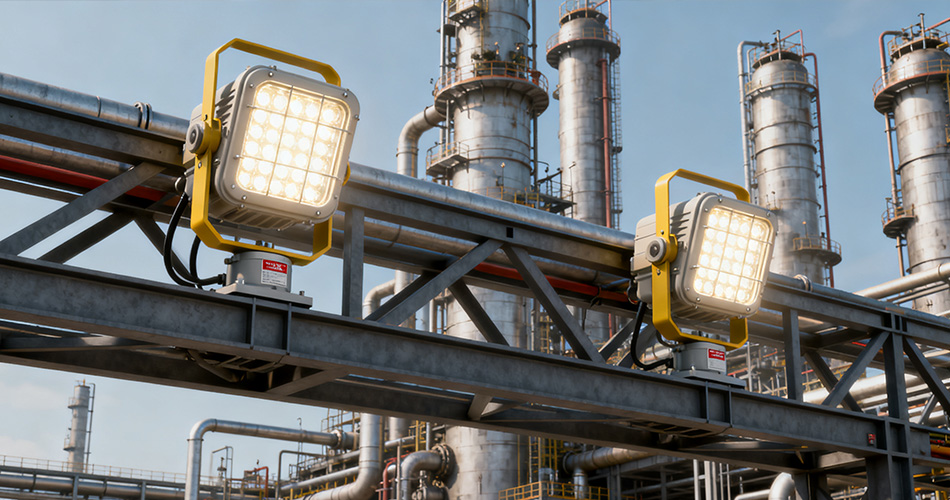
ATEX certified lighting systems are engineered to eliminate ignition risks through robust design, with three primary types tailored to industrial needs:
Design Focus: Permanent installation in hazardous zones, with explosion-proof enclosures (flameproof “d” protection) or increased safety (“e” protection) to contain or prevent ignition.
Key Features: Resistant to corrosion, vibration, and extreme temperatures (common in offshore platforms or chemical plants). LED technology is standard, offering low heat output (aligning with T6 temperature classes) and long lifespans to reduce maintenance downtime.
Applications: Process areas in refineries, chemical storage facilities, and manufacturing plants (Zone 1/2 for gas, Zone 21/22 for dust).
Design Focus: Mobile illumination for maintenance, inspection, or emergency response in hazardous areas. Battery-powered to avoid wired connections that could create sparks.
Key Features: Intrinsically safe (“i” protection) design, where electrical energy is limited to levels that cannot ignite explosive atmospheres. Lightweight yet durable, with IP65+ ingress protection against dust and water.
Applications: Pipeline inspections, confined space entry (e.g., tanks, silos), and temporary work zones in mining or oil rigs (Zone 0/1/2 for gas, Zone 20/21/22 for dust).
Design Focus: Backup illumination for evacuation or critical operations during power outages, mandatory in high-risk areas per safety regulations.
Key Features: Self-contained battery backup (minimum 3-hour runtime), automatic activation when main power fails, and clear, glare-free light to guide evacuation routes. Complies with both ATEX and emergency lighting standards (e.g., EN 50172).
Applications: Exit routes in chemical plants, offshore living quarters, and mining tunnels (all ATEX zones, with priority for Zone 0/20 and Zone 1/21).
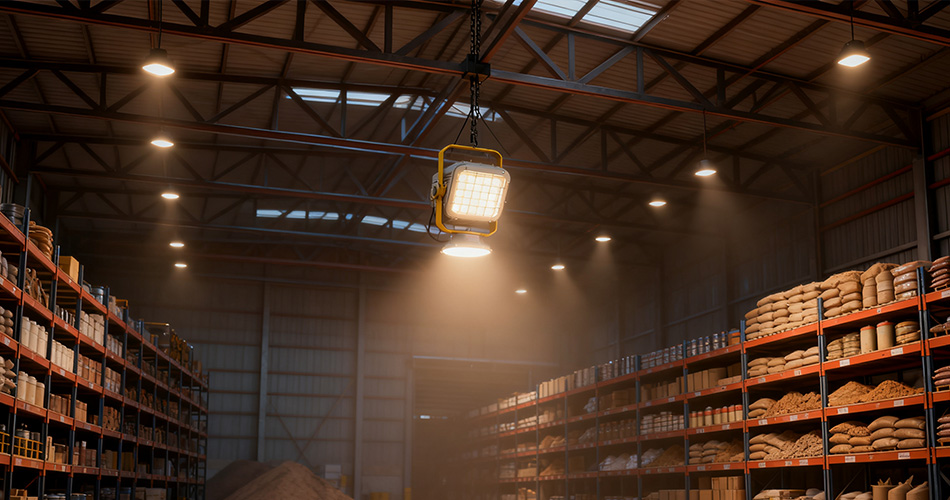
ATEX certified hazardous area lighting systems are indispensable across sectors where explosive atmospheres are inherent:
Upstream: Offshore oil rigs and onshore drilling sites use fixed ATEX lighting for drilling platforms, wellheads, and accommodation areas (Zone 1/2 for gas, Zone 21/22 for drilling dust). Portable systems support maintenance on rigs and pipelines.
Midstream: Pipeline pumping stations and storage terminals rely on corrosion-resistant fixed lighting (Zone 2/22) to withstand harsh outdoor conditions, while emergency systems ensure safe evacuation during power failures.
Downstream: Refineries and petrochemical plants use CAT 1/CAT 2 fixed lighting in Zone 0/1 areas (e.g., distillation units) and CAT 3 systems in Zone 2 storage yards.
Fixed ATEX lighting is installed in mixing areas, solvent storage facilities, and reaction vessels (Zone 1/2 for flammable solvents, Zone 21/22 for powder ingredients).
Intrinsically safe portable lighting supports batch testing and equipment cleaning in confined spaces, while emergency systems align with GMP (Good Manufacturing Practices) for safety compliance.
Underground mines use explosion-proof fixed lighting for tunnels and processing areas (Zone 20/21/22 for coal dust or mineral fibers) and portable systems for exploration and maintenance.
Surface processing plants (crushing, screening) deploy dust-resistant ATEX lighting to prevent ignition of airborne mineral dust (Zone 22).
Grain silos, flour mills, and powder mixing facilities (e.g., cocoa, sugar) use ATEX certified lighting to mitigate dust explosion risks (Zone 21/22). LED systems are preferred for low heat output, reducing the chance of igniting combustible dust clouds.
Selecting the right ATEX certified lighting requires aligning the system with hazard classification, environmental conditions, and regulatory requirements:
Ensure the system’s ATEX category and zone rating match the area’s classification (e.g., CAT 1 for Zone 0, CAT 2 for Zone 1). Using under-certified lighting (e.g., CAT 3 in Zone 1) violates regulations and creates safety risks.
Verify compatibility with the hazard group (gas vs. dust) and temperature class—e.g., T6 systems for low-flashpoint substances like ethanol.
For outdoor or corrosive environments (offshore, chemical plants), choose lighting with IP66+ ingress protection and corrosion-resistant materials (stainless steel, marine-grade aluminum).
For extreme temperatures (arctic pipelines, desert refineries), select systems rated for -40°C to 60°C operating ranges.
Prioritize systems with tool-less access for bulb replacement (reducing downtime) and compatibility with standard mounting hardware (e.g., pole, ceiling brackets).
Ensure maintenance procedures comply with ATEX—only trained personnel should service fixtures, and inspections should be conducted at regular intervals (annually for high-risk zones).
Beyond EU ATEX, confirm compliance with regional standards: IECEx (global), NEC 500/505 (US), CEC (Canada), and GB 3836 (China) to ensure multi-jurisdictional compliance for global operations.
ATEX certified hazardous area lighting systems deliver value beyond compliance:
Risk Mitigation: Eliminates ignition sources (sparks, excessive heat) to prevent explosions and fires, protecting personnel and assets.
Reliability: Robust design ensures consistent performance in harsh conditions (vibration, corrosion, extreme temperatures), reducing downtime.
Cost Efficiency: LED-based ATEX lighting reduces energy consumption by 40-60% compared to traditional incandescent/high-intensity discharge (HID) systems, while long lifespans (50,000+ hours) lower replacement and maintenance costs.
Compliance Confidence: Certified systems simplify audits and regulatory reporting, avoiding fines for non-compliance with ATEX and industry-specific safety standards.
ATEX certified hazardous area lighting systems are non-negotiable for industries operating in explosive atmospheres, blending safety, compliance, and reliability to protect personnel and critical operations. By understanding hazard classification, selecting the right system type, and prioritizing regulatory alignment, businesses can mitigate risks while optimizing energy use and maintenance efficiency. Whether in oil rigs, chemical plants, or grain silos, ATEX certified lighting is a foundational safety investment that ensures operations proceed without compromising on safety or compliance.


)
)
)
)

+86 15899791249

+86 755 2955 3313


Address: Huafeng No.1 Science and Technology Park, Sanwei, Bao'an District, Shenzhen, Guangdong, China.
