

Time:2026-05-26
The commercial building sector is changing fast. In 2026, building owners are no longer installing isolated lighting fixtures. Instead, they demand scalable, modern iot lighting control frameworks. These systems slash electricity overhead, meet green laws, and collect building data automatically.
At the center of this wireless movement is Silvair. They are a major industry leader in Bluetooth Mesh and Bluetooth Networked Lighting Control (NLC) firmware. For design-build contractors and system integrators, using a Silvair system ensures great wireless reliability.
However, supply chain problems often force engineering teams to look for third-party parts. Finding reliable alternative silvair sensors is now a top goal for project managers. The right alternative helps you meet your project deadlines without lowering your technical standards.
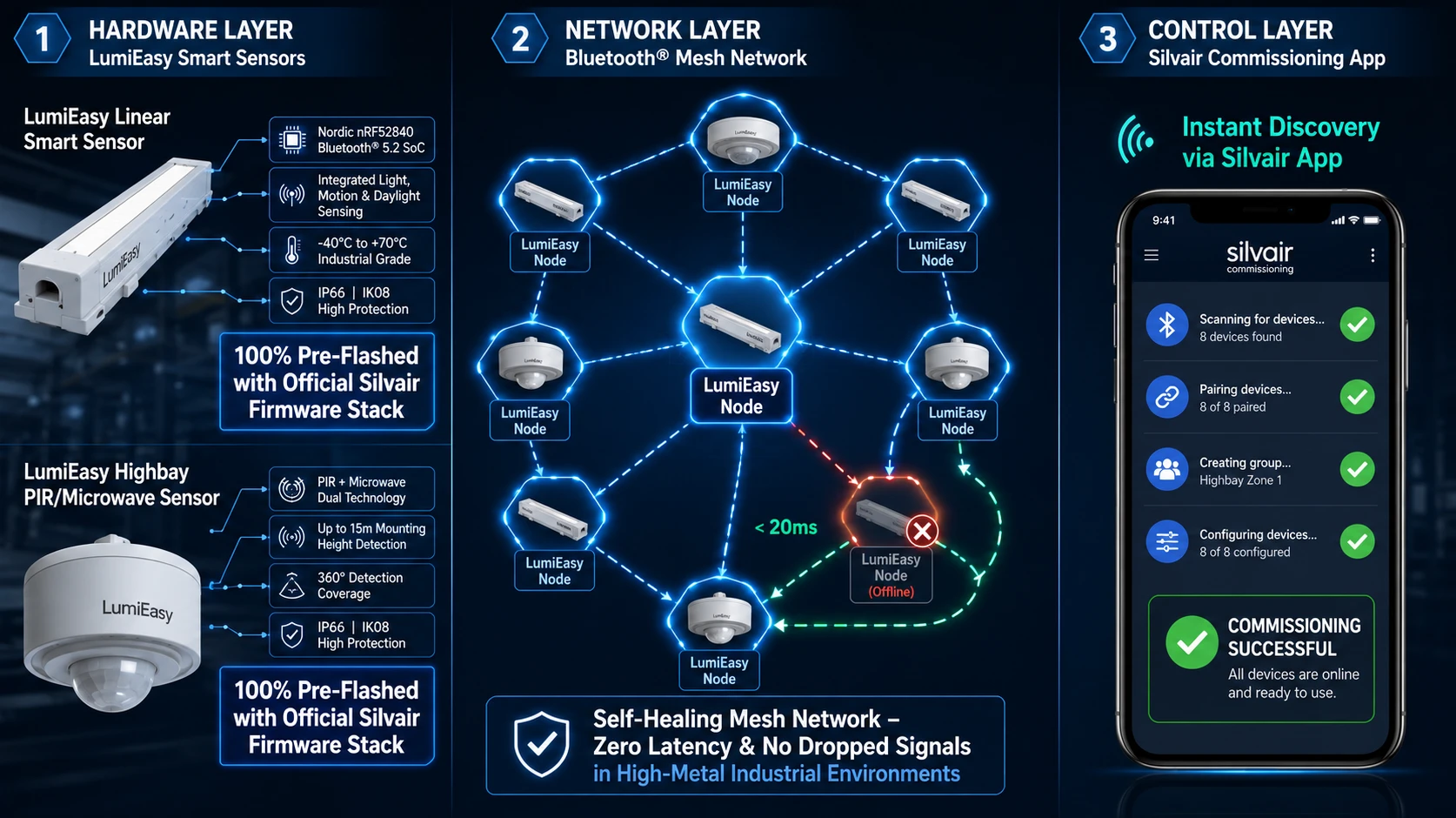
In a complex global market, relying on a single hardware vendor is a risk. Sourcing a dependable alternative does not mean buying lower quality. Instead, it expands your supply chain choices. You can work with agile manufacturers to expand your options. This helps you get better delivery times, unique product shapes, or lower prices.
When evaluating an alternative silvair sensors strategy, you must look beyond basic hardware size. True hardware compatibility requires perfect matching across three technical areas:
Radio Frequency (RF) Performance: The substitute hardware must have a strong wireless signal to prevent data drops or transmission delays.
Firmware Profiles: The component must support identical Bluetooth Mesh lighting models to keep system logic working correctly.
Motion Detection Thresholds: Substitute occupancy sensors must cover the same zone patterns to keep occupants comfortable and safe.
By expanding your hardware sourcing, your project teams can avoid unexpected factory delays. This strategy also keeps you competitive during large commercial bidding processes.
The biggest benefit of standard Bluetooth Networked Lighting Control is native, cross-brand compatibility. Old closed systems trap buyers with a single vendor. In contrast, certified Bluetooth NLC parts talk to each other flawlessly across different hardware brands.
However, getting smooth performance from an alternate sensor vendor requires close attention to firmware details.
Every sensor on a qualified Bluetooth Mesh network sends data using standard models. For example, an alternate occupancy sensor must send clean occupancy data. The target central controller must be able to read this data instantly.
If the alternative hardware uses non-standard property settings, the network may fail to read the device. This error causes slow motion response times, or the lights might stay on all day.
During large building projects, components may arrive at the site with different firmware versions. Some sensors might use older firmware versions. Meanwhile, newer alternative models feature the latest Bluetooth NLC updates.
System integrators must check that their chosen substitute sensors support over-the-air (OTA) updates. This feature allows you to update the entire sensor grid easily using centralized ble commissioning tools. This proactive step prevents setup errors across different hardware batches.
To choose the right alternative sensor, you must check two things: your site’s mounting style and its electrical properties.
Commercial ceiling designs vary widely between office spaces and industrial factories. Facility teams must choose replacement sensors that offer flexible physical mounting styles:
Ceiling Mount Units: These models fit directly into acoustic ceiling tiles. They are ideal for standard office areas, conference rooms, and hallways.
Fixture-Integrated Sensors: These small sensors fit directly into pre-punched holes on LED fixtures. This choice cuts down on on-site assembly work.
High-Bay Lenses: These units use special optics to track motion accurately. They work perfectly from high factory ceilings up to 40 feet.
Modern smart building networks increasingly use safe, low-voltage control circuits. Sourcing alternative sensors that run on a standard 12V/24V DC input loop brings great benefits. It allows installation teams to bypass expensive, rigid high-voltage metal conduit.
Data technicians can route low-voltage wires quickly through drop ceilings. This simple setup lowers installation costs and accelerates your project completion schedule.
On-site commissioning is one of the biggest financial risks during the deployment of a smart lighting system. Older systems forced technicians to adjust tiny mechanical dials while standing on a ladder. That process is slow, imprecise, and expensive.
Modern alternative hardware avoids these maintenance traps by using comprehensive wireless configuration apps. Field data technicians simply open their mobile application on a tablet. They discover the over-the-air network nodes and connect using a secure cryptographic token.
Once inside the interface, installers can wirelessly adjust motion hold times. They can set daylight harvesting lux benchmarks and tweak PIR motion sensitivity thresholds from 0% to 100%. After refining the settings, the app executes an instant bulk wireless push. This action updates all local sensor nodes simultaneously.
Field crews can adjust sensor sensitivity completely from the ground. They do this over the air using standard Bluetooth Low Energy (BLE) protocols. This remote setup helps energy managers work faster. They can change hold times, dimming steps, and lux limits across entire floors instantly. This removes the need for high lifts, saving thousands of dollars in long-term building maintenance budgets.
Deploying alternative sensors does more than just switch lights on and off. It converts your building's lighting layout into an active, high-speed data collection pipeline.
Alternative sensors send clean occupancy data back to a central Smart Gateway. This data shows exactly how people use your building spaces. This continuous stream of information supports complex Space Utilization Data Collection systems:
| Spatial Data Vector | Technical Extraction Method | Practical Application for Enterprise Facilities |
| Occupancy Heatmapping | Real-time PIR tracking logs duration of human presence per zone. | Identifies empty or underused conference rooms. This data allows corporate teams to repurpose space effectively. |
| Daylight Optimization | Continuous photodiode lux tracking near windows and skylights. | Monitors live daylight levels. It tracks how well natural light replaces artificial lighting near windows. |
| Predictive Security Signals | Off-hours motion event tagging sent over the Bluetooth Mesh. | Logs unusual off-hours movement. It automatically brightens specific zones and sends alerts to security teams. |
This useful space data gives corporate leadership concrete proof. It helps them lower carbon footprints, optimize cleaning schedules, and produce accurate corporate green reports.
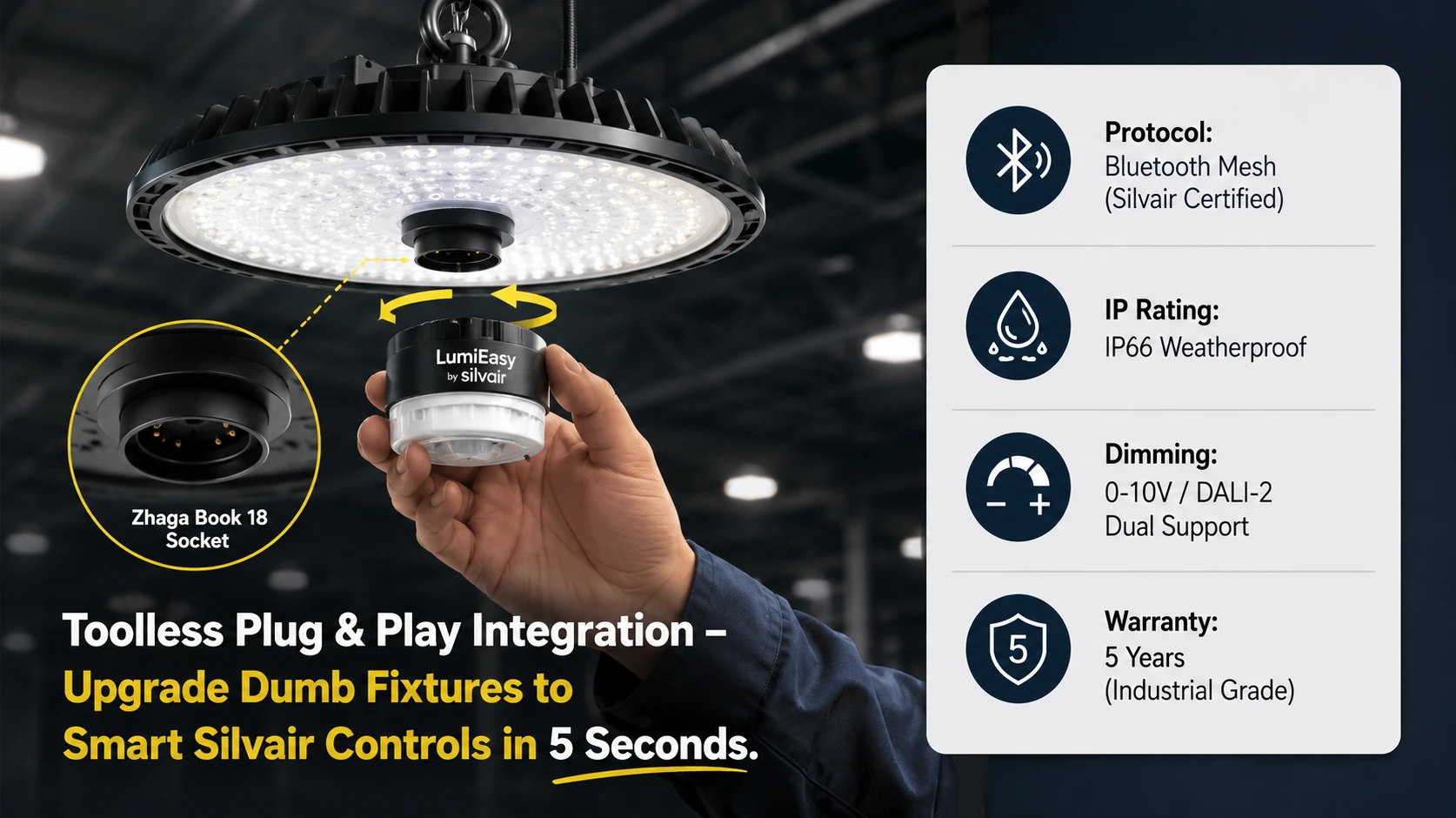
When engineers write hardware specifications for enterprise properties, component validation is crucial. You must select alternative hardware built on verified technical rules rather than cheap, unbranded commodities.
Components must maintain proper electrical isolation. This safety feature prevents feedback loops in low-voltage circuits.
Sourcing from experienced manufacturers ensures that alternative sensors comply fully with global rules. These include the DesignLights Consortium (DLC) Networked Lighting Control technical requirements. This technical compliance protects your investment and ensures long-term system stability.
For harsh building zones, like outdoor loading docks or unheated storage warehouses, project planners must look for durability. Choose sensors that carry a verified linear smart sensor ip rating.
A high IP rating means the sensor housing has tight physical seals. These seals protect internal electronic chips from fine dust, ambient moisture, and water. By selecting rugged alternative sensors, you minimize component failures and prevent costly facility downtime.
Q: Are LumiEasy alternative sensors fully compatible with existing Silvair networks?
A: Yes. LumiEasy manufactures a premium selection of wireless sensors. They are engineered specifically to act as seamless drop-in alternative silvair sensors. They use matching Bluetooth Mesh lighting models. This design allows them to pair instantly with existing Silvair web and mobile apps without requiring custom software patches.
Q: Can we calibrate LumiEasy alternative sensors from the floor after a commercial lighting retrofit?
A: Absolutely. All LumiEasy wireless sensors are fully compatible with standard ble commissioning tools. An energy manager can execute a precise lighting sensor sensitivity adjustment remotely. You can change hold times, dimming steps, or motion thresholds from a smartphone or tablet using standard lumieasy tools.
Q: Do LumiEasy alternative sensors support both low-voltage and line-voltage installations?
A: Yes. Our product lineup includes highly adaptable options. We offer low-voltage models that operate on a clean 12V/24V DC input for maximum safety. We also offer line-voltage units designed for standard high-voltage layouts. This flexibility allows developers to maintain a consistent lighting control system across diverse facility styles.
Q: How do LumiEasy sensors protect building security when connected to a Smart Gateway?
A: Security is central to our hardware design. LumiEasy sensors use multi-layered AES-128 encryption keys. During the initial network pairing phase, the system generates secure tokens locally for each zone. This safety feature ensures that unauthorized users cannot access your lighting grid, keeping your corporate data completely private.
Q: Can LumiEasy sensors handle the heavy environmental demands of industrial facilities?
A: Yes. LumiEasy offers specialized industrial models featuring an advanced linear smart sensor ip rating (up to IP65/IP66). These rugged housings feature specialized gaskets. These tight seals protect the internal Silvair-compatible processors from damage caused by fine metal dust, oil vapors, and moisture.


)
)
)
)

+86 15899791249

+86 755 2955 3313


Address: Huafeng No.1 Science and Technology Park, Sanwei, Bao'an District, Shenzhen, Guangdong, China.
