

Time:2026-03-05
Industrial buildings are under pressure to reduce energy waste, simplify maintenance, and make lighting systems easier to manage. In warehouses, factories, logistics centers, and commercial facilities, traditional lighting control often depends on complex wiring, manual switching, or fixed schedules that do not match real building usage.
This is where wireless BLE lighting control creates practical value.
Instead of relying only on wired control panels or standalone sensors, a wireless BLE lighting control system connects lighting controllers, occupancy sensors, daylight sensors, switches, gateways, and management platforms through low-power wireless communication. The result is a more flexible lighting control network that can support zoning, dimming, scheduling, sensor-based automation, and remote management.
For building owners, facility managers, electrical contractors, and system integrators, wireless BLE lighting is not just about “smart lighting.” It is about reducing installation complexity, improving energy performance, and making lighting control easier to adjust after the project is completed.
Wireless BLE lighting control uses Bluetooth Low Energy communication to connect lighting control devices within a building. In a commercial or industrial lighting system, BLE can be used to support communication between:
Wireless occupancy sensors
Daylight harvesting sensors
0-10V or DALI lighting controllers
Wireless wall switches
High-bay lighting control modules
BLE gateways
Lighting management platforms
Unlike consumer smart lights, industrial wireless BLE lighting control focuses on building operation. The goal is not only to turn lights on or off from an app. The real value is to make lighting respond to occupancy, daylight availability, working schedules, and zone requirements.
For example, in a warehouse aisle, lights can remain at a low standby level when the area is empty and automatically increase brightness when workers or forklifts enter the zone. In an office or production area, lighting can be adjusted by occupancy, daylight contribution, and working hours.
BLE technology offers several advantages that make it ideal for factory lighting control:
Low power consumption: Devices operate for long periods without frequent maintenance.
Wireless communication: Eliminates complex wiring infrastructure.
Scalability: Thousands of fixtures can communicate within a network.
Interoperability: Compatible with smartphones, tablets, and IoT gateways.
In industrial environments where reliability and efficiency are essential, BLE provides a stable platform for intelligent lighting automation.
Factories equipped with BLE-enabled lighting can automatically adjust brightness levels according to occupancy, daylight availability, and production schedules. This not only reduces energy costs but also improves worker comfort and productivity.
Bluetooth is a broad wireless technology used in many devices. BLE, or Bluetooth Low Energy, is designed for low-power communication between connected devices.
For lighting control, BLE is useful because sensors, switches, controllers, and gateways often need to send small amounts of data reliably without high power consumption. This makes BLE suitable for wireless lighting control devices in commercial and industrial buildings.
In many lighting projects, BLE can also work together with Bluetooth mesh networking. Bluetooth mesh allows many devices to communicate across a larger network, which is especially useful for buildings with multiple zones, sensors, and control nodes.
For industrial and commercial lighting, the key point is not the name of the wireless protocol alone. The real question is whether the system can support stable control, flexible zoning, sensor-based automation, and remote management.

The introduction of Bluetooth 4.0 BLE marked a major breakthrough for IoT-based lighting control.
Bluetooth 4.0 introduced several capabilities that transformed smart lighting technology:
Ultra-low power operation
Secure device pairing
Stable mesh networking
Fast device discovery
Long battery life for sensors
These features enable wireless lighting systems to operate reliably even in large industrial facilities.
Factories using Bluetooth 4.0 BLE lighting control can achieve:
Automated lighting schedules
Motion-activated illumination
Adaptive daylight harvesting
Remote monitoring and diagnostics
Because BLE devices consume very little energy, sensors and controllers can operate for years without battery replacement.
Many people wonder about the difference between BLE vs Bluetooth. While both technologies belong to the same wireless communication family, they serve different purposes.
Feature | BLE | Classic Bluetooth |
Power Consumption | Very Low | Higher |
Data Transfer | Small packets | Larger data streams |
Use Case | IoT devices | Audio streaming |
Battery Life | Long | Shorter |
Network Scalability | High | Limited |
For industrial lighting control, BLE is the preferred choice because it supports large networks of low-power devices.
BLE allows hundreds or even thousands of lighting nodes to communicate efficiently. This scalability makes it particularly suitable for:
Smart factories
Distribution centers
Commercial buildings
Industrial warehouses
With BLE mesh networking, each lighting fixture can act as a communication node, ensuring reliable signal coverage across the entire facility.
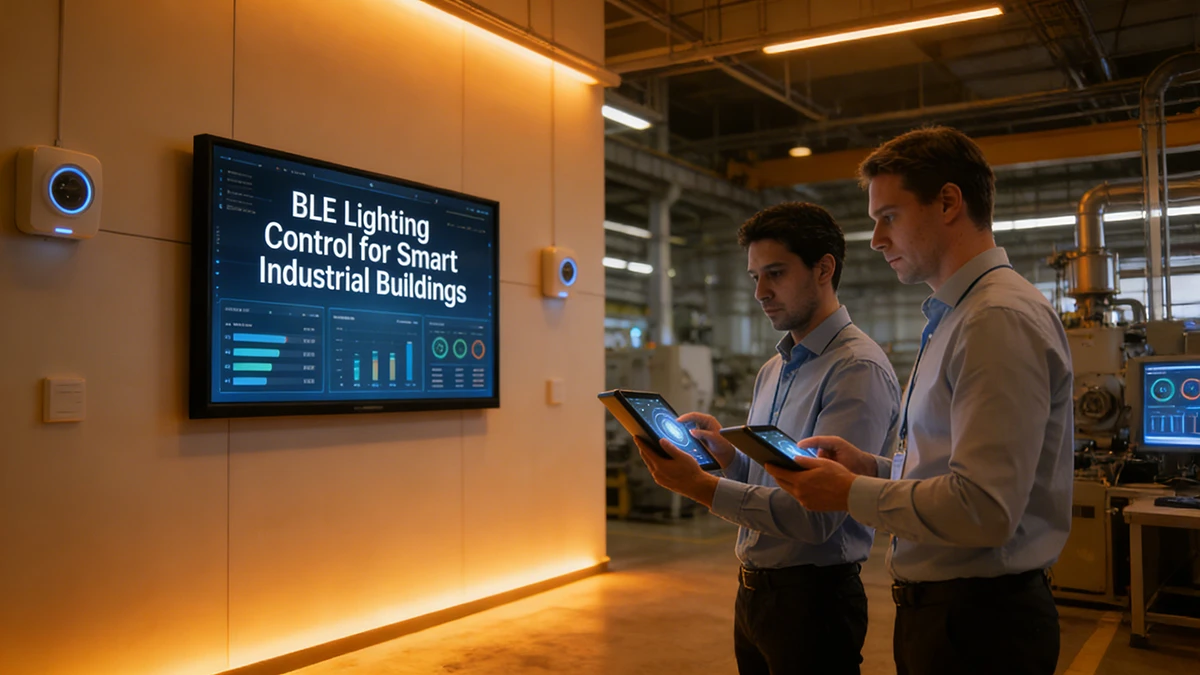
Bluetooth lighting control systems allow wireless management of lighting infrastructure through mobile devices or centralized management platforms.
These systems support features such as:
Zone-based lighting control
Automatic dimming schedules
Occupancy-triggered illumination
Energy monitoring dashboards
Factory managers can easily adjust lighting levels in different work areas depending on operational needs.
For example, production lines may require bright illumination, while storage zones may operate with reduced brightness to conserve energy.
Commissioning is a critical stage in any lighting installation project. BLE network commissioning tools simplify this process by allowing technicians to configure lighting systems directly through mobile applications.
With these tools, installers can:
Scan and identify lighting fixtures
Assign devices to zones
Adjust dimming parameters
Update firmware wirelessly
This wireless configuration eliminates the need for complex wiring or manual programming, saving time and reducing installation costs.
LumiEasy provides intuitive commissioning software that enables fast deployment of industrial BLE lighting systems.
Beyond lighting control, BLE beacon positioning applications provide valuable location-based services in industrial environments.
BLE beacons can be installed in lighting fixtures to enable indoor positioning systems. These systems support applications such as:
Asset tracking
Worker safety monitoring
Equipment location services
Warehouse navigation
For large logistics centers or manufacturing plants, BLE beacon technology enhances operational visibility and improves workflow efficiency.
When integrated with smart lighting infrastructure, beacon technology creates a powerful IoT ecosystem within industrial facilities.
While BLE devices communicate locally, large industrial networks often require integration with centralized management systems. This is where BLE gateway system integration becomes essential.
A BLE gateway acts as a bridge between the lighting network and external platforms such as:
Building management systems (BMS)
Energy management software
Cloud analytics platforms
Industrial IoT dashboards
With gateway integration, factory managers can monitor lighting performance, energy consumption, and system status from a centralized interface.
LumiEasy designs scalable gateway solutions that connect BLE lighting networks with enterprise management platforms, enabling intelligent automation across industrial buildings.
Implementing BLE lighting control systems offers numerous advantages for industrial clients:
Smart lighting automation reduces electricity consumption by adjusting brightness based on occupancy and daylight availability.
Wireless BLE systems eliminate extensive wiring, reducing installation labor and infrastructure costs.
New lighting fixtures can be added to the network without modifying existing wiring or infrastructure.
Real-time data allows facility managers to monitor energy usage and system performance.
Automated lighting ensures that work areas are properly illuminated whenever personnel are present.
When selecting a wireless BLE lighting control system, buyers should look beyond basic wireless communication. A good system should support real building operation needs.
Before choosing a supplier, consider these questions:
Does the system support occupancy sensing and daylight harvesting?
Can fixtures be grouped into zones?
Can delay time, dimming level, and sensor sensitivity be configured?
Does the system support 0-10V, DALI, or other common lighting interfaces?
Is there a gateway for remote management?
Can the system support warehouse high-bay lighting control?
Is the solution suitable for retrofit projects?
Can the supplier provide technical support for commissioning and project design?
For B2B projects, the most important question is not only whether the system is wireless. The key question is whether the wireless BLE lighting control system can match the actual space, installation conditions, and energy-saving goals of the building.
LumiEasy provides smart lighting control solutions for commercial and industrial applications. Our system is designed to help building owners, facility managers, contractors, ESCOs, and system integrators improve lighting efficiency with wireless control devices and intelligent management tools.
LumiEasy wireless BLE lighting control solutions can include:
Bluetooth mesh lighting control devices
Wireless occupancy sensors
Daylight harvesting sensors
Smart wall switches
0-10V and DALI lighting control interfaces
BLE gateways
Lighting management platforms
Zone control, scheduling, dimming, and sensor-based automation
Our solutions are suitable for warehouses, factories, logistics centers, parking garages, offices, schools, and commercial retrofit projects.
Instead of simply adding more sensors or controllers, LumiEasy focuses on building a complete control strategy. The system can help lighting respond to real occupancy, daylight conditions, building schedules, and zone requirements.
The integration of IoT technologies continues to transform industrial environments. BLE lighting networks are evolving beyond simple lighting control into comprehensive digital infrastructure.
In the future, BLE-enabled lighting systems will support:
AI-driven energy optimization
Predictive maintenance analytics
Indoor navigation services
Integration with robotics and automation systems
As factories adopt Industry 4.0 technologies, smart lighting will play a key role in building connected, data-driven industrial ecosystems.
Wireless BLE lighting control uses Bluetooth Low Energy communication to connect lighting controllers, sensors, switches, gateways, and management platforms. It allows lighting systems to support wireless zoning, dimming, scheduling, occupancy sensing, and daylight harvesting.
Yes. Wireless BLE lighting control is suitable for many industrial and commercial buildings, especially warehouses, factories, logistics centers, parking garages, and retrofit projects where new control wiring is difficult or costly.
BLE refers to Bluetooth Low Energy communication. Bluetooth mesh is a networking technology built for many-to-many device communication. In lighting control, Bluetooth mesh can help sensors, controllers, switches, and gateways communicate across larger networks.
Yes. Energy savings usually come from better control logic, such as occupancy-based switching, standby dimming, daylight harvesting, scheduling, and zone-based control. The actual result depends on building usage, sensor placement, commissioning, and control settings.
A gateway is not always required for basic local control, but it is recommended when the project needs remote management, centralized monitoring, scheduling, data visibility, or integration with a lighting management platform.
Yes, depending on the controller design. Wireless BLE lighting control systems can be designed to support 0-10V dimming, DALI control, relay switching, or other lighting control interfaces.
Choose a supplier that understands commercial and industrial lighting control, not just wireless devices. The supplier should support sensors, controllers, gateways, commissioning tools, project guidance, and after-sales technical support.
Wireless BLE lighting control is becoming a practical solution for industrial and commercial buildings that need more flexible, efficient, and manageable lighting systems.
For warehouses, factories, logistics centers, parking garages, and retrofit projects, wireless BLE lighting can reduce wiring work, support occupancy sensing, enable daylight harvesting, improve zoning, and simplify remote management.
If you are planning a commercial or industrial lighting control project, LumiEasy can help you design a wireless BLE lighting control solution based on your building layout, control goals, and installation requirements.
Related news
2025 NLC System Certification Requirements & Linear Sensor Guide | LumiEasy
Boost Efficiency with Commercial Lighting Control Retrofit


)
)
)
)

+86 15899791249

+86 755 2955 3313


Address: Huafeng No.1 Science and Technology Park, Sanwei, Bao'an District, Shenzhen, Guangdong, China.
