

Time:2025-11-14
Accurately verifying energy savings from commercial smart lighting deployments is critical for justifying investments, validating ROI, and meeting ESG reporting requirements. A robust commercial smart lighting energy savings verification methodology eliminates guesswork, accounts for external variables, and delivers credible, audit-ready results—whether for internal stakeholders, investors, or regulatory bodies. Unlike generic energy audits, this methodology is tailored to the unique capabilities of commercial smart lighting (e.g., automation, occupancy sensing, daylight harvesting) and addresses the complexities of commercial spaces (variable occupancy, multi-system integration, dynamic usage patterns). This article outlines a step-by-step commercial smart lighting energy savings verification methodology that balances rigor, practicality, and compliance with global standards.
The foundation of any commercial smart lighting energy savings verification methodology is a precise baseline—representing energy use before the smart lighting upgrade. This step ensures savings are attributed solely to the retrofit, not external factors.
Data Collection Scope: Gather 12–24 months of historical lighting energy data (preferably at 15–60 minute intervals) from utility bills, smart meters, or building management systems (BMS). For buildings without granular data, install temporary sub-meters on lighting circuits to capture 3–6 months of pre-retrofit usage.
Key Baseline Metrics: Calculate average daily/weekly/monthly lighting energy consumption (kWh), peak usage periods, and usage patterns tied to occupancy (e.g., office hours vs. after-hours). Include supplementary data: lighting fixture count/types (e.g., fluorescent troffers, metal halide high-bays), wattage per fixture, and control logic (e.g., manual switches, basic timers).
Normalization: Adjust baseline data to account for fixed variables (e.g., building square footage, number of workstations) to ensure apples-to-apples comparison with post-retrofit performance. Use standards like ASHRAE Guideline 14 for normalization best practices.
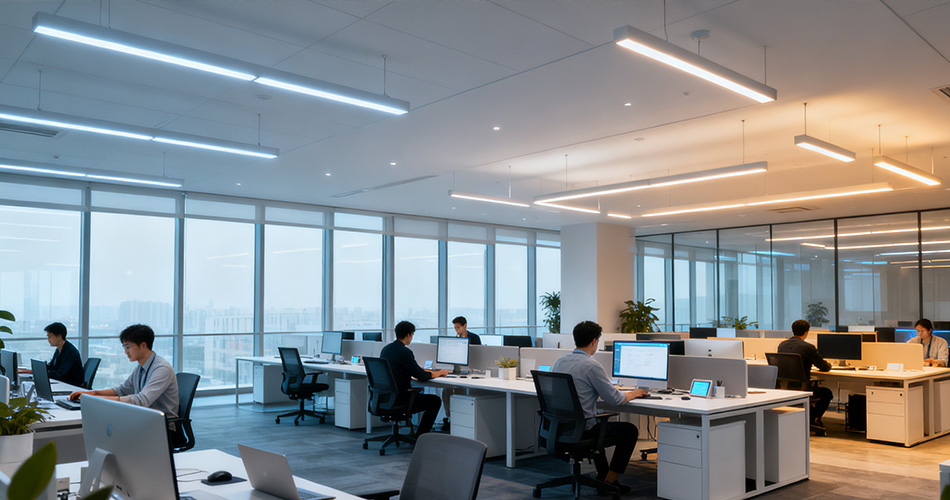
A credible commercial smart lighting energy savings verification methodology requires consistent, granular post-retrofit data collection—aligned with the smart system’s capabilities.
Monitoring Tools: Leverage built-in commercial smart lighting sensors, cloud-based energy management platforms, and integrated smart meters to capture real-time data. Supplement with:
Occupancy sensors (to track space utilization and link to lighting activation)
Daylight sensors (to measure natural light intensity and daylight harvesting effectiveness)
Circuit-level sub-meters (to isolate lighting energy from other building systems like HVAC)
Core Monitoring Metrics: Track kWh consumption, lighting run-time per zone, dimming levels, occupancy-triggered activation rates, and daylight harvesting contribution. Collect data at the same interval as the baseline (15–60 minutes) for consistency.
Monitoring Duration: Conduct continuous monitoring for at least 6 months post-installation. Extend to 12 months for seasonal spaces (e.g., retail, hospitality) to account for winter/summer daylight variations and occupancy fluctuations.
Commercial spaces are subject to dynamic factors that impact energy use—this step of the methodology isolates the true savings from commercial smart lighting by accounting for these variables.
Key Variables to Adjust For:
Occupancy Changes: If staff count or operational hours increase/decrease post-retrofit, use occupancy sensor data to scale baseline usage (e.g., a 10% increase in office occupancy justifies a 10% baseline adjustment).
Daylight Availability: Compare pre- and post-retrofit daylight hours (using weather station data) to adjust for seasonal changes—e.g., more natural light in summer reduces lighting demand regardless of the smart system.
Non-Lighting Loads: Ensure data excludes energy use from other systems (e.g., plug loads, HVAC) by using circuit-level sub-meters or BMS segmentation.
Calibration Process: Use statistical tools (e.g., regression analysis) to model baseline energy use against variables like occupancy and daylight. Apply this model to post-retrofit variables to generate a “counterfactual baseline”—what energy use would have been without the smart lighting upgrade.
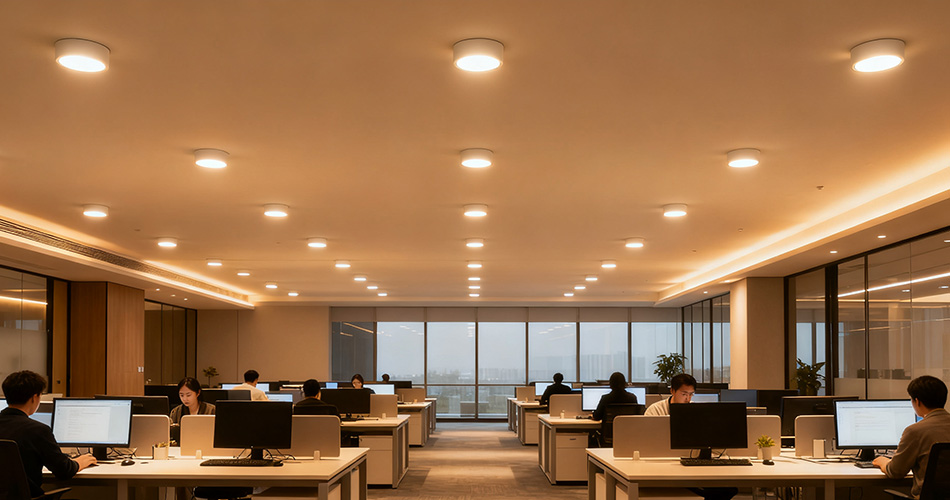
The commercial smart lighting energy savings verification methodology relies on two primary calculation approaches, chosen based on data availability and project complexity:
Approach: Directly compare normalized baseline energy use to post-retrofit consumption, adjusted for variables.
Formula: Energy Savings (kWh) = Counterfactual Baseline Energy (kWh) – Post-Retrofit Measured Energy (kWh)
Applicability: Ideal for simple retrofits (e.g., replacing fluorescent fixtures with smart LEDs) where baseline data is robust and variables are easy to quantify.
Example: A warehouse’s baseline lighting energy use is 10,000 kWh/month. Post-retrofit, measured use is 4,500 kWh/month. After adjusting for a 5% increase in occupancy, the counterfactual baseline is 10,500 kWh/month—resulting in 6,000 kWh/month in verified savings.
Approach: Use energy modeling software (e.g., EnergyPlus, DIALux) to simulate baseline and post-retrofit lighting performance.
Process: Input building characteristics (square footage, ceiling height), fixture details (wattage, efficiency), and smart lighting logic (occupancy sensing, dimming schedules) into the model. Run simulations to generate baseline and post-retrofit energy use.
Applicability: Suitable for complex spaces (e.g., multi-tenant office towers, retail malls) or retrofits with limited baseline data. Requires calibration with real-world post-retrofit measurements to ensure accuracy.
For high-stakes projects (e.g., large-scale retrofits, ESG reporting, incentive applications), include third-party verification in the commercial smart lighting energy savings verification methodology.
Third-Party Roles: Accredited firms (e.g., LEED AP, ASHRAE-certified professionals) review baseline data, monitoring protocols, variable adjustments, and calculation methods to ensure compliance with standards like IPMVP (International Performance Measurement and Verification Protocol) or ISO 50001.
Benefits: Enhances credibility with stakeholders, reduces audit risk, and qualifies for energy efficiency incentives (many utilities and governments require third-party verification for rebates).
A complete commercial smart lighting energy savings verification methodology includes transparent documentation and standardized reporting.
Documentation Requirements:
Baseline data sources and normalization procedures.
Monitoring tools, sensor placement, and data collection intervals.
Variable adjustment calculations and calibration results.
Savings calculation methodology and formulas.
Third-party verification reports (if applicable).
Reporting Metrics: Present total verified savings (kWh/year), percentage reduction from baseline, cost savings (USD/year), and carbon emission reductions (tons CO₂/year). Include monthly/quarterly trends to show consistency over time.
Compliance Alignment: Format reports to meet ESG frameworks (e.g., GRI, SASB) or incentive program requirements (e.g., US DOE Better Buildings, EU Horizon 2020).
Avoid Overlooking Smart Lighting Features: Ensure the methodology accounts for unique smart capabilities (e.g., daylight harvesting, occupancy-driven dimming) by monitoring their activation rates and energy impact separately.
Maintain Data Integrity: Use calibrated sensors and meters, and conduct regular audits of monitoring systems to prevent data gaps or inaccuracies.
Align with Project Goals: Tailor the methodology to your objectives—e.g., focus on granular zone-level savings for multi-tenant buildings, or carbon reduction metrics for ESG-focused businesses.
A structured commercial smart lighting energy savings verification methodology turns abstract energy claims into tangible, auditable results. By establishing a precise baseline, accounting for external variables, using validated calculation methods, and documenting processes transparently, businesses can confidently demonstrate the value of their commercial smart lighting investments. This methodology not only validates ROI but also strengthens ESG credibility, supports incentive applications, and provides insights to optimize the smart lighting system for further savings. In an era where data-driven decision-making is paramount, investing in a rigorous verification process is as critical as the smart lighting upgrade itself.


)
)
)
)

+86 15899791249

+86 755 2955 3313


Address: Huafeng No.1 Science and Technology Park, Sanwei, Bao'an District, Shenzhen, Guangdong, China.
