

Time:2026-01-04
Motion detection is a cornerstone of modern security and automation systems, safeguarding diverse spaces from residential homes to commercial facilities. However, traditional Passive Infrared (PIR) sensors often struggle with detection blind spots in complex environments—areas shielded by obstacles, irregular layouts, or wide coverage requirements—undermining system reliability. Dual-element PIR anti-blind spot technology, featuring two coordinated infrared sensing elements, addresses this critical flaw by expanding detection coverage and minimizing blind zones. By synergizing signals from dual elements, this technology ensures consistent motion detection even in spaces with structural barriers or large footprints. For security engineers, facility managers, and smart home integrators, understanding the value and application of dual-element PIR anti-blind spot technology is essential to building robust, all-round protection systems. This article explores the core advantages, targeted application scenarios, implementation guidelines, and future trends of dual-element PIR anti-blind spot technology, highlighting its indispensable role in optimizing motion detection performance.
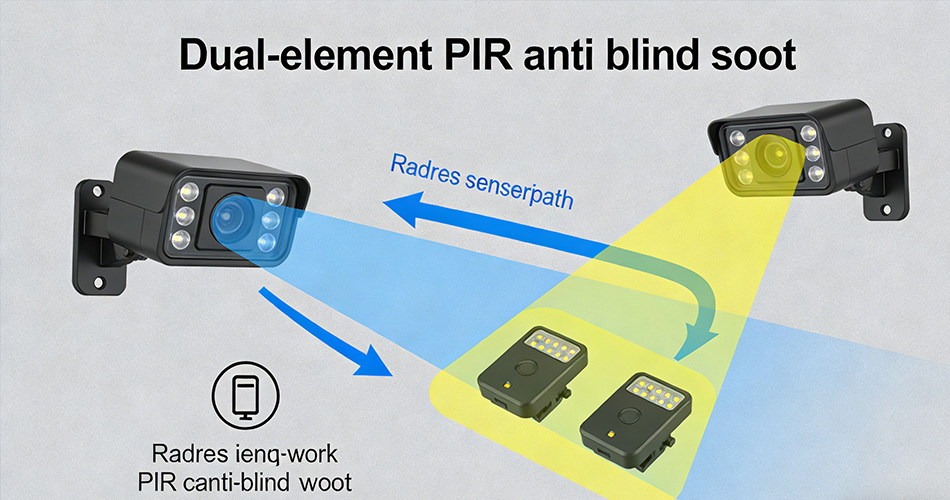
Single-element PIR sensors, the most common traditional motion detection solution, face inherent limitations in eliminating blind spots, especially in complex or large-scale spaces. A primary issue is their narrow detection angle and limited signal coverage: a single sensing element can only monitor a fixed, narrow range, leaving corners, behind obstacles (such as shelves or pillars), or distant areas unmonitored. For example, in a large commercial warehouse with stacked goods, single-element PIR sensors may fail to detect movement behind pallet racks, creating critical security blind spots.
Another critical flaw is their vulnerability to signal disruption from environmental and structural factors. Irregular room shapes, high ceilings, or airflow disturbances can distort the infrared signal received by a single element, further expanding blind spots. In residential spaces like multi-story villas, single-element sensors installed in stairwells may miss movement on landing platforms due to limited coverage. These limitations not only compromise security but also reduce the efficiency of automated systems (such as lighting or HVAC control) that rely on accurate motion detection. Dual-element PIR anti-blind spot technology resolves these pain points by leveraging dual sensing elements to widen coverage and enhance signal stability.
Dual-element PIR anti-blind spot technology redefines motion detection performance through four key advantages, tailored to complex space needs:
- Expanded coverage and blind spot elimination: The core advantage of dual-element PIR anti-blind spot technology lies in the synergy between two sensing elements. These elements are calibrated to cover complementary ranges, creating a wider, overlapping detection area. For instance, one element may cover a horizontal range while the other monitors a slightly angled zone, ensuring that corners, edges, and areas behind low obstacles are not overlooked. This coordinated design effectively eliminates blind spots that plague single-element sensors.
- Enhanced signal stability and anti-interference capability: Dual elements work together to filter out false signals and stabilize infrared detection. When environmental factors (such as airflow or temperature fluctuations) affect one element, the other element’s signal acts as a reference, reducing the risk of false triggers or missed detections. This anti-interference capability ensures reliable performance in challenging environments, such as warehouses with constant temperature changes or outdoor covered spaces exposed to wind.
- Adaptability to diverse space layouts: Unlike single-element sensors limited to specific space shapes, dual-element PIR anti-blind spot technology can be adjusted to match various layout characteristics. Whether it is a narrow corridor, an irregularly shaped retail store, or a high-ceilinged auditorium, the dual-element design allows for flexible calibration of detection angles and ranges, ensuring comprehensive coverage regardless of space complexity. This adaptability makes it suitable for both residential and commercial applications.
- Improved system efficiency and cost-effectiveness: By eliminating blind spots with fewer sensors, dual-element PIR anti-blind spot technology reduces the number of devices needed for full-space coverage. Compared to installing multiple single-element sensors to cover blind spots, a single dual-element sensor can achieve broader coverage, lowering procurement, installation, and maintenance costs. For large facilities, this translates to significant cost savings while maintaining or enhancing security performance.
Dual-element PIR anti-blind spot technology delivers unique value in scenarios where comprehensive motion detection and blind spot elimination are critical:
- Commercial Warehouses and Storage Facilities: Warehouses with stacked goods, pillars, and large footprints are prone to detection blind spots. Dual-element PIR anti-blind spot sensors monitor aisles, behind pallet racks, and corner areas simultaneously, ensuring that unauthorized movement is detected regardless of obstacle placement. This enhances security against theft and vandalism while supporting automated lighting control for energy savings.
- Underground Garages and Parking Lots: Underground parking facilities have irregular layouts, pillars, and narrow passages that create numerous blind spots. Dual-element sensors cover wide lanes and adjacent parking spaces, detecting movement of vehicles and pedestrians without missing hidden areas (such as behind support columns). They also adapt to the low-light, stable-temperature environment of underground garages, ensuring reliable performance.
- Open-Plan Office Areas and Retail Stores: Open-plan offices with cubicles, partitions, or large furniture, and retail stores with display shelves, often have scattered blind spots. Dual-element PIR anti-blind spot technology covers workstations, store aisles, and behind-display areas, ensuring that security alarms are triggered for suspicious activity and that automated lighting activates only when humans are present. This balances security with user convenience.
- Large Residential Spaces (Villas, Multi-Story Homes): Spacious homes with stairwells, hallways, and multiple rooms require comprehensive motion detection. Dual-element sensors installed in stairwells cover landings and adjacent rooms, eliminating blind spots between floors. In open living areas with furniture, they monitor the entire space without missing areas behind sofas or cabinets, enhancing home security and supporting smart automation (such as motion-activated lighting).
To fully leverage the value of dual-element PIR anti-blind spot technology, follow these scenario-specific implementation guidelines:
- Conduct space layout and blind spot analysis: Before installation, map the target space to identify potential blind spots (such as corners, behind obstacles, or narrow passages). This analysis helps determine the optimal number and placement of dual-element sensors to ensure full coverage. For large spaces, use a zoned approach, installing sensors at key junctions to cover overlapping areas.
- Optimize sensor placement and angle calibration: Mount dual-element PIR anti-blind spot sensors at a height of 7-8 feet (suitable for most indoor spaces) to maximize coverage. Calibrate the angle of each sensing element to cover complementary ranges—for example, adjusting one element to cover a horizontal span and the other to tilt slightly downward to monitor near-ground areas. Avoid placing sensors directly facing heat sources (such as vents) to reduce interference.
- Calibrate sensitivity based on space characteristics: Adjust sensor sensitivity according to the space’s usage and environmental conditions. For high-traffic areas (such as retail store aisles), moderate sensitivity prevents false triggers from frequent movement; for low-traffic areas (such as warehouse storage zones), higher sensitivity ensures no movement is missed. Conduct on-site testing to fine-tune settings.
- Integrate with smart security and automation systems: Connect dual-element PIR anti-blind spot sensors to a centralized security or building management system. This enables real-time monitoring of detection status, remote adjustment of settings, and linkage with other devices (such as cameras, alarms, or lighting). Ensure compatibility with mainstream communication protocols for seamless integration.
Driven by advancements in smart security and IoT technology, dual-element PIR anti-blind spot technology is evolving toward greater intelligence and integration:
- AI-driven adaptive coverage adjustment: Future dual-element sensors will integrate AI algorithms to learn space usage patterns and adjust detection angles and sensitivity dynamically. For example, in a retail store, the sensor can widen coverage during peak hours to monitor crowded aisles and narrow coverage during off-peak hours to reduce false triggers.
- Multi-technology fusion for enhanced accuracy: Sensors will combine dual-element PIR technology with other sensing methods (such as microwave or acoustic sensing) to further eliminate blind spots and improve motion detection accuracy. This fusion allows for reliable detection even in environments with extreme temperature changes or heavy obstacles.
- Wireless and battery-free design: Advances in low-power wireless communication and energy-harvesting technology (such as solar or kinetic energy) will enable wireless, battery-free dual-element sensors. This simplifies installation in hard-to-reach areas (such as high-ceilinged warehouses) and reduces maintenance costs, enhancing system flexibility.
- Cloud-based remote monitoring and management: Smart dual-element PIR anti-blind spot sensors will support cloud connectivity, allowing facility managers or homeowners to monitor detection status, receive real-time alerts, and adjust settings remotely via mobile apps. This enhances operational efficiency and provides greater control over security systems.
In conclusion, dual-element PIR anti-blind spot technology is a transformative solution for overcoming the limitations of traditional single-element PIR sensors, delivering comprehensive, reliable motion detection in complex spaces. Its ability to eliminate blind spots, enhance anti-interference capability, and adapt to diverse layouts makes it indispensable for commercial warehouses, underground garages, open-plan offices, and large residential spaces. By following scientific implementation guidelines—including space analysis, optimized placement, and system integration—users can fully leverage this technology to build secure, efficient, and cost-effective motion detection systems. As AI and IoT technologies advance, dual-element PIR anti-blind spot technology will become even more intelligent and versatile, playing an increasingly important role in the development of modern security and automation ecosystems. For anyone involved in designing or managing security systems, prioritizing this technology is a strategic choice to enhance protection coverage, improve system reliability, and ensure all-round safety for diverse spaces.


)
)
)
)

+86 15899791249

+86 755 2955 3313


Address: Huafeng No.1 Science and Technology Park, Sanwei, Bao'an District, Shenzhen, Guangdong, China.
