

Time:2026-04-16
In the modern landscape of high-performance architectural design, lighting and HVAC automation represent the largest opportunities for energy conservation. However, the effectiveness of these automated systems depends entirely on the reliability of the underlying detection hardware. For facility managers and electrical contractors, the most persistent challenge is the "false trigger"—lights turning on for an empty room or, conversely, turning off while a person is still working. To solve this, the industry has transitioned toward Dual technology sensors, a sophisticated solution that combines multiple sensing methods to achieve unparalleled accuracy.
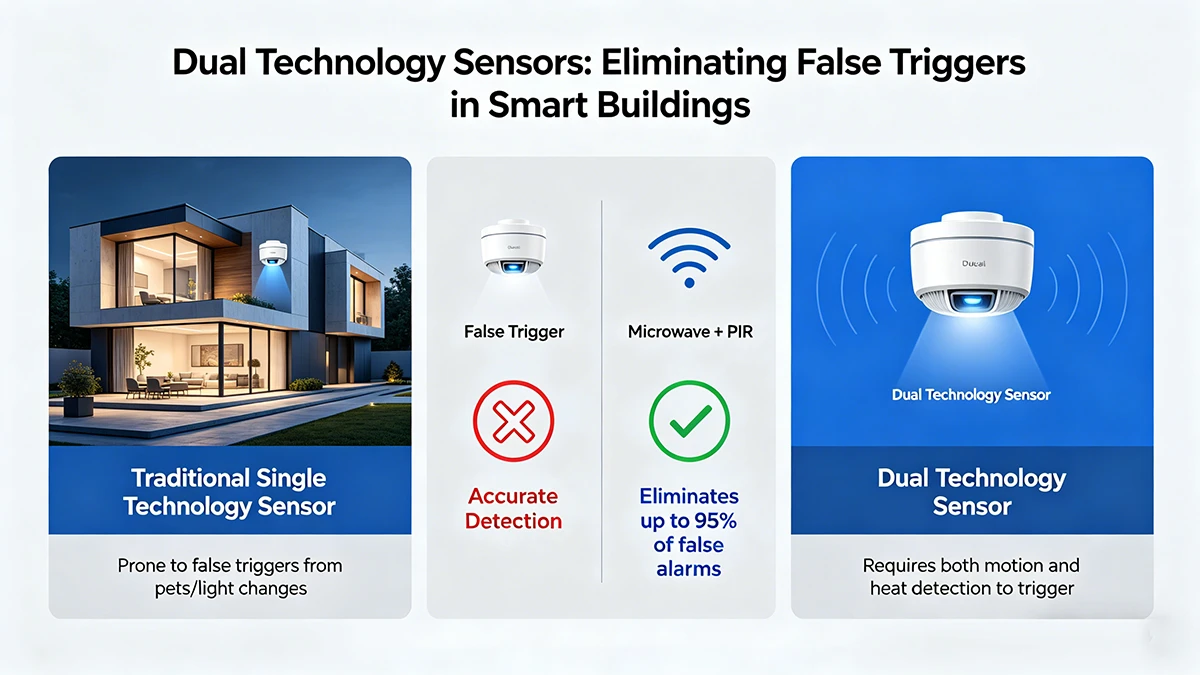
A dual technology motion sensor is not simply a redundant device; it is a logic-based system designed to cross-verify movement before taking action. By requiring two different physical triggers to activate, these sensors drastically reduce errors in complex smart building environments.
The most common configuration in the market today is the dual technology pir sensor paired with microwave (MW) detection.
Passive Infrared (PIR): This technology detects the movement of heat signatures (infrared energy) across its field of view.
Microwave (MW): This active technology emits low-power radio waves and measures the reflection (Doppler effect) to detect physical displacement.
A PIR microwave dual sensor requires both heat and physical movement to trigger an "occupied" state. This ensures that a sudden change in temperature (like an HVAC vent turning on) or a non-human movement (like a blowing curtain) does not cause a false alarm.
In large-scale commercial applications, dual tech occupancy sensors provide a layer of "Invisible Intelligence". Unlike single-technology sensors that might have "blind spots," the overlapping fields of PIR and Microwave ensure that even micro-movements—such as a person typing at a desk or flipping a page—are captured. This level of dual technology sensor accuracy is what defines a truly smart building.
In the world of B2B procurement and facility management, understanding the difference between occupancy and vacancy logic is critical for meeting energy codes like Title 24.
The dual technology occupancy sensor ceiling mount is the standard for open-plan offices, restrooms, and storage facilities. These sensors utilize "Auto-On / Auto-Off" logic. As soon as the dual technology occupancy sensor detects a verified heat-and-motion signature, the lights activate instantly. This provides a seamless, hands-free experience for employees and visitors.
For meeting rooms and private offices, many codes now mandate a dual technology vacancy sensor. This requires a "Manual On / Auto-Off" operation. The user must physically press a switch to turn the lights on, but the dual technology occupancy sensors will automatically turn the lights off once the room is empty. This prevents lights from being triggered by people walking past an open door, leading to maximum energy savings.
The primary driver for the adoption of dual technology motion sensors is dual sensor false alarm reduction. In a massive warehouse or a multi-story office building, every false trigger represents wasted electricity and unnecessary wear on LED drivers.
False triggers generally fall into two categories:
Type A (False Positive): Lights turn on in an empty room due to air currents or pets.
Type B (False Negative): Lights turn off while a person is present because their movement was too small for a PIR sensor to see.
By utilizing dual technology sensors, the system effectively "filters" these errors. The PIR component handles the initial detection, while the microwave or ultrasonic component maintains the "occupied" status even if the person remains relatively still.
For high-end architectural projects, the lutron maestro dual technology occupancy sensor switch and the lutron maestro 2-circuit dual technology occupancy sensor are industry favorites. These devices integrate dual tech occupancy sensors into a sleek wall-switch form factor. They allow for granular control over two separate lighting circuits, making them ideal for classrooms where one circuit controls the whiteboard lights and the other controls the general seating area.
As we move toward 2026, the PIR microwave dual sensor is becoming the global standard for industrial lighting.
Microwave Penetration: Unlike PIR, which cannot see through thin walls or glass, microwave sensors can detect movement behind obstacles. This is useful for detecting movement in bathroom stalls or behind office partitions.
Thermal Stability: PIR sensors can struggle in very hot environments where the ambient temperature is close to human body temperature. The microwave component of a dual tech occupancy sensor remains unaffected by heat, ensuring constant reliability.
Programmable Sensitivity: High-quality dual technology sensors from brands like LumiEasy allow technicians to adjust the sensitivity of both sensing technologies independently, allowing for perfect calibration.
LumiEasy focuses on industrial-grade dual technology sensor accuracy. Our sensors use high-performance microwave nodes and multi-segmented PIR lenses to ensure that even the smallest movements in a 40-foot high-bay warehouse are captured, effectively achieving dual sensor false alarm reduction in the toughest environments.
Absolutely. In rooms with powerful HVAC systems, single-technology PIR sensors often trigger falsely due to moving air. Our dual technology sensors require a secondary microwave trigger, which ignores air temperature changes and only responds to physical displacement, keeping your lights off when the room is empty.
Not with LumiEasy's "Retrofit-Ready" designs. Similar to the lutron maestro dual technology occupancy sensor switch, our wall-mounted units are designed to fit into standard electrical boxes. Many of our models are "No Neutral Required," allowing contractors to upgrade old buildings to smart sensing tech in minutes.
LumiEasy sensors utilize "Signal Mass Analysis". The dual technology motion sensors are calibrated to ignore small reflections (like a cat or dog) while responding instantly to the larger physical mass and heat signature of a human.


)
)
)
)

+86 15899791249

+86 755 2955 3313


Address: Huafeng No.1 Science and Technology Park, Sanwei, Bao'an District, Shenzhen, Guangdong, China.
