

Time:2025-11-17
Enterprise level lighting control systems integration represents the pinnacle of smart building technology, enabling organizations to unify lighting infrastructure across multi-site operations, complex campus environments, and diverse business units. Unlike commercial-grade solutions, enterprise systems demand seamless interoperability with core business technologies, centralized governance, and scalability to support thousands of fixtures and users. This guide outlines the critical integration frameworks, technical enablers, and best practices for enterprise-level deployments, focusing on system architecture, cross-platform compatibility, communication protocols, and integrated functionality—without vendor-specific parameters.
Enterprise lighting integration requires a modular, distributed architecture that balances local autonomy with global control:
Distributed-Centralized Hybrid Model: Combines edge computing at each site (for real-time decision-making like occupancy-based dimming) with cloud-based central management (for cross-site policy enforcement, reporting, and firmware updates). This structure reduces latency for critical operations while enabling enterprise-wide visibility .
Unified Integration Layer: Extends beyond basic API connectivity to include enterprise service buses (ESBs) and middleware that standardize data exchange between lighting systems and enterprise applications (ERP, CRM, facility management software). This layer supports bidirectional data flow—e.g., lighting occupancy data feeding into space utilization analytics, or ERP cost codes triggering energy-saving lighting schedules .
Redundant Infrastructure: Incorporates failover mechanisms for mission-critical sites, such as redundant controllers, dual-network connectivity (wired/wireless), and backup power integration. For example, healthcare campuses or data centers can maintain lighting functionality during network outages via local edge controllers .
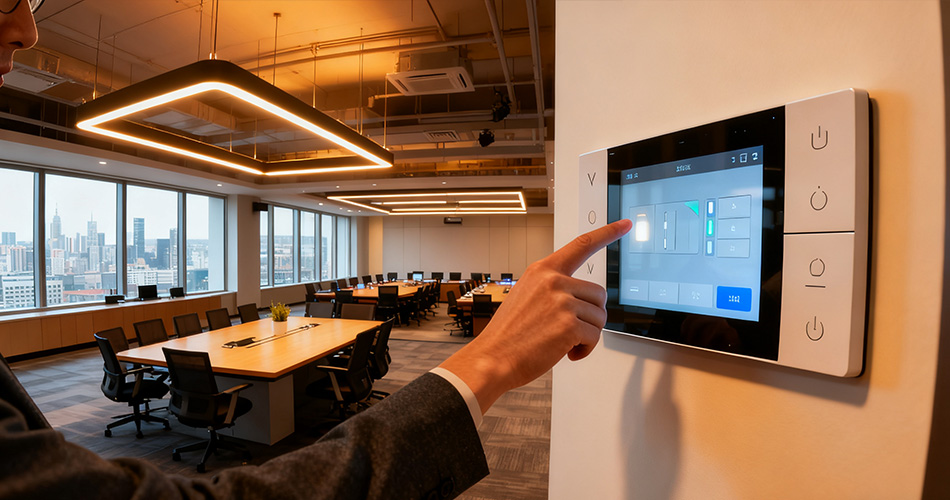
Enterprise integration succeeds when lighting systems seamlessly connect with existing enterprise ecosystems:
Enterprise IT System Integration: Supports interoperability with core business tools, including:
Building Management Systems (BMS): Synchronizes with Siemens, Honeywell, or Johnson Controls platforms to align lighting with HVAC and security operations (e.g., dimming lights in unoccupied zones while adjusting temperature) .
IoT Ecosystems: Integrates with Azure IoT, AWS IoT, or Google Cloud IoT for unified data analytics and AI-driven optimization.
Workplace Collaboration Tools: Links with Microsoft 365 or Google Workspace to trigger lighting scenes based on meeting schedules or employee presence .
Multi-Vendor Fixture Compatibility: Adheres to open standards (DALI-2, DMX512, 0-10V) to support mixed-fixture deployments across sites. Enterprise systems avoid proprietary hardware locks, enabling organizations to retain existing fixtures or expand with best-of-breed components .
Scalability Without Overhead: Designed to scale from 10,000 to 100,000+ fixtures via modular controllers and cloud-native management. This eliminates the need for infrastructure overhauls when adding new sites or expanding existing facilities .
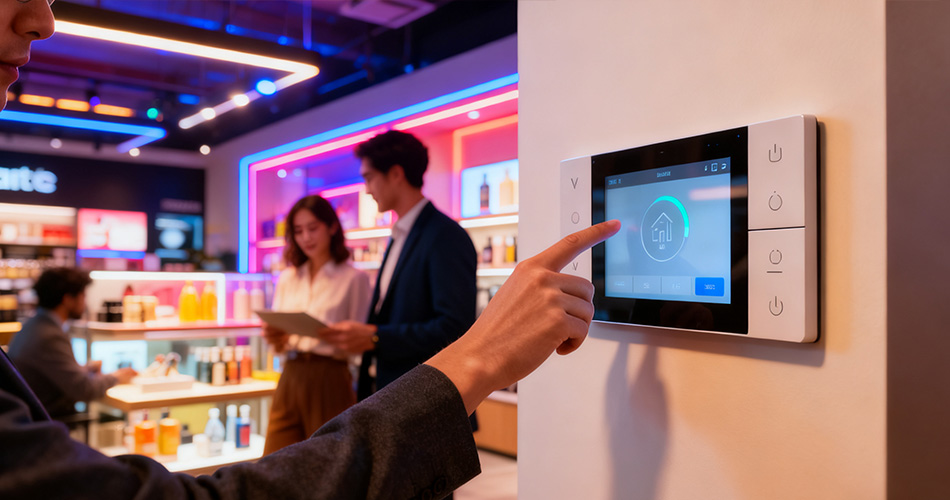
Reliable, secure communication is foundational for enterprise integration, with protocols selected for scalability and interoperability:
OPC UA (Unified Architecture): Emerges as the enterprise standard for industrial IoT integration, enabling secure, platform-agnostic data exchange between lighting systems, PLCs, and enterprise applications. Its ability to handle complex data models makes it ideal for transmitting lighting analytics (energy use, occupancy patterns) to business intelligence tools .
PoE (Power over Ethernet): Powers lighting controllers, sensors, and fixtures via Ethernet cables, simplifying deployment across large campuses. When paired with Cisco Catalyst switches or similar enterprise networking hardware, PoE enables centralized power management and reduces wiring complexity .
Dual-Network Redundancy: Combines wired Ethernet (for backbone connectivity) with wireless BLE Mesh or Zigbee 3.0 (for sensor-to-controller communication). This hybrid approach ensures connectivity in remote areas while providing failover during network disruptions .
Matter Compliance: Supports the cross-vendor smart building standard to ensure future-proof integration with emerging enterprise technologies, from smart locks to environmental monitoring systems .
Enterprise lighting integration delivers value beyond energy savings by embedding lighting into core business processes:
Centralized Policy Management: Enables enterprise administrators to set global lighting rules (e.g., "dim to 30% after 7 PM across all office sites") while allowing local facility managers to adjust for site-specific needs (e.g., extended hours for manufacturing plants). Role-based access control (RBAC) ensures granular permission management .
Data-Driven Decision Support: Integrates lighting data with enterprise analytics platforms to generate actionable insights—e.g., correlating occupancy patterns with space utilization to optimize real estate investments, or tracking energy use across sites to identify cost-saving opportunities .
Emergency Response Integration: Syncs with enterprise security systems to trigger emergency lighting scenes (e.g., illuminated evacuation routes) during alarms or crises. Integration with fire safety and access control systems ensures compliance with global safety standards .
Sustainability Reporting: Automatically feeds lighting energy data into ESG reporting tools, calculating carbon emissions reductions and simplifying compliance with global standards (ISO 14001, GRI). This eliminates manual data collection across multi-site operations .
Security by Design: Implements enterprise-grade cybersecurity measures, including AES-256 encryption, two-factor authentication, and regular firmware updates, to protect lighting systems from unauthorized access. Compliance with ISO 27001 ensures alignment with enterprise IT security policies .
Phased Deployment Strategy: Begins with pilot integration at a single site to test interoperability with existing systems, then scales gradually to avoid disruption. Prioritizes high-impact integrations (e.g., BMS sync for energy savings) before expanding to secondary use cases (e.g., workplace collaboration tools) .
Vendor Neutrality: Selects solutions based on open standards rather than proprietary ecosystems, ensuring flexibility to switch vendors or add new technologies without reworking integration frameworks .
Enterprise level lighting control systems integration transforms lighting from a standalone utility into a strategic business asset. By leveraging distributed-centralized architecture, open communication protocols, and cross-platform compatibility, organizations can unify operations across sites, reduce costs, and enhance sustainability. The key to success lies in prioritizing enterprise-specific needs—scalability, governance, and integration with core business systems—while adhering to open standards that ensure future-proofing. For large-scale organizations, this integration is not just a technical upgrade but a foundational step toward building intelligent, efficient, and resilient workplaces.


)
)
)
)

+86 15899791249

+86 755 2955 3313


Address: Huafeng No.1 Science and Technology Park, Sanwei, Bao'an District, Shenzhen, Guangdong, China.
