

Time:2026-03-25
In 2026, the global shift toward smart city infrastructure and sustainable industrial management has placed a massive spotlight on advanced sensing technologies. For facility managers overseeing expansive outdoor areas—such as logistics hubs, shipping terminals, and corporate campuses—the transition to high-sensitivity microwave sensors for outdoor lighting IP65 is no longer a luxury; it is a mechanical necessity for operational efficiency and security.
This guide explores the technical superiority of microwave detection, the critical importance of ingress protection, and how modern wireless protocols like Bluetooth Mesh are revolutionizing the way we control outdoor motion sensor lights.
When selecting an outdoor motion sensor light for commercial or industrial applications, understanding the fundamental difference between Passive Infrared (PIR) and Microwave technology is critical. While PIR is a cost-effective choice for indoor residential hallways, the unpredictable variables of industrial outdoor environments demand the "active" and robust detection capabilities that only high-sensitivity microwave sensors can provide.
The primary advantage of microwave technology lies in its method of detection. Unlike PIR, which acts as a "passive" receiver requiring a clear, direct line of sight to "see" moving heat signatures, microwave sensors are "active" devices. They emit low-power electromagnetic pulses that bounce off moving objects and return to the sensor.
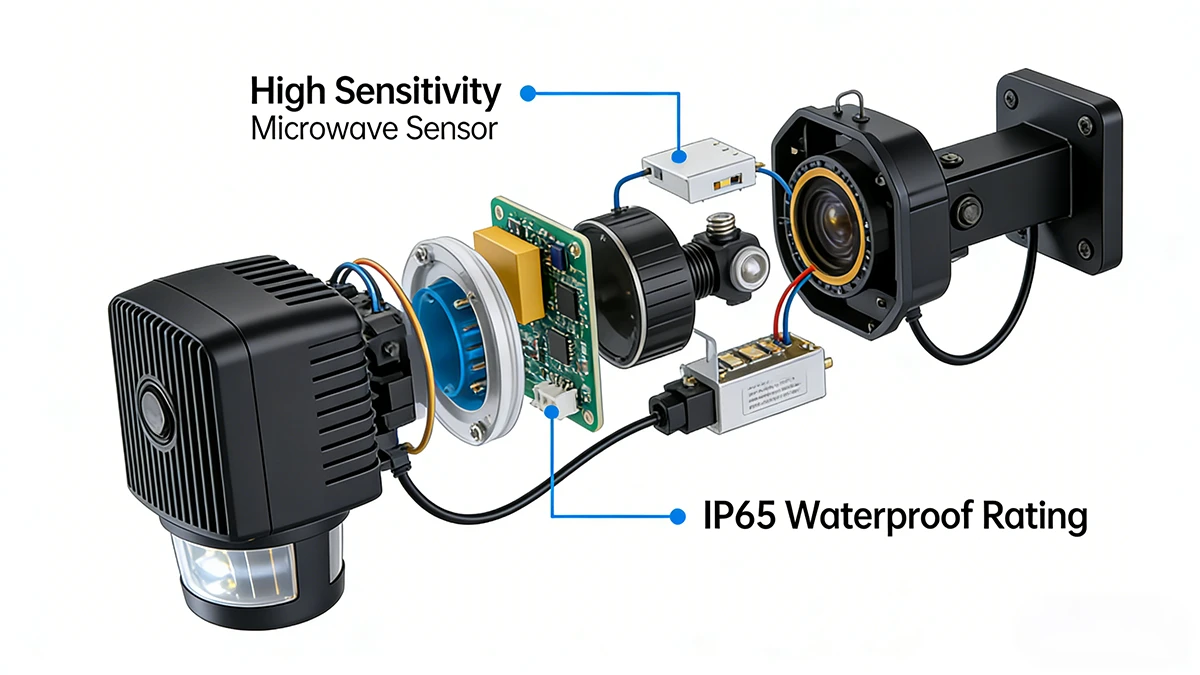
Crucially, these microwave waves can penetrate non-metallic materials such as high-impact plastic, glass, and even thin masonry or wood. This allows the sensor to be completely hidden inside a rugged, weatherproof lighting sensor housing or embedded deep within the light fixture itself. This "invisible" installation protects the delicate sensor electronics from UV degradation, corrosive salt air, and physical vandalism, all while maintaining a comprehensive, 360-degree detection radius that leaves no blind spots in a parking lot or loading dock.
Outdoor settings are notorious for environmental triggers—wind-blown debris, heavy rain, and rapid temperature fluctuations—that frequently cause "false positives" in PIR sensors. Because high-sensitivity microwave sensors detect physical mass and velocity rather than heat, they remain exceptionally stable in volatile climates. They are not blinded by the "heat shimmer" of a hot asphalt parking lot or confused by a sudden cold snap. This reliability makes them the best outdoor motion sensor lights for regions with extreme weather, ensuring that the motion sensor outdoor light activates only when actual physical movement—such as a delivery vehicle or a security patrol—is detected, thereby maximizing energy savings and reducing light pollution.
One of the most daunting and costly challenges in modern facility management is the technical upgrade of legacy infrastructure. For property owners with aging HID or basic LED installations, the question is always the same: What are the best wireless outdoor lighting sensors for retrofitting existing parking lot fixtures without rewiring? In the past, adding "intelligence" to a parking lot meant a massive construction project. However, in 2026, the industry-standard answer lies in NLC-certified outdoor motion sensors equipped with high-performance Bluetooth Mesh technology.
Traditionally, adding sensors to a 100-pole parking lot required more than just new heads; it required digging deep trenches through asphalt to lay dedicated low-voltage signal wires (such as DALI or 0-10V lines) between every single pole. This process is prohibitively expensive, visually disruptive, and can take weeks to complete. By choosing a motion sensor outdoor light system that utilizes a Bluetooth Mesh protocol, each fixture is transformed into a smart wireless node that talks to its neighbors.
Zero Signal Wiring: Because these sensors operate on a decentralized wireless frequency, they only require standard line-voltage power. The communication happens "over the air," completely eliminating the need for signal cabling.
Self-Healing Network Architecture: Unlike older "hub-and-spoke" wireless systems that fail if the central controller goes down, a Bluetooth Mesh network is self-healing. If one outdoor motion sensor light node experiences a disruption, the data packets automatically reroute through the next closest node, ensuring 100% uptime for the entire lot.
Granular Digital Control: Once installed, managers can use a smartphone app to create "zones." This allows for sophisticated "follow-me" lighting patterns—where a single sensor trigger at the entrance causes the entire row of outdoor motion sensor lights to brighten in anticipation of a vehicle’s path, providing a premium security experience while maximizing energy savings.
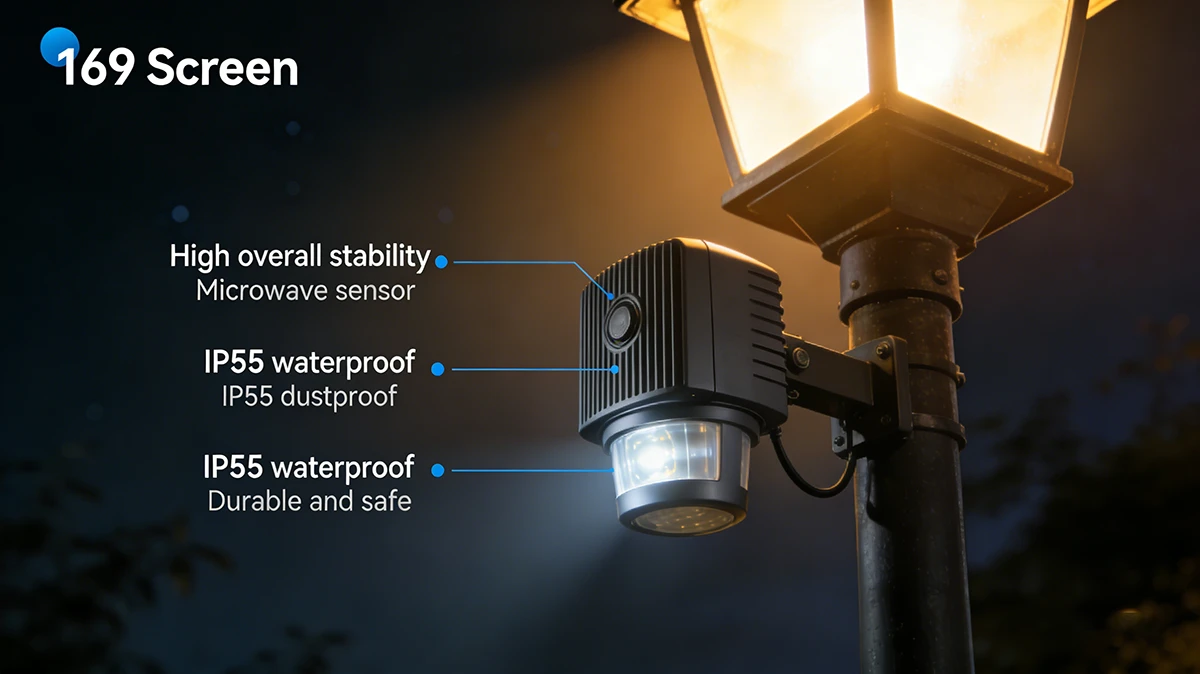
In the world of industrial facility management, an outdoor motion sensor light is only as reliable as its protective seal. When hardware is mounted 20 feet in the air on a parking lot pole or a loading dock, it is constantly bombarded by the elements—from fine particulate dust and salt spray to torrential downpours. In these environments, the weatherproof lighting sensor rating is the single most important factor in determining the return on investment (ROI) and the overall lifespan of the system. Without a high-grade Ingress Protection (IP) rating, even the most advanced high-sensitivity microwave sensors will eventually succumb to internal moisture, causing short circuits and expensive maintenance calls.
To ensure long-term stability for motion sensor lights outdoor, procurement officers must look for two specific standards:
IP65 Protection: This is the baseline "gold standard" for professional-grade outdoor motion sensor lights. An IP65 rating guarantees that the housing is completely "dust-tight," preventing microscopic debris from interfering with the internal circuitry. Furthermore, it ensures the unit is protected against low-pressure water jets from any angle, making it perfectly suited for standard rainy climates.
IP66 High-Pressure Resistance: For facilities located in coastal environments subject to heavy seas or industrial sites like food processing docks that undergo high-pressure chemical washdowns, IP66 is mandatory. This rating provides a superior seal against powerful, high-pressure water jets, ensuring that the weatherproof lighting sensor remains operational even in "hurricane-force" weather conditions.
By utilizing high-sensitivity microwave sensors housed in these ruggedized IP65/IP66 enclosures, facility managers can effectively eliminate the risk of internal corrosion—which remains the leading cause of premature failure in solar lights outdoor motion sensor setups. Choosing the correct IP rating ensures that your motion sensor lights outdoor continue to provide security and energy savings for a decade, regardless of the local climate.
In expansive outdoor industrial environments, localized wildlife and nocturnal insects are a constant source of operational frustration. Traditional Passive Infrared (PIR) sensors are notoriously sensitive to minor thermal changes, often triggering full-power illumination every time a moth flutters past the lens or a stray cat wanders across a loading dock. These frequent "false positives" lead to significant energy waste, unnecessary wear on LED drivers, and increased light pollution that disrupts the surrounding ecosystem.
To solve this, the modern anti-pest lighting sensor utilizes advanced microwave Doppler logic to effectively filter out small-mass movements. Unlike legacy systems, these high-sensitivity microwave sensors can be digitally programmed with specific detection thresholds. By adjusting the "signal strength" requirements, the system can be calibrated to ignore objects under a certain physical size—such as birds, rodents, or wind-blown debris—while remaining hyper-responsive to larger masses like a human pedestrian or a moving forklift.
This intelligent filtering ensures that your outdoor motion sensor lights stay dormant when they aren't truly needed, preserving the longevity of the lighting hardware and supporting the global "dark sky" initiatives aimed at reducing urban light spill. For facility managers, an anti-pest lighting sensor means fewer maintenance complaints and a more professional, "smart" perimeter that only responds to genuine security or operational events. By deploying these precision controls, businesses can achieve a 15–20% higher energy savings margin compared to standard, non-adjustable motion sensor lights outdoor.
For large-scale commercial and industrial projects, selecting NLC-certified outdoor motion sensors is no longer just a technical preference—it is a cornerstone of sophisticated financial planning. The DesignLights Consortium (DLC) Networked Lighting Controls (NLC) certification serves as a global benchmark, ensuring that each sensor meets rigorous standards for energy reporting accuracy, robust cybersecurity, and seamless interoperability across different hardware platforms. Without this certification, a facility risks investing in a "closed" system that lacks the transparency and security required for modern enterprise operations.
When evaluating the return on investment (ROI) for an outdoor motion sensor light deployment, NLC certification provides three distinct financial and operational advantages:
Maximum Utility Rebates: In North America and Europe, energy providers offer aggressive financial incentives to businesses that reduce their carbon footprint. Most high-tier "Prescriptive" and "Custom" rebate programs strictly require NLC-certified hardware. By meeting these standards, facility managers can often offset 30% to 70% of their total project hardware costs, dramatically shortening the payback period.
Actionable Data Analytics: Beyond simple illumination, these sensors function as high-fidelity data collectors. They allow managers to monitor granular occupancy patterns within parking lots and loading bays. By analyzing this data, a company can optimize security patrol routes to focus on high-traffic zones and adjust maintenance schedules based on actual fixture "burn time" rather than estimated hours, leading to significant long-term labor savings.
Future-Proofing through Software Agility: An NLC-certified system is designed for longevity. Because these sensors support Over-the-Air (OTA) updates, your motion sensor lights outdoor can be upgraded with new firmware as communication protocols or security standards evolve. This ensures that your infrastructure remains at the cutting edge for a decade or more, preventing the costly "rip-and-replace" cycles common with non-certified, standalone sensors.
By choosing LumiEasy NLC-certified solutions, wholesalers and contractors can provide their clients with a high-performance outdoor sensor lights network that is as much a financial asset as it is a lighting utility.
For remote industrial areas, expansive perimeter fences, or rural storage yards where grid power is unavailable, a solar motion sensor light outdoor is the most cost-effective and environmentally sustainable solution. In these "off-grid" scenarios, the cost of trenching and laying hundreds of meters of electrical conduit can often exceed the cost of the lighting fixtures themselves. However, it is vital to recognize that true industrial-grade solar lighting requires a sophisticated power management ecosystem—it is far more than just a basic photovoltaic panel paired with a standard LED bulb.
To ensure 365-day reliability in a commercial setting, the best outdoor solar motion sensor light systems utilize a triad of high-performance components designed to maximize energy harvest and storage:
High-Efficiency Monocrystalline Panels: Unlike cheaper polycrystalline alternatives, monocrystalline silicon panels offer superior conversion rates. This ensures that the solar lights outdoor motion sensor can still reach a functional charge even during shorter winter days or under persistent overcast skies, providing consistent security regardless of the season.
Intelligent Microwave Motion Detection: Battery preservation is the most critical factor in solar reliability. By utilizing "active" microwave sensors rather than passive infrared, the system can remain in a low-power "dim mode" (typically 10-20% brightness) during inactive periods. The moment physical movement is detected within a 360-degree radius, the motion sensor outdoor light instantly ramps up to 100% output, squeezing
maximum utility out of every stored milliamp.
Lithium-Ion Phosphate (LiFePO4) Batteries: The "engine" of the system is the battery. Industrial-grade units utilize LiFePO4 technology, which supports over 2,000 to 3,000 charge cycles—three to five times the lifespan of standard lithium batteries. More importantly, these cells are thermally stable, ensuring the solar motion sensor light outdoor continues to operate safely in extreme desert heat or freezing northern winters without the risk of capacity loss or thermal runaway.
By combining these three elements, LumiEasy provides a "set-and-forget" solar solution that turns isolated dark zones into well-lit, secure assets with zero ongoing utility costs.
For enterprise-level infrastructure, the return on investment (ROI) for NLC-certified outdoor motion sensors is driven by a combination of immediate capital savings and long-term operational reductions. LumiEasy’s NLC-certified solutions are engineered to meet the strict data-logging and cybersecurity standards required by the DesignLights Consortium, which is the primary gatekeeper for high-tier utility rebate eligibility in North America and Europe. By securing these rebates, facility managers can often recover up to 50% of their hardware costs before the first light is even switched on.
Operationally, the ROI is accelerated through precision energy management. By automating granular dimming schedules and utilizing high-sensitivity microwave sensors to slash unnecessary "burn time," these systems typically achieve a full break-even point within just 12 to 18 months. Beyond energy, the most significant "hidden" ROI factor is the integration of Bluetooth Mesh technology. This wireless protocol allows for the seamless upgrading of existing parking lot fixtures without rewiring, completely eliminating the massive labor and material costs associated with trenching new signal cables. By transforming every light pole into a smart, networked node via the cloud, LumiEasy ensures that your outdoor motion sensor lights function as a high-value, future-proof asset rather than a recurring utility expense.
The best industrial solar motion sensor light outdoor is one that features an IP65/IP66 rating and uses microwave sensors rather than PIR. LumiEasy recommends our high-output series which features a 360-degree detection radius and intelligent battery management that ensures the light stays active even after three days of no sunlight.
For most weatherproof lighting sensors, a manual reset involves turning the power off at the circuit breaker for 30 seconds and then back on. However, if you are using LumiEasy’s Bluetooth Mesh system, you can reset the entire network or individual outdoor motion sensor lights directly through our smartphone app without ever needing a ladder.
The "best" system is one that is scalable and wireless. A Bluetooth Mesh network of high-sensitivity microwave sensors is currently the industry gold standard for 2026. It allows for seamless integration of outdoor sensor lights, solar lights outdoor motion sensor, and commercial floodlights into a single, easy-to-manage dashboard.


)
)
)
)

+86 15899791249

+86 755 2955 3313


Address: Huafeng No.1 Science and Technology Park, Sanwei, Bao'an District, Shenzhen, Guangdong, China.
