

What is Industrial smart lighting?
Industrial smart lighting is an integrated approach that combines:
Industrial LED luminaires (high-bay, linear, area/yard)
Sensors (occupancy/motion, daylight)
Control logic (dimming, zoning, scenes, schedules)
Central software for configuration, monitoring, and optimization
Instead of treating lighting as fixed wiring groups, smart systems treat fixtures as controllable nodes. That lets facility teams manage lights individually or in groups, create scenes by task, adjust intensity automatically, and connect lighting operations to broader building workflows when required.
Why industrial warehouse smart lighting is a high-ROI upgrade
Warehouses and factories have predictable patterns that create predictable waste—and predictable savings.
1) Intermittent occupancy in large zones
Storage zones, aisles, and staging areas are often empty for long periods. Sensors ensure lights activate only when movement is detected, reducing unnecessary runtime and energy spend.
2) Daylight variability (skylights, loading doors, perimeter windows)
Daylight harvesting uses light sensors to reduce artificial lighting when natural daylight is available—maintaining required illumination while cutting electricity consumption.
3) Shift-based operations and safety requirements
Automated schedules keep facilities properly lit during shifts while preventing overuse after hours—reducing manual adjustments and helping consistency across teams.
4) Maintenance cost and downtime pressure
Smart systems can speed up fault detection and troubleshooting by providing device status and alerts, which reduces “walk-and-check” effort and supports faster repairs.
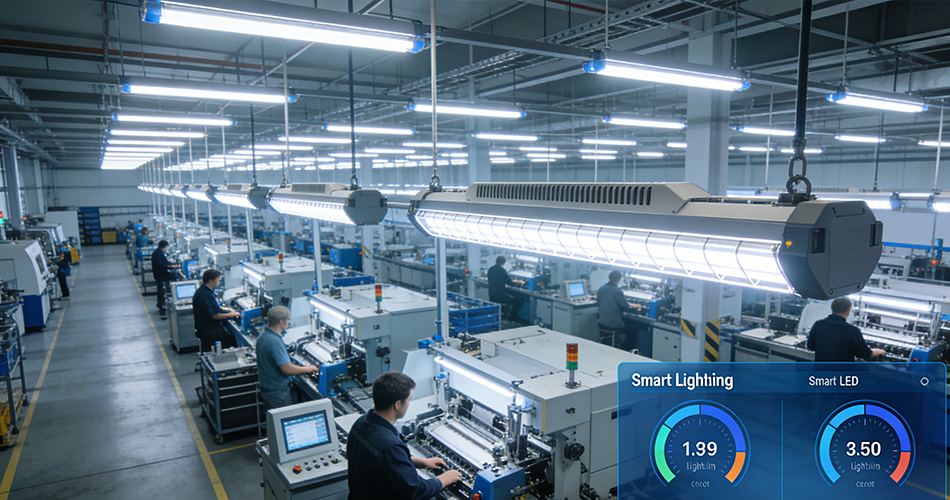
What industrial smart lighting control systems should include
Not every “smart” product is industrial-ready. For industrial smart lighting control systems, require these capabilities:
A) Zoning, grouping, and scenes (task-based lighting)
Industrial facilities are not uniform. Picking aisles, docks, traffic lanes, inspection areas, and workcells each need different light levels and behavior. A capable system should support:
Luminaire-level or zone-level control
Quick regrouping when layouts change
Scene presets (production, inspection, cleaning, security)
B) Sensor-driven automation (occupancy + daylight)
Smart systems should use motion/daylight sensors to adjust output automatically as conditions change. This is where most measurable savings come from in logistics environments.
C) Scheduling (shift logic + safety overrides)
Schedules should support:
Shift start/stop ramping
Weekly patterns and holiday exceptions
After-hours “dim-to-low” modes with occupancy boost
Supervisor overrides for inventory counts and incident response
D) Monitoring, alerts, and reporting
Long-term savings depend on visibility. The system should provide:
Online/offline device status
Fault alerts and diagnostics
Runtime trends by zone
Reporting that helps track optimization and justify ROI
E) Integration options (BMS-ready where needed)
If your facility standardizes controls across multiple buildings or uses a central building management approach, integration options become valuable for unified operations and reporting.
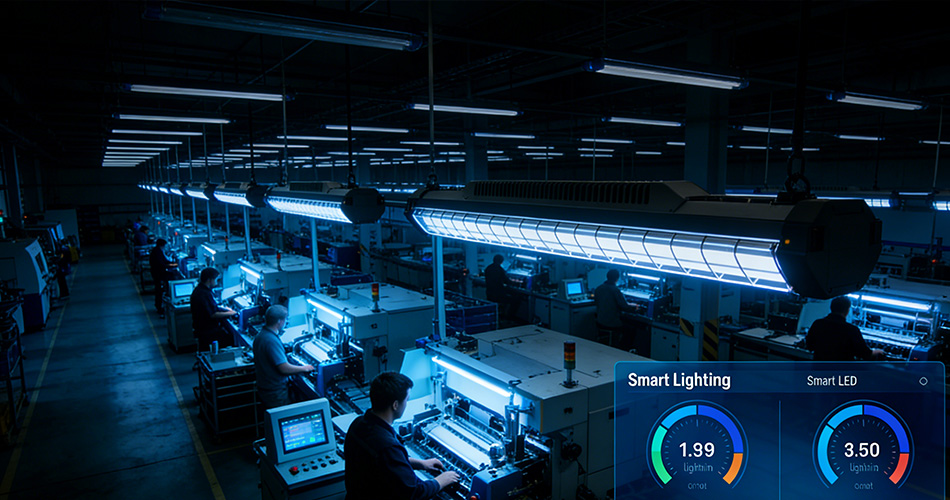
Designing for harsh environments: IP65 industrial smart lighting
Industrial sites often have dust, humidity, washdown areas, cold rooms, and exposure to splashes or debris. In these environments, IP65 industrial smart lighting is a practical specification—not a luxury.
Best practices for IP65 industrial smart lighting
Use IP65 where dust and water jets are expected (washdown, loading areas, plant rooms)
Ensure sensors, connectors, and cable entry points maintain protection integrity
Choose mounting solutions that support fast installation and easier maintenance access
Confirm thermal management is suitable for the ambient temperature range
Procurement note: IP rating should cover the complete system performance—fixture body, lens, seals, and any integrated control components that could become failure points.
Industrial smart lighting hazardous areas: what changes in Zone-rated spaces
Some industrial facilities include classified hazardous locations (chemical processing, oil & gas, petrochemical, certain manufacturing processes). Here, “smart” must never compromise compliance.
For industrial smart lighting hazardous areas, the approach changes:
Start with classification and compliance
Identify the site’s hazardous area classification and certification requirements (region-specific: e.g., ATEX/IECEx)
Select certified luminaires appropriate to the zone
Use certified explosion-protected products designed for the correct zone and application (high-bay, linear, emergency)
Design controls with compliance in mind
Confirm compatibility of control interfaces and installation methods with hazardous-location rules
Use approved components and practices for wiring, enclosures, and maintenance
Important: In hazardous areas, safety and certification always come first. Smart control strategies may still be possible (to reduce runtime and improve visibility) but must be implemented within the compliance framework.
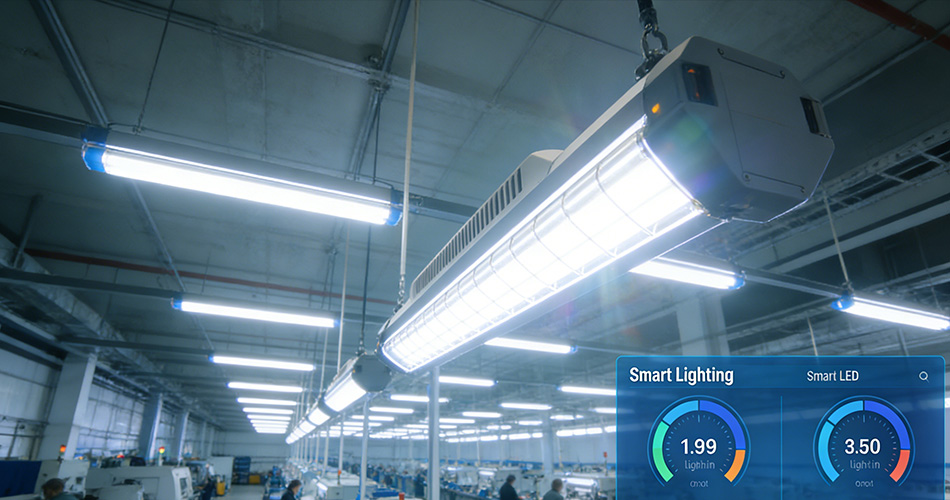
Industrial smart lighting maintenance: reduce truck rolls, improve uptime
Maintenance is where smart lighting can outperform LED-only retrofits.
A strong industrial smart lighting maintenance workflow should include:
Fault detection & alerts: identify fixture failures or offline devices early
Zone-based diagnostics: know exactly where issues occur (aisle, dock, bay)
Planned maintenance: coordinate lift access efficiently and avoid emergency callouts
Runtime management: use dimming and automation to reduce stress and extend component life
Maintenance KPIs you can track
Mean time to detect (MTTD) lighting failures
Mean time to repair (MTTR) by zone
After-hours runtime per building
Percentage of lighting time at full output vs dimmed modes
Industrial warehouse smart lighting: a zone-by-zone control playbook
Use this practical approach for most warehouse and factory layouts:
1) High-rack aisles
Occupancy sensors per aisle or aisle segment
Default to low safe level; boost to task level on motion
Add daylight harvesting where skylights are present
2) Loading docks and staging
Schedules aligned to peak operations
Occupancy triggers for intermittent activity
Scene presets for safety checks and inventory counts
3) Production workcells
Stable task lighting levels (avoid nuisance dimming)
Local overrides for inspections
Grouping/scenes by activity (setup, production, cleaning)
4) Storage zones (low traffic)
Strong occupancy-driven control to prevent “always-on” behavior
5) Yards and perimeter routes
Time-of-night schedules + motion-boost zones
Higher output for vehicle paths, lower output for unused perimeter areas
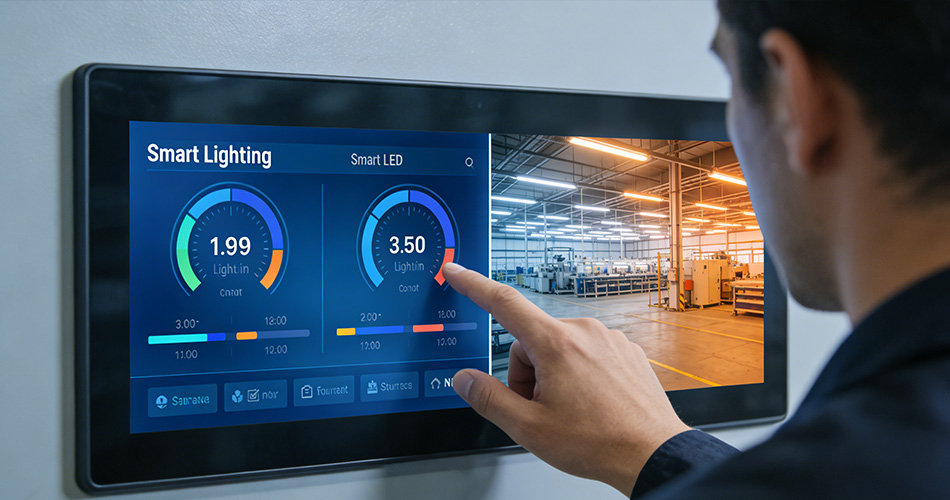
Deployment roadmap: implement without disrupting operations
Step 1: Audit and design intent
Define control intent by zone:
Target illumination and safety requirements
Occupancy logic (timeouts, dim levels)
Daylight zones
Schedules and overrides
Step 2: Start with high-return zones
Begin with:
Aisles and low-traffic areas (big runtime reduction)
Perimeter daylight zones (daylight harvesting impact)
After-hours zones (scheduling impact)
Step 3: Commission, test, and tune
Validate sensor placement and timeout settings
Ensure daylight harvesting is smooth (no “pumping”)
Confirm schedules match real shifts, including overtime patterns
Step 4: Operate with metrics
Use monitoring and periodic reviews to prevent performance drift and maintain savings year after year.
ROI language industrial buyers trust
When presenting Industrial smart lighting to factory and warehouse decision-makers, focus on measurable levers:
Reduced runtime through occupancy + schedules
Reduced over-lighting via daylight harvesting
Lower maintenance burden through alerts and faster fault isolation
Improved safety visibility and operational consistency
Buyer tip: Avoid generic “percentage savings” claims. Strong proposals show zone-based logic (aisles vs docks vs workcells) and how each strategy contributes to measurable results.
FAQ
1) What is Industrial smart lighting?
Industrial smart lighting uses sensors, controls, and software to automate and optimize lighting in factories and warehouses, enabling zoning, dimming, scheduling, and monitoring for better safety and lower operating costs.
2) How is industrial warehouse smart lighting different from standard LED upgrades?
Industrial warehouse smart lighting adds occupancy/daylight sensors, scheduling, and centralized control so lighting output adapts to real usage. Unlike LED-only retrofits, smart systems reduce unnecessary runtime and support ongoing optimization.
3) When should I specify IP65 industrial smart lighting?
Choose IP65 industrial smart lighting in dusty or wet environments (washdown zones, loading areas, plant rooms, humid warehouses) where fixtures and controls need high ingress protection for reliability and safety.
4) Can industrial smart lighting be used in hazardous areas?
Yes, but industrial smart lighting hazardous areas require certified luminaires and compliant system design based on the site’s zone classification and regional certification requirements.
5) How does industrial smart lighting maintenance improve over time?
Industrial smart lighting maintenance improves through centralized status monitoring, fault alerts, and faster detection of luminaire issues—reducing “walk-and-check” labor and enabling planned maintenance with fewer disruptions.
Call to Action (for factory and warehouse buyers)
If you’re planning a warehouse retrofit or factory lighting upgrade, a well-designed Industrial smart lighting system can reduce wasted runtime, improve safety visibility, and simplify industrial smart lighting maintenance—especially when you specify durable IP65 industrial smart lighting for harsh environments and plan compliant options for industrial smart lighting hazardous areas where required.
For an accurate proposal, prepare:
Facility type (factory / warehouse / logistics center) and zone layout
Fixture types and mounting heights (high-bay, linear, yard lighting)
Environmental requirements (dust, humidity, washdown → IP rating needs)
Hazardous area details (if any): zone classification and certification requirements
Operating schedule (shifts, overtime patterns)
Key goals (energy reduction, safety, maintenance reduction, reporting)
Related news
How Smart Lighting Solutions Reduce Energy Costs | LumiEasy
Commercial Lighting Cost Analysis Comparison Report: A Guide to Smart Investments for Businesses
Commercial Smart Lighting Energy Savings: Proven Strategies to Cut Costs & Boost Sustainability
Industrial Warehouse Smart Lighting: Comprehensive Solutions & Best Practices


)
)
)
)


