

Time:2025-11-21
Industrial smart lighting has emerged as a cornerstone of Industry 4.0 transformation, revolutionizing how factories, warehouses, and industrial facilities manage illumination, energy use, and operational efficiency. Unlike traditional lighting systems, industrial smart lighting integrates IoT connectivity, advanced sensors, rugged design (e.g., IP65 dustproof/waterproof ratings), and AI-driven controls to deliver far more than just light—it’s a data-rich, energy-efficient solution that enhances safety, reduces costs, and supports seamless integration with industrial ecosystems. This guide, optimized for Google search intent, covers everything from core technology to real-world applications, helping facility managers and decision-makers unlock the full potential of industrial smart lighting.
Industrial smart lighting refers to industrial-grade lighting systems equipped with:
IoT Connectivity: 5G, LoRaWAN, or Wi-Fi integration for remote monitoring, control, and data transmission.
Advanced Sensors: Motion/radar sensors, ambient light detectors, temperature/humidity sensors, and occupancy trackers.
Smart Controls: AI-driven dimming, scheduling, daylight harvesting, and scene customization (sync with production shifts or tasks).
Rugged Design: IP65+ ingress protection, IK10+ impact resistance, corrosion-resistant materials (304/316L stainless steel), and extreme temperature tolerance (-40℃ to 90℃).
Energy-Efficient LEDs: High-lumen output (130+ lm/W) with 50,000-100,000 hour lifespans—60-80% more efficient than metal halide or fluorescent fixtures.
Unlike commercial smart lighting, industrial-grade systems are engineered to withstand harsh conditions: dust, vibration, moisture, chemical exposure, and 24/7 operation. Key variants include IP65 industrial smart lighting (the most versatile for general industrial use), IP69K washdown-rated fixtures (for food processing), and ATEX/IECEx-certified models (for hazardous zones).
Investing in industrial smart lighting delivers measurable value across operational, financial, and safety metrics:
Dynamic Efficiency: Sensors trigger lights to dim (20-30% standby) in idle zones or turn off completely when no activity is detected—reducing energy use by 30-50%.
LED Longevity: LEDs last 5-7x longer than traditional bulbs, cutting replacement costs by 50% and reducing maintenance labor.
Daylight Harvesting: Ambient light sensors adjust artificial lighting based on natural light levels, saving an additional 10-15% on energy bills.
Data-Driven Optimization: Cloud platforms analyze energy use patterns to identify further savings (e.g., adjusting schedules for off-peak hours).
Consistent Illumination: Maintains 1000-2000 lux (industry standard for industrial tasks) to reduce eye fatigue and human error—OSHA data shows proper lighting cuts workplace accidents by 35%.
Emergency Response: Auto-brightens escape routes during alarms; battery backup (≥180 minutes) ensures visibility during power outages.
Hazard Detection: Integrated sensors (e.g., gas, temperature) can trigger alerts for overheating equipment or toxic fumes, adding an extra layer of safety.
Anti-Glare Optics: UGR <16 ratings reduce glare from machinery or reflective surfaces, preventing temporary blindness and collisions.
Task-Tailored Lighting: Tunable color temperature (2700K-6500K) and beam angles adapt to tasks—5000K cool white for precision engineering, 3500K warm white for quality inspection.
Industrial Ecosystem Sync: Integrates with PLCs, SCADA, MES, and WMS systems—illuminates specific workstations during production batches, dims during maintenance, or syncs with AGV routes.
Remote Management: Cloud dashboards (e.g., Philips Interact IoT, Azure IoT Hub) let managers control lighting from anywhere, reducing on-site visits by 60%.
Predictive Maintenance Alerts: Embedded sensors monitor fixture health (temperature, power draw, seal integrity) and alert teams to issues before failures occur—cutting unplanned downtime by 40%.
Rugged Construction: IP65 dustproof/waterproof seals, anti-corrosion coatings, and vibration-resistant mounting ensure performance in harsh environments (mining, steel mills, coastal facilities).
Low Maintenance: Sealed components and long-lasting LEDs reduce maintenance frequency—industrial smart lighting costs \(50-100 per fixture annually to maintain, vs. \)200-300 for traditional lighting.
Long ROI: Typical payback period of 12-24 months, with lifetime savings of \(1,500-\)3,000 per fixture (energy + maintenance + replacement costs).
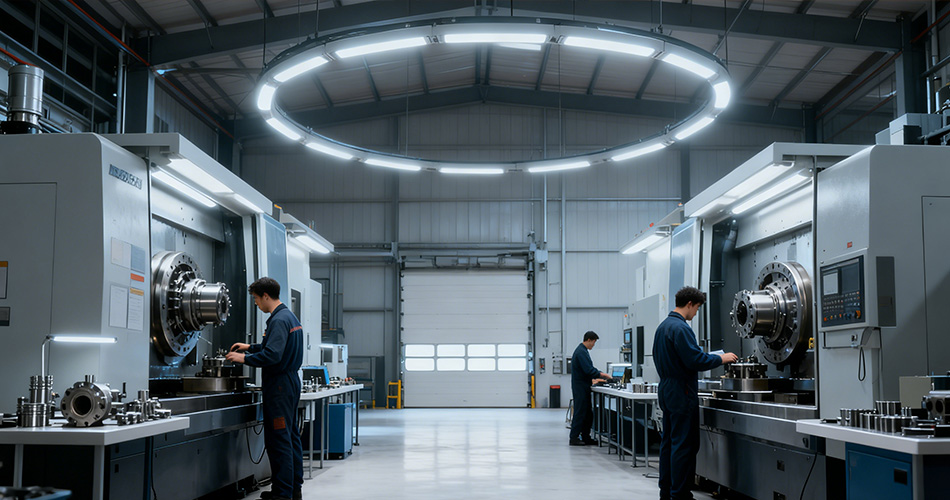
Industrial smart lighting is versatile enough to serve diverse sectors, with tailored solutions for each environment:
Challenges: High vibration, dust, variable task requirements, 24/7 production.
Solutions: IP65 industrial smart lighting (80-200W) with anti-vibration brackets, radar sensors (distinguish workers from machinery), and MES integration.
Results: 72% energy savings vs. metal halide, 15% faster assembly times, compliance with IATF 16949.
Challenges: Large open spaces, AGV traffic, dust, shift-based operations.
Solutions: High-bay IP65 fixtures (150-220W, 140+ lm/W) with wide beam angles (110°), motion sensors (25m detection range), and WMS sync.
Results: 75% energy savings, 30% faster picking times, 40% fewer collisions.
Challenges: Hygiene requirements, washdowns, cold storage (-35℃), chemical exposure.
Solutions: IP69K washdown fixtures (316L stainless steel) for production zones, IP65 industrial smart lighting for dry storage, UV-C disinfection integration.
Results: FDA/FSMA compliance, 68% energy savings, 35% less cleaning time.
Challenges: Extreme cold (-40℃), frost buildup, energy inefficiency.
Solutions: Low-temperature IP65 fixtures with anti-frost optics, low-power drivers, and daylight harvesting.
Results: 65% energy savings, 80% reduction in frost-related maintenance.
Challenges: Extreme dust, high temperature (80℃), vibration, remote operation.
Solutions: Dust-tight IP65 fixtures (200-300W), air-cooled heat sinks, LoRaWAN connectivity for remote monitoring.
Results: 75% energy savings vs. halogen, 90% less downtime, compliance with MSHA standards.
Challenges: Saltwater corrosion, high winds, humidity, hazardous zones.
Solutions: Marine-grade IP66-enhanced industrial smart lighting (316L stainless steel), wind-load resistant mounting, ATEX Zone 2 certification.
Results: 68% energy savings, zero corrosion failures in 3 years, compliance with API RP 540.
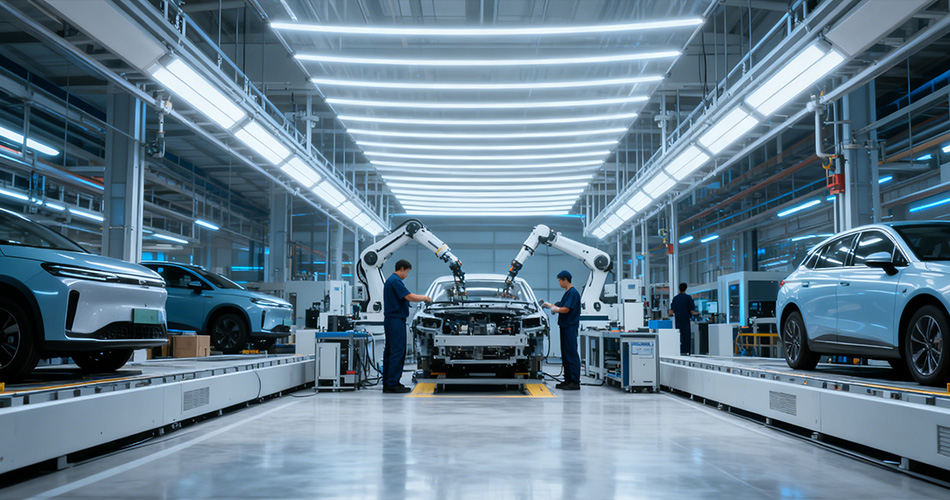
Selecting the optimal system requires aligning features with your facility’s unique needs:
Ingress Protection: IP65 for general industrial use, IP69K for washdowns, IP66 for coastal/high-humidity zones.
Temperature Range: Ensure fixtures operate within your facility’s temp extremes (-40℃ to 90℃).
Corrosion Resistance: 316L stainless steel for chemical/coastal environments, polyurethane coatings for general use.
Brightness & Beam Angle: 150-250W (high-bay, 8m+ ceilings), 80-120W (low-bay, 4-8m), wide beam angles (100°+) for open spaces.
Controls: Motion/radar sensors, daylight harvesting, scheduling, remote control (5G/LoRaWAN).
Integration: Ensure compatibility with existing systems (PLCs, MES, WMS, cloud platforms).
Energy Efficiency: ≥130 lm/W for maximum savings.
Durability: IK10+ impact resistance, vibration-dampening mounting.
Smart Functionality: Predictive maintenance alerts, scene customization, data analytics.
Regional Standards: UL 1598A (North America), IEC 60598 (Europe), GB 7000.1 (China).
Industry-Specific: FDA 21 CFR Part 117 (food), ATEX/IECEx (hazardous zones), MSHA (mining).
Energy Certifications: DLC Premium, ENERGY STAR, ErP (EU) for rebate eligibility.
The industrial smart lighting market is evolving rapidly, with these key trends shaping the future:
Predictive maintenance 2.0: AI algorithms analyze sensor data to predict failures (e.g., gasket wear, driver degradation) weeks in advance.
Autonomous adaptation: Fixtures self-adjust sensitivity, brightness, and connectivity based on real-time conditions (e.g., switch to LoRaWAN in dusty zones with poor 5G).
Sensor fusion: Fixtures act as "environmental hubs," combining motion, temperature, gas, and dust sensors to transmit holistic facility data.
Digital twin integration: 3D digital twins simulate lighting placement and performance, enabling remote adjustments and scenario testing.
Solar-assisted fixtures for outdoor/remote sites (mining camps, pipelines) reduce grid dependency by 20-25%.
Kinetic energy harvesting from machinery vibration to supplement power in high-stress zones.
Circadian rhythm alignment: Tunable color temperature syncs with shift schedules (cool white for day shifts, warm white for nights) to reduce fatigue and boost productivity.
Task-specific spectral tuning: High-R9 (≥85) for color matching (automotive paint shops), UV-C for disinfection, narrow-band lighting for semiconductor inspection.
Industrial smart lighting is more than a lighting upgrade—it’s a strategic investment in efficiency, safety, and operational excellence. By combining energy-efficient LEDs, IoT connectivity, rugged design, and AI-driven controls, it addresses the unique pain points of industrial environments while delivering measurable ROI. Whether you’re operating a manufacturing plant, warehouse, food processing facility, or mining site, industrial smart lighting adapts to your needs, integrates with your existing systems, and future-proofs your facility for Industry 4.0.
To maximize results, pair your industrial smart lighting with a proactive maintenance plan (as outlined in our industrial smart lighting maintenance guide)—regular cleaning, sensor calibration, and component checks ensure long-term performance and savings.
Ready to transform your facility with industrial smart lighting? Contact our team for a customized assessment, energy savings calculation, or quote tailored to your industry and budget.


)
)
)
)

+86 15899791249

+86 755 2955 3313


Address: Huafeng No.1 Science and Technology Park, Sanwei, Bao'an District, Shenzhen, Guangdong, China.
