

Time:2025-11-19
Industrial warehouse smart lighting systems transcend basic aisle illumination to address the unique challenges of large-scale, high-intensity operations—including high-rack storage (10m+), heavy machinery traffic, multi-functional zones, and harsh environmental conditions. Unlike standard warehouse lighting, industrial-grade solutions prioritize industrial durability, system scalability, cross-system integration, and regulatory compliance while delivering exceptional energy savings. This guide covers full-warehouse system design, zone-specific solutions, industrial-grade technology requirements, and real-world implementations.
Industrial-grade systems require a holistic approach built on four foundational pillars:
Harsh Environment Adaptation: Withstand extreme temperatures (-40℃ to 60℃), high humidity (up to 95% RH), heavy dust, and chemical exposure (for manufacturing/chemical warehouses) .
Mechanical Durability: Resist vibrations from forklifts, conveyors, and industrial machinery (IK08+ impact resistance) to avoid premature failure.
24/7 Operational Stability: Support continuous operation with MTBF (Mean Time Between Failures) ≥ 100,000 hours, critical for round-the-clock industrial facilities.
Function-Aligned Brightness: Match lighting output to industrial tasks—e.g., 300-500 lux for storage zones, 800-1000 lux for precision picking/assembly areas, 150-200 lux for auxiliary zones .
Dynamic Zone Control: Independent lighting control for functional zones (storage, orting,loading docks, maintenance bays, offices) to avoid over-illumination of inactive areas.
High-Rack Penetration: Ensure vertical illumination uniformity for racks 8-15m tall, eliminating dark spots at mid-rack heights.
Industrial IoT (IIoT) Compatibility: Integrate with warehouse management systems (WMS), manufacturing execution systems (MES), and AGV/AMR control platforms for automated lighting triggers.
Safety System Linkage: Sync with fire alarm systems (auto-switch to emergency lighting) and access control (illuminate zones when authorized personnel enter).
Data Sharing Capabilities: Transmit energy use, fixture status, and occupancy data to industrial control dashboards (e.g., SCADA) for unified operations management.
Energy Efficiency Standards: Meet industrial-specific certifications (DLC Premium, ErP Class A+, ENERGY STAR) to qualify for utility rebates and reduce operational costs.
Safety Certifications: Comply with industrial safety standards (OSHA, IEC 60598) and explosion-proofSS requirements (ATEX, IECEx) for hazardous environments (chemical, oil & gas warehouses) .
Light Pollution Control: Adhere to industrial zoning regulations with shielded fixtures that prevent light spillage to adjacent areas.

A complete industrial-grade system combines specialized hardware and software for end-to-end control:
High-Bay LED Lights: 100-200W fixtures with 130-150 lumens per watt (lm/W) output, optimized for 8-15m ceiling heights. Choose UFO or linear designs based on rack layout—UFO for open storage, linear for narrow aisles.
Explosion-Proof Fixtures: For hazardous areas (Zone 1/2 for gases, Zone 21/22 for dust), select ATEX/IECEx-certified fixtures with sealed housings and thermal protection.
Emergency Backup Fixtures: Integrate rechargeable batteries (90-minute runtime) to maintain illumination during power outages, critical for industrial safety compliance.
Low-Bay Lights: 50-100W fixtures for 4-8m height zones (offices, maintenance bays, packaging areas) with reduced glare for close-range tasks.
Multi-Function Sensors: Combine motion detection (radar/laser), ambient light sensing, and temperature/humidity monitoring for comprehensive environmental awareness.
Heavy-Duty Radar Sensors: Extended detection range (up to 30m) and vibration resistance for high-traffic industrial zones with forklifts, pallet jacks, and heavy machinery.
Zone-Aware Sensors: Networked sensors that communicate with adjacent units to create "lighting corridors" for moving equipment, eliminating dark gaps in large industrial spaces.
Fixed-Mount Environmental Sensors: For extreme conditions (e.g., foundry warehouses), separate IP67-rated sensors monitor temperature and dust levels to adjust lighting performance.
Ruggedized Controllers: Industrial-grade gateways (IP65-rated) with redundant connectivity (Ethernet, LoRaWAN, 5G) to withstand electromagnetic interference (EMI) from industrial equipment.
Edge Computing Nodes: Process sensor data locally to reduce latency, critical for real-time lighting adjustments in automated industrial environments (e.g., AS/RS systems).
Wired/Wireless Hybrid Networks: Use wired connections (CAT6A) for critical zones and wireless (LoRa, Zigbee) for flexible expansion, ensuring reliable communication across large warehouses (10,000+ sqm).
Cloud/On-Premise Software: Choose on-premise platforms for industrial facilities with strict data security requirements, or cloud-based systems for remote monitoring across multiple warehouses.
Industrial Dashboard Integration: Embed lighting controls into existing industrial management software (e.g., SAP, Oracle Supply Chain) for unified operations.
Predictive Maintenance Tools: Analyze fixture temperature, power draw, and performance data to schedule maintenance before failures occur, reducing industrial downtime.

Tailor lighting to the unique needs of each industrial zone:
Solution: Linear high-bay LED lights (150-200W) with integrated radar sensors + mid-rack auxiliary sensors. Lights dim to 20% standby, brighten to 100% when motion is detected. For double-deep racks, use dual-directional sensors to cover both rack faces.
Key Features: Vertical illumination uniformity (UGR < 19 to avoid glare), Zhaga-compliant sensor integration, and wind load resistance (for high-ceiling air circulation).
Energy Savings: 70-80% vs. traditional metal halide fixtures, with 50,000+ hour lifespan reducing replacement frequency.
Solution: Dimmable high-bay lights (100-150W) with 800-1000 lux output, paired with laser sensors for fast response (<0.3s). Integrate with WMS to automatically brighten zones when picking orders are assigned.
Key Features: Color rendering index (CRI) ≥ 80 for accurate product identification, flicker-free operation (<10% flicker) to reduce operator fatigue, and task-specific dimming profiles.
Operational Benefit: 15-20% improvement in picking accuracy and reduced eye strain for industrial workers.
Solution: Weatherproof high-bay lights (IP66-rated) with motion sensors and daylight harvesting. Lights activate when trucks enter the dock area and adjust based on natural light (e.g., brighten during night shifts, dim during daytime).
Key Features: Wide beam angle (120°+) for full dock coverage, corrosion resistance (for saltwater environments), and cold-start capability (-40℃ to +60℃).
Safety Enhancement: Eliminate dark spots in truck loading/unloading areas, reducing accident risks by 30% .
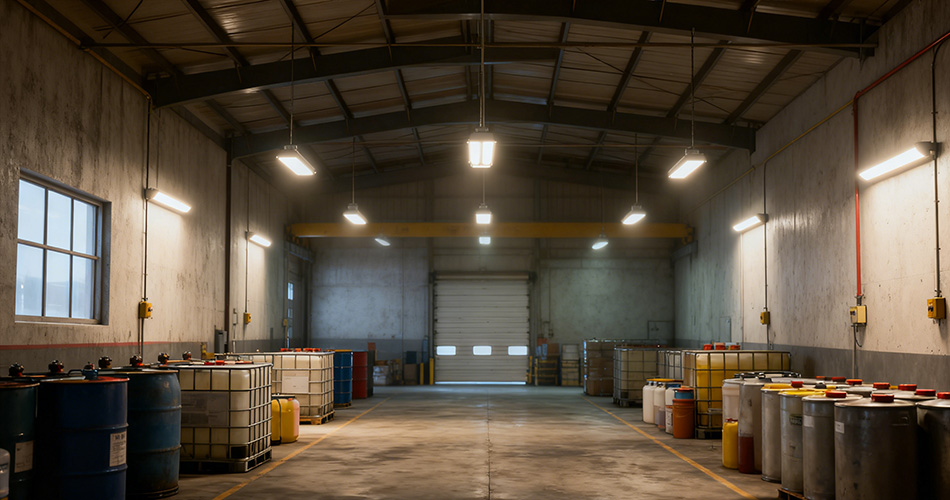
Solution: ATEX/IECEx-certified explosion-proof smart lights with intrinsic safety barriers. Use wireless (LoRa) sensors to avoid electrical wiring risks, with manual override controls for emergency situations.
Key Features: Sealed housings (IP68-rated), thermal runaway protection, and compatibility with gas/dust detection systems (auto-dim if hazardous levels are detected).
Compliance Benefit: Meets OSHA and EPA regulations for hazardous material storage facilities.
Solution: Adjustable arm LED lights (30-50W) for task lighting + overhead low-bay lights (50-100W) for general illumination. Use occupancy sensors to activate lights only when technicians are present.
Key Features: Flexible positioning for equipment repairs, high CRI (≥90) for detailed work, and shock resistance (IK10) for industrial tool impacts.
Cost Savings: 60-70% energy reduction vs. traditional incandescent task lights.
Maximize value by linking smart lighting to industrial operations:
Sync lighting zones with inventory locations: When a WMS generates a picking order for Zone B, only Zone B lights activate, reducing energy waste in unused areas.
Trigger lighting based on production schedules: Automatically brighten assembly zones during production shifts and dim to standby during maintenance breaks.
Pre-activate lighting corridors ahead of AGV movement (2-3 seconds in advance) to ensure continuous visibility, reducing AGV stop time by 5-10% .
Use AGV location data to adjust lighting brightness (e.g., full brightness for AGV navigation paths, reduced brightness for adjacent storage zones).
Integrate with fire alarm systems: When an alarm is triggered, smart lights switch to emergency mode (red/white alternating) to guide personnel to exits.
Sync with access control: Illuminate restricted industrial zones only when authorized personnel scan their credentials, enhancing security.
Connect to industrial energy management systems (EMS) to monitor lighting energy use in real-time and implement peak-load reduction strategies (e.g., dim non-critical zones during peak electricity hours).
Qualify for industrial energy rebates by meeting DLC Premium or ENERGY STAR industrial lighting standards, reducing upfront costs by 20-30% .
Real-world industrial implementations demonstrate tangible benefits:
Solution: 400+ high-bay smart LEDs (150W) with radar sensors, WMS integration, and cloud-based management. Zoned control for storage, picking, and loading docks.
Result: 78% energy savings vs. metal halide fixtures (annual savings of $45,000), 25% reduction in maintenance costs, and compliance with ISO 50001 energy management standards .
Solution: Explosion-proof smart lights (ATEX-certified) with LoRa sensors and intrinsic safety barriers. Integrated with gas detection system.
Result: 65% energy savings, zero safety incidents related to lighting, and full compliance with OSHA hazardous materials storage regulations.
Solution: Low-temperature-resistant smart high-bay lights (IP67-rated) with radar sensors (operational down to -40℃). Daylight harvesting and scheduled control for shift-based operations.
Result: 72% energy savings vs. traditional cold-storage lighting, no fixture failures due to temperature extremes, and improved visibility for forklift operators.
Follow these steps to ensure industrial-grade performance:
Document ceiling height, rack layout, and functional zones (storage, picking, loading, hazardous areas).
Evaluate environmental conditions: Temperature range, humidity, dust levels, and explosion risks (conduct hazard classification for chemical/industrial warehouses).
Review existing industrial systems (WMS, MES, AGV) to identify integration requirements.
Prioritize fixtures with IP65+ protection, IK08+ impact resistance, and MTBF ≥ 100,000 hours.
For hazardous zones, verify ATEX/IECEx certifications and intrinsic safety ratings.
Choose sensors with industrial EMI resistance and long detection ranges (15-30m) for large spaces.
Calculate required lux levels based on industrial tasks (refer to OSHA/IESNA standards: 300 lux for storage, 800 lux for picking).
Optimize fixture spacing: For 12m ceilings, space high-bay lights 5-6m apart for uniform coverage.
Plan sensor placement to avoid blind spots from industrial equipment or tall racks (use mid-rack sensors for high-rack zones).
Work with IT/OT teams to integrate lighting with existing industrial systems (WMS, MES, SCADA).
Test connectivity in industrial environments (ensure sensors/ controllers resist EMI from machinery).
Set up emergency lighting protocols (e.g., fire alarm linkage, backup power activation).
Use the management platform to monitor fixture temperature, power draw, and performance.
Schedule maintenance during industrial downtime (e.g., weekend shifts) to avoid operational disruptions.
Stock spare parts for critical zones (e.g., loading docks, hazardous areas) to minimize downtime.
Operational Efficiency: WMS/AGV integration reduces task time by 5-15%, while predictive maintenance minimizes industrial downtime.
Safety & Compliance: Meets OSHA, ATEX, and ISO standards, reducing accident risks by 30-40% and avoiding regulatory fines.
Cost Reduction: 65-80% energy savings, 50% lower maintenance costs (long LED lifespans), and eligibility for industrial energy rebates.
Scalability: Industrial-grade controllers support up to 10,000 fixtures, enabling expansion to additional warehouse bays or industrial facilities.
Sustainability: Reduced carbon footprint (up to 80% less CO2 emissions vs. traditional lighting) supports industrial sustainability goals (e.g., net-zero targets).
Industrial warehouse smart lighting is a strategic investment that combines energy efficiency with industrial-specific reliability, safety, and integration. By selecting ruggedized components, designing zone-targeted solutions, and integrating with WMS/MES/AGV systems, industrial facilities achieve significant cost savings while enhancing operational efficiency and compliance. Unlike standard warehouse lighting, industrial-grade solutions are built to withstand harsh conditions, support 24/7 operations, and scale with growing industrial needs—making them essential for modern manufacturing, logistics, and chemical warehouses.
Related news
How Smart Lighting Solutions Reduce Energy Costs | LumiEasy
Ceiling Mounted Sensor for Smart Industrial Lighting Control | LumiEasy
Commercial Lighting Cost Analysis Comparison Report: A Guide to Smart Investments for Businesses
Linear Smart Sensor Solutions for Smart Infrastructure | LumiEasy
Linear Microwave Smart Sensor Type B


)
)
)
)

+86 15899791249

+86 755 2955 3313


Address: Huafeng No.1 Science and Technology Park, Sanwei, Bao'an District, Shenzhen, Guangdong, China.
