

Time:2026-05-15
In the rugged landscape of industrial facilities—ranging from high-moisture food processing plants to dust-filled warehouses—the reliability of a smart lighting system is only as strong as its weakest component.
While many facilities invest heavily in high-output LED fixtures, they often overlook the "eyes" of the system: the sensors.
Specifically, understanding the linear smart sensor ip rating is essential for any energy manager who wants to avoid frequent maintenance cycles and hardware failure.
As we advance through the future of automated commercial spaces, sensors have evolved from basic motion detectors into sophisticated smart devices. These devices must not only talk to a central controller but also survive the brutal physical conditions of the industrial floor.
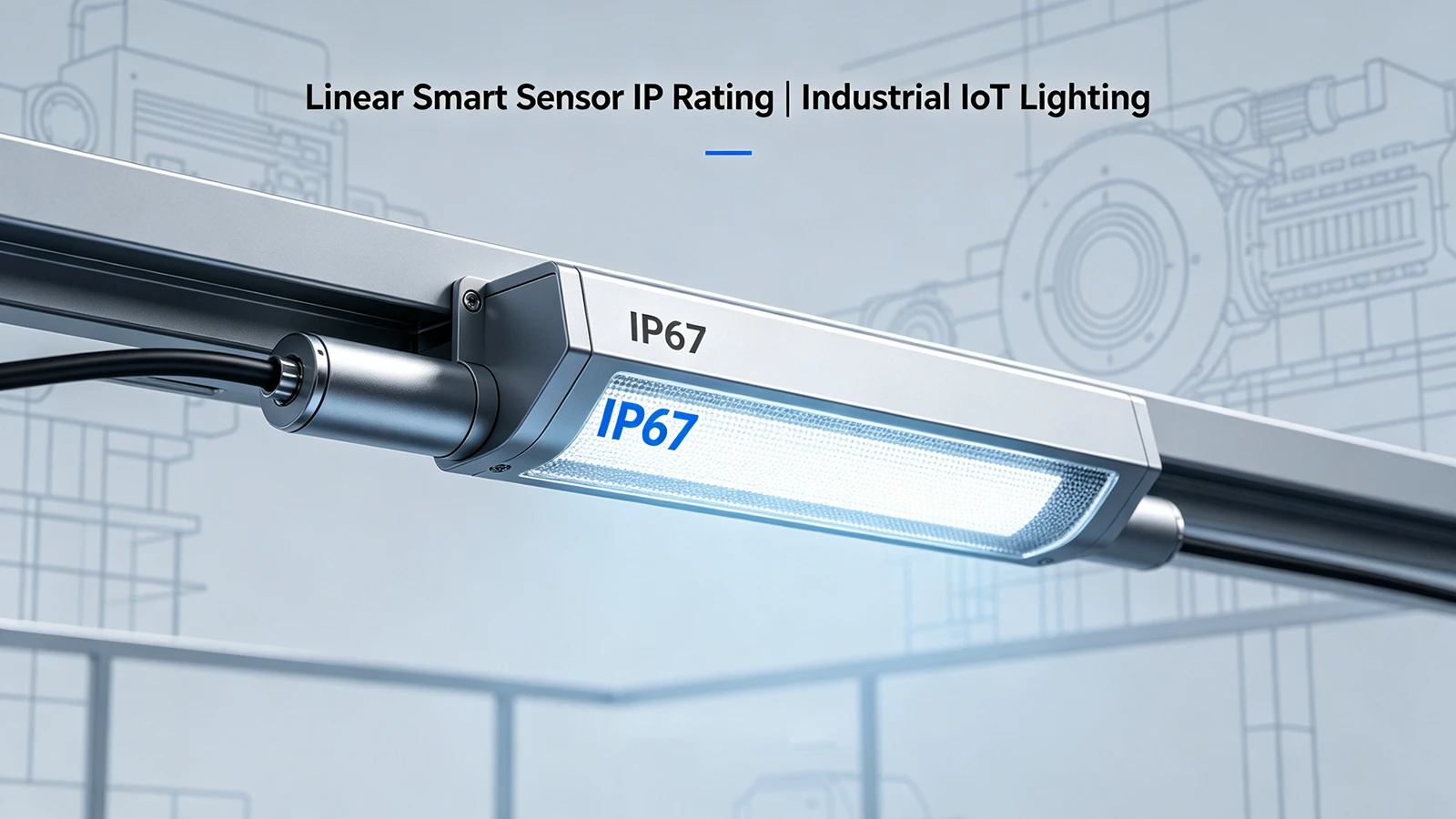
The IP (Ingress Protection) rating is an international standard that defines how well a device is sealed against solids and liquids. For a linear smart sensor ip rating, these two numbers tell the story of the device's survival odds.
The First Digit (Solids): Ranges from 0 to 6. A "6" means the sensor is entirely dust-tight. In a woodworking shop or a textile mill, a lower rating would allow fine particles to clog the sensor's "vision."
The Second Digit (Liquids): Ranges from 0 to 9. For an office lighting retrofit, an IP20 might suffice. However, for a facility that uses high-pressure washdowns, you need an IP65, IP66, or even IP69K.
Choosing the correct linear smart sensor ip rating ensures that your lighting control system remains responsive, even when covered in dust or sprayed with water.
Modern industrial sites are no longer just buildings; they are complex iot lighting control networks. If moisture leaks into a sensor, the damage goes beyond one light. In a networked system, a failing sensor can send 'dirty data' to the central controller. This creates errors across the entire lighting zone.
In a large-scale commercial lighting retrofit, labor is the most expensive variable. If a low-rated sensor fails 30 feet up in the rafters, the repair costs will skyrocket. The price of a new part is small compared to the cost of renting a scissor lift and hiring a technician. LumiEasy’s high-IP smart devices are built to save you from these "hidden" expenses.
Different environments demand different levels of protection. An energy manager must match the linear smart sensor ip rating to the specific challenges of the zone.
Warehousing & Logistics: These areas are often prone to high dust levels. An IP65 rating is usually the standard, ensuring that fine debris doesn't interfere with the bluetooth mesh commissioning logic.
Cold Storage & Food Processing: Here, moisture and condensation are the enemies. A linear smart sensor ip rating of IP66 or higher is required to withstand the temperature swings and humidity.
Outdoor Loading Docks: Exposed to rain and snow, these smart devices need robust seals to maintain a reliable lighting control system year-round.
For a building to be truly "smart," it should utilize NLC certified lighting (Networked Lighting Control). This certification guarantees that the sensors, fixtures, and central controller work together to save energy.
Using BLE commissioning tools, technicians can set up high-IP sensors without ever opening the housing. This is vital. Opening a sealed sensor to flip manual switches can break the waterproof gasket. With lumieasy tools, you maintain the integrity of the linear smart sensor ip rating by programming the device wirelessly via a smartphone.
As we look toward the future of AI-driven lighting automation, sensors will collect more than just occupancy data. They will track temperature, humidity, and even air quality. This makes the linear smart sensor ip rating even more important. The more complex the internal electronics of these smart devices, the more protection they need from the external environment.
A resilient lighting control system starts with the physical layer. By selecting sensors with a verified linear smart sensor ip rating, you ensure that your iot lighting control infrastructure is ready for the demands of 2026 and beyond.
An office lighting retrofit might focus on aesthetics, but an industrial upgrade focuses on ROI. High-IP sensors offer:
Lower Maintenance: Fewer failures mean fewer work orders.
Consistent Savings: A functioning sensor ensures that daylight harvesting and occupancy dimming actually work.
Data Accuracy: Clean sensors provide the energy manager with accurate space utilization data.
A: It is not recommended. Dust can still migrate into the fixture. For a reliable lighting control system, we suggest using a linear smart sensor ip rating of at least IP65 for any industrial space.
A: Our BLE commissioning tools allow for 100% wireless setup. Since you don't need to open the sensor to adjust "dip switches," the factory-sealed gasket stays intact, preserving the linear smart sensor ip rating.
A: You should match the rating to the environment. While an IP69K is impressive, it might be overkill for a dry warehouse. Lumieasy tools and sensors provide a range of ratings to ensure you get the right protection at the right price point.
A: Yes. LumiEasy sensors are designed for high-performance iot lighting control. They integrate seamlessly with any central controller that follows standard Bluetooth Mesh protocols.
Related new
Linear Microwave Smart Sensor Type B


)
)
)
)

+86 15899791249

+86 755 2955 3313


Address: Huafeng No.1 Science and Technology Park, Sanwei, Bao'an District, Shenzhen, Guangdong, China.
