

Time:2026-04-09
In the sophisticated landscape of 2026 industrial automation, the trend toward extreme verticality is undeniable. As modern logistics hubs, aerospace hangars, and manufacturing plants push ceiling heights to the 40-to-60-foot threshold, facility managers face a critical technical bottleneck. They must implement intelligent Networked Lighting Controls (NLC) at elevations where traditional sensors often fail.
Legacy occupancy detection technologies typically lack the volumetric reach and environmental resilience required for these demanding high-bay applications. Consequently, the industrial sector is pivoting toward the industrial microwave lighting sensor. Utilizing high-frequency Doppler radar, these advanced components ensure unerring motion detection from significant heights. They successfully harmonize operational safety with aggressive energy-saving mandates.
For luminaire manufacturers and specification engineers, mastering the integration of microwave technology is no longer optional. Especially within slim linear high-bay profiles, it is now the definitive requirement for modern industrial excellence.
Determining the appropriate sensory architecture for ceilings exceeding 40 feet requires a careful analysis of detection physics. When evaluating microwave vs PIR sensors (Passive Infrared) in high-volume spaces, the operational limitations of thermal sensing become apparent.
PIR sensors function by identifying infrared radiation fluctuations between a moving heat source and the background. In high-bay environments, this presents several fatal challenges:
Thermal Equilibrium: In non-climate-controlled facilities during summer, ambient temperatures often mirror human body heat. This effectively "blinds" the sensor to pedestrian activity.
Line-of-Sight Dependency: PIR technology is fundamentally limited by physical obstructions. Accumulated industrial dust on the lens or high-density racking systems can severely compromise the optical path.
Sensitivity Degradation: At elevations beyond 30 feet, PIR requires prohibitively large lenses. These often result in fragmented detection zones and premature "timeout" events where lights turn off unexpectedly.
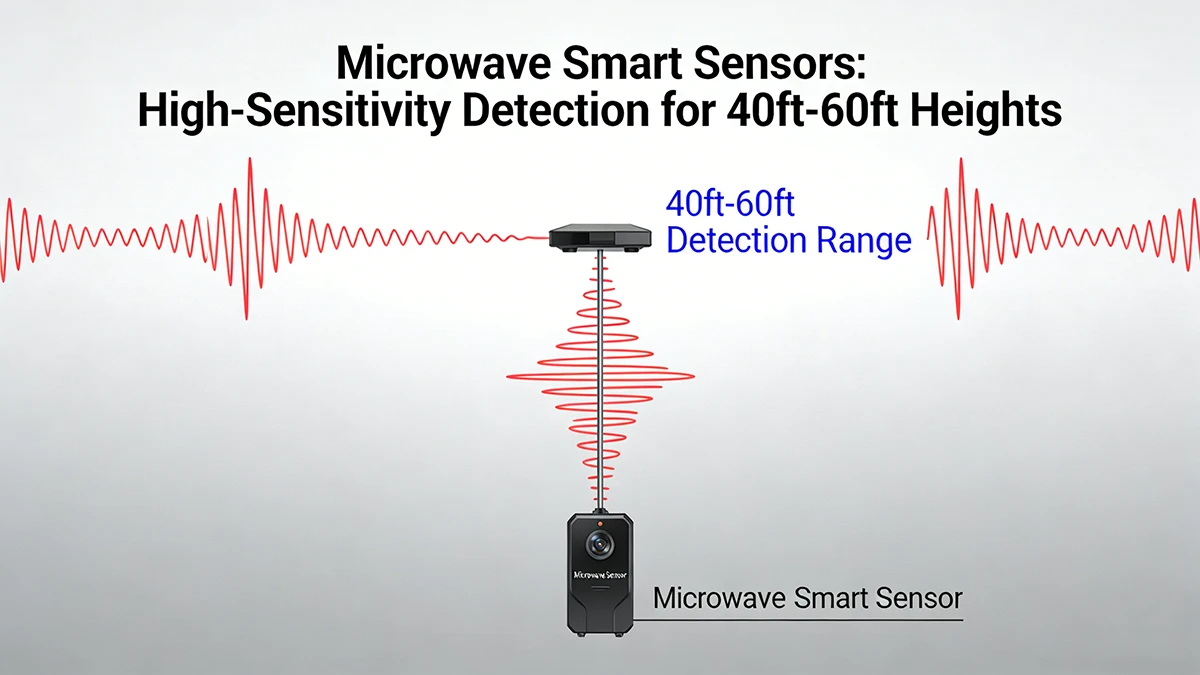
Conversely, an industrial microwave lighting sensor functions as an active radar system. It emits high-frequency electromagnetic waves and analyzes the frequency shift—known as the Doppler effect—as they reflect off moving masses.
Volumetric Penetration: Microwave signals possess the unique ability to penetrate non-metallic materials. This allows the sensor to "see" through polycarbonate diffusers or glass partitions without signal loss.
Environmental Autonomy: Detection is based on kinetic movement rather than thermal signatures. Therefore, these sensors remain indifferent to extreme temperature fluctuations in cold storage or heavy industrial zones.
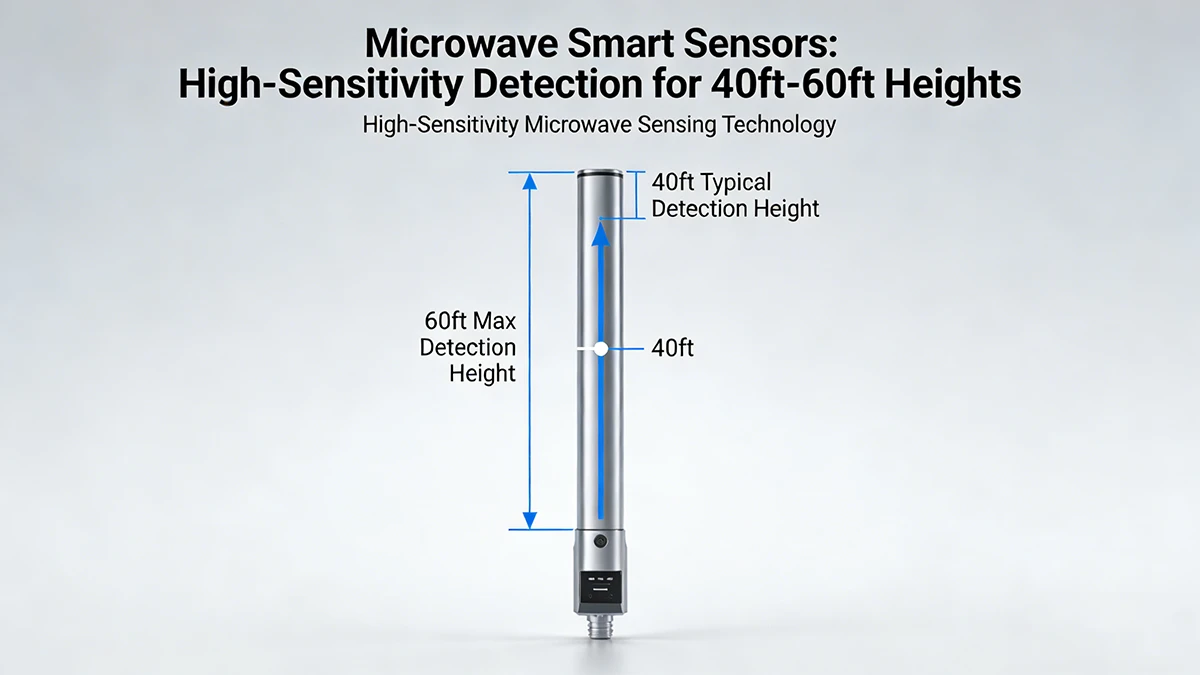
Extensive Microwave Smart Sensor Range: Through high-gain antenna arrays, modern modules project a concentrated detection cone. This maintains high sensitivity at 60 feet, capturing both micro-movements and heavy machinery transit.
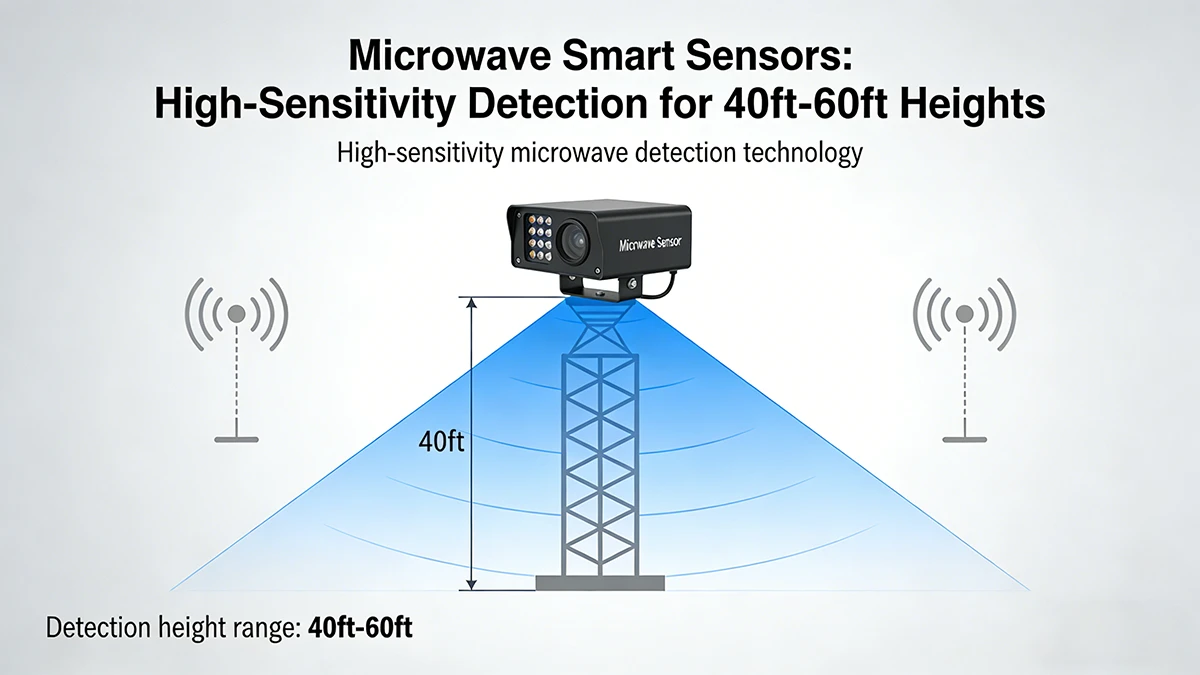
The prevalence of linear high-bay luminaires in modern racking aisles necessitates seamless embedding of microwave hardware. This must be achieved within highly constrained aluminum profiles.
Precision engineering is required when aligning linear smart sensor dimensions with modern fixture aesthetics. The microwave transceiver must be sufficiently miniaturized to reside within standard 50mm to 75mm tracks. Crucially, it must not obstruct the thermal management of the LED drivers. LumiEasy’s ultra-compact modules ensure the sensory "brain" remains entirely concealed. This preserves the luminaire’s sleek architectural profile while delivering robust high-bay functionality.
In specialized cleanroom or pharmaceutical environments, a recessed linear lighting sensor configuration is often mandated. This design eliminates dust-collecting protrusions. Microwave technology is the superior choice here. Because radar waves propagate through the fixture’s flush-mounted lens, the sensor can be hermetically sealed within the housing. This preserves both structural integrity and strict hygienic standards.
Standard 360-degree detection is often counterproductive in narrow aisles. It leads to unnecessary energy consumption in adjacent zones. By utilizing advanced wave-shaping algorithms, the linear sensor detection pattern is transformed into a longitudinal elliptical footprint. This ensures the sensory field is restricted strictly to the aisle of travel. It detects approaching forklifts from significant distances while ignoring lateral movement in neighboring racks.
Industrial sensors situated at 50 feet encounter a rigorous regimen of airborne particulates, moisture, and mechanical vibration. Failure is not an option when maintenance access is so difficult.
To ensure decades of reliable service, the linear smart sensor IP rating serves as the primary metric for resilience. LumiEasy’s high-bay sensors are engineered to achieve IP65 or IP66 certifications. By potting the microwave antenna in specialized thermal resins, the internal 12V/24V DC circuitry is effectively shielded from ingress. This ensures the sensor’s lifecycle is commensurate with the 100,000-hour rating of the LED array itself.
Historically, the hyper-sensitivity of microwave radar led to occasional false activations. In 2026, sophisticated Digital Signal Processing (DSP) provides a definitive microwave sensor false trigger fix.
Kinetic Velocity Filtering: Modern algorithms differentiate between the repetitive vibration of HVAC systems and the distinct movement of personnel.
Electronic Range Adjustment: Facility managers can digitally constrain the microwave smart sensor range via software. This prevents the radar from penetrating walls into adjacent administrative spaces.
The logistical cost of deploying high-reach equipment for sensor adjustments is massive. Consequently, the linear smart sensor installation and commissioning protocol must be optimized for maximum efficiency.
LumiEasy has streamlined the installation phase by utilizing standardized 4-pin quick-connect interfaces. This allows OEMs to pre-integrate microwave nodes during factory assembly. Upon arrival at the site, the contractor simply suspends the luminaire and connects primary power. This eliminates complex on-site sensor calibration.
The era of manual dip-switch adjustment at extreme heights is over. Every LumiEasy component is designed for interoperability with Bluetooth Mesh or DALI-2 ecosystems. By scanning a permanent QR code on the luminaire, technicians can access the digital linear smart sensor manual. They can then modify sensitivity, hold times, and daylight harvesting thresholds from the safety of the floor.
As global infrastructure continues its vertical ascent, the necessity for high-precision, long-range occupancy data is paramount. The industrial microwave lighting sensor represents the nexus of high-performance detection and architectural elegance. By addressing the challenges of height, environmental ingress, and signal interference, LumiEasy empowers engineers to deliver lighting systems that are both cognitively intelligent and operationally efficient.
PIR sensors are limited by thermal diffusion. At 50 feet, the infrared delta between a human body and the environment is often too small for reliable detection. Microwave technology bypasses this thermal dependency by utilizing active radar. This ensures consistent performance in extreme industrial temperatures where PIR would typically fail.
Modern Digital Signal Processing (DSP) allows the sensor to analyze the frequency and amplitude of reflections. It distinguishes between "nuisance" movement—such as wind-induced vibration—and the specific Doppler shift of human transit. This ensures the system reacts only to intentional occupancy.
Integrating low-voltage DC sensors directly into the luminaire’s architecture simplifies electrical design and increases safety. Because the microwave sensor functions behind the diffuser without a dedicated aperture, it maintains a superior linear smart sensor IP rating and a cleaner aesthetic.
LumiEasy provides a permanent QR code laser-etched onto each unit. Scanning this code provides immediate access to the digital linear smart sensor manual, wiring schematics, and the mobile commissioning interface for ground-level adjustments.


)
)
)
)

+86 15899791249

+86 755 2955 3313


Address: Huafeng No.1 Science and Technology Park, Sanwei, Bao'an District, Shenzhen, Guangdong, China.
