

Time:2025-12-15
Lighting sensors are foundational to energy-efficient smart lighting systems, but false triggers—activated by non-target factors like wind-blown debris, pet movement, or equipment vibration—undermine their performance. These inaccuracies lead to wasted energy, disrupted user experiences, and unnecessary maintenance costs across residential, commercial, and industrial settings. Multi criteria false trigger prevention emerges as a breakthrough solution, leveraging multiple verification standards (e.g., motion pattern, duration, environmental context) to distinguish genuine occupancy from irrelevant disturbances. For facility managers, smart home users, and commercial operators, integrating multi criteria false trigger prevention into lighting sensors is critical to unlocking the full potential of automated lighting control. This article explores the core value, application scenarios, and implementation strategies of this technology, highlighting its role in redefining sensor reliability.
False triggers are more than just a minor annoyance—they impose tangible costs on users and organizations. In commercial buildings, lights activated by passing wildlife or air duct airflow can increase energy bills by 20-30% annually. In residential settings, frequent false activation of outdoor lights disrupts neighbors and wastes electricity. In industrial facilities, false triggers may keep lights on in unoccupied work zones, inflating operational costs while offering no safety benefit.
Traditional single-criteria false trigger prevention methods (e.g., adjusting sensitivity or detection range) fail to address these issues comprehensively. A sensor set to low sensitivity to avoid wind-related triggers may miss genuine human movement, compromising safety. Narrowing detection range works for small spaces but is ineffective in large areas like retail floors or warehouse aisles. These one-dimensional solutions force a trade-off between false trigger reduction and detection reliability— a gap that multi criteria false trigger prevention fills by evaluating multiple signals simultaneously to confirm genuine occupancy.

Multi criteria false trigger prevention delivers three key benefits that outperform traditional single-criteria methods, ensuring precise and reliable lighting control:
First, multi-dimensional disturbance differentiation. This technology evaluates multiple complementary criteria to distinguish genuine triggers from interference. Common criteria combinations include "motion pattern + duration" (e.g., distinguishing human walking patterns from random debris movement and requiring a minimum 2-second presence to activate lights), "motion + environmental context" (e.g., ignoring motion detected during heavy rain but responding to it in dry conditions), and "motion + acoustic verification" (e.g., pairing motion detection with human voice or footstep sounds). This multi-layered analysis eliminates false triggers while maintaining sensitivity to genuine occupancy.
Second, adaptive compatibility with diverse scenarios. Multi criteria false trigger prevention systems allow customization of criteria combinations to match specific environment needs. For example, a retail store can use "motion + dwell time" criteria to avoid triggering lights for customers passing quickly by shelves while activating them for those browsing (dwell time > 5 seconds). A residential backyard can use "motion size + speed" criteria to ignore small pets while detecting human movement. This adaptability makes the technology suitable for virtually any smart lighting application.
Third, enhanced energy efficiency and user experience. By eliminating false triggers, multi criteria false trigger prevention reduces unnecessary lighting activation, cutting energy consumption significantly compared to single-criteria systems. It also improves user experience by ensuring lights turn on only when needed—no more disrupted sleep from randomly activating outdoor lights, no more frustration from dark hallways when a sensor misses genuine movement. This balance of efficiency and convenience is a key advantage for smart environment implementations.
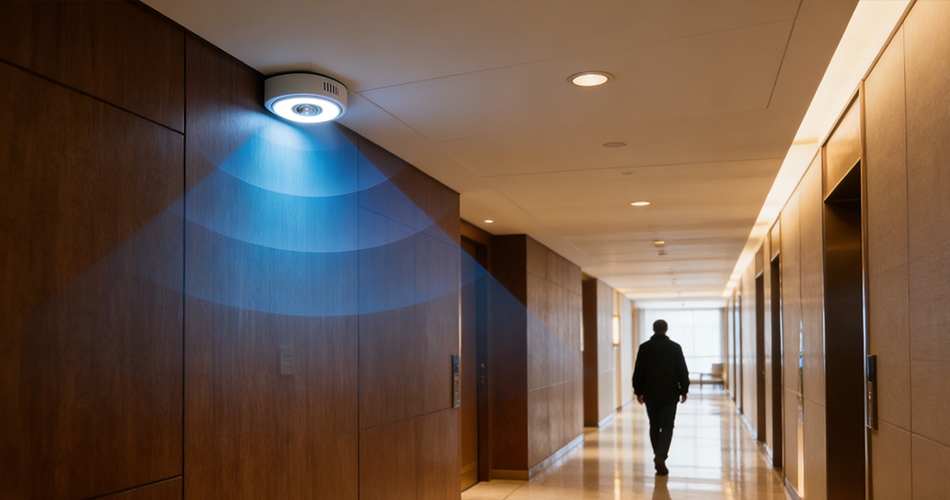
This technology excels in environments where false triggers are frequent and detection precision is critical, delivering targeted value across residential, commercial, educational, and industrial sectors:
Smart retail stores & shopping malls: Retail environments face frequent false trigger risks from shopping cart movement, floating balloons, or air conditioning airflow. Multi criteria false trigger prevention uses "motion trajectory + dwell time" criteria to activate lights only for customers browsing aisles (stable trajectory + long dwell time) while ignoring transient disturbances. In fitting rooms, "motion + door state" criteria ensure lights turn on only when both motion is detected and the door is closed, avoiding triggers from passing store staff.
Intelligent campuses & educational facilities: Schools and universities use this technology to balance energy efficiency and student safety. In library reading areas, "motion + acoustic" criteria ignore subtle book-turning movements but activate lights for students entering the space (combining motion with low-level voice or footstep sounds). In laboratory corridors, "motion + time" criteria restrict lighting activation to class hours, avoiding false triggers from overnight equipment cooling fans while ensuring lights work during peak use times.
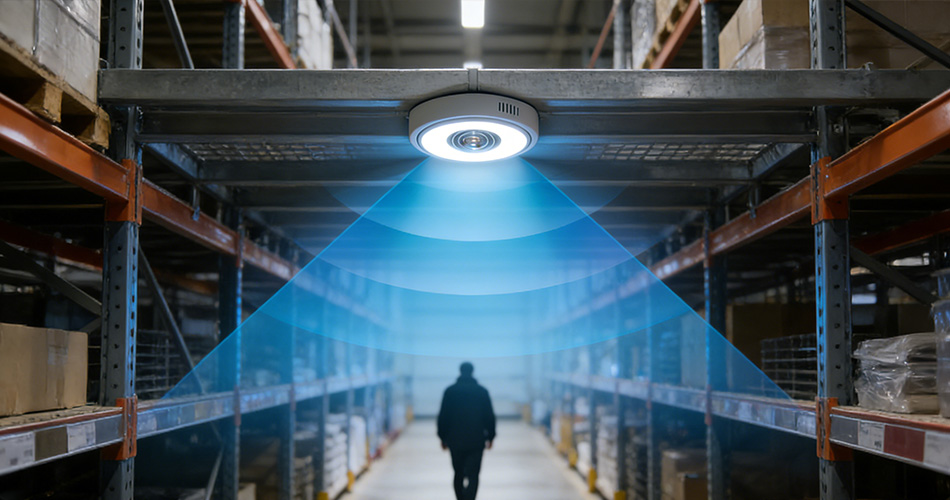
Industrial maintenance zones & warehouses: Industrial settings struggle with false triggers from machinery vibration, forklift movement, or falling inventory. Multi criteria false trigger prevention uses "motion + human characteristic" criteria (e.g., detecting upright posture and slow movement vs. fast-moving forklifts or random debris) to activate lights only for maintenance workers. In high-vibration areas, "motion + vibration frequency" criteria filter out machine-related disturbances, ensuring lights turn on only for human activity.
High-end residential communities & smart homes: Homeowners benefit from "motion size + speed" criteria to avoid false triggers from pets, squirrels, or wind-blown branches. Outdoor security lights equipped with multi criteria false trigger prevention activate only when detecting human-sized objects moving at walking speed, while ignoring small animals. In indoor hallways, "motion + time" criteria can be set to ignore movement during sleep hours, preventing disruptions from household appliances.
To maximize the value of multi criteria false trigger prevention, follow these strategic implementation guidelines:
First, tailor criteria combinations to environment-specific risks. Conduct a site assessment to identify common false trigger sources (e.g., pets in residential areas, shopping carts in retail) and select complementary criteria to filter them out. For example, in windy outdoor spaces, pair "motion" with "duration" criteria to ignore short-lived disturbances from wind.
Second, prioritize user-friendly configuration interfaces. Select lighting sensors with intuitive multi criteria false trigger prevention settings, such as pre-set scenario templates (retail, residential, industrial) or mobile app-based customization. Avoid overly complex programming that requires specialized expertise, especially for small businesses or homeowners.
Third, ensure compatibility with smart lighting ecosystems. Verify that sensors with multi criteria false trigger prevention integrate seamlessly with existing smart lighting controls, building management systems (BMS), and IoT platforms. This allows for centralized monitoring of trigger events and remote adjustment of criteria, enhancing operational efficiency.
Fourth, conduct iterative testing and calibration. After installation, test the system under various conditions (e.g., different times of day, weather conditions) to fine-tune criteria thresholds. For example, adjust dwell time settings in retail stores to ensure lights activate for genuine shoppers but not casual passersby. Schedule quarterly re-calibration to adapt to changing environment conditions.
As smart lighting technology advances, multi criteria false trigger prevention is becoming more intelligent and integrated, further enhancing precision:
One trend is AI-driven dynamic criteria optimization. Future systems will use artificial intelligence to analyze historical trigger data, automatically adjusting criteria combinations in real time. For example, a retail sensor can learn peak shopping hours and adjust dwell time thresholds accordingly, reducing false triggers during busy periods.
Another trend is biometric-based criteria enhancement. Sensors will integrate biometric verification (e.g., human silhouette recognition, thermal imaging) into multi criteria false trigger prevention, further improving the accuracy of human vs. non-human detection. This is particularly valuable for high-security areas like industrial facilities or restricted campus zones.
Finally, cross-system data fusion. Multi criteria false trigger prevention will integrate data from other building systems (e.g., security cameras, access control) to enhance verification. For example, a sensor can cross-reference motion detection with access card swipes to confirm genuine occupancy, eliminating false triggers from unauthorized disturbances.
In conclusion, multi criteria false trigger prevention is a critical advancement in lighting sensor technology, addressing the long-standing challenge of false triggers that undermine energy efficiency and user experience. By leveraging multi-dimensional verification criteria, this technology delivers precise detection across diverse environments, eliminating trade-offs between sensitivity and false trigger reduction. Through strategic implementation and adherence to best practices, organizations and homeowners can maximize the value of their smart lighting systems. As AI and biometric technology advance, multi criteria false trigger prevention will become even more intelligent, solidifying its role as a cornerstone of reliable, efficient smart lighting. For anyone investing in automated lighting control, prioritizing multi criteria false trigger prevention is a strategic choice that delivers long-term energy savings and user satisfaction.


)
)
)
)

+86 15899791249

+86 755 2955 3313


Address: Huafeng No.1 Science and Technology Park, Sanwei, Bao'an District, Shenzhen, Guangdong, China.
