

Time:2025-12-31
Modern open offices, characterized by cubicle partitions and semi-open collaboration zones, strike a balance between teamwork and individual focus. However, this layout poses unique challenges for space management, energy efficiency, and user comfort—challenges that traditional sensing solutions struggle to address. Open office partition sensor systems, tailored to the semi-open nature of partitioned workspaces, integrate advanced detection technologies to overcome blind spots, optimize resource usage, and enhance workspace adaptability. By precisely identifying occupancy and activity within partitioned areas, these systems serve as the backbone of intelligent open office management, supporting facility managers in reducing operational costs and improving employee experience. This article explores the core value, targeted applications, implementation guidelines, and future trends of open office partition sensor systems, highlighting their indispensable role in modern workplace optimization.
Traditional occupancy or lighting sensors are ill-suited for open office partition layouts, leading to inefficiencies and user frustration. A primary issue is the prevalence of detection blind spots: passive infrared (PIR) sensors, the most common traditional type, rely on unobstructed line of sight to detect heat signatures. Cubicle walls and partition panels easily block these signals, rendering sensors unable to detect seated workers engaged in low-movement activities like typing or reading—a phenomenon known as "heat shadows". This results in lights or HVAC systems shutting down prematurely in occupied areas, disrupting work and reducing comfort.
Conversely, over-sensing is another critical flaw. To compensate for blind spots, many facilities install excessive sensors, leading to overlapping coverage zones. A single employee walking down a corridor can trigger lights in three or four adjacent unoccupied workstations, wasting energy instead of conserving it. Additionally, traditional sensors fail to support modern hybrid work models, as they cannot provide granular data on partitioned space utilization—leaving facility managers unable to optimize desk allocation or identify underused areas. These limitations underscore the need for specialized open office partition sensor systems designed to navigate the unique geometry and usage patterns of semi-open workspaces.

Open office partition sensor systems address the shortcomings of traditional solutions through four key advantages, tailored specifically to semi-open work environments:
- Blind spot elimination with hybrid sensing technologies: Unlike single-technology traditional sensors, modern open office partition sensor systems often integrate dual technologies—such as PIR combined with microphonics (acoustic sensing). Acoustic sensors detect human activities like talking, typing, or moving chairs, complementing PIR’s motion detection to identify even stationary workers behind partitions. This hybrid approach eliminates heat shadow blind spots, ensuring reliable occupancy detection across all partitioned zones.
- Precision zoning for energy efficiency: These systems enable granular control over individual partitioned areas (e.g., single workstations, small collaboration pods). Sensors are calibrated to cover only specific partitioned zones, avoiding overlapping coverage that triggers unnecessary lighting or HVAC activation in adjacent unoccupied spaces. Studies show that such precision can reduce open office energy consumption by 20-30% by eliminating wasteful "over-illumination" and idle system operation.
- Data-driven space utilization optimization: Open office partition sensor systems capture real-time data on how partitioned spaces are used—including peak occupancy times, underused workstations, and collaboration zone demand. This data helps facility managers optimize desk layouts, adjust hot-desking policies, and reconfigure partitions to match actual employee needs, reducing unused workspace by up to 40% and lowering real estate costs. It also validates booking software data, ensuring that reserved spaces are actually occupied.
- Seamless integration with smart office ecosystems: These sensor systems integrate seamlessly with lighting, HVAC, and workspace management platforms. For example, they can dim lights in unoccupied partitioned workstations while maintaining optimal brightness in collaboration zones, or adjust HVAC airflow based on occupancy density in semi-open areas. Integration with mobile apps also allows employees to check real-time desk availability, enhancing the hybrid work experience.
Open office partition sensor systems deliver unique value in scenarios where semi-open space management, energy efficiency, and hybrid work support are prioritized:
- Modular Cubicle Workstations: In large open offices with standardized cubicle partitions, these systems ensure each workstation’s lighting and power are activated only when occupied. Hybrid sensors detect both movement and subtle activities (e.g., typing) to avoid false off-triggers for stationary workers, while precision zoning prevents corridor traffic from activating unoccupied desks’ systems.
- Semi-Open Collaboration Zones: Partitioned collaboration pods (with low-height walls for privacy) benefit from sensor systems that adjust lighting and HVAC based on group size. Sensors detect occupancy density, ensuring sufficient illumination for team discussions while conserving energy when pods are empty. Data on pod usage also helps optimize collaboration space allocation.
- Hybrid Work Hot-Desking Areas: In hot-desking environments, open office partition sensor systems provide real-time occupancy data via workplace apps, helping employees find available desks quickly. They also trigger automatic cleaning alerts for used desks, supporting hygiene protocols, and inform facility managers about peak usage times to adjust desk availability.
- Partitioned Meeting Room Anterooms: Semi-open anterooms outside meeting rooms use these sensors to control transitional lighting and monitor pre-meeting gatherings. Sensors ensure lights are on only when people are present, while data on anteroom usage helps optimize meeting room scheduling and space design.
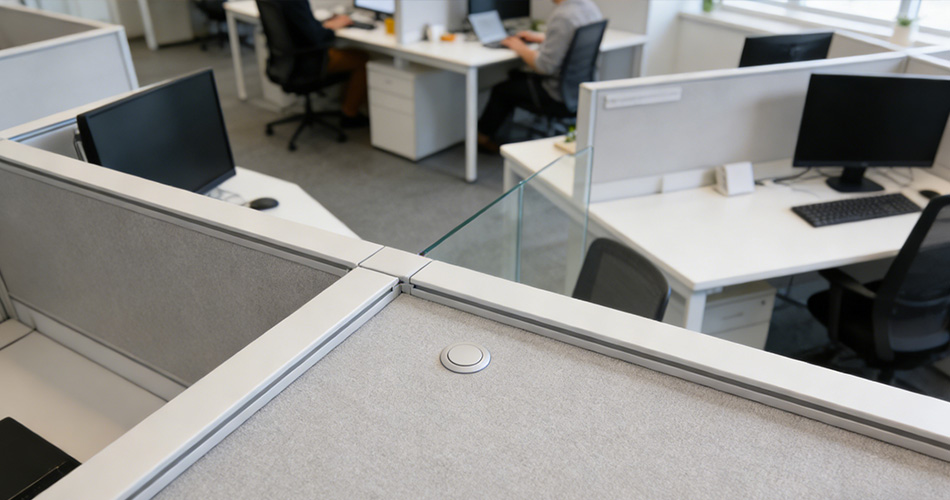
To maximize the effectiveness of open office partition sensor systems, follow these scenario-specific implementation guidelines:
- Select hybrid sensing technologies based on partition type: For solid cubicle walls that block PIR signals, choose PIR-microphonic dual-technology sensors to ensure reliable detection. For glass partitions (opaque to PIR infrared), opt for ultrasonic or acoustic sensors that penetrate transparent barriers. Avoid single-technology sensors that struggle with partition-related obstructions.
- Optimize sensor placement for partitioned layouts: Install sensors above partitioned workstations (e.g., on cubicle tops or ceiling directly above desks) to focus on specific zones, rather than wide corridor areas. Ensure overlapping coverage only in high-traffic walkways to avoid blind spots while preventing excessive cross-zone triggering. Keep sensors at least 4 feet away from air vents to avoid airflow interference.
- Calibrate settings for office activity patterns: Adjust sensor timeout settings to match open office dynamics—use longer timeouts (15-20 minutes) for workstations where employees may be stationary for extended periods, and shorter timeouts for high-traffic collaboration zones. Fine-tune acoustic sensor sensitivity to filter out ambient noise (e.g., HVAC, printers) while detecting human activities.
- Integrate with a centralized management platform: Connect sensors to a cloud-based workspace management system to aggregate occupancy data, enable remote monitoring, and automate reports. Ensure compatibility with existing BMS (Building Management Systems) for seamless integration with lighting and HVAC. Prioritize platforms with user-friendly dashboards for facility managers to easily analyze space utilization trends.
Driven by hybrid work adoption and smart building advancements, open office partition sensor systems are evolving toward greater intelligence and integration:
- AI-driven adaptive sensing: Future systems will use AI to learn office activity patterns, adjusting sensor sensitivity and timeout settings dynamically. For example, sensors will recognize peak work hours and reduce false triggers, or increase responsiveness during quiet periods when employees are more likely to be stationary.
- Integration with hybrid work tools: Sensors will sync with desk booking and employee scheduling software, automatically releasing unoccupied reserved desks and updating availability in real time. This closes the gap between digital bookings and physical space usage, enhancing hybrid work efficiency.
- Low-power and wireless deployment: Advances in energy-harvesting (solar, kinetic) and low-power wireless protocols will enable battery-free sensor operation, eliminating wiring constraints in modular partitioned offices. This simplifies installation and allows flexible reconfiguration of sensors as office layouts change.
- Wellness-focused monitoring: Next-generation systems may integrate air quality or thermal comfort sensors, linking partitioned space occupancy to environmental conditions. This enables facility managers to optimize HVAC for both energy efficiency and employee well-being, creating healthier semi-open work environments.
In conclusion, open office partition sensor systems are a specialized solution for the unique challenges of semi-open workspaces, addressing blind spots, energy waste, and inefficient space utilization that plague traditional sensing technologies. Their hybrid sensing capabilities, precision zoning, and data-driven insights make them indispensable for modern open offices embracing hybrid work models. By following targeted implementation strategies—such as selecting appropriate technologies and optimizing placement—facility managers can fully leverage these systems to reduce costs, enhance employee comfort, and create future-proof workspaces. As AI and hybrid work tools advance, open office partition sensor systems will become even more integral to intelligent office management, bridging the gap between physical space and digital workplace needs. For anyone involved in designing or managing open office environments, prioritizing these specialized sensor systems is a strategic choice to optimize efficiency, adaptability, and user experience.


)
)
)
)

+86 15899791249

+86 755 2955 3313


Address: Huafeng No.1 Science and Technology Park, Sanwei, Bao'an District, Shenzhen, Guangdong, China.
