

Time:2026-01-04
As pets become an integral part of households and even pet-friendly commercial environments, the demand for security and automation systems that coexist harmoniously with furry companions is rising. Passive Infrared (PIR) sensors are widely used for motion detection, but traditional models often trigger false alarms due to pet movements, undermining their reliability. Pet immune PIR sensor sensitivity— the ability to adjust the sensor’s response threshold to distinguish between human activity and pet movements—emerges as a critical solution. By optimizing this sensitivity, pet immune PIR sensors can effectively ignore the thermal signals of pets while maintaining accurate detection of human intruders or desired motion events. For homeowners, facility managers of pet-friendly businesses, and security professionals, understanding the value and optimization of pet immune PIR sensor sensitivity is essential to building efficient, worry-free security and automation systems. This article explores the core significance, targeted application scenarios, implementation guidelines, and future trends of pet immune PIR sensor sensitivity, highlighting its indispensable role in pet-friendly space management.
Traditional PIR sensors operate by detecting changes in infrared radiation emitted by warm-blooded creatures, but they lack the ability to differentiate between humans and pets, leading to frequent false alarms in pet-inhabited spaces. A primary limitation is their fixed sensitivity, which cannot adapt to the size, weight, or movement patterns of pets. For example, a small dog or cat moving across a room may trigger a traditional PIR sensor just as easily as a human, causing unnecessary alarm activations that waste time for homeowners or security personnel and may even lead to complacency toward real threats.
Another critical flaw is the inability to adapt to dynamic environmental conditions. Factors such as ambient temperature fluctuations, direct sunlight, or air currents can further disrupt traditional sensors’ performance, compounding false alarm issues when combined with pet movements. In commercial spaces like pet clinics or pet-friendly cafes, this unreliability can disrupt operations and create a negative experience for customers. These limitations highlight the necessity of pet immune PIR sensors with adjustable sensitivity, which can be tailored to specific pet characteristics and environmental conditions to ensure reliable detection.
Optimizing pet immune PIR sensor sensitivity transforms the performance of motion detection systems in pet-friendly environments, delivering four key benefits:
- Precise differentiation between pets and humans: The core advantage of adjusting pet immune PIR sensor sensitivity lies in its ability to set a threshold that ignores the thermal signal changes caused by pets. By analyzing the size of the heat source and the speed of movement—characteristics that differ between pets and humans—optimized sensitivity ensures the sensor only triggers alerts for human activity. This eliminates false alarms while maintaining robust security against intruders.
- Adaptability to diverse pet and space characteristics: Every pet-friendly space has unique needs, from small apartments with cats to large homes with multiple dogs. Pet immune PIR sensor sensitivity can be fine-tuned to match the size and activity level of pets—for example, lower sensitivity settings for larger pets that move more vigorously, and moderate settings for small, agile pets. This adaptability makes the sensors suitable for a wide range of pet-friendly environments.
- Enhanced reliability in varying environmental conditions: Environmental factors like temperature changes or sunlight can affect PIR sensor performance. Optimizing sensitivity helps mitigate these impacts—for instance, increasing sensitivity slightly in cold environments where the thermal contrast between humans and the surroundings is reduced, or decreasing it in sunlit areas to avoid false triggers from heat fluctuations. This ensures consistent performance regardless of environmental changes.
- Improved user experience and system efficiency: Reducing false alarms significantly improves the user experience by eliminating the frustration of frequent, unnecessary alerts. For security systems, this means security personnel can focus on genuine threats, enhancing operational efficiency. In automated systems (such as lighting or HVAC control), optimized pet immune PIR sensor sensitivity ensures devices only activate for human presence, avoiding energy waste caused by pet-triggered operations.
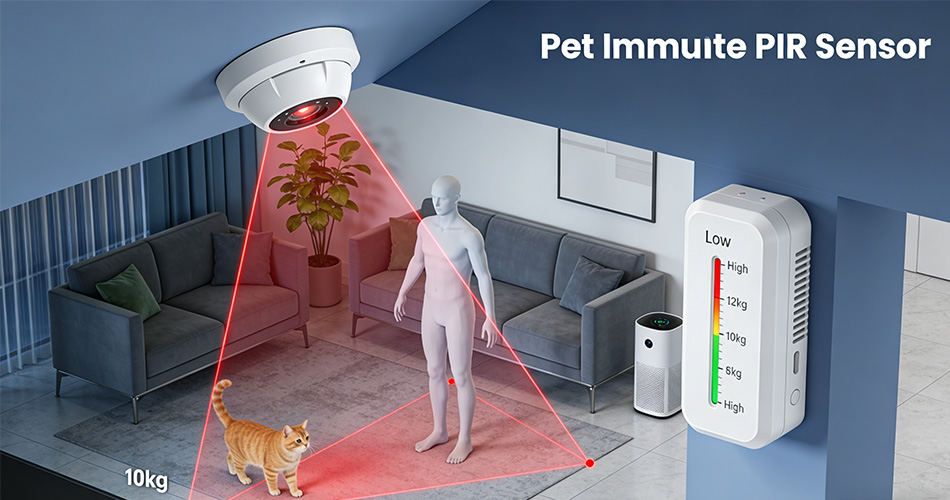
Optimized pet immune PIR sensor sensitivity delivers unique value in scenarios where pet coexistence and reliable motion detection are both critical:
- Residential Pet-Friendly Homes: In homes with dogs, cats, or other pets, adjusting pet immune PIR sensor sensitivity ensures security alarms only trigger for intruders, not for pets roaming freely. For example, in a living room where a dog frequently plays, lower sensitivity settings prevent false alarms while maintaining detection of human entry through windows or doors. It also supports automated systems like motion-activated lighting, ensuring lights turn on only when family members are present.
- Pet Clinics and Grooming Salons: These commercial spaces have high pet traffic, making reliable motion detection challenging. Optimized sensitivity allows security sensors to ignore the constant movement of pets being treated or groomed, while still detecting unauthorized human entry after hours. It also helps with energy management by triggering HVAC adjustments only when staff or clients are present, not for animals.
- Pet-Friendly Retail Stores and Cafés: Retail spaces that allow pets (such as pet supply stores or dog-friendly cafes) benefit from adjusted pet immune PIR sensor sensitivity. Sensors can be calibrated to ignore pets accompanying customers while detecting suspicious human activity, such as shoplifting or after-hours intrusions. This balances a welcoming environment for pet owners with effective security.
- Pet Boarding Facilities: With multiple pets in confined spaces, pet immune PIR sensor sensitivity optimization is crucial for security and operational efficiency. Sensors ensure alarms are only triggered by human intruders, not by pets moving between kennels. They also support staff workflow by activating lights or alerts only when employees are in specific areas, improving operational efficiency.
To fully leverage the value of pet immune PIR sensor sensitivity, follow these scenario-specific implementation guidelines:
- Conduct a comprehensive pet and space assessment: Before adjusting sensitivity, evaluate the size, weight, and activity level of pets in the space, as well as the layout and environmental conditions (such as sunlight exposure and temperature fluctuations). This assessment helps determine the appropriate sensitivity range—for example, larger, more active pets require lower sensitivity, while small, calm pets can tolerate moderate settings.
- Perform systematic walk-testing: After initial sensitivity adjustment, conduct walk-tests with pets present to verify performance. Have pets move freely in the monitored area while observing if the sensor triggers false alarms. Adjust sensitivity incrementally until the sensor ignores pet movements but reliably detects human activity. Repeat tests at different times of the day to account for environmental changes.
- Optimize sensor placement: Sensor placement complements sensitivity adjustment. Mount sensors at an appropriate height (typically 6.5 to 7.5 feet) to focus on human movement patterns while minimizing exposure to pet movements near the ground. Avoid placing sensors near areas where pets frequently jump or climb (such as couches or cat trees) to reduce false trigger risks.
- Regularly recalibrate for changing conditions: Over time, pet behavior, space layout, or environmental conditions may change. Periodically recalibrate pet immune PIR sensor sensitivity to adapt to these changes—for example, if a new pet is added to the household or if furniture is rearranged. Regular recalibration ensures consistent, reliable performance.
Driven by advancements in smart technology and the growing pet care industry, pet immune PIR sensor sensitivity is evolving toward greater intelligence and adaptability:
- AI-driven adaptive sensitivity: Future pet immune PIR sensors will integrate AI algorithms to learn pet behavior patterns and automatically adjust sensitivity in real time. For example, the sensor can recognize the movement pattern of a household’s dog and adjust sensitivity accordingly, eliminating the need for manual recalibration when pet behavior changes.
- Wireless remote sensitivity control: Smart pet immune PIR sensors will support remote sensitivity adjustment via mobile apps. This allows homeowners or facility managers to fine-tune settings from anywhere, making it easier to adapt to changing conditions without physical access to the sensor.
- Multi-sensor fusion for enhanced accuracy: Sensors will combine PIR technology with other sensing methods (such as acoustic or visual sensors) to further improve differentiation between pets and humans. This multi-sensor fusion will enable more precise sensitivity control, even in complex environments with multiple pets and dynamic conditions.
- Low-power and energy-efficient designs: Advances in low-power technology will ensure that sensors with adjustable sensitivity operate efficiently, extending battery life. This is particularly beneficial for wireless sensors in remote areas of pet-friendly spaces, reducing maintenance costs and ensuring continuous performance.
In conclusion, pet immune PIR sensor sensitivity is a critical factor in ensuring reliable motion detection in pet-friendly environments, addressing the false alarm issues that plague traditional PIR sensors. Its ability to differentiate between pets and humans, adapt to diverse scenarios, and maintain performance in varying conditions makes it indispensable for residential and commercial pet-friendly spaces. By following systematic implementation guidelines—including comprehensive assessment, walk-testing, and regular recalibration—users can fully leverage the value of pet immune PIR sensor sensitivity to build secure, efficient, and pet-friendly environments. As AI and smart technology advance, pet immune PIR sensor sensitivity will become even more intelligent and adaptive, playing an increasingly important role in the growing pet care and smart home industries. For anyone involved in designing or managing pet-friendly spaces, prioritizing the optimization of pet immune PIR sensor sensitivity is a strategic choice to enhance security, improve user experience, and ensure harmonious coexistence between pets and technology.


)
)
)
)

+86 15899791249

+86 755 2955 3313


Address: Huafeng No.1 Science and Technology Park, Sanwei, Bao'an District, Shenzhen, Guangdong, China.
