

Time:2025-11-04
In commercial smart lighting systems, photocells serve as the backbone of automated dusk-to-dawn operation—triggering lights on as natural light fades and off as sunrise breaks. However, their performance hinges on consistent reliability, making photocell dusk dawn operation reliability testing an indispensable step for businesses investing in outdoor or semi-outdoor lighting solutions. Whether illuminating parking garages, warehouse yards, campus walkways, or retail exteriors, untested photocells can lead to costly downtime, energy waste, or safety hazards. This article explores the critical role of photocell dusk dawn operation reliability testing and outlines best practices to ensure your commercial smart lighting system delivers consistent, dependable performance.
Photocells are exposed to harsh environmental conditions—extreme temperatures, rain, dust, and fluctuating light levels—that can degrade their performance over time. Without proper testing, even high-quality photocells may fail to trigger lights at the right time: staying off during dusk (creating safety risks) or remaining on during daylight (wasting energy).
For commercial facilities, the consequences of unreliable photocell operation are tangible. A warehouse with malfunctioning photocells might leave loading docks unlit after dark, endangering workers. A retail store’s outdoor signage lights failing to turn on at dusk could reduce visibility and foot traffic. Additionally, inconsistent operation undermines the energy-saving benefits of commercial smart lighting, as lights run unnecessarily or fail to activate when needed.
Photocell dusk dawn operation reliability testing mitigates these risks by validating that sensors perform as intended across real-world conditions. It also ensures compatibility with other smart components—controllers, gateways, and remote management systems—creating a cohesive, trustworthy lighting ecosystem.
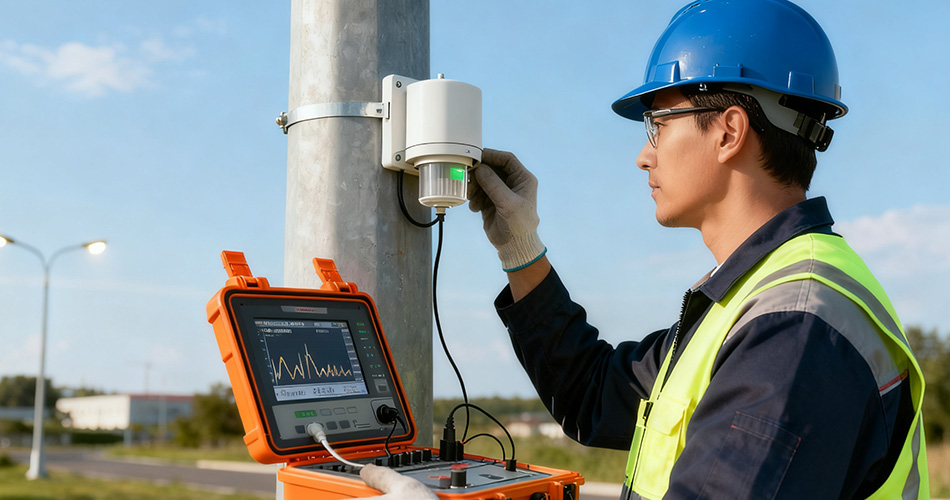
Effective testing goes beyond basic “on/off” checks, focusing on three key dimensions that directly impact commercial use cases:
This test verifies that the photocell activates and deactivates lights at consistent, accurate thresholds.
- Simulate dusk and dawn using light-dimming chambers to replicate gradual light level changes.
- Record trigger times across multiple cycles to ensure consistency—avoiding erratic activation from passing clouds or temporary shade.
- Align thresholds with business needs: for example, ensuring parking lot lights turn on 15 minutes before full dusk to maintain safety during evening transitions.
Commercial photocells operate in diverse climates, so testing must replicate real-world conditions.
- Expose sensors to temperature extremes (from -20°C to 50°C) to mimic seasonal variations.
- Subject units to simulated rain, dust, or humidity to validate weatherproofing integrity during operation.
- Ensure performance remains consistent post-exposure—no delayed triggers or false activations after environmental stress.
Reliability over months (not just days) is critical for commercial lighting systems with low maintenance budgets.
- Run continuous dusk-dawn cycles for 30–60 days to simulate extended use.
- Monitor for drift in trigger thresholds (e.g., a sensor that gradually activates lights earlier than intended).
- Test compatibility with smart controllers over time—ensuring communication remains seamless without signal drops.

To maximize the value of photocell dusk dawn operation reliability testing, integrate it into your overall lighting system deployment:
Conduct preliminary testing in a controlled environment (e.g., a facility workshop) before deploying photocells to outdoor spaces. This identifies faulty units early, avoiding costly rework.
Test photocells alongside other smart components to ensure synergy. For example, verify that a photocell’s dusk trigger communicates seamlessly with a central controller to dim lights incrementally, rather than switching on at full brightness abruptly.
After mounting photocells, perform on-site testing to account for location-specific factors:
- Check for interference from reflective surfaces (e.g., metal awnings) or nearby light sources.
- Validate performance during actual weather events (e.g., rainy dusk) to ensure real-world reliability.
- Use remote monitoring tools (via gateways) to track trigger times for 1–2 weeks post-installation, making minor adjustments as needed.
Reliability degrades over time, so incorporate retesting into annual maintenance plans. This proactive approach catches gradual performance declines before they impact operations.
Photocell dusk dawn operation reliability testing is a non-negotiable component of deploying effective commercial smart lighting solutions. By validating trigger precision, environmental resilience, and long-term stability, businesses ensure their lighting systems are energy-efficient, safe, and low-maintenance. For organizations relying on automated dusk-dawn lighting—from industrial facilities to educational campuses—testing transforms photocells from simple sensors into dependable workhorses that support daily operations.
When integrated with a full suite of smart lighting components—controllers, gateways, and remote management tools—tested photocells deliver a cohesive system that adapts to business needs while withstanding the elements. The result is a lighting infrastructure that requires minimal intervention, reduces costs, and maintains consistent performance year-round.


)
)
)
)

+86 15899791249

+86 755 2955 3313


Address: Huafeng No.1 Science and Technology Park, Sanwei, Bao'an District, Shenzhen, Guangdong, China.
