

Time:2026-05-20
The commercial construction sector is facing an unprecedented labor shortage. At the same time, newly updated 2026 building codes demand the strict implementation of Networked Lighting Control (NLC) solutions. For project developers, general contractors, and electrical engineers, meeting these requirements using traditional electrical wiring methods has become a major financial bottleneck.
To solve this problem, forward-thinking engineers are changing how commercial grids are designed. The integration of nlc power over ethernet (PoE) has emerged as a disruptive force. This technology uses a single low-voltage network cable to carry both electricity and high-speed data.
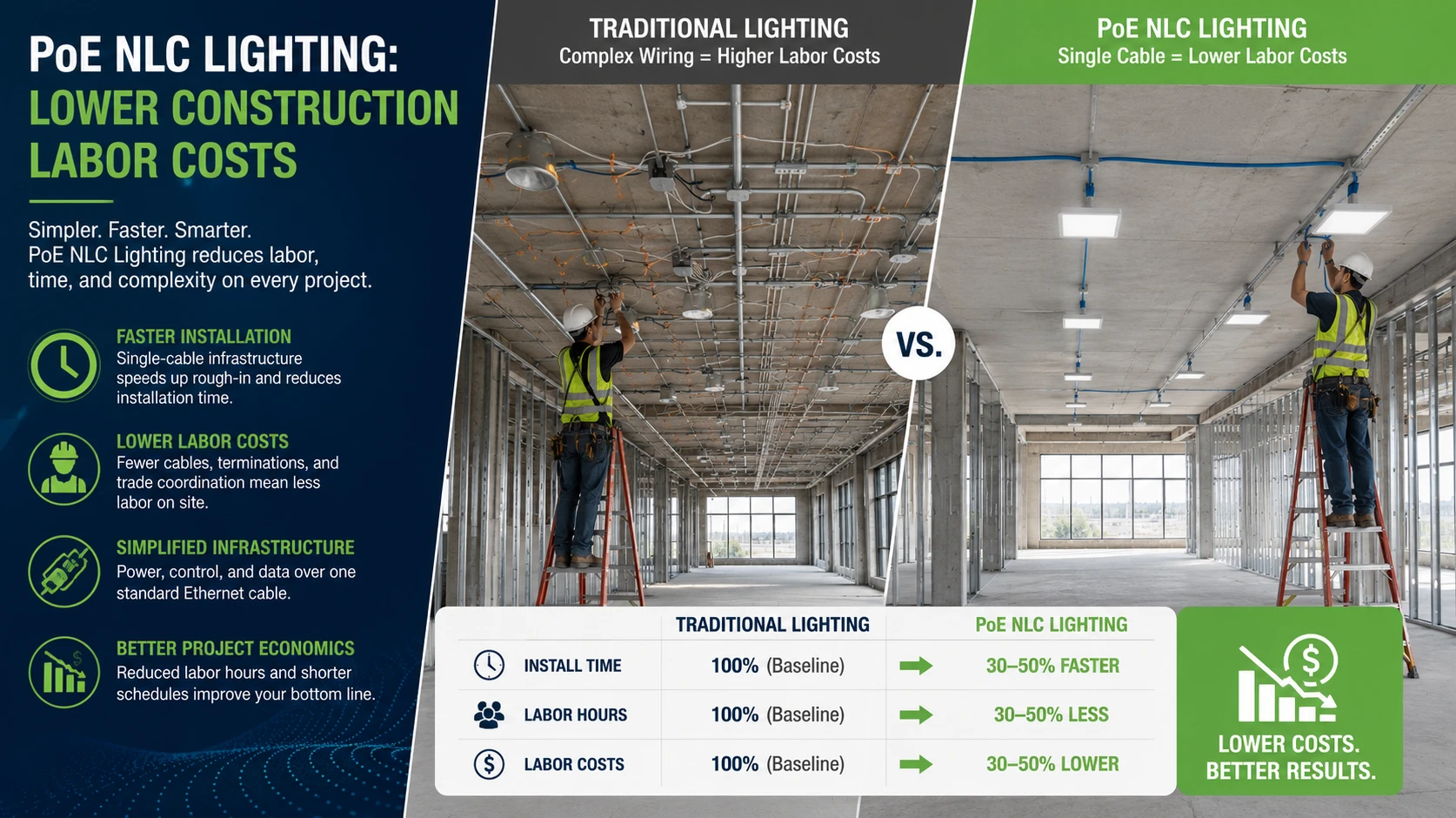
As a result, it completely changes installation economics. Contractors can now deploy a scalable, enterprise-grade smart lighting system while cutting field labor costs by significant margins.
To calculate your true financial return, look at how an nlc power over ethernet system simplifies
building hardware. Traditional commercial setups require two separate pathways: heavy copper high-voltage conduit for power, and separate low-voltage lines for control communication.
A PoE setup eliminates this duplication. It uses standard Category 6 (Cat6) network cables to deliver DC power directly to your smart devices.
Standard LED fixtures operate internally on low-voltage DC power. In a typical AC grid, every single light fixture must contain an internal driver to convert high-voltage AC electricity down to DC. This driver creates heat, acts as a common point of hardware failure, and increases fixture engineering costs.
With nlc power over ethernet, the power distribution happens at a centralized network switch rack. Clean DC power flows directly down the data lines, creating a much more stable and resilient lighting control system.
By centralizing power conversion, manufacturers like LumiEasy remove the weak point from individual fixtures, extending the overall lifecycle of the hardware deployment.
The primary driver for choosing an nlc power over ethernet setup in new building projects is the massive drop in structural installation labor. High-voltage electrical work is heavily regulated, slow, and expensive. Low-voltage data cabling, however, follows a much faster and more flexible workflow.
Pulling heavy metal conduit and thick armored copper wire requires highly specialized, high-wage field labor. In contrast, running lightweight ethernet cables does not require rigid metal tracking or complex bending tools.
A single data technician can route Cat6 lines through open ceiling spaces rapidly. By switching to nlc power over ethernet, project managers can optimize their field labor allocations. They can save certified high-voltage electricians for major sub-panel infrastructure while data teams handle the entire lighting layout safely.
Copper pricing has hit historic highs, making traditional electrical wiring a major risk for project budgets. Ethernet lines use thinner copper cores and require zero expensive metal junction boxes. This shift cuts raw material costs drastically. It also ensures that a standard commercial lighting retrofit or new build project stays well within its financial boundaries.
Running the wires does not end the labor savings of a PoE-driven network. The commissioning phase, where you group sensors, switches, and fixtures, often causes major project delays in traditional projects.
When an installer connects a PoE fixture to the network switch, the device is immediately powered and assigned a unique IP address. By using advanced ble commissioning tools and localized data protocols, the system maps itself automatically.
Software-Defined Grouping: Technicians do not need to physically trace wires back to a wall switchboard. You can use standard lumieasy tools on a tablet to create structural zones in seconds.
Instant Calibration: An energy manager can handle a precise lighting sensor sensitivity adjustment remotely. You can fine-tune motion sensors across fifty rooms at once without climbing a single ladder.
Dynamic Flexibility: If an office wall is moved during a future tenant change, you do not need to strip out wiring. You simply reconfigure the software boundaries to establish a new zone lighting control layout.
Once a new building is occupied, nlc power over ethernet changes how the facility is managed. It provides an unmatched level of operational visibility that traditional wired packs cannot match.
Because every light fixture is a native node on the corporate IT network, it acts as a high-speed sensor hub. The infrastructure continuously feeds occupancy and ambient light metrics back to a centralized cloud platform.
This allows the energy manager to generate real-time heatmaps, tracking exactly how employees use collaborative zones, conference spaces, and quiet rooms. This accurate data provides empirical evidence for real estate resizing and precise HVAC scheduling.
In an older lighting control system, tracking down a failed driver required physical diagnostics on a ladder. With a PoE setup, the network switch monitors the exact wattage draw of every individual bulb. If a fixture behaves oddly, the platform sends an automated alert to the repair team, pinpointing the exact room and port number. This predictive approach keeps operational downtime at zero.
Modern commercial structures require total automation across all building systems. An nlc power over ethernet backbone serves as the central nervous system for this unified approach, linking lighting directly with HVAC, access control, and security platforms.
| Feature Variable | Standard High-Voltage NLC | PoE Low-Voltage NLC |
| Cable Infrastructure | Heavy 12/2 Copper + Metal Conduit | Lightweight Cat6 Network Cables |
| Installation Speed | Slow (Requires specific structural paths) | Fast (Simple plug-and-play layouts) |
| Safety Threshold | High Risk (Requires lock-out safety) | Safe (Low-voltage power carries no shock risk) |
| Data Bandwidth | Low (Basic wireless or slow bus lines) | High (Gigabit network speeds per node) |
By placing your smart lighting system onto the same native network as your IT servers, you eliminate the need for expensive third-party conversion gateways. The building speaks one clean language, making it fully ready for future AI-driven optimization updates.
A: Under standard Ethernet rules, a single cable run from the network switch rack to a fixture can reach only 100 meters (328 feet). Therefore, for larger building footprints, LumiEasy architectures rely on distributed edge switches to maintain an efficient lighting control system across a multi-floor campus.
A: Yes. Even if your main building server goes offline for routine IT updates, the localized network switches keep running. Wall dimmers and motion sensors maintain direct communication with their local fixtures. This decentralized redundancy prevents any disruption to daily business operations.
A: Absolutely. Because PoE runs on low-voltage DC power (under 60 volts), it carries zero risk of dangerous electrical shocks. Our PoE sensors and fixtures meet a high linear smart sensor IP rating, allowing you to deploy them safely in food processing areas, commercial kitchens, and parking drop zones.
A: Yes. Many LumiEasy PoE fixtures include built-in Bluetooth transceivers. This allows an installer to use our standard ble commissioning tools to handle initial pairing and lighting sensor sensitivity adjustment locally from the floor. The configuration then syncs back to the main data registry automatically.
Related new
NLC Power Over Ethernet: Future of Connectivity


)
)
)
)

+86 15899791249

+86 755 2955 3313


Address: Huafeng No.1 Science and Technology Park, Sanwei, Bao'an District, Shenzhen, Guangdong, China.
