

Time:2026-04-22
Commercial buildings in 2026 require more than just simple toggles. Modern facility managers demand a robust lighting control system that provides real-time data and remote access. To achieve this, a central controller is necessary to link local hardware to the internet.
The smart lighting gateway serves as this critical bridge. It connects smart devices—like sensors and switches—to a secure cloud connected lighting gateway network. This integration is the foundation of professional iot lighting control, allowing for massive scalability and energy efficiency.
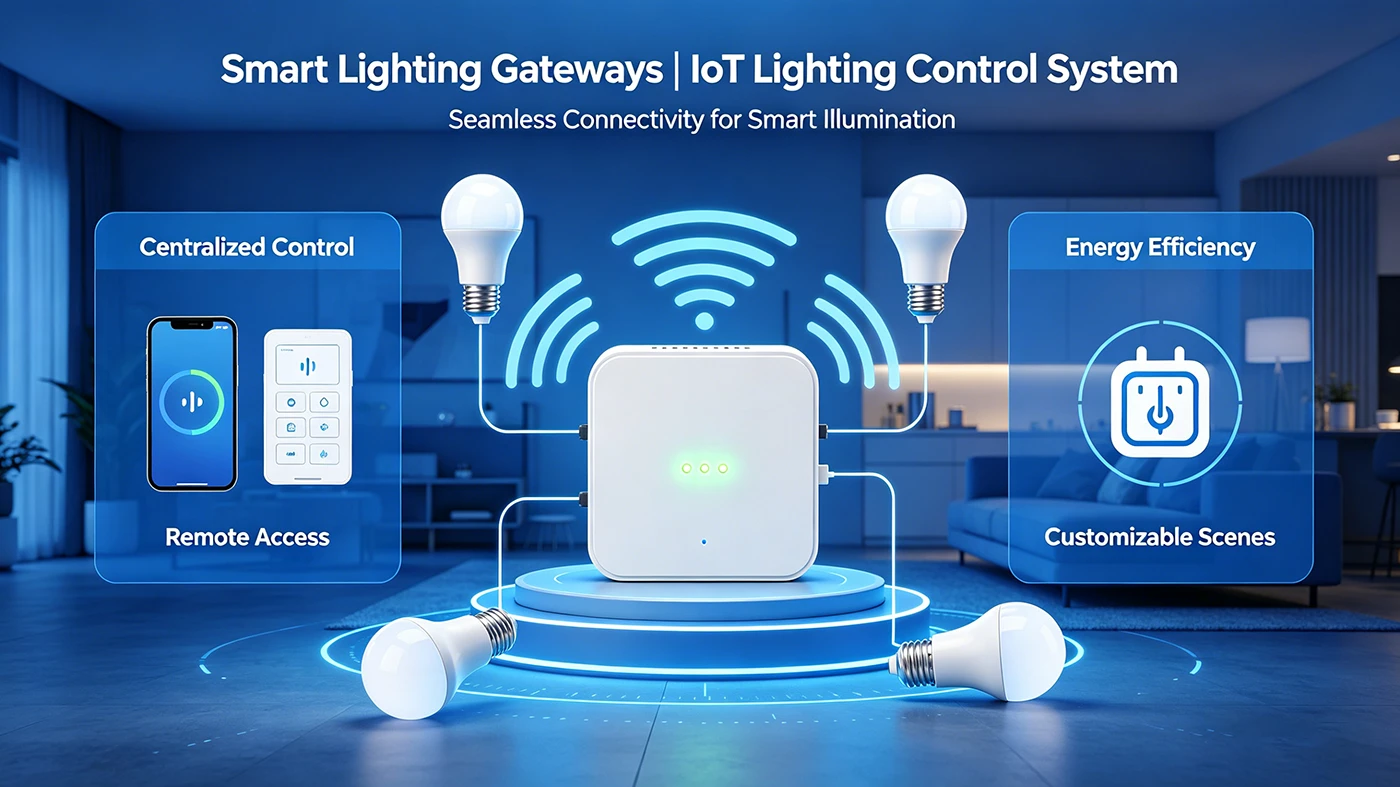
A smart lighting gateway is a hardware translator. Most industrial smart devices communicate using low-power protocols like Bluetooth Mesh to save energy. However, these signals cannot reach the internet directly.
The gateway acts as a bluetooth mesh bridge. It receives local data and converts it into a format suitable for Wi-Fi or Ethernet. This enables gateway lighting system integration, allowing users to manage their entire facility from a smartphone or computer dashboard.
Selecting the right protocol for your lighting control system depends on your building’s scale.
A Zigbee smart lighting gateway is reliable for smaller offices or residential buildings. It uses a structured network that is easy to manage. However, it can face signal interference in large metal industrial spaces.
For 2026 industrial standards, Bluetooth Mesh is the preferred choice. It allows for a decentralized network where every fixture reinforces the signal. A Bluetooth-based smart lighting gateway can handle hundreds of nodes across a warehouse without needing a central hub for every room.
Why connect your lighting control system to the cloud? The value lies in long-term management and data.
Remote Energy Monitoring: Track power usage in real-time to meet ESG goals.
OTA Updates: A cloud connected lighting gateway allows manufacturers like LumiEasy to push security patches wirelessly to all smart devices.
Predictive Maintenance: The system can alert you before a driver fails, reducing downtime.
By focusing on iot lighting control, businesses can reduce their carbon footprint while lowering operational costs through automated scheduling.
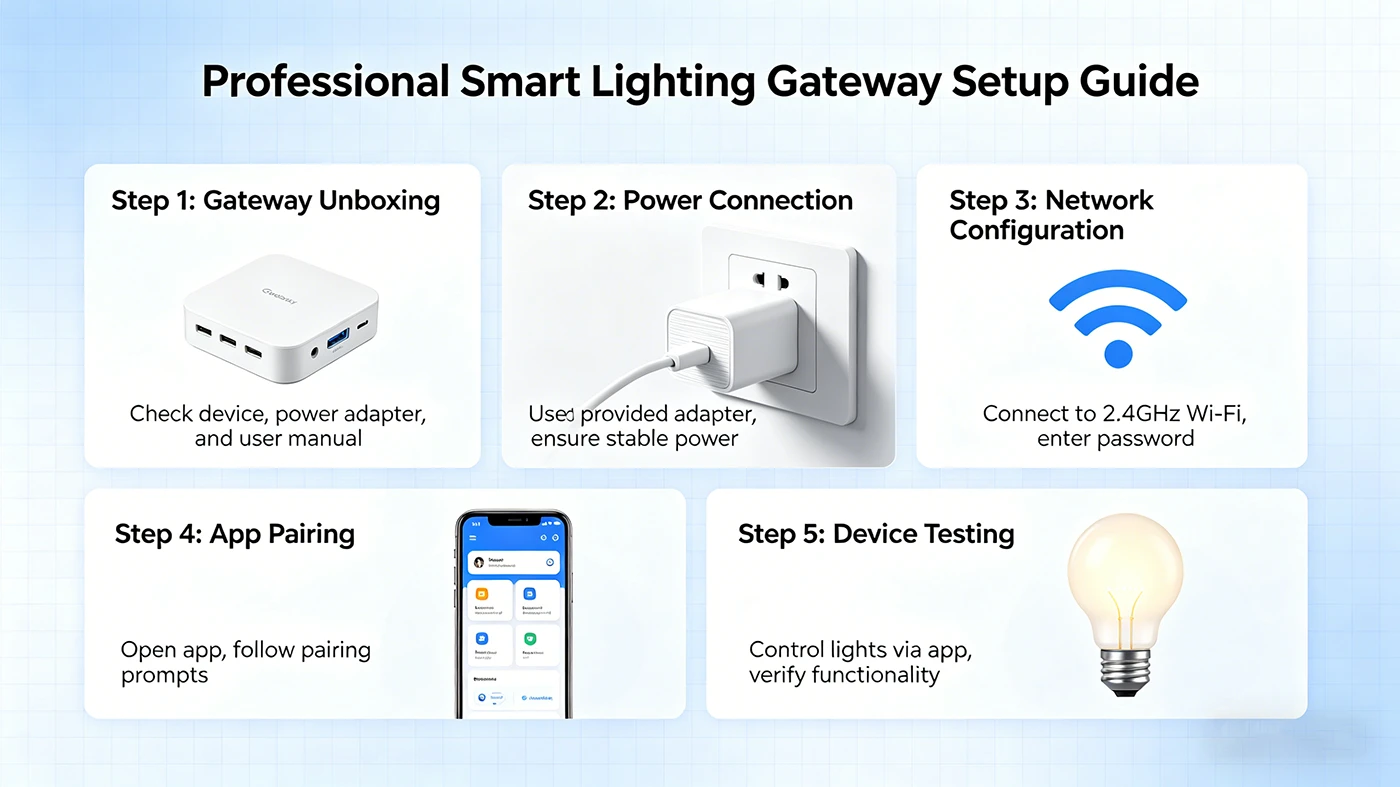
To minimize labor costs, a smart lighting gateway setup must be fast. Professional systems should not require advanced coding knowledge.
The LumiEasy Setup Workflow:
Hardware Connection: Plug the gateway into the local network via Ethernet or Wi-Fi.
Device Discovery: Use the mobile app to scan for nearby Bluetooth Mesh nodes.
Cloud Pairing: Securely sync the central controller to your cloud account.
Zoning: Group your smart devices into specific areas like "Loading Dock" or "Parking Lot."
This streamlined smart lighting gateway setup allows contractors to commission large-scale projects in a fraction of the time required by traditional wired systems.
Successful gateway lighting system integration requires compatibility. Your gateway should act as an open bridge, not a locked cage.
Key Integration Features:
Protocol Flexibility: Support for both Bluetooth Mesh and 0-10V dimming.
BMS Compatibility: The ability to share occupancy data with HVAC systems to save even more energy.
Security: High-level encryption to protect the lighting control system from external cyber threats.
Integrating a high-quality smart lighting gateway ensures your facility is ready for future IoT advancements.
A: While a gateway has a high signal range, we recommend one central controller per floor or per large zone to ensure the lowest latency and best iot lighting control performance.
A: No, Zigbee and Bluetooth use different frequencies. However, LumiEasy offers multi-protocol gateways that can facilitate gateway lighting system integration across different hardware types.
A: The system maintains "Local Logic." Your lighting control system will continue to operate based on pre-set schedules and sensor triggers. The gateway will simply sync the data once the cloud connection is restored.
A: A single LumiEasy smart lighting gateway is optimized to manage up to 200 nodes, ensuring a smooth and responsive user experience without lag.


)
)
)
)

+86 15899791249

+86 755 2955 3313


Address: Huafeng No.1 Science and Technology Park, Sanwei, Bao'an District, Shenzhen, Guangdong, China.
