

Time:2025-11-19
Warehouse aisle motion sensor systems address the unique pain points of narrow/long aisles—shelter obstruction, frequent forklift/personnel movement, and uneven illumination—by combining targeted motion detection with adaptive lighting control. Unlike general high bay lighting, these systems prioritize "no blind spots, fast response, and anti-interference" to balance energy savings and operational safety. This guide focuses on aisle-specific sensor selection, layout strategies, linkage technologies, and real-world results, avoiding excessive technical parameters.
Aisle lighting systems must align with the narrow/long and dynamic characteristics of warehouse aisles, built on three foundational principles:
Obstruction Resistance: Sensors must penetrate shelf gaps or avoid being blocked by stored goods, ensuring reliable detection even in high-rack aisles (8m+ height) .
Dual-Scenario Adaptation: Distinguish between slow-moving personnel and fast-moving forklifts to avoid false triggers (e.g., non-motion shelf vibration) or delayed response .
Zone-Specific Activation: Illuminate only the active segment of the aisle (not the entire length) to maximize energy savings—critical for long aisles (50m+).
Aisle-Exclusive Linkage: Adopt interactive sensing technology where triggering one light activates adjacent fixtures in sequence, eliminating "dark gaps" between independently controlled lights .
Directional Following: Lights ahead of moving objects (personnel/forklifts) brighten first, while lights behind dim after a delay—ensuring continuous visibility without wasting energy on unused segments .
Speed-Adaptive Delay: Adjust light-off delay based on movement speed (e.g., 10-second delay for personnel, 30-second delay for forklifts) to match aisle operation rhythms.
Anti-Interference Design: Resist dust, humidity, and temperature fluctuations (e.g., cold storage aisles) to maintain detection accuracy .
Vibration Resistance: Withstand forklift-induced vibrations to avoid false activation, ensuring stable operation in high-traffic aisles.

Choose sensors based on aisle width, shelf height, and traffic type—avoid one-size-fits-all solutions:
Key Advantages: Long detection range (up to 20m), wide angle, and ability to penetrate dust, thin shelf materials, or fog—unaffected by temperature changes (critical for cold storage) .
Best For: Wide aisles (3m+), high-rack aisles (6m+), and aisles with frequent forklift movement. Solves shelf obstruction issues that plague other sensor types.
Practical Tip: Select models with adjustable sensitivity to avoid triggering by distant aisle traffic (e.g., limit detection to 10m for narrow aisles).
Key Advantages: Low cost, human-body heat targeting (reduces false triggers from inanimate objects), and easy installation—suitable for low-traffic, narrow aisles (1-2m) .
Limitations: Susceptible to shelf blockage and temperature extremes (e.g., detection range shortens in cold storage).
Best For: Small warehouses, pick-only aisles, or auxiliary corridors with minimal forklift use.
Key Technology: Lights communicate with each other (via wireless or wired links)—triggering one fixture activates a "light chain" ahead of movement, while behind fixtures dim sequentially .
Core Benefit: Eliminates "bright spot isolation" in long aisles, where independent sensors may leave dark gaps between activated lights.
Best For: Distribution center main aisles, automated storage/retrieval system (AS/RS) aisles, or any aisle over 30m in length.
Key Advantages: High precision, fast response (≤0.5s), and compatibility with AGV/AMR systems—detects small movements and adapts to vehicle speed .
Best For: Automated warehouses, aisles with frequent AGV operations, or high-precision picking zones where fast illumination response is critical.
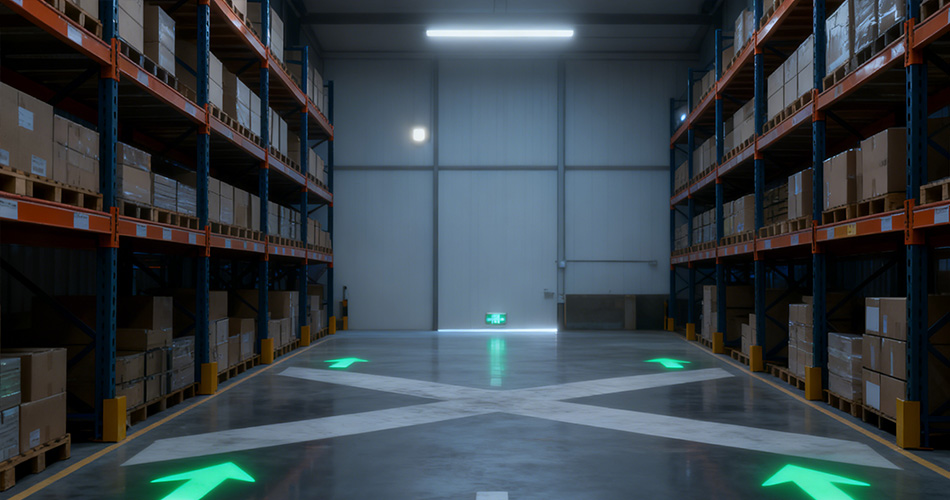
Poor sensor placement leads to blind spots or excessive energy use—follow these aisle-specific rules:
Narrow Aisles (1-2m): Install sensors on fixture bodies or shelf sides, spaced 8-10m apart. Avoid mounting on aisle ends (prone to false triggers from adjacent areas) .
Wide Aisles (3m+): Use ceiling-mounted dual-sensor fixtures (left/right coverage) or side-mounted sensors on both shelf rows, spaced 12-15m apart.
High-Rack Aisles (6m+): Add mid-shelf sensors (at 2/3 shelf height) to complement ceiling sensors—solves detection blind spots caused by tall stored goods .
Mount sensors at the "aisle centerline" height (not too high or low) to bypass shelf edge blockage. For double-deep racks, install sensors on the rack columns facing the aisle.
Use angled sensor lenses (15-30° downward) to focus detection on the aisle floor, not on shelf contents.
Divide long aisles (30m+) into 10-15m segments, each with independent sensor control. This ensures only the occupied segment illuminates, not the entire aisle.
Sync zone boundaries with warehouse management system (WMS) picking zones—e.g., when a picking order targets Zone A of an aisle, only Zone A sensors activate.
Cold Storage Aisles: Choose low-temperature-resistant sensors (-20℃ to +50℃) and avoid infrared sensors (performance degrades in cold).
Dusty Aisles (e.g., bulk goods): Select sealed radar sensors with IP65+ protection to prevent dust accumulation on lenses .

Real-world implementations demonstrate targeted results for different aisle types:
Solution: Infrared-interactive sensor system (8-10m spacing) with 15-second delay for personnel. Lights brighten to 100% when occupied, dim to 20% standby.
Result: 82% energy savings vs. constant-on fluorescent lights. Eliminated blind spots in mid-aisle, improving picking accuracy by 12% .
Solution: Radar sensors (15m spacing) with speed-adaptive delay (30s for forklifts, 10s for personnel) + interactive linkage.
Result: 75% energy savings vs. traditional LED lights. No false triggers from shelf vibrations, and forklift operators reported 100% aisle visibility .
Solution: Ceiling radar sensors + mid-shelf auxiliary sensors + WMS integration. Lights activate 2 segments ahead of the AS/RS shuttle.
Result: 78% energy savings, with zero blind spots. The system reduced shuttle stop time (no waiting for lights to brighten) by 5% .
Prioritize the following recommendations to match your specific aisle characteristics:
Narrow Aisles (1-2m) with Personnel-Focused Traffic: Opt for infrared sensors or small-range radar sensors. Prioritize low cost and human-targeted detection capabilities to minimize false triggers from inanimate objects.
Wide Aisles (3m+) with Heavy Forklift Traffic: Choose long-range radar sensors. Focus on anti-dust performance, wide coverage area, and vibration resistance to withstand forklift-induced movement and warehouse debris.
Long Aisles (30m+) with Multi-Segment Use: Select interactive radar or laser sensing systems. Prioritize zone control functionality and sequential linkage to eliminate dark gaps and avoid illuminating unused segments.
High-Rack Aisles (6m+) with Obstruction Risks: Use dual-sensor setups (ceiling-mounted + mid-shelf auxiliary sensors). Prioritize blind spot elimination through multi-position detection to bypass tall stored goods.
Cold or Dusty Environments: Opt for sealed radar or laser sensors. Prioritize low-temperature resistance (for cold storage) and IP65+ protection (for dusty aisles) to maintain detection accuracy in harsh conditions.
Safety Enhancement: Eliminates dark gaps in aisles, reducing trip/fall risks and improving forklift operator visibility. Interactive linkage ensures no "dark zones" during movement .
Operational Efficiency: Fast sensor response (≤1s) matches personnel/forklift speed—no waiting for lights to activate. WMS integration aligns lighting with picking tasks, saving time.
Low Maintenance: Sealed sensor designs (for dusty/cold aisles) and long LED lifespans (50,000+ hours) reduce replacement frequency. Cloud monitoring alerts to faulty sensors before blind spots occur.
Scalability: Zhaga standard interfaces allow incremental upgrades—add sensors to new aisle segments without rewiring the entire system .
Warehouse aisle lighting motion sensor systems deliver maximum value when tailored to aisle width, height, traffic type, and environment. By selecting the right sensor technology (radar for wide/obstructed aisles, infrared for narrow/personnel aisles), optimizing placement to avoid blind spots, and leveraging interactive linkage, warehouses achieve 75-85% energy savings while enhancing safety and productivity. Unlike generic high bay systems, these aisle-specific solutions solve the unique challenges of narrow/long spaces—making them a critical investment for cost-conscious and operationally efficient warehouses.


)
)
)
)

+86 15899791249

+86 755 2955 3313


Address: Huafeng No.1 Science and Technology Park, Sanwei, Bao'an District, Shenzhen, Guangdong, China.
