

Time:2026-04-13
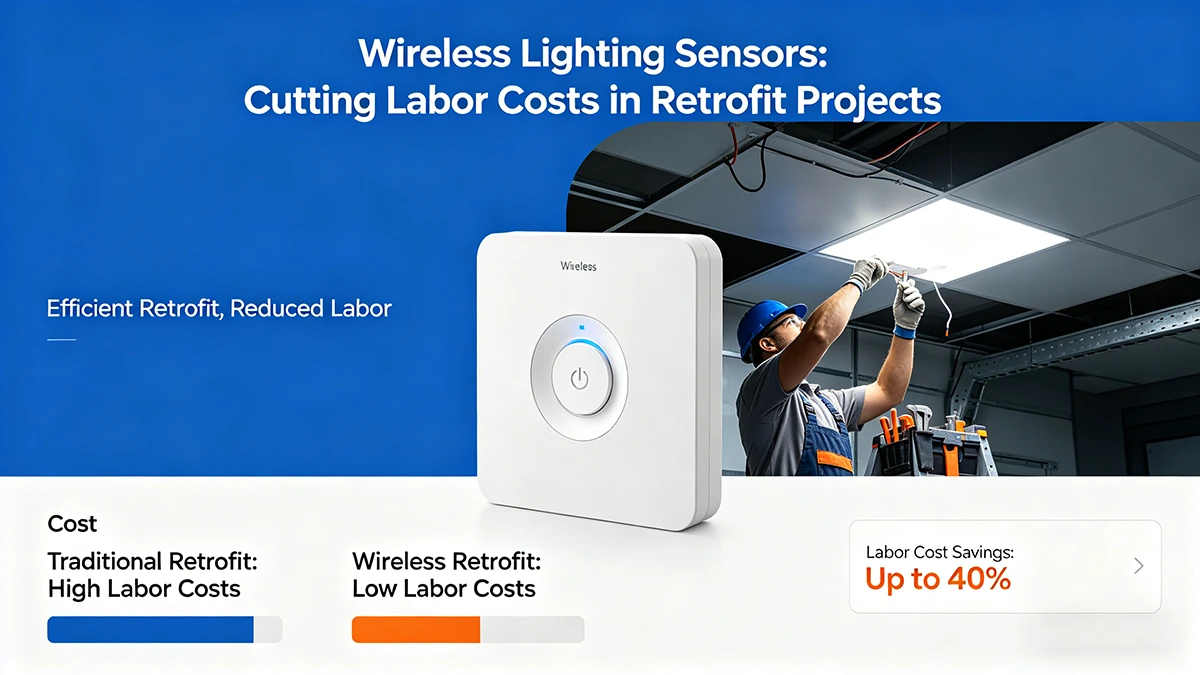
In the competitive landscape of 2026 commercial real estate, the drive for energy efficiency has moved beyond simple lightbulb replacement. Property owners and facility managers are now focusing on the "intelligence" of their buildings. However, the most significant barrier to upgrading existing structures—known as retrofitting—is not the cost of the hardware itself, but the staggering expense of manual labor and electrical wiring.
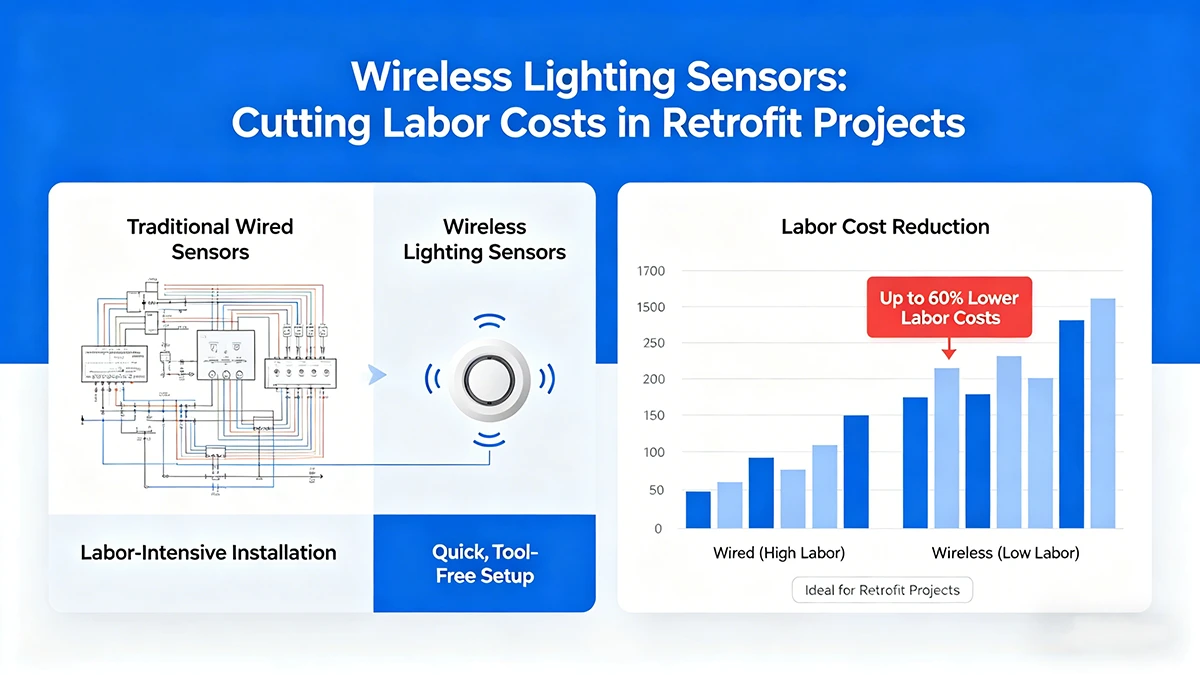
Traditional wired control systems require cutting into drywall, pulling miles of copper wire through ceilings, and hiring teams of licensed electricians for weeks of high-voltage work. This is why the industry has reached a tipping point: the shift toward the wireless lighting sensor. By removing the need for control wiring, these devices are fundamentally changing the financial equation of building renovations.
For lighting professionals and distributors, offering wireless solutions is the most effective way to help clients slash installation overhead and realize a much faster Return on Investment (ROI).
The primary financial drain in any lighting upgrade is "labor hours." In Western markets, the hourly rate for a specialized electrician continues to climb, making traditional wired systems prohibitively expensive for older buildings.
A wireless lighting sensor eliminates what many contractors call the "copper tax." In a wired system, every sensor must be physically connected to a controller or a power pack. In a large office or warehouse, this involves hundreds of feet of conduit and wire.
Zero Control Wiring: Wireless sensors communicate via radio frequency (RF) signals, such as Bluetooth Mesh, Zigbee, or EnOcean.
Reduced Demolition: Because there is no need to pull wires through walls, there is no need for costly drywall repair or painting after the electrical work is finished.
When comparing project timelines, the wireless sensor installation time is often 70% to 80% faster than wired alternatives. A technician can typically mount and commission a wireless unit in under five minutes, whereas a wired sensor might require an hour of labor to wire, mount, and test. For a facility with 500 sensors, this difference represents hundreds of thousands of dollars in saved labor costs.
The most common concern regarding wireless technology is maintenance—specifically, the fear of constantly changing batteries. In 2026, technology has effectively solved this issue through high-density power storage and energy harvesting.
Modern sensors utilize advanced lithium-thionyl chloride (Li-SOCl2) technology. A high-quality wireless lighting sensor battery is now engineered to last 8 to 10 years under normal operating conditions. This matches or exceeds the typical maintenance cycle of the LED fixtures themselves. Most systems now include automated "low battery" alerts sent directly to a facility manager's smartphone, allowing for planned, proactive maintenance rather than emergency repairs.
For projects aiming for the ultimate "fit-and-forget" solution, the self powered wireless sensor is the gold standard. These devices do not use traditional batteries. Instead, they harvest energy from their environment:
Kinetic Energy: Some wall switches generate enough power to send a wireless signal simply from the mechanical force of a human finger pressing the button.
Photo-Voltaic (Solar) Cells: Many ceiling-mounted sensors feature tiny solar strips that draw enough energy from the room's ambient light to power the internal radio and occupancy detection hardware.
Thermal Harvesting: In industrial settings, sensors can even harvest minute amounts of energy from the heat generated by machinery or lighting drivers.
Wireless technology is no longer restricted to a single room. It has expanded to cover the entire building envelope, from the interior office to the exterior parking structure.
Inside a commercial office or hospital, a wireless lighting sensor for room control provides granular intelligence. These sensors track more than just movement; they often include integrated photocells for Daylight Harvesting. By measuring the natural light coming through windows, the sensor tells the lights to dim, saving an additional 20% in energy costs. Because they are wireless, they can be easily moved. If a tenant decides to move a partition wall or change the office layout, the sensors can be unmounted and repositioned in seconds without an electrician.
The wireless lighting sensor outdoor application is critical for security and safety. These units are built with robust, weather-resistant housings (typically IP65 or IP66 rated) to withstand rain, snow, and extreme heat. Outdoor wireless sensors are particularly valuable for parking lots. Wiring a parking lot for sensors usually requires expensive trenching and tearing up asphalt. A wireless system allows sensors to be mounted directly onto existing light poles, communicating back to the building's gateway without a single inch of new underground wiring.
As buildings become more connected, the risk of "hacking" becomes a serious concern for IT departments. A lighting system should never be a backdoor into a corporate network.
Today’s professional-grade hardware is designed as an encrypted wireless lighting sensor. Modern protocols utilize AES-128 or AES-256 bit encryption, the same standard used by banking institutions.
Secure Commissioning: New sensors are added to the network using secure "handshakes," ensuring that unauthorized devices cannot join or sniff the network traffic.
Interference Immunity: Advanced frequency-hopping technology ensures that the lighting signal does not interfere with the building’s Wi-Fi or cellular signals, providing a stable, flicker-free experience.
For distributors and contractors, the "pitch" for wireless is simple: Speed, Savings, and Scalability.
Speed to Completion: Tell the client their building can be "smart" by next week, not next month. Wireless systems allow for "phased" installs where one floor is finished at a time without shutting down the entire building's power.
Scalability: Start with a wireless lighting sensor for room control in the lobby. If the client likes it, they can add sensors to the entire parking garage later without needing a new master controller.
Data Ready: These sensors don't just turn lights off. They collect occupancy data. In the AI era, knowing which rooms are actually used helps managers optimize cleaning schedules and HVAC settings, leading to even greater savings.
Retrofitting doesn't have to be a logistical nightmare of wires and walls. The wireless lighting sensor has matured into a reliable, secure, and incredibly cost-effective solution for 2026. By focusing on high-capacity batteries, self-powered options, and encrypted security, LumiEasy provides the tools you need to outpace the competition.
Whether you are looking for a wireless lighting sensor outdoor for a massive industrial park or a precise indoor solution to cut installation time, the future of lighting is wireless.
CTA: Ready to cut your labor costs by 70%? Contact our engineering team today for a free wireless retrofit audit. Let us show you how to make your building smarter without the wires.
In professional-grade units, you can expect 8 to 10 years. Our sensors are designed with low-power sleep modes, only waking up when motion is detected or when they need to "check-in" with the network.
Yes. For indoor environments with at least 50 lux of light (standard hallway lighting), solar-harvesting sensors are extremely reliable. For dark areas or storage rooms, we recommend battery-powered units for 100% uptime.
Absolutely. We use specialized lithium batteries and sealed electronics that are rated for operation from -40°C to +60°C. The wireless signal is not affected by rain or snow.
On average, a wireless install is 5x to 10x faster than a wired one. Because no conduit or high-voltage wiring is required, one technician can finish an entire floor in the time it used to take to finish two rooms.


)
)
)
)

+86 15899791249

+86 755 2955 3313


Address: Huafeng No.1 Science and Technology Park, Sanwei, Bao'an District, Shenzhen, Guangdong, China.
