

Time:2026-06-09
Most parking lot lighting waste is not caused by outdated fixtures alone. It is often caused by static lighting logic.
In many commercial parking lots, lights turn on at a fixed time, stay at full brightness all night, and do not respond to daylight, occupancy, weather, or real site activity. This creates unnecessary runtime, higher energy costs, and repeated manual schedule adjustments.
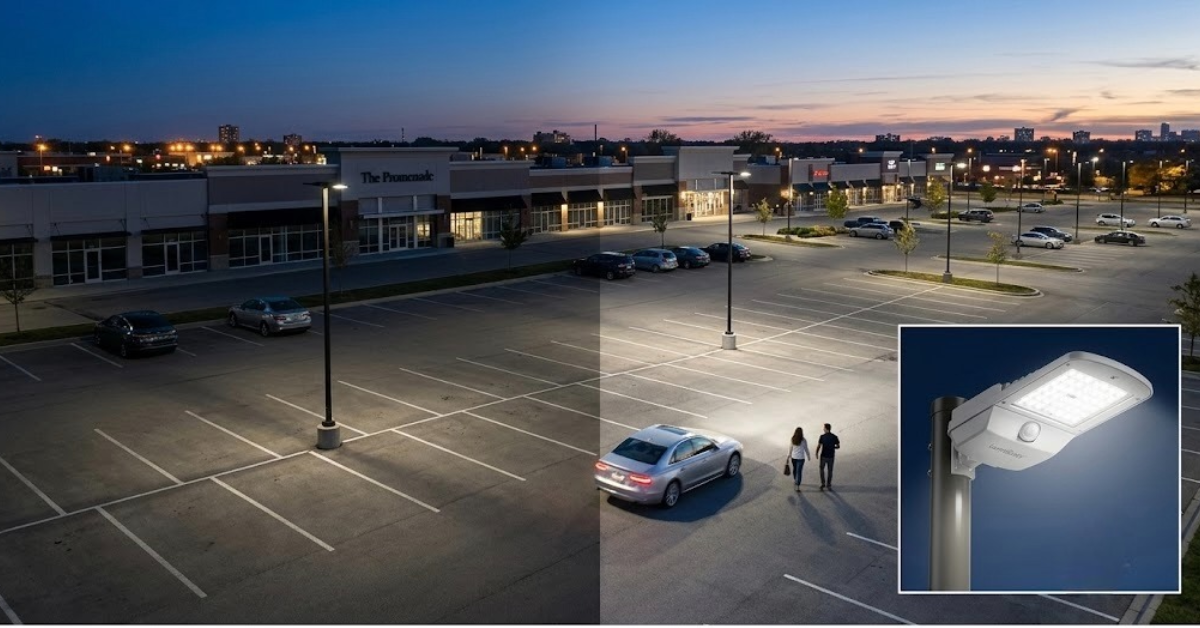
At The Promenade Bolingbrook, a retail property in the Chicago metropolitan area, LumiEasy upgraded 106 outdoor area light fixtures with a smart parking lot lighting control system. By combining photocell sensing and PIR motion detection, the property reduced parking lot lighting energy consumption by approximately 50%.
| Item | Details |
|---|---|
| Property Type | Commercial parking facility |
| Location | Chicago metropolitan area |
| Project Site | The Promenade Bolingbrook |
| Retrofit Scope | 106 outdoor area light fixtures |
| Fixture Power | 200W per fixture |
| Control Strategy | Digital photocell + PIR motion sensing |
| Control Architecture | Fixture-level smart outdoor lighting control |
| Interface | Zhaga-compliant sensor mounting |
| Activation Threshold | Below 100 lux |
| Dimming Strategy | Dim to 50% output after 30 minutes without motion |
| Result | Approximately 50% reduction in parking lot lighting energy consumption |
The American Midwest has large seasonal daylight differences. In winter, darkness arrives early. In summer, natural light can remain strong into the evening.
For parking lots controlled by fixed schedules, this creates a common problem:
Lights may turn on too early during bright summer evenings.
Fixtures may stay at 100% output even when traffic is low.
Facility teams must manually adjust schedules several times a year.
Energy is wasted in areas with little or no activity.
The property needed a lighting control system that could respond to real conditions instead of relying only on preset schedules.
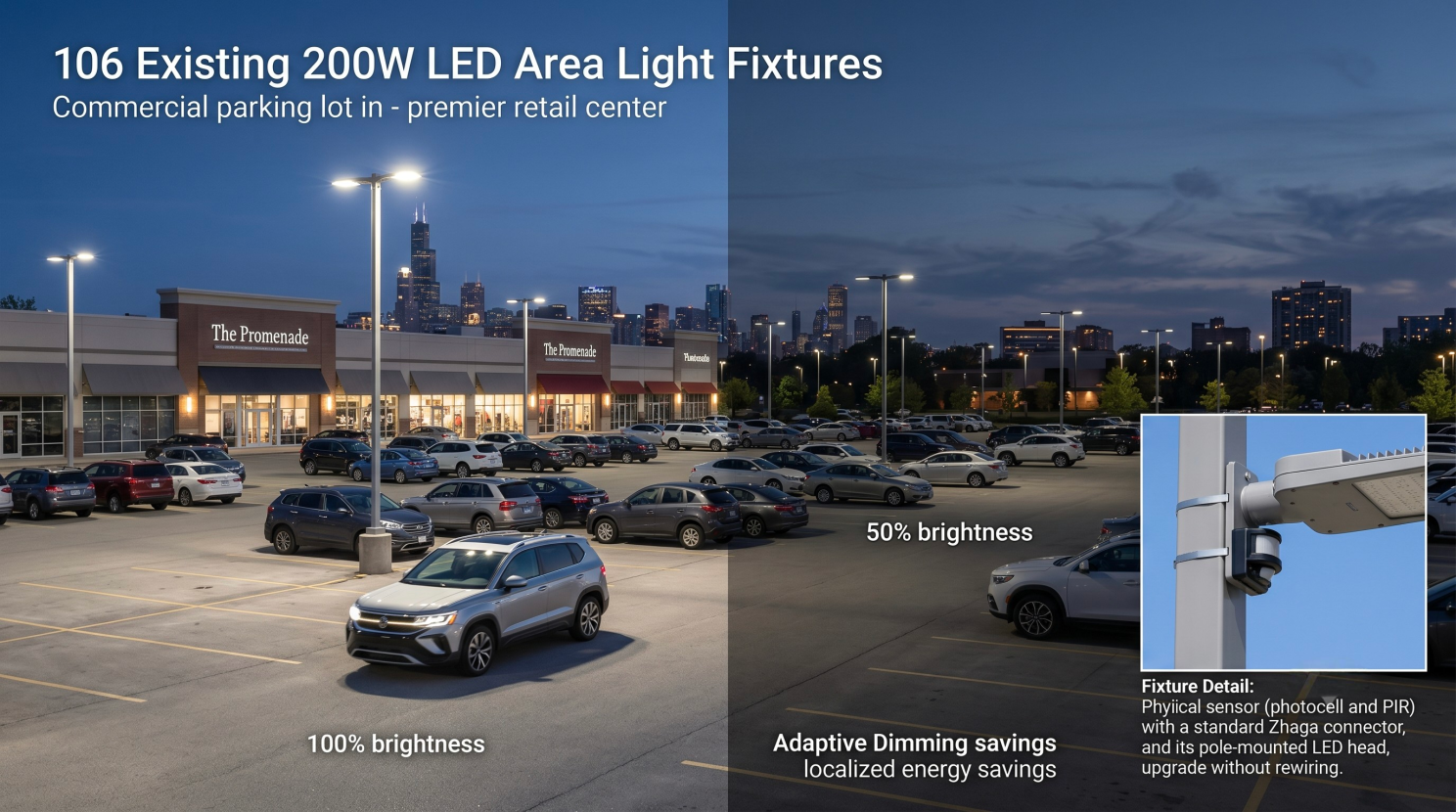 LumiEasy used a fixture-level outdoor lighting control solution. Each fixture was equipped with a smart sensor combining two key functions:
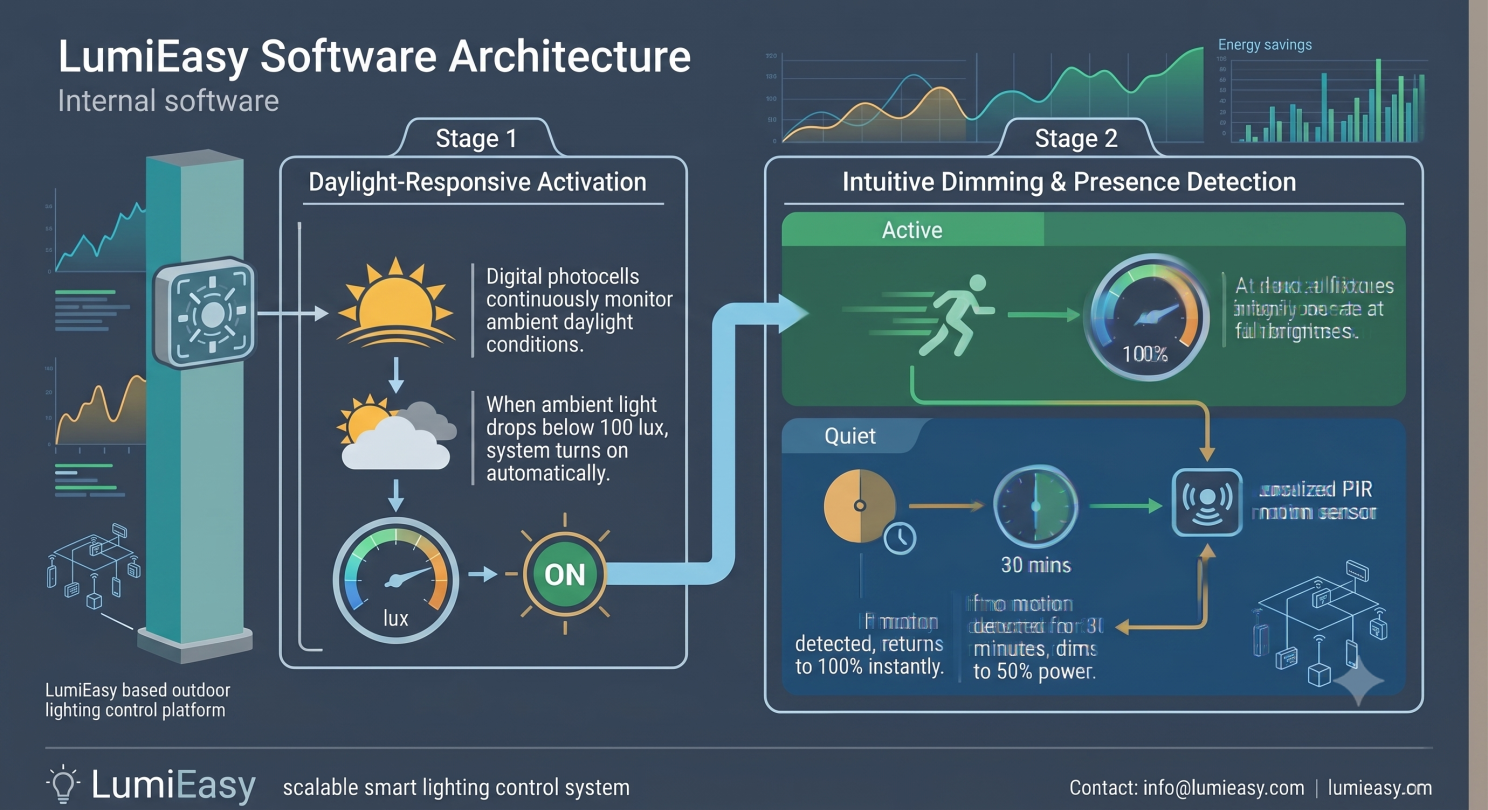
The sensor monitors ambient daylight and turns lights on only when natural light drops below the set threshold.
The sensor detects vehicle and pedestrian movement, allowing the fixture to brighten when activity is present and dim when the area is inactive.
The sensors were installed through a Zhaga-compliant interface, allowing them to be mounted directly onto compatible outdoor luminaires. This helped simplify installation and reduce disruption compared with major rewiring or trenching.
The control logic is simple and practical.
First, when ambient light drops below 100 lux, the system turns the parking lot lights on automatically. This helps the lighting respond to actual daylight conditions, including seasonal changes and cloudy weather.
Second, during active evening hours, fixtures can provide full brightness for visibility and safety. Later, when traffic decreases, the system reduces unnecessary energy use. If no motion is detected in a parking zone for 30 minutes, the corresponding fixture dims to 50% output. When a vehicle or pedestrian enters the area, the fixture returns to full brightness immediately.
This approach keeps the parking lot safe and usable while avoiding full-output operation in inactive areas.
The retrofit helped the property move from static lighting to adaptive parking lot lighting control.
By reducing unnecessary full-brightness runtime, the system helped cut parking lot lighting energy use by about half.
The photocell-based control logic allows the system to respond to real daylight conditions instead of relying on manual schedule changes.
The maintenance team no longer needs to adjust lighting schedules several times a year. The system now adapts automatically in the background.
Because fixtures do not need to stay at 100% output all night, the system can reduce unnecessary full-load operation and support more efficient long-term performance.
Area | Standard LED Parking Lot Lighting | Smart Parking Lot Lighting Control |
Control Logic | Fixed schedule or timer | Responds to daylight and motion |
Night Operation | Often 100% output all night | Dims inactive areas |
Daylight Response | Manual schedule adjustment | Automatic photocell activation |
Energy Saving Logic | Reduces fixture wattage | Reduces wattage and runtime waste |
Retrofit Flexibility | Limited control intelligence | Fixture-level sensors support easier upgrades |
The key lesson is simple:
LED fixtures reduce wattage. Smart lighting control reduces unnecessary runtime.
Even after LED upgrades, parking lots can still waste energy if lights remain at full brightness when daylight is available or when the site is inactive.
The Promenade Bolingbrook project shows how smart parking lot lighting control can reduce energy waste while keeping outdoor commercial spaces safe and easy to manage.
By combining photocell sensing, PIR motion detection, Zhaga-compliant installation, and fixture-level control, LumiEasy helped a Chicago-area retail property reduce parking lot lighting energy consumption by approximately 50%.
For commercial property owners, facility managers, and lighting retrofit teams, the next step after LED conversion is not just brighter lighting. It is adaptive lighting control that responds to real site conditions.
LumiEasy helps commercial properties deploy scalable smart lighting control systems that reduce energy waste, simplify facility operations, and support long-term energy efficiency.
Contact us for a free quote: info@lumieasy.com


)
)
)
)

+86 15899791249

+86 755 2955 3313


Address: Huafeng No.1 Science and Technology Park, Sanwei, Bao'an District, Shenzhen, Guangdong, China.
