

Time:2026-06-12
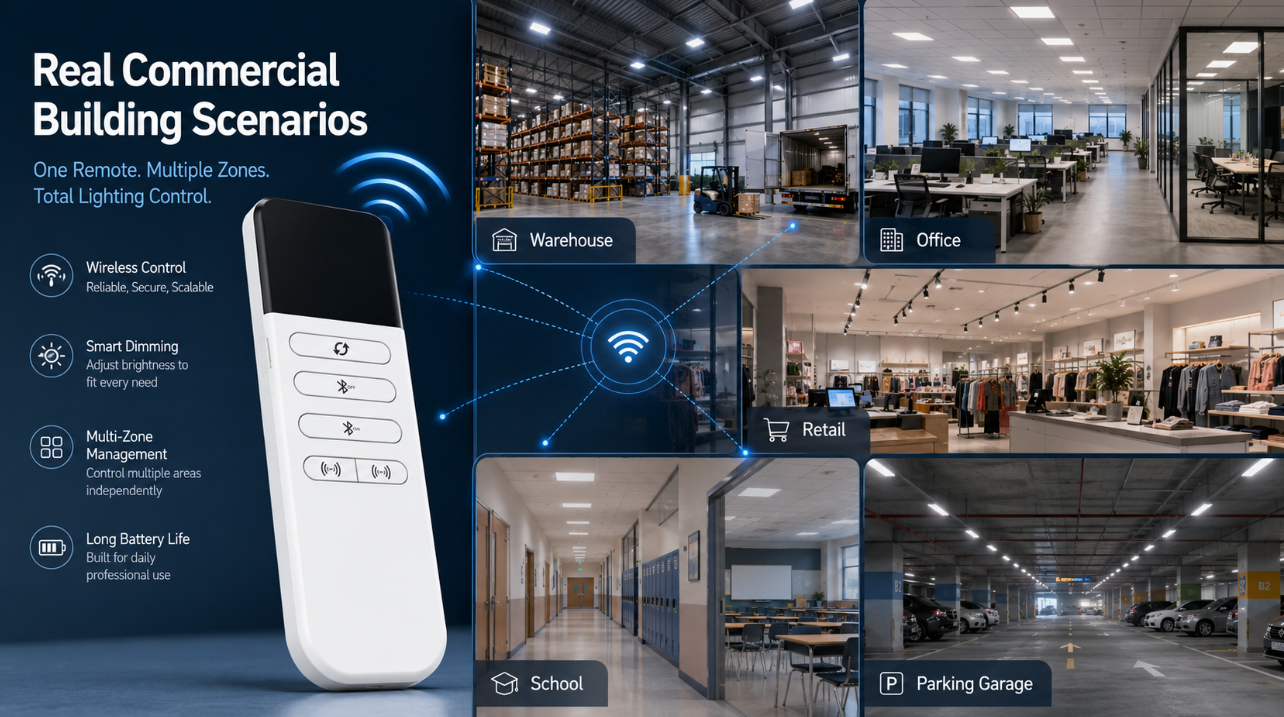
A multi-zone lighting remote matters in commercial buildings because different areas rarely need the same lighting at the same time. Warehouses, offices, retail stores, schools, and parking garages all have different occupancy patterns, daylight conditions, schedules, and safety needs.
Compared with a single-zone remote, a multi-zone lighting remote for commercial buildings gives facility teams one local control point for several lighting zones. It can support zoning, dimming, scene control, wireless lighting control, and retrofit lighting control. However, it is not a standalone energy-saving tool. Its value depends on proper zoning design, occupancy sensors, daylight sensors, schedules, dimming logic, networked lighting controls, and a lighting management platform.
Commercial buildings are not single-use spaces. A warehouse may include loading docks, storage aisles, packing areas, offices, and emergency routes. An office may include meeting rooms, open workstations, corridors, and reception areas. A parking garage may require different light levels at entrances, ramps, stairwells, and low-traffic zones.
If all areas are controlled together, lights may stay on where no one is working, while active zones may not get the right brightness. This is why multi-zone lighting control is important. It helps facility management teams control lighting according to real space usage, not just building layout.
A multi-zone lighting remote is a local control device that allows users to manage multiple lighting zones from one interface. Depending on the system, it may support on/off control, dimming, scene control, group control, and temporary override.
In a wireless multi-zone lighting control system, the remote can communicate with controllers, sensors, gateways, or luminaires through technologies such as Bluetooth Mesh lighting control. This makes it useful for retrofit lighting control projects where rewiring is costly or disruptive.
The remote is not the entire commercial building lighting control system. It is a local control entry point that works best when connected with sensors, schedules, dimming logic, and a lighting management platform.
Factor | Single-Zone Remote | Multi-Zone Lighting Remote |
Control range | One room or group | Multiple lighting zones |
Best use | Small rooms | Warehouses, offices, retail, schools, parking garages |
Dimming | One dimming level | Different dimming by zone |
Scene control | Limited | Supports task-based scenes |
Retrofit use | Basic | Better for wireless retrofit projects |
Sensor integration | Less flexible | Works with occupancy sensors and daylight sensors |
Facility operation | More manual | Faster local control |
Energy efficiency | Limited | Stronger with zoning, sensors, schedules, and platform logic |
| Scenario | Control Need | How a Multi-Zone Remote Helps |
|---|---|---|
| Warehouse aisles | Different activity levels by aisle | Adjust or override specific zones without changing the whole warehouse |
| Meeting rooms | Presentation, meeting, cleaning modes | Switch between preset lighting scenes quickly |
| Retail stores | Sales floor, display, storage zones | Control customer-facing and back-area lighting separately |
| Parking garages | Safety and energy balance | Support local override during maintenance or inspection |
| Retrofit projects | Less rewiring, faster setup | Works with wireless control logic to reduce installation complexity |
Commercial buildings rarely operate as one uniform space. A warehouse aisle, loading dock, office meeting room, and parking garage do not need the same lighting level at the same time.
A multi-zone lighting remote gives facility managers and operators more practical control in daily operation.
A multi-zone lighting remote can support commercial building energy efficiency, but it does not guarantee savings by itself. Energy performance depends on how the whole system is designed and managed.
Better results come when the remote works with proper zoning, occupancy sensors, daylight sensors, schedules, dimming rules, and a lighting management platform. If zoning is poorly planned, or if sensor delays and dimming levels are not configured correctly, the system may still waste energy.
The real value is operational control. The remote helps people control the right zones at the right time, while the broader networked lighting controls system handles automation, data, and long-term optimization.
In a Bluetooth Mesh lighting control project, lighting devices, sensors, switches, gateways, and remotes can work together as part of a connected system.
A local remote can support practical field operation, such as zone control, scene selection, commissioning, reset, or temporary override depending on system configuration.
For example, LumiEasy’s 5-Button Bluetooth Reset Remote Control can be used as part of a wireless lighting control workflow for commercial projects that require simple local interaction with Bluetooth lighting control devices.
Many existing buildings were not designed for modern lighting control. Adding new wired zones can be expensive and disruptive. Wireless lighting control and Bluetooth Mesh lighting control can make retrofit projects more flexible.
For electrical contractors, ESCOs, and system integrators, a lighting control remote for retrofit projects can simplify local operation after installation. For facility teams, it reduces dependence on manual switching and makes daily adjustments easier.
It is used to control multiple lighting zones from one device, including on/off control, dimming, scene selection, and temporary override.
Multiple zones can be controlled through wireless lighting control technologies, connected controllers, gateways, occupancy sensors, and daylight sensors.
Yes. It is suitable for warehouses, offices, schools, retail stores, parking garages, and other spaces with different lighting zones.
No. The remote provides local control. The lighting management platform supports centralized scheduling, configuration, monitoring, and system optimization.
It can support energy efficiency, but only when combined with good zoning, sensor logic, dimming, schedules, and platform management.
A multi-zone lighting remote matters because commercial buildings need flexible, zone-based lighting control. It helps facility teams manage different areas more efficiently, supports wireless retrofit lighting control, and improves daily operation.
Its real value is not just remote control. It is the ability to connect local user needs with a smarter commercial building lighting control system.
Related news
Multi Zone Lighting Remotes | Office Lighting Retrofit | LumiEasy


)
)
)
)

+86 15899791249

+86 755 2955 3313


Address: Huafeng No.1 Science and Technology Park, Sanwei, Bao'an District, Shenzhen, Guangdong, China.
