

Time:2026-06-22
A 0-10V multi zone dimming remote allows users to adjust different groups of commercial LED fixtures from one wireless control device. Each zone can be switched or dimmed independently, while selected zones can also respond together when required.
This solution is particularly useful when existing 0-10V LED fixtures need more flexible control without adding extensive control wiring.
However, the remote is only one part of the system. Before choosing a product, buyers must confirm LED driver compatibility, wireless controllers, zone requirements, communication coverage and sensor integration.
A 0-10V LED driver adjusts light output according to a low-voltage control signal. In a wireless retrofit, a compatible controller is installed between the wireless control network and the 0-10V driver.
The control process generally follows this path:
Remote command → wireless lighting controller → 0-10V LED driver → fixture dimming
The remote does not normally send a 0-10V signal directly to the fixture. Instead, it sends a wireless command to a controller that translates the command into the appropriate dimming signal.
This distinction is important when evaluating system compatibility. A wireless remote and a 0-10V fixture cannot work together unless a compatible lighting controller connects them.
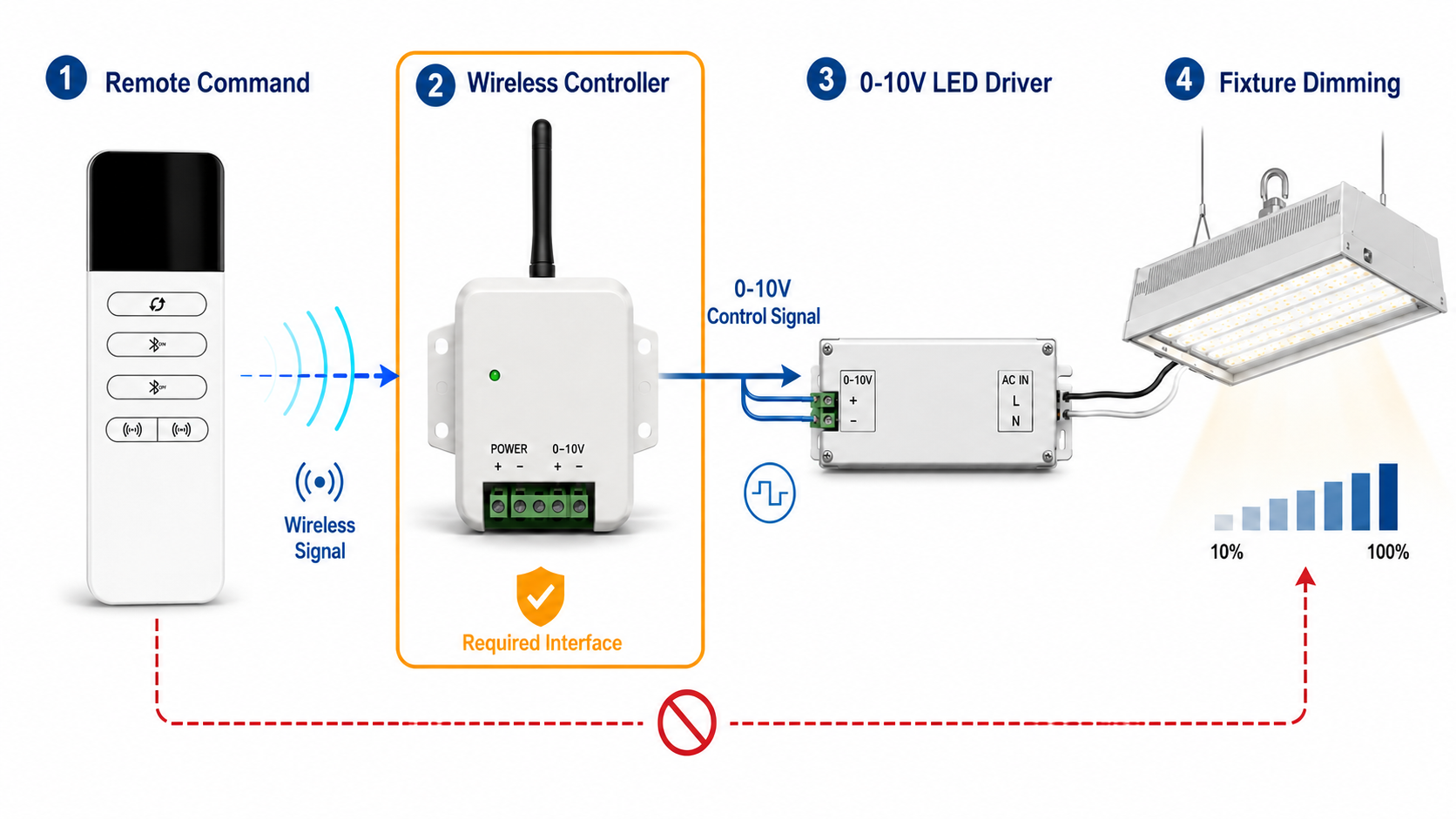
Before selecting a wireless 0-10V lighting control solution, check the label or technical documentation of the existing LED driver.
Confirm the following information:
| Driver Information | Why It Matters |
Dimming interface | Confirms whether the driver supports 0-10V |
Input voltage | Must match the project’s electrical system |
Minimum dimming level | Determines how low the fixture can dim |
Dimming behavior | Helps prevent unexpected shutoff or unstable output |
Wiring configuration | Affects controller installation |
Fixture quantity | Helps determine controller loading and project scale |
Not every dimmable fixture uses 0-10V. Some fixtures use DALI, phase-cut or proprietary control interfaces. Selecting the remote before checking the driver may result in an incompatible system.
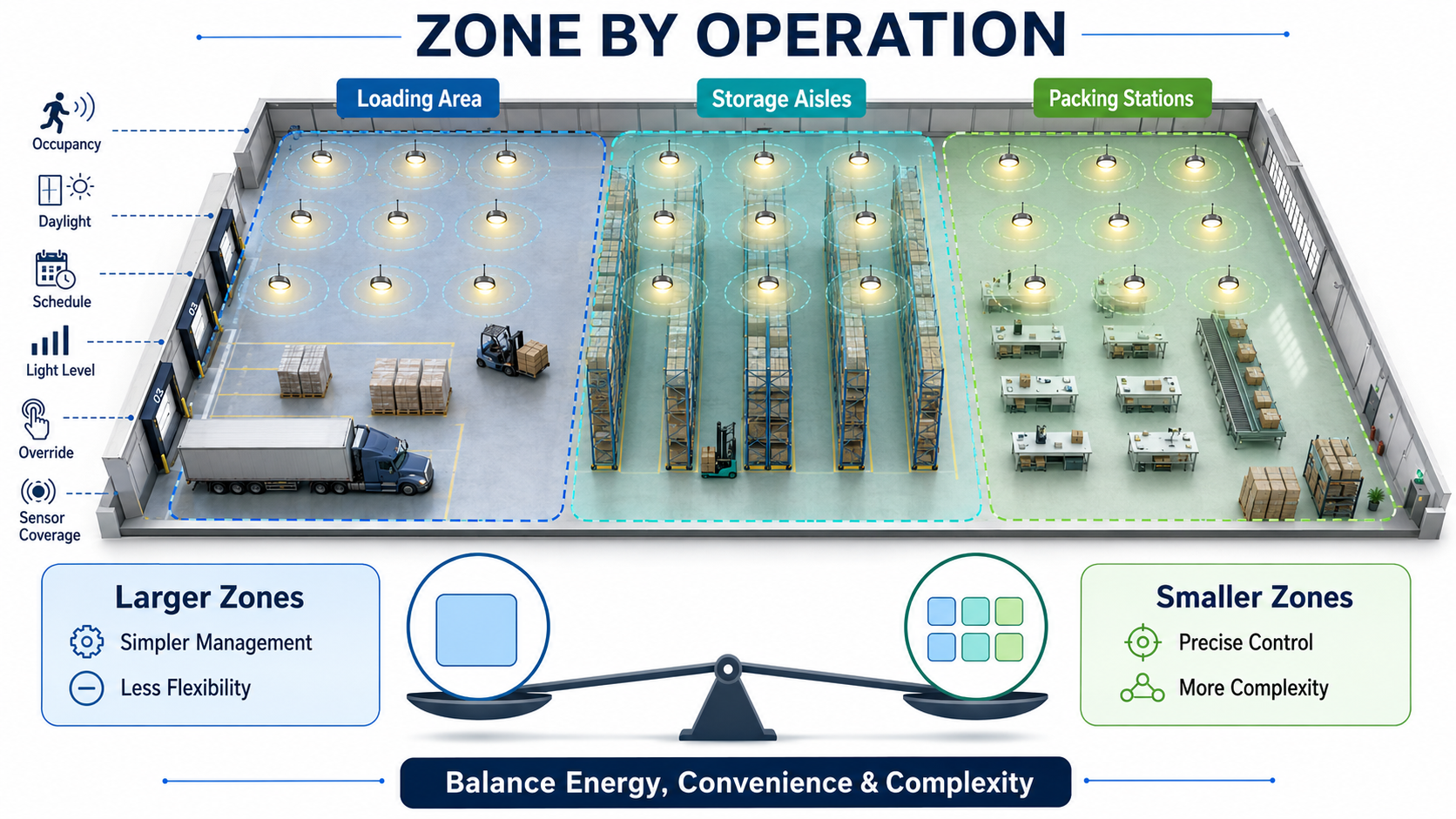
A lighting zone is a group of fixtures that responds to the same command.
Zones should be based on how the space operates, rather than simply following room boundaries. In a warehouse, for example, loading areas, storage aisles and packing stations may need different light levels and operating schedules.
When planning the zones, consider:
Occupancy patterns
Daylight availability
Work schedules
Required light levels
Temporary override needs
Sensor coverage
Maintenance responsibilities
Large zones are easier to manage but provide less control flexibility. Smaller zones offer more precise control but may require additional controllers and commissioning work.
A practical design balances energy management, user convenience and system complexity.
A suitable 0-10V multi zone dimming remote should support more than individual zone selection.
The three most useful operating modes are:
The user selects one zone and adjusts it without affecting other areas.
Several related zones respond to the same command. This is useful when multiple work areas need the same temporary light level.
Every assigned zone can be switched or dimmed together, such as during closing, maintenance or testing.
Buyers should also confirm whether the remote can recall preset scenes. A scene stores predefined settings for several zones, reducing the need to adjust each zone separately.
A Bluetooth remote is not automatically compatible with every Bluetooth lighting controller.
Compatibility may depend on:
Bluetooth version and control protocol
Mesh network implementation
Device provisioning method
Manufacturer or platform requirements
Supported commands
Security and network configuration
For a Bluetooth Mesh project, the remote, controllers and sensors should be evaluated as one system. Product compatibility should be confirmed before fixtures are installed across the building.
It is also important to ask whether the remote is commissioned through a mobile App and whether replacement remotes can be added without rebuilding the entire network.
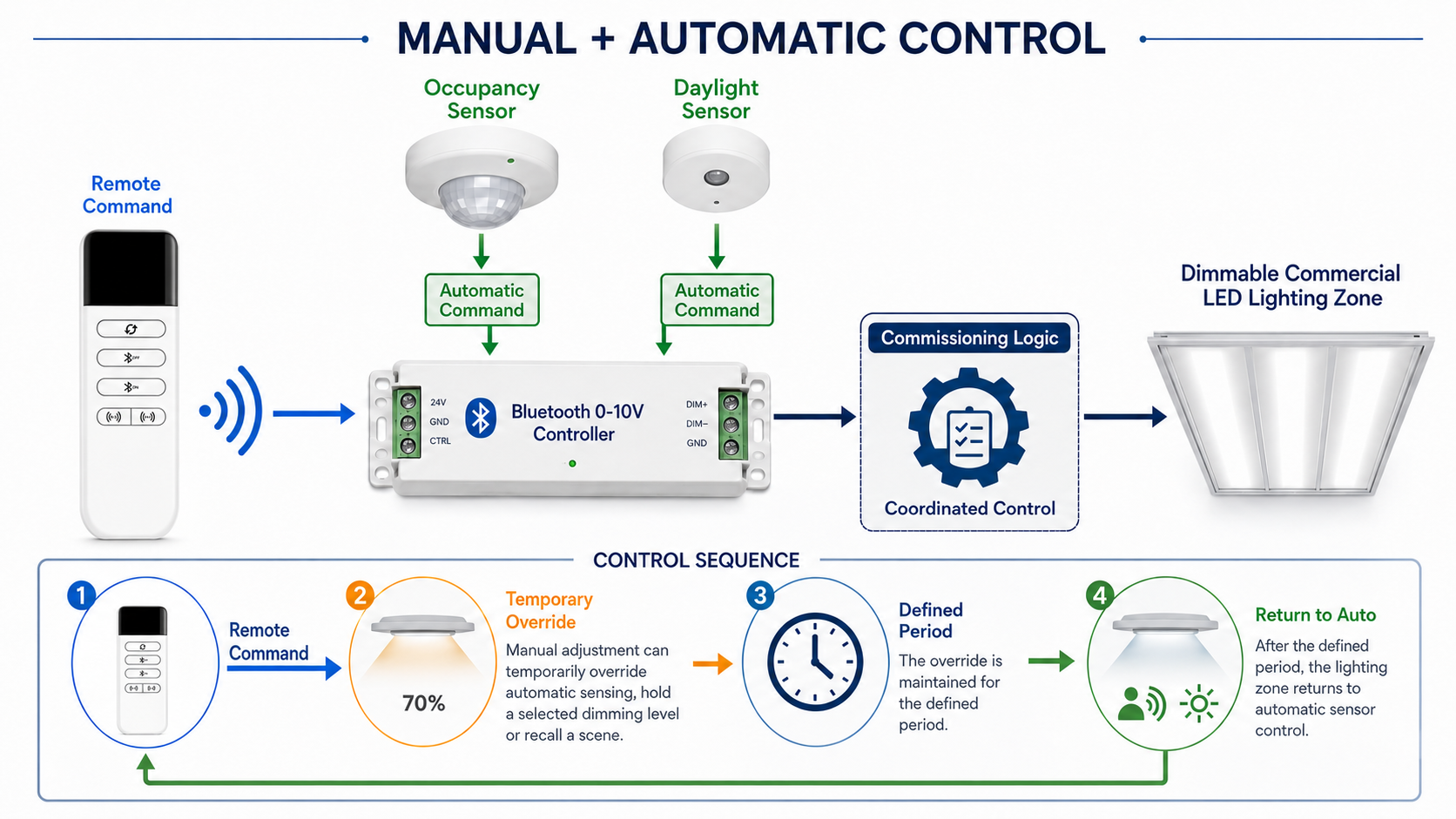
A Bluetooth 0-10V lighting controller may also receive commands from occupancy and daylight sensors.
The control logic should define what happens when a user manually adjusts the lights. Depending on the system configuration, a manual command may:
Temporarily override the occupancy sensor
Remain active for a defined period
Change the target dimming level
Recall a preset scene
Return the zone to automatic control
This interaction should be planned during commissioning. Otherwise, manual remote commands and automatic sensor responses may conflict.
A handheld remote is designed primarily for fast local operation. It allows authorized staff to control commonly used functions without opening an App.
Cloud management serves a different purpose. A gateway-connected platform may provide remote monitoring, scheduling, device management and energy data.
| Control Method | Typical Purpose |
Handheld remote | Immediate local control |
Wireless wall switch | Fixed daily operation |
Mobile App | Device setup and commissioning |
Cloud platform | Remote and multi-site management |
Projects do not always need every control method. A small retrofit may only require a remote and wireless controllers, while a larger facility may benefit from sensors, gateways and centralized management.
Before choosing a wireless lighting controller supplier, ask:
Is the solution compatible with the existing 0-10V drivers?
How many zones can one remote control?
Can zones be controlled independently and together?
Does the system support continuous dimming?
What happens after a power interruption?
Can occupancy and daylight sensors join the same network?
How is the remote commissioned?
Is a gateway required for local control?
Can additional controllers and zones be added later?
Are OEM configuration or labeling options available?
These questions help buyers compare complete control solutions instead of comparing only remote appearance or price.
Yes, provided the fixtures use compatible 0-10V LED drivers and are connected to suitable wireless controllers.
Not necessarily. The controller configuration depends on fixture loading, wiring layout and whether the fixtures need to be controlled individually or as a group.
A gateway may not be required for basic local remote control. It is generally used when remote access, cloud management or building-system integration is needed.
This depends on the remote, wireless network and commissioning platform. Expansion requirements should be confirmed before selecting the system.
Related news
Multi Zone Lighting Remotes | Office Lighting Retrofit | LumiEasy
Why Do Multi-Zone Lighting Remotes Matter in Commercial Buildings丨LumiEasy


)
)
)
)

+86 15899791249

+86 755 2955 3313


Address: Huafeng No.1 Science and Technology Park, Sanwei, Bao'an District, Shenzhen, Guangdong, China.
