

Time:2026-07-08
In high-risk heavy industrial manufacturing environments, facility safety is a non-negotiable operation protocol. For environment health and safety (EHS) managers, electrical procurement directors, and engineering procurement construction (EPC) contractors in the oil, gas, chemical, and pharmaceutical sectors, implementing atex certified hazardous area lighting systems is the single most critical step to avoiding catastrophic electrical ignition events. Operating under the stringent European Union 2014/34/EU directive, ATEX compliance guarantees that industrial illumination infrastructure can withstand volatile ambient gases, vapors, and combustible dust clouds without triggering secondary industrial disasters.
Sourcing high-integrity heavy-duty hardware introduces significant certification, thermal profiling, and component tracing overhead for factory buyers. This engineering evaluation manual details the specific mechanical designs, zone classifications, and hardware structural requirements necessary for factory scaling in explosive atmospheres.
In commercial facilities subjected to continuous petrochemical processing or grain milling, dust and gas mixtures represent a constant source of potential fuel. Standard industrial lighting can act as an immediate ignition source due to internal electrical arcing, static buildup, or high surface operating temperatures.
By mandating verified explosion-proof fixtures that carry official European certificates, factory operators protect their facilities from multi-million dollar liability risks:
Absolute Flame Proof Isolation: ATEX-certified housings are designed to contain any internal electrical spark or explosion inside the robust housing itself, preventing it from interacting with ambient combustible gases.
Strict Outer Temperature Caps: Certified lighting setups feature calculated temperature classes (T-ratings) that ensure the outer structural surfaces never exceed the ignition thresholds of the chemicals present in the facility.
Global Supply Infrastructure Fit: Sourcing verified hardware expedites localized structural engineering approvals, clearing customs hurdles and regulatory workplace safety audits instantly across international boundaries.
Industrial facilities must be segmented according to the duration and frequency of the presence of explosive hazards. Sourcing zone 1 and zone 21 led lighting hardware requires an understanding of how these deployment sites operate.
Zone 0: Explosive gas atmospheres are continuously present for long intervals. Highly specialized intrinsically safe instrumentation is required here; typical primary illumination is mounted externally.
Zone 1: Flammable atmospheres are likely to occur occasionally during normal everyday manufacturing processes. This is the primary operational environment for heavy-duty explosion proof led fixtures.
Zone 2: Flammable gas mixtures are not likely to occur during normal operations, or will persist for only a short duration during equipment maintenance anomalies.
Zone 20: Combustible dust clouds are continuously present in high-density concentrations.
Zone 21: Flammable dust clouds are likely to occur occasionally under standard manufacturing conditions.
Zone 22: Flammable dust layers are unlikely to form, or disappear rapidly if structural leaks occur.
To ensure your procurement pipeline perfectly matches its targeting zone assignments, engineering managers can cross-reference our explicit industry breakdown within our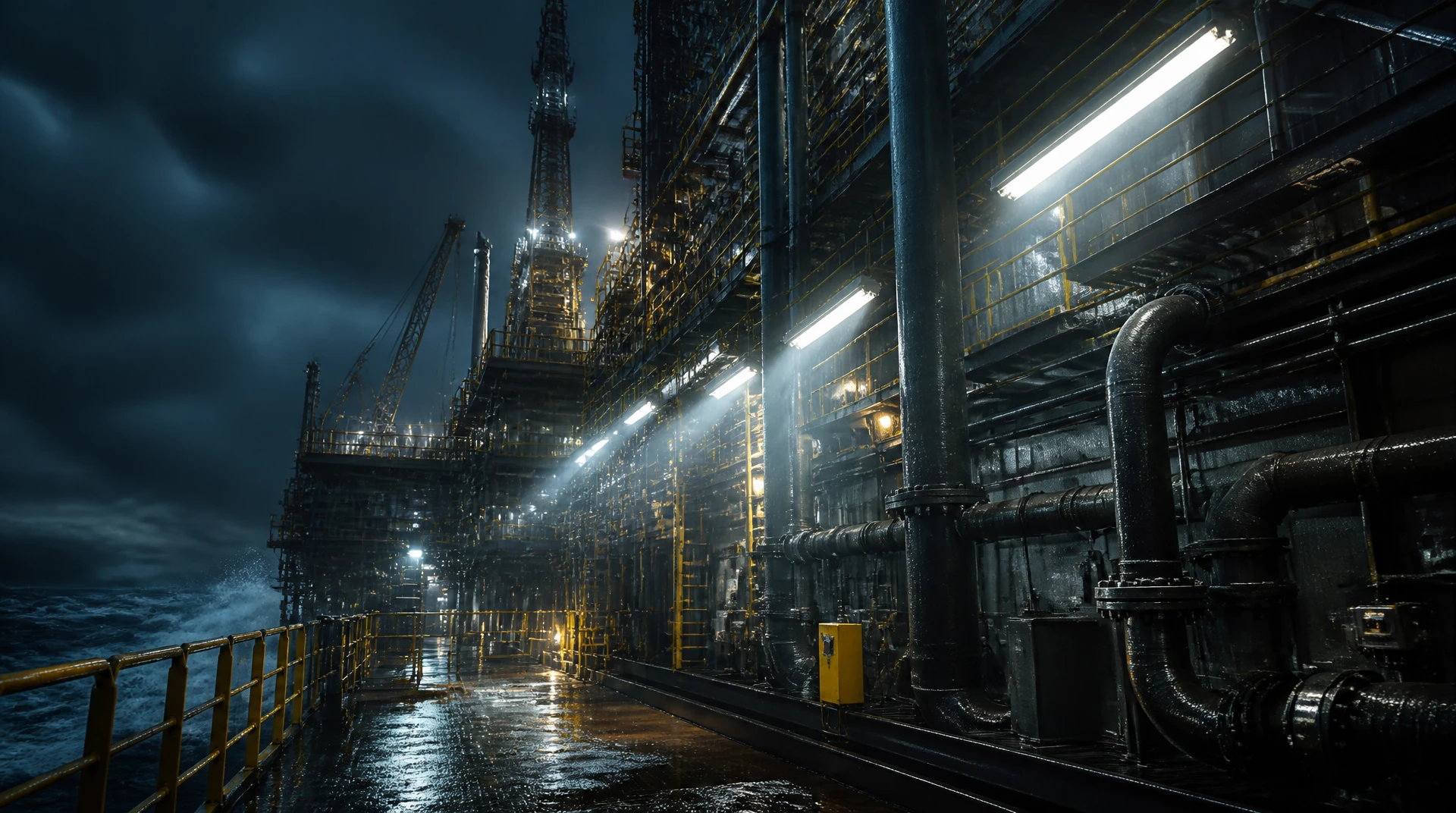
Deploying long-lasting infrastructure inside chemical plants or offshore marine drilling platforms demands ruggedized material science configurations. The matrix below outlines how certified hardware elements are engineered to prevent premature field degradation.
| Material Property / Specification | Certified Heavy-Duty ATEX Enclosures | Standard Commercial Lighting Components | Factory Longevity Advantage |
| Structural Casting Base | Heavy-duty copper-free die-cast aluminum alloy. | Thin sheet metal or structural polycarbonate polymer housings. | Eliminates oxidation and prevents corrosion in high-salinity marine environments. |
| Optic Window Lens | IK10 high-impact thermal shock-resistant tempered glass. | Basic acrylic polymer or standard polystyrene lenses. | Withstands intense mechanical impacts and harsh high-pressure industrial washing cycles. |
| Ingress Protection (IP) | Verified IP66 / IP67 dual-stage silicone gasket seals. | Standard IP20 or low-grade IP54 spray protection seals. | Guarantees complete isolation against fine high-velocity dust entry and water jets. |
| Thermal Dissipation Architecture | Patented multi-channel active convection aerodynamic cooling fins. | Flat, enclosed unvented driver chambers. | Slashes internal junction temperatures, keeping the T6 outer surface profile under 85°C. |
True explosion-proof protection cannot be mass-produced through superficial marketing claims. As an established, technology-driven harsh environment lighting solutions provider, LumiEasy subjects every industrial fixture prototype to a battery of rigorous structural validation sequences inside our specialized quality testing labs.
Overpressure Explosion Chamber Shock: Our engineers place assembled housings inside a heavy sealed test chamber filled with explosive gas mixtures. We intentionally trigger an internal spark inside the fixture to confirm that the flame path of the ip66 waterproof ex d light completely cools and contains the blast, without igniting the surrounding environment.
Thermal Endurance & Heat Dissipation Analysis: The luminaire is run at maximum power draw inside heated testing chambers exceeding 55°C for weeks at a time. Infrared thermal imaging arrays continuously check that external structural casings never breach safety ratings.
Salt Spray & Anti-Corrosion Chemical Exposure: To simulate offshore oil platforms and coastal refining plants, components face hundreds of hours of high-concentration salt-fog atomization to guarantee that our specialized electrostatically applied epoxy powder coatings remain completely free of bubbling or deterioration.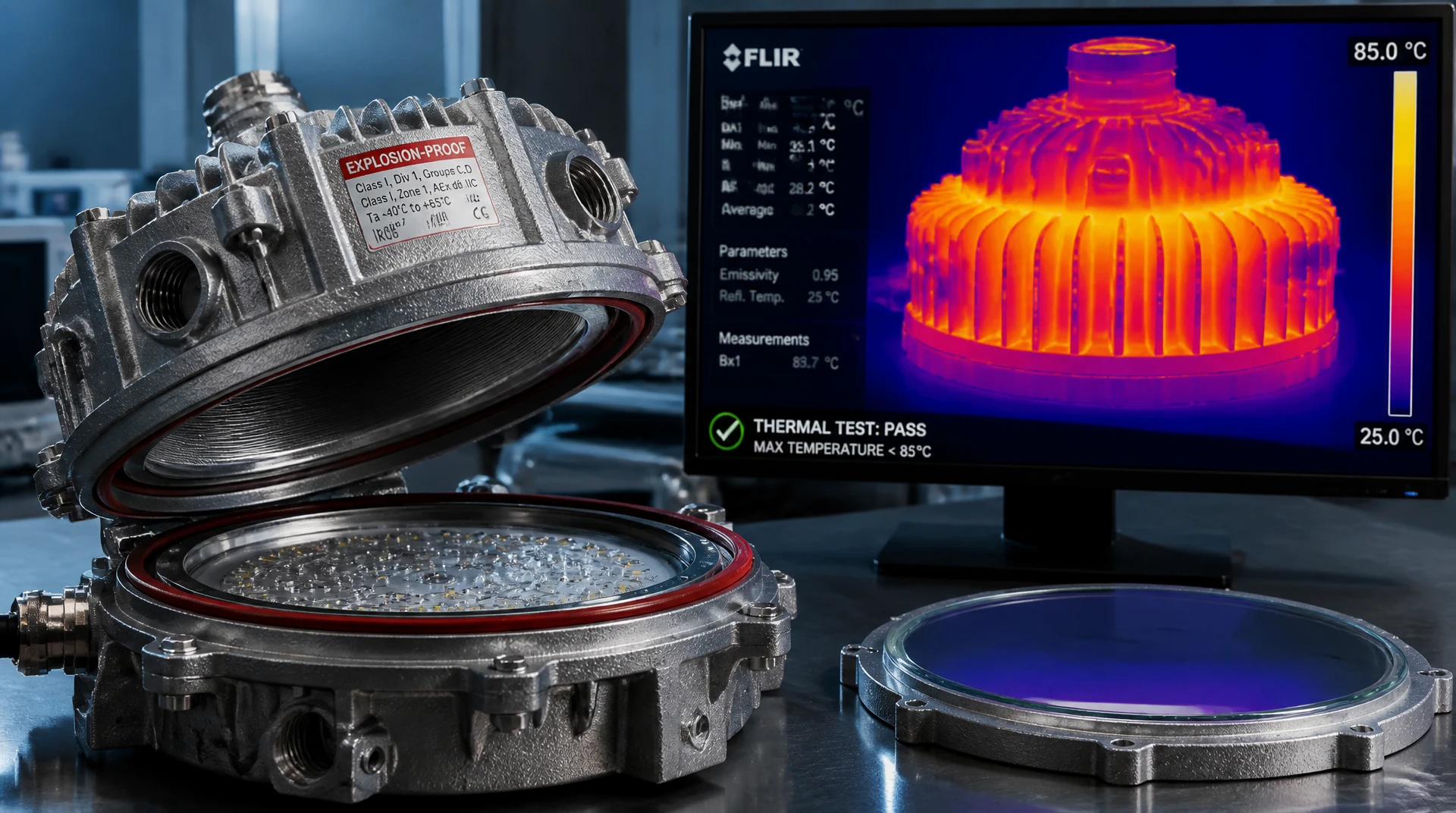
Maintaining strict manufacturing yields when handling high-power explosion-proof lighting require assembly lines to execute meticulous quality protocols:
Precision Flame-Path Inspection: The machined mating surfaces of flameproof (Ex d) joint designs must remain perfectly smooth and free of scratches. Even a microscopic gouge across an aluminum flange can allow a high-temperature flame front to leak out into the manufacturing facility during an internal electrical failure.
Torque-Calibrated Fastening: All structural closure bolts securing the tempered glass window to the main enclosure must be tightened using precision digital torque wrenches. Uneven pressure allocation can fracture internal silicone seals or compromise the ingress protection envelope during thermal expansion cycles.
High-Voltage Dielectric Insulation Assurances: Production lines must incorporate computerized ground-continuity and high-voltage isolation tests on 100% of finished units to eliminate stray current leakage before the products leave the factory floor.
Modern industrial sites demand both automated safety protocols and energy efficiency. High-performance ATEX lighting platforms integrate advanced secondary systems to protect personnel during power failures:
Integrated Emergency Battery Arrays: High-temperature Ni-Cd or LiFePO4 battery modules are built directly into flameproof enclosures. If main grid power drops during a plant fire or equipment failure, the fixture instantly shifts into emergency mode, providing 90 to 180 minutes of continuous illumination along evacuation routes.
Intelligent Autonomous Diagnostics: Advanced internal driver logic chips run automatic self-testing routines at 30-day intervals, flashing a external localized LED indicator light if a battery cell drops charge capacity or an LED board detects component degradation.
A1: Zone 1 certified lighting features extra mechanical safety margins, utilizing robust flameproof (Ex d) or increased safety (Ex e) structures because explosive gases are expected to appear under normal daily operations. Zone 2 systems can utilize restricted-breathing (Ex nR) structures since hazards appear only during rare system anomalies.
A2: Every industrial flameproof industrial luminaire produced by LumiEasy undergoes an advanced surface pre-treatment process, followed by an electrostatically applied high-thickness anti-corrosion epoxy powder coating. This ensures complete immunity against acidic vapors, sulfur dioxide, and coastal marine environment salt sprays.
A3: Absolutely. All LumiEasy hazardous area systems undergo continuous thermal profiling to guarantee precise T-rating compliance (such as T5 or T6 classifications). This ensures outer casing temperatures remain well below the auto-ignition points of surrounding volatile gases.
Upgrading your processing plant, hazardous waste warehouse, or industrial refinery with high-efficiency LED infrastructure shouldn't mean compromising on safety certifications. By cooperating with an advanced, technical industrial manufacturer like LumiEasy, your facility procurement workflow gains immediate access to durable, ruggedized, and fully certified explosion-proof hardware built to survive the harshest industrial testing environments. Slashes your ongoing facility maintenance overhead, protect human life, and establish complete operational safety compliance.
Don't expose your industrial workforce to uncertified or low-grade lighting solutions. Contact our heavy-industry engineering division today to review technical submittals, request factory certification documents, and lock in contract wholesale OEM project pricing.


)
)
)
)

+86 15899791249

+86 755 2955 3313


Address: Huafeng No.1 Science and Technology Park, Sanwei, Bao'an District, Shenzhen, Guangdong, China.
