

Time:2026-06-08
The modern logistics and supply chain sector faces intense financial pressure. Global warehouse operators, distribution managers, and third-party logistics (3PL) providers see utility bills climb to historic highs. Large-scale fulfillment hubs must run around the clock to meet fast consumer shipping demands. However, keeping massive vertical storage spaces safely lit can quickly drain an enterprise's monthly cash flow.
Traditional industrial facility lighting relies on old metal halide lamps or basic high-voltage fluorescent tubes. These legacy fixtures create massive electrical waste. They burn at full intensity even when an aisle is completely empty. They also generate huge amounts of extra heat. This forces cooling units to work twice as hard. Leaving thousands of high-wattage bulbs running over empty concrete floors eats away at a company's bottom line. It also violates regional clean energy laws.
The definitive solution to this operational cash drain is installing high-efficiency network infrastructure. Deploying a rugged, software-configured automated lighting systems warehouse setup slashes monthly energy bills instantly.
By combining low-voltage dc lines with smart network nodes, large commercial storage facilities can automate their light schedules perfectly. This modern approach reduces energy consumption by up to 75%. It keeps busy sorting zones bright and perfectly safe for workers while lowering operating costs.
Managing standard high-voltage industrial lighting lines requires heavy steel conduits and thick copper wiring grids. If an electrical team wants to change a facility's scheduling grid, they have to run expensive new wiring paths. This rigid physical design prevents logistics facility managers from adapting their spaces to shifting material workflows.
Modern automated lighting solutions for warehouses completely remove this physical infrastructure bottleneck. These smart grids use safe low-voltage dc lines and category cabling (like Cat6). This allows them to deliver both electrical power and fast data signals to high-bay led fixtures simultaneously. This creates a flexible, digital control system across your whole building.
This setup uses safe, low-voltage power loops instead of traditional dangerous AC power lines. Because of this, teams can change light zones in a few seconds. They just use a simple software dashboard. This digital approach turns simple light fixtures into responsive network nodes. Every high-bay light panel across your vast facility can send and receive real-time data. This data goes straight back to a central computer.
Do not treat a whole 500,000-square-foot facility as one massive electrical block. Instead, management teams can group and control single storage racks or loading dock doors. They can also manage active packaging tables down to the individual square inch.
Finance directors and operation managers want a cost effective plan. They also need fast investment returns before approving a major equipment upgrade. Standard high-bay lighting installations burn full wattage continuously during a typical 12-hour or 24-hour shift.
Our smart efficient warehouse lighting systems remove this constant utility waste by automating three key energy-saving actions:
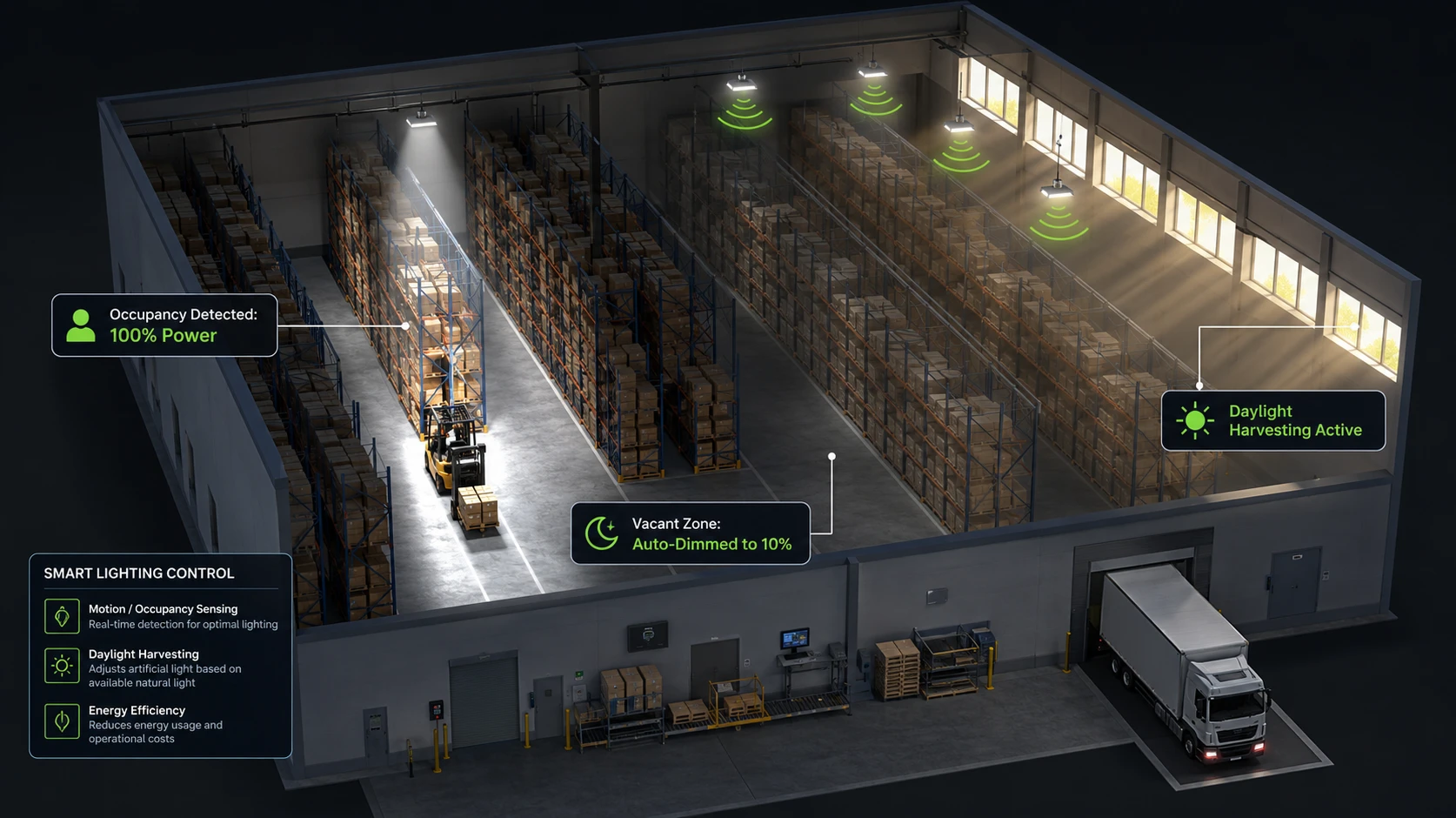
Storage aisles often sit empty for hours while staff work in different zones. Integrated occupancy sensors and motion sensors can keep empty paths safely dimmed down to a minimal 10% safety level.
The moment a fast forklift approaches a storage lane, the local sensor triggers the led high bay lights. The lights instantly ramp up to full brightness ahead of the vehicle. Then, they dim back down smoothly as soon as the driver exits.
Out-of-the-box commercial high-bay light panels often output much more light than a standard picking path actually needs. Via your central admin software dashboard, facility supervisors can permanently cap maximum lumen outputs at a comfortable 75% power limit.
This tiny change slashes energy consumption immediately. Even better, it extends the working life of your expensive high bay fixtures by several years.
Loading bays and shipping bays feature large overhead glass doors or clear roof panels that let in free natural light. Built-in light sensors continually scan incoming sun levels.
The lighting system automatically scales down the power flow to the front rows of LED lights during bright hours. It keeps your workspace visibility perfectly balanced while lowering your utility bill to the bare minimum.
High-precision automated lighting systems warehouse networks do more than just lower electric bills. The embedded sensor arrays act as a continuous space utilization data collection system for your active distribution floor. Because high-bay led fixtures are spread evenly across your ceiling grid, they sit in the perfect position to monitor real-time material handling workflows.
| Tracked Area | Measured Data | Software Output |
| High-Bay Aisles | Forklift transit speed & times | Fixes traffic bottlenecks |
| Loading Docks | Door activity & staff habits | Balances layout shifts |
| Packing Desks | Real-time occupancy rates | Tunes local lumen levels |
This dense sensor network allows managers to capture valuable floor-traffic metrics around the clock. The system generates automated floor maps that reveal exactly where your forklifts experience tight traffic bottlenecks.
Operations managers can review data to see which specific picking racks get heavy use. They can also see which storage aisles sit cold all month. Additionally, built-in temperature and humidity nodes track shifting air pockets across your high-ceiling racks. This data helps your central HVAC system run smarter, protecting temperature-sensitive inventory from moisture damage.
High-speed shipping facilities can be dangerous environments for busy floor crews. Forklifts moving quickly around tight vertical racks create serious blind-spot hazards. If a legacy high-voltage light fixture burns out unexpectedly, a whole storage path can plunge into total darkness. This sudden visibility loss can stall picking lines for hours and create severe safety risks for your warehouse staff.
Our advanced, automated industrial lighting systems solve these safety challenges by providing improved visibility and using rugged hardware components designed for heavy work environments. The professional lighting design uses a special lens array to ensure perfect, even light distribution across the floor. This eliminates deep shadows and blind spots entirely.
Optics Engineering: Toughened polycarbonate safety shield avoids accidental breakage from high forklift pallets.
Thermal Core Setup: Thick anodized aluminum heatsink base draws damaging heat away from the tracking microchips to keep elements cool.
Visual Optimization: Delivers a crisp 5000K color temperature (daylight white) to help workers stay alert and reduce eye strain over long night shifts.
The system links directly with your central facility security setup. If a fire alarm or emergency exit switch is tripped anywhere on the property, the automated lighting network acts instantly. It will bypass normal dimming schedules immediately. It floods all exit paths and loading bays with full-intensity light to help your staff evacuate safely.
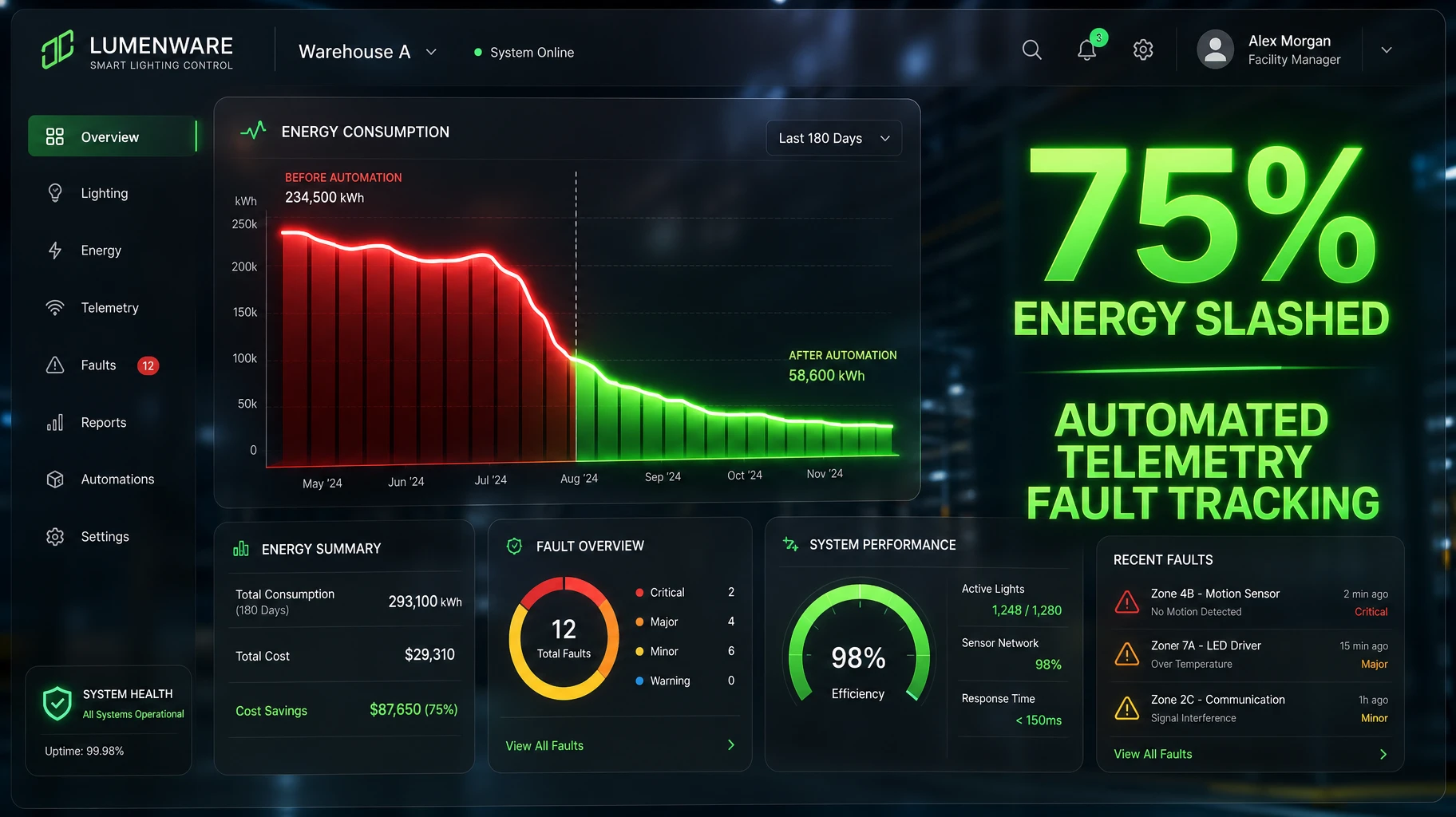
For facilities teams overseeing giant international distribution networks with a high ceiling, inspecting thousands of isolated high-bay lights on tall ladders is a slow, expensive chore. Traditional facilities rely on reactive repairs. Maintenance crews have to wait for an unhappy tenant to file a complaint about a dark lane. Otherwise, they must send staff down every single aisle on expensive scissor lifts just to hunt for failed lamps.
Moving your inventory hub to an intelligent, automated infrastructure completely cuts down your maintenance cost by using digital self-diagnostics:
Live Tracking Alerts: The tracking microchip inside each light panel monitors operational currents and internal temperatures around the clock. If a component encounters an electrical glitch, the fixture flags the error immediately.
Exact Facility Grid Routing: The admin software highlights the dead fixture's exact room code. It shows the precise aisle row and grid coordinate on a live digital floor plan. Your repair crew can walk straight to the correct light without wasting time.
Predictive Lifespan Planning: The software tracks total active burn hours for every lighting element. Since our heavy-duty premium LEDs are rated to run for over 50,000 hours, the system alerts your procurement team weeks before a batch of bulbs hits its calculated replacement date. This allows you to schedule simple bulk swaps during standard down periods.
Modern multinational corporations face strict regional environmental laws and corporate green targets. Vague utility estimates are no longer enough to satisfy strict audit inspectors. Deploying an integrated software platform across your logistics facilities provides the precise, empirical data required to satisfy international environmental reviews.
| Part Name | Technical Spec | Main Benefit |
| Outer Shield | Toughened industrial housing | Rates IP65/IP68 dust and water resistance |
| Chamber Seal | Polyurethane potting compound | Seals core wiring away from factory moisture |
| Power Node | Next-gen solid-state chip core | Gives true zero-standby power draw |
Advanced industrial lights use heavy polyurethane potting seals to fill internal wiring spaces completely. Your facility might handle heavy dry cardboard dust or undergo high-pressure chemical washes. Either way, the internal power electronics stay perfectly clean and dry.
This approach reduces your carbon footprint. It easily satisfies green building codes. It also helps your company earn valuable LEED and WELL building honors. Additionally, our smart power nodes deliver true zero-standby power draw. Old-style smart bulbs pull a hidden electrical current even when switched off just to keep their internal wireless links active. Our automated network switches cut the electrical rail power to vacant zones entirely during off-hours.
Setting up an industrial facility upgrade requires a smart balance between initial equipment costs and long-term operating value. To get the highest possible return on investment, savvy buying managers avoid closed, single-brand ecosystems. These closed systems lock operations into high proprietary hardware costs. Instead, look for open-architecture setups that mesh with different equipment brands.
Choosing an open-standard automated lighting layout provides major construction advantages:
No Expensive Metal Conduits: Safe, low-voltage category data lines run freely across open ceiling trays. They do not need heavy metal junction boxes or thick protective piping.
Massive Labor Cost Savings: Low-voltage DC power carries no shock or electrical fire hazards. Because of this, general low-voltage data technicians can handle the physical installation safely. This lowers your dependency on high-priced electrical contractors.
Fast Future Facility Changes: Your warehouse layout might change later, or you may add new vertical racks down the road. Moving an open plug-and-play setup takes just a few minutes. You simply unbolt the light housing and slide it into its new position.
Choosing an open, automated network setup protects your timeline. It slashes your material expenses and maximizes your company's long-term operational savings.
Achieving total energy efficiency on a busy distribution floor requires a unified approach. It pairs rugged, low-profile industrial hardware with flexible digital control software. Moving away from bulky old high-voltage power grids and standardizing on intelligent automated lighting systems warehouse layouts protects your project timeline. It also maximizes your long-term corporate ROI.
Are you ready to eliminate manual maintenance headaches? Do you want to drop your product assembly costs and build an intelligent, data-driven machinery layout? Do not let supply chain delays or uncertified components compromise your engineering standards. Partner with an industry-tested manufacturing expert. This partnership secures high-quality, factory-direct smart components tailored to your exact architectural needs.
Do you need comprehensive product catalogs or technical engineering data sheets? Do you want an exact project price quote? Please visit our official B2B portal. You can submit your technical blueprint requirements directly to our team through our
A: Yes, absolutely. Our premium lighting setups use open API code frameworks and universal industrial connection paths like BACnet. This open design allows our central control software to share data. It sends real-time floor metrics and aisle presence logs directly to your existing warehouse management systems (WMS). You can sync your facility light paths with active digital picking tickets across your entire floor without needing custom software patches.
A: Yes, our hardware is built specifically for harsh industrial settings. Every commercial high-bay light panel features a rugged anodized aluminum body and a solid-state internal power node. This design contains no loose mechanical parts or delicate filaments. Our fixtures easily handle continuous vibrations from heavy industrial ceiling fans and fast automated picking rails. They run smoothly without slipping out of calibration or suffering data drops.
A: System safety and facility uptime are our primary manufacturing goals. If your building loses its external web connection, the automated network switches instantly to a local fail-safe mode. All motion tracking nodes, time schedules, and emergency light settings continue running locally within the building’s intranet without lag. The system automatically uploads its collected energy logs to your cloud dashboard as soon as the main network reconnects.
【Contact us for a free quote】
Related Articles
Automated Lighting Systems: Smart Controls for Commercial and Industrial Buildings


)
)
)
)

+86 15899791249

+86 755 2955 3313


Address: Huafeng No.1 Science and Technology Park, Sanwei, Bao'an District, Shenzhen, Guangdong, China.
