

Time:2026-01-23
Warehouses and factories rarely use every part of a building at the same time. Aisles may stay empty for hours, loading docks may operate around changing schedules, and production areas may require steady task lighting throughout a shift.
Automated lighting systems adjust illumination to these conditions. They combine sensors, schedules, dimming controls, and management software to reduce unnecessary lighting use while keeping work areas safe and functional.
This guide explains how to choose an automated lighting system, compare wired and wireless architectures, and estimate the potential return on investment.
An automated lighting system controls lights according to occupancy, operating schedules, daylight, and task requirements.
A complete system may include:
Occupancy or motion sensors
Daylight sensors
Dimming controls
Lighting control modules
Wired or wireless communication
Management software
Reporting and maintenance tools
The system should reflect the way the building operates. A high-rack aisle, production line, loading dock, and office area should not all use the same control logic.
Industrial buildings typically have large lighting loads and long operating hours. That creates several opportunities for control improvements.
Automated lighting can help reduce:
Lighting that remains on in vacant zones
Full-output operation during low-activity periods
After-hours runtime
Manual switching and adjustment
Unnecessary maintenance visits
It can also help facility teams maintain more consistent lighting levels across different shifts and operating areas.
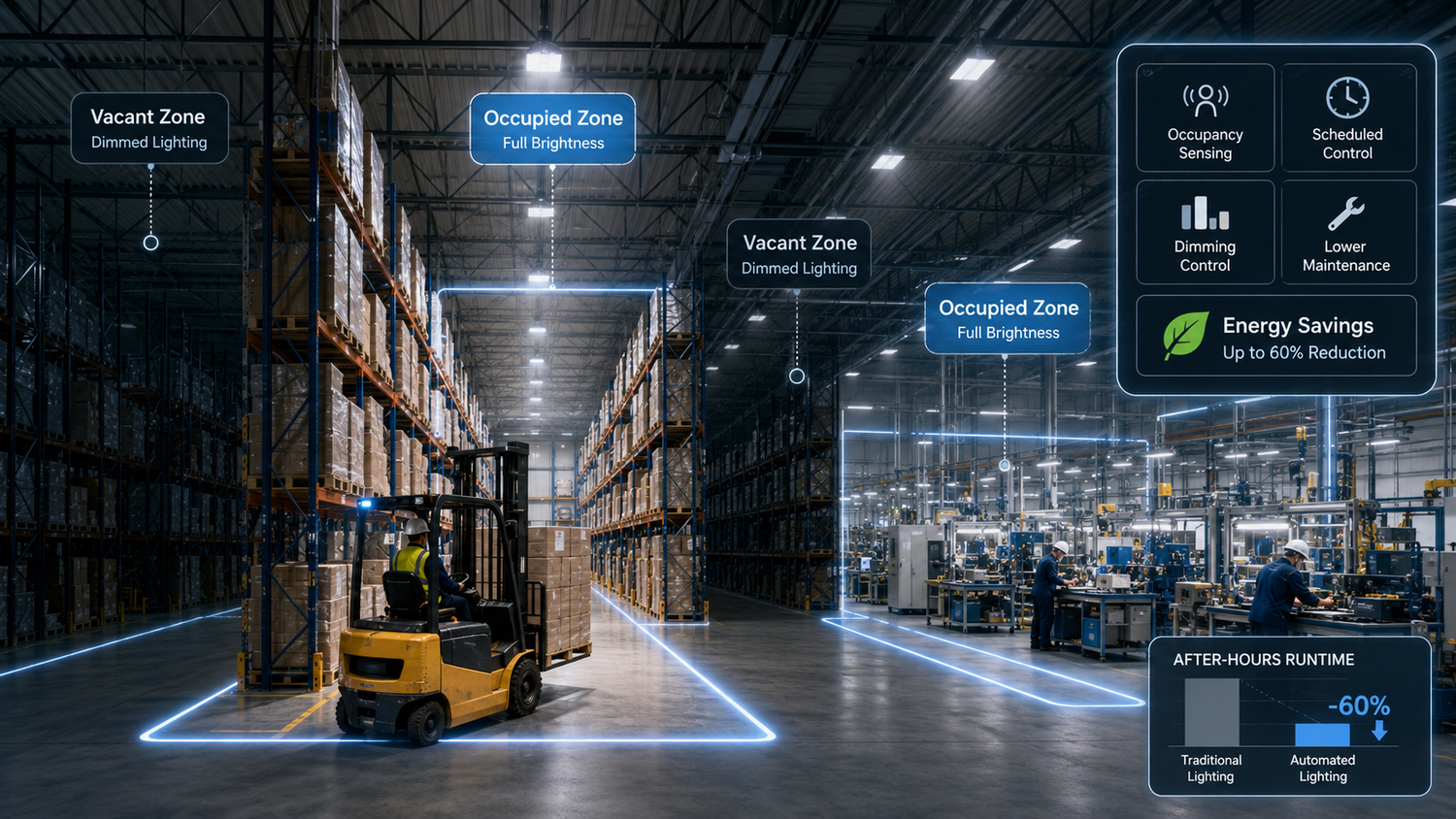
Energy savings depend on the existing system, operating schedule, fixture type, daylight availability, and control settings. The U.S. Department of Energy reports warehouse lighting savings of approximately 35%–54% for occupancy sensor applications, although results vary by facility. DOE FEMP guidance
see more: industrial smart lighting solutions for factories and warehouses
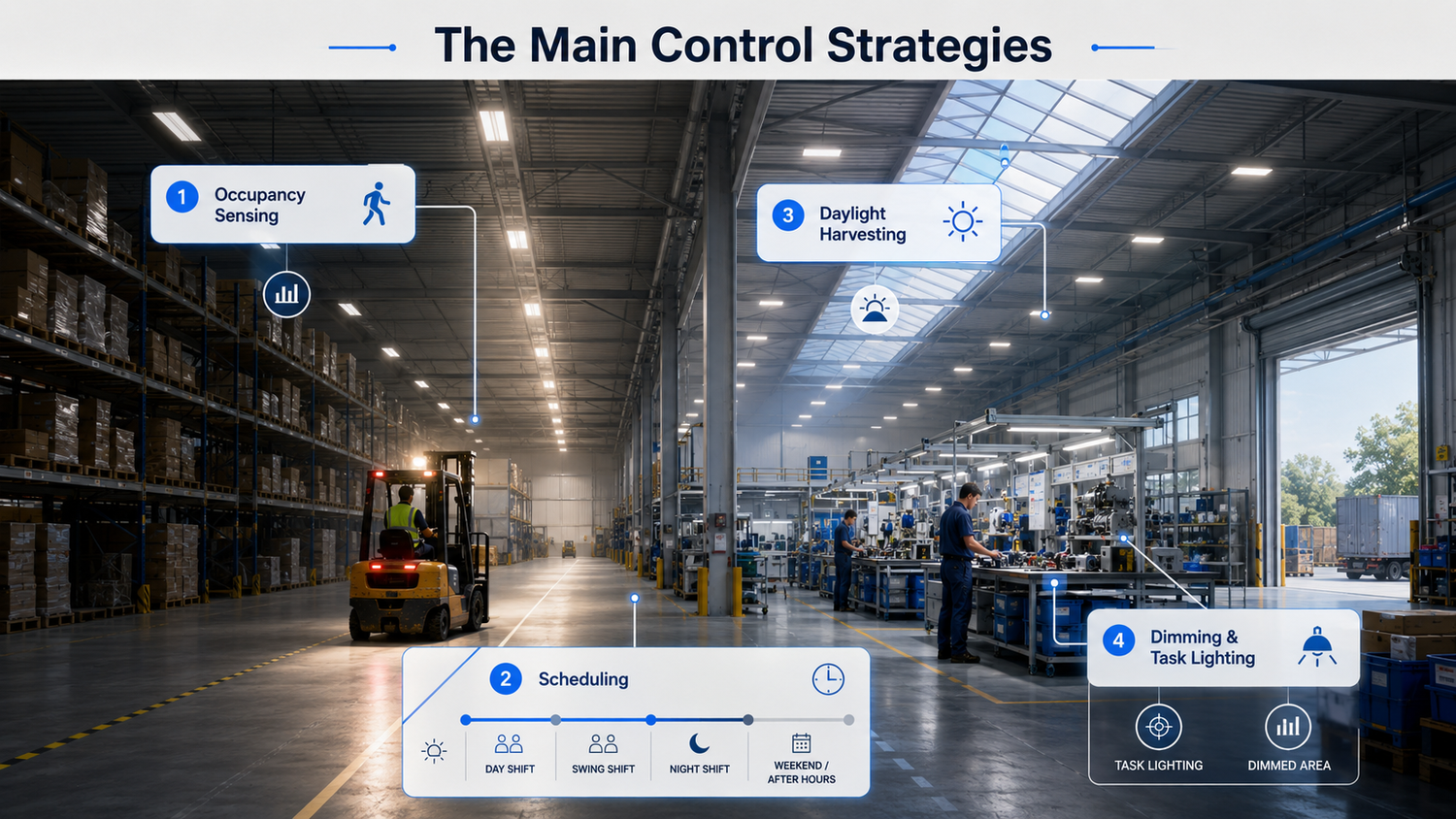
Occupancy sensors increase lighting when workers or vehicles enter a zone. When the zone becomes vacant, the system can dim the fixtures to a background level or switch them off when conditions allow.
In warehouses, aisle-level control is often more useful than controlling an entire floor. The system can light the aisle where work is taking place while keeping unused areas at a lower level.
The result depends on correct sensor placement and commissioning. Sensitivity, detection range, time delay, fade settings, and minimum dim level all affect performance.
Schedules provide a baseline for the building. They can follow:
Shift start and end times
Weekend and holiday patterns
Cleaning periods
Inventory checks
Security operation
Loading and delivery activity
Industrial facilities often need several profiles rather than one fixed schedule. Manual overrides should also be available for overtime, inspections, maintenance, and unexpected operations.
Daylight harvesting uses ambient light sensors to reduce electric lighting when natural light is available.
It works best in areas with:
Skylights
Clerestory windows
Perimeter glazing
Large loading doors
Open commercial spaces
Fixtures should be grouped according to their daylight exposure. Lights near windows or skylights may dim more than fixtures in the center of the building.
Dimming gives facility teams more control than a simple on/off system. It allows the system to maintain different light levels for different tasks.
For example:
A storage aisle may use a low background level when vacant.
A picking area may use task-level lighting during activity.
A production line may require stable illumination throughout a shift.
A loading dock may use a higher scene for loading and inspection.
The right architecture depends on the building, installation conditions, and future plans.
Architecture | Suitable For | Main Benefit | Main Consideration |
Wired | New builds and major renovations | Stable infrastructure | More cabling and installation work |
Wireless | Occupied buildings and retrofits | Less rewiring and disruption | Requires communication planning |
Hybrid | Complex or expanding facilities | Flexible deployment | Requires careful integration |
see more: commercial smart lighting retrofit solutions
Wired controls can work well when control cabling is already part of the construction plan. They may be suitable for large projects that need fixed infrastructure, centralized commissioning, and long-term standardization.
Wireless controls can reduce disruption during warehouse and factory retrofits. Facility teams can upgrade selected zones, reconfigure groups after layout changes, and avoid extensive new control wiring.
Wireless design still requires attention to signal coverage, device compatibility, cybersecurity, and battery maintenance where applicable.
A hybrid system may use wired controls in new production areas and wireless controls in existing warehouse zones. This approach can make sense when different parts of the facility have different installation constraints.
The decision should be based on serviceability, commissioning, expansion, and total project cost rather than on feature lists alone.
A basic ROI estimate starts with the current annual lighting cost.
Annual lighting savings =
Current annual lighting cost × Expected reduction

Simple payback =
Total project cost ÷ Annual lighting savings
The estimate should include:
Fixture quantity and wattage
Operating hours
Operating days
Electricity rate
Current lighting controls
Expected runtime reduction
Expected dimming reduction
Installation cost
Commissioning cost
Maintenance benefits
A zone-based estimate is more reliable than applying one percentage to the whole building. A low-traffic storage aisle may produce a different result from a continuously occupied production area.
A pilot project can validate the assumptions. Choose a representative zone, measure the baseline, install the controls, and compare actual runtime and output before expanding the system.
see more: smart lighting control systems for industrial energy savings
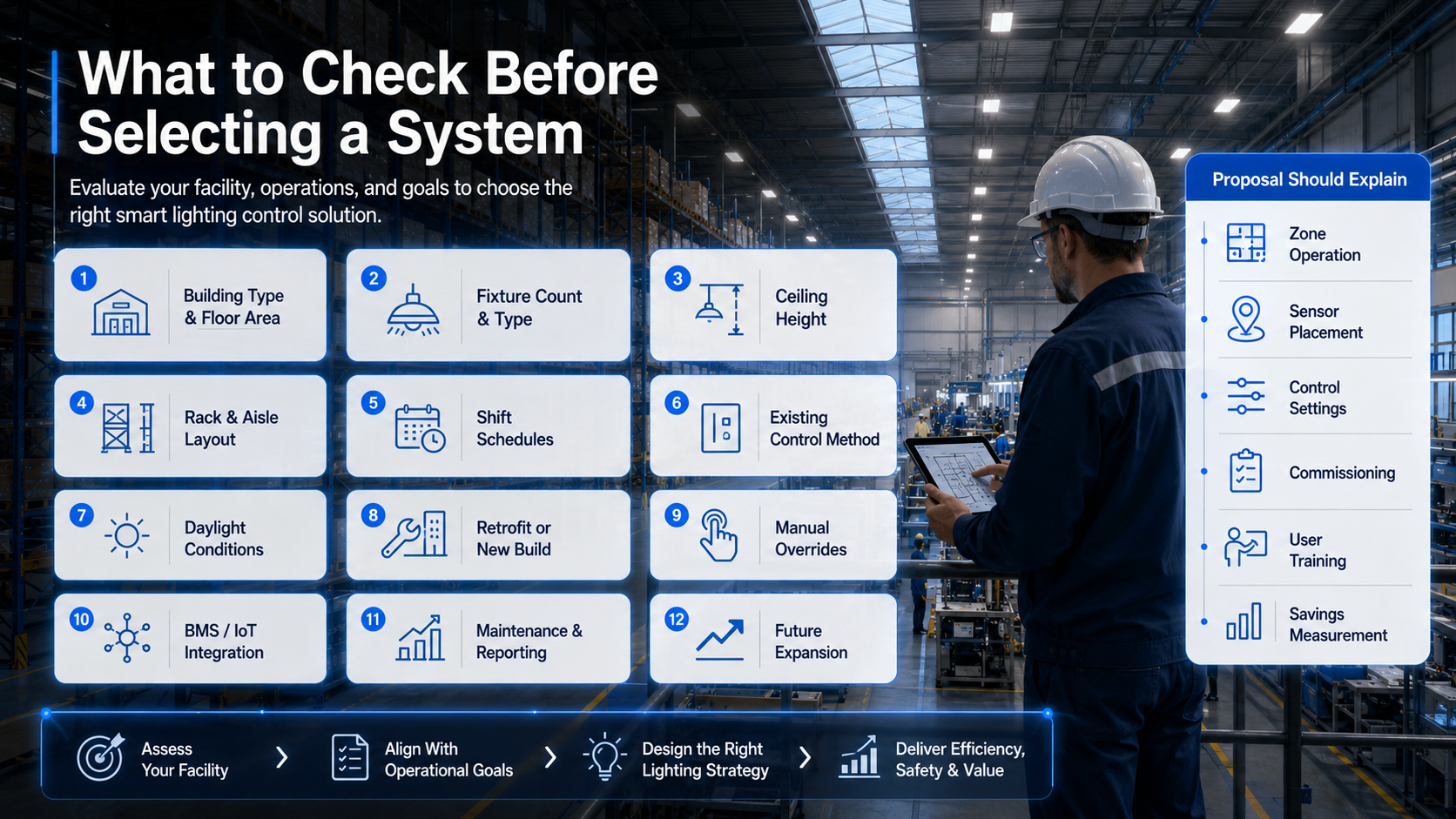
Before requesting a proposal, prepare:
Building type and floor area
Fixture count and fixture type
Ceiling height
Rack and aisle layout
Shift schedules
Existing control method
Daylight conditions
Retrofit or new-build status
Required manual overrides
BMS or IoT integration needs
Maintenance and reporting requirements
Future expansion plans
The proposal should explain how each zone will operate. It should also describe sensor placement, control settings, commissioning, user training, and how savings will be measured.
Normal lighting automation and emergency lighting monitoring address different requirements.
Automated lighting manages everyday illumination based on occupancy, schedules, daylight, and tasks. Emergency lighting monitoring focuses on emergency luminaires, exit signs, batteries, test results, and faults.
For large commercial or industrial facilities, centralized emergency lighting monitoring can provide a single view of device status, fault alerts, maintenance records, and test reports. It should remain separate from normal occupancy-based controls so that safety lighting continues to operate under emergency conditions.
Lumieasy helps commercial and industrial teams plan lighting controls around actual building operations.
Depending on the project, the evaluation may cover:
Zone-by-zone control logic
Occupancy and daylight strategies
Wired, wireless, or hybrid architecture
Retrofit requirements
Sensor and dimming options
Pilot-zone planning
Estimated energy savings and payback
Expansion across departments or sites
The first step is to understand how the facility operates: when each zone is occupied, how the layout changes, which areas need stable task lighting, and what maintenance information the team needs.
see more: app control for smart lighting systems
Automated lighting systems use sensors, schedules, dimming controls, and management software to adjust lighting according to occupancy, daylight, operating hours, and task requirements.
Yes. Warehouses often contain large areas with intermittent occupancy, making aisle-level sensing, scheduling, and dimming useful control strategies.
They can be suitable when rewiring would disrupt operations. The project should still assess communication coverage, compatibility, maintenance, and future expansion.
Savings vary by facility. Occupancy, scheduling, daylight harvesting, and dimming each affect a different part of the lighting load. A pilot zone provides a more dependable estimate.
Compare the project cost with the expected annual reduction in lighting energy and maintenance costs. Use actual operating hours, electricity rates, and zone-level control assumptions.
If you’re evaluating automated lighting systems for a warehouse, factory, or commercial building, Lumieasy can help you define the right control strategy, choose the best-fit architecture, and estimate ROI based on your operating profile.
Contact Lumieasy to request:
A zone-by-zone control recommendation
An architecture review
An automated lighting ROI estimate
A pilot-zone plan
A roadmap for scaling across facilities
Related Articles
Automated Lighting Systems Warehouse: Transforming Industrial Illumination for Efficiency and Safety
AI Automated Lighting Systems: Redefining Efficiency and Intelligence in Smart Buildings
Automated Theatre Lighting Systems: Shaping Narrative and Immersion in Live Performances
How Multi User App Permissions Improve Data Security
Automated Lighting Systems Warehouse Slashes Energy Bills


)
)
)
)

+86 15899791249

+86 755 2955 3313


Address: Huafeng No.1 Science and Technology Park, Sanwei, Bao'an District, Shenzhen, Guangdong, China.
