

Time:2026-08-27
Industrial manufacturing facilities, logistics centers, and heavy assembly plants are undergoing rapid digital modernization. Operational leaders face dual pressures: lowering energy overhead under strict international carbon reduction targets and improving facility visibility through Industrial Internet of Things (IIoT) infrastructure. Modern factory lighting is no longer just an illumination utility; it serves as an intelligent physical network spanning every square meter of the facility floor.
Deploying a ble bluetooth mesh control network allows plant managers to replace rigid, hardwired lighting systems with a decentralized, wireless lighting control infrastructure capable of automated occupancy sensing, daylight harvesting, asset tracking, and real-time energy telemetry.
Understanding what is ble bluetooth and how it differs from traditional consumer wireless technology is essential for facility engineers evaluating smart factory controls.
Standardized by the Bluetooth Special Interest Group (SIG), ble bluetooth low energy (also known as Bluetooth LE) was engineered specifically to transmit short bursts of data while consuming minimal power. Unlike legacy Bluetooth Classic—which maintains continuous point-to-point streaming channels—Bluetooth LE operates on an event-driven architecture.
Operating Frequency: 2.4 GHz ISM Band (2.402 GHz to 2.480 GHz across 40 physical channels).
Network Topology: Managed Flooding Mesh (peer-to-peer communication with no central router dependency).
Security Encryption: Mandatory 128-bit AES-CCM encryption at both the Network and Application layers.
Maximum Node Capacity: Up to 32,767 nodes per network domain.
Latency: Sub-100 millisecond response times across multi-hop node arrays.
In an industrial lighting deployment, every fixture, high-bay sensor, and wall switch acts as a node within a unified mesh topology. To explore further context on how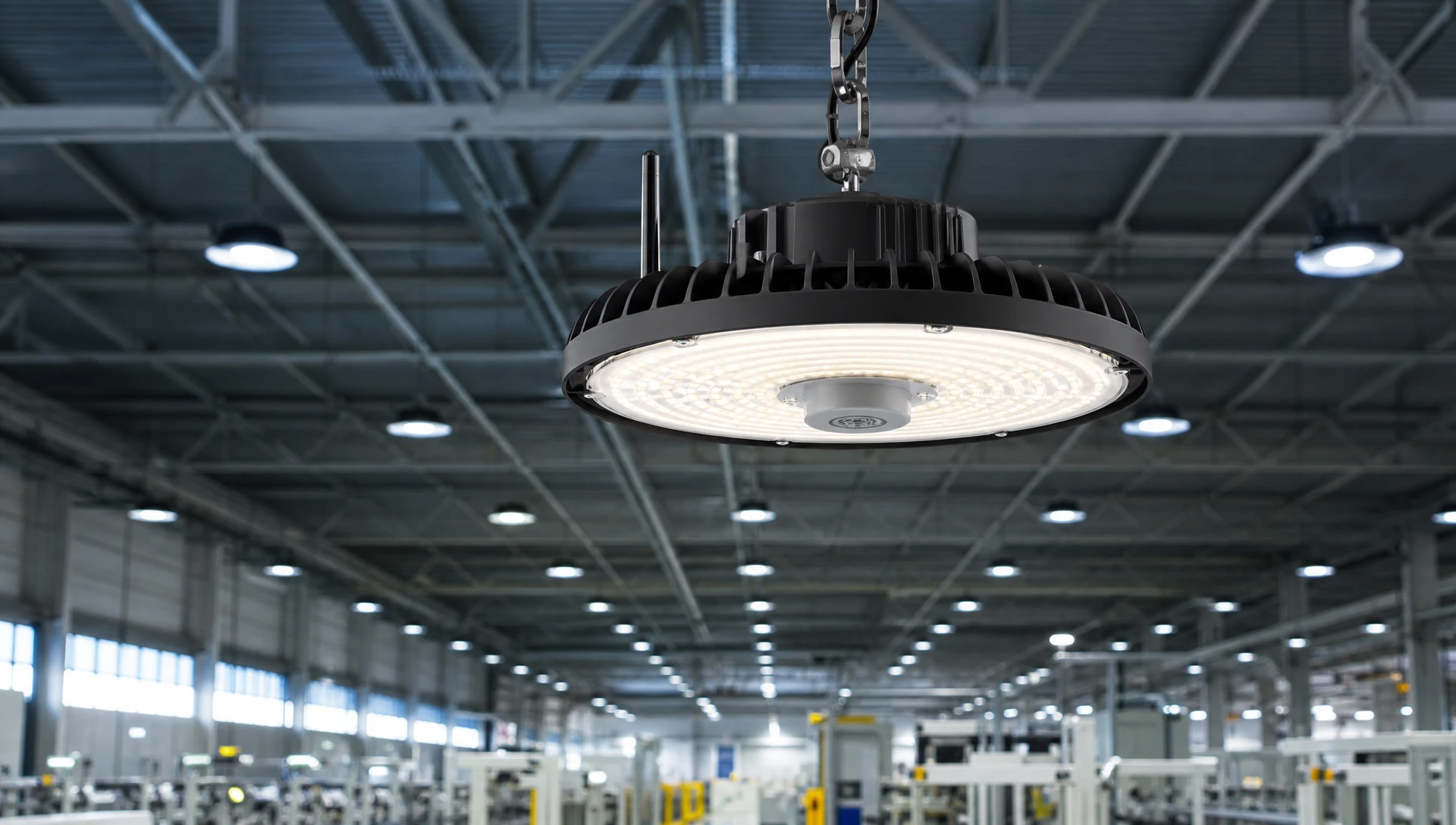
Industrial plant floors present severe challenges for radio frequency (RF) signals. High-density steel racking, heavy stamping machinery, overhead cranes, and high-voltage motor feeder lines create electromagnetic noise and signal reflections (multipath fading).
To maintain continuous connectivity, ble bluetooth low energy mesh networks rely on two core RF mechanisms:
The 2.4 GHz spectrum contains 40 channels, including 37 data channels and 3 dedicated advertising channels (Channels 37, 38, and 39). When electrical interference or co-existing Wi-Fi networks occupy specific frequencies, the ble bluetooth protocol dynamically shifts transmissions to clear channels in milliseconds, preventing packet loss.
RF engineers calculate node spacing on factory ceilings by modeling signal attenuation against physical obstacles. The received signal strength and path loss are calculated using the text-based log-distance path loss formula:
Formula: PL(d) = PL(d0) + 10 * n * log10(d / d0) + X_sigma
Where:
PL(d): Total path loss at distance d (in decibels, dB).
PL(d0): Path loss at reference distance d0 (typically 1 meter).
n: Path loss exponent (ranging from 2.0 in open-space warehousing to 3.5–4.5 in dense metal fabrication bays).
X_sigma: Zero-mean Gaussian random variable representing shadow fading caused by steel machinery.
By maintaining node placement within calculated RF budgets, a ble bluetooth mesh network achieves signal reliability exceeding 99.99% without requiring dedicated control wiring.
Selecting the correct wireless or wired lighting protocol is a critical decision for factory procurement teams. The table below compares ble bluetooth mesh against other common industrial lighting control standards.
| Technical Parameter | BLE Bluetooth Mesh | Zigbee 3.0 | Wi-Fi 6 (802.11ax) | Wired DALI-2 |
| Network Architecture | Decentralized Mesh | Coordinator-Based Mesh | Star Topology | Wired Bus / Loop |
| Single Point of Failure | None | High (Coordinator Node) | High (Access Point) | Medium (Gateway Bus) |
| Maximum System Nodes | 32,767 Nodes | ~250 Nodes per Gateway | ~200 Nodes per AP | 64 Nodes per Channel |
| Installation Cost | Lowest (Wireless) | Low (Wireless) | Moderate | High (Dedicated Conduit) |
| Commissioning Method | Mobile App / Auto-Scan | Manual Gateway Pairing | Network Provisioning | Dedicated DALI Software |
| Integrated Asset Tracking | Supported (BLE Beacons) | Not Supported | Limited (High Power) | Not Supported |
| Commissioning Speed | High | Moderate | Low | Low |
1. Decentralized Intelligence: No central controller failure risk
2. Granular Motion Sensing: PIR & Microwave high-bay integration
3. Dynamic Daylight Control: Automated dimming near skylights & bay doors
4. Integrated Asset Location: Track forklifts and AGVs via BLE beacons
5. Scalable Commissioning: Over-The-Air (OTA) firmware updates
Traditional centralized control systems rely on a main server or master gateway to process control signals. If the master gateway fails, entire production zones lose lighting control. In a ble bluetooth mesh network, control intelligence is distributed directly to the Bluetooth-enabled LED drivers and sensors. Each fixture independently executes scheduling, occupancy sensing, and task tuning logic.
Factory spaces with high skylights or loading dock doors experience fluctuating natural light. Integrated ble bluetooth low energy sensors continuously monitor ambient lux levels and adjust LED output in real time to maintain a constant target illuminance (e.g., 500 lux on assembly benches). Combined with high-bay Passive Infrared (PIR) or Microwave motion sensors, unused aisles instantly dim to 10% background levels, delivering immediate energy reductions.
Because ble bluetooth radios natively support beaconing (iBeacon and Eddystone protocols), smart lighting fixtures double as an indoor real-time location system (RTLS). Industrial plants can track mobile assets—such as forklifts, tool carts, raw material pallets, and automated guided vehicles (AGVs)—by measuring Received Signal Strength Indicator (RSSI) vectors across the ceiling mesh network.
Implementing a industrial ble bluetooth lighting system follows a standardized engineering procedure:
Step 1: Physical Fixture Mounting & Power Topology Verification
Mount industrial high bays, low bays, or linear fixtures containing integrated BLE drivers. Verify stable AC voltage input (120 to 480 V AC) and confirm that fixture housings are properly grounded to prevent electrostatic interference.
Step 2: Network Provisioning & Security Key Distribution
Using a secure mobile commissioning application, field technicians scan the factory floor to auto-discover unprovisioned BLE nodes. The application assigns a unique Network Key (NetKey) and Application Key (AppKey) using 128-bit AES encryption to prevent unauthorized network intrusion.
Step 3: Logical Grouping & Control Scene Assignment
Organize fixtures into functional operational zones (e.g., "Aisle 4 Warehousing," "Machining Bay B," or "Emergency Egress Lanes"). Define specific dimming levels, motion sensor hold-times, and daylight harvesting thresholds for each group.
Step 4: Sensor & Wall Switch Calibration
Pair wireless Bluetooth wall switches and high-bay sensors to their respective lighting groups. Calibrate daylight photo-sensors under natural daylight and zero-daylight conditions to establish precise foot-candle or lux response curves.
Step 5: Cloud Gateway & Enterprise BMS Integration
Connect edge Bluetooth-to-Ethernet gateways to bridge the local BLE mesh network with the plant's Building Management System (BMS) or SCADA platform via BACnet/IP, Modbus, or MQTT protocols.
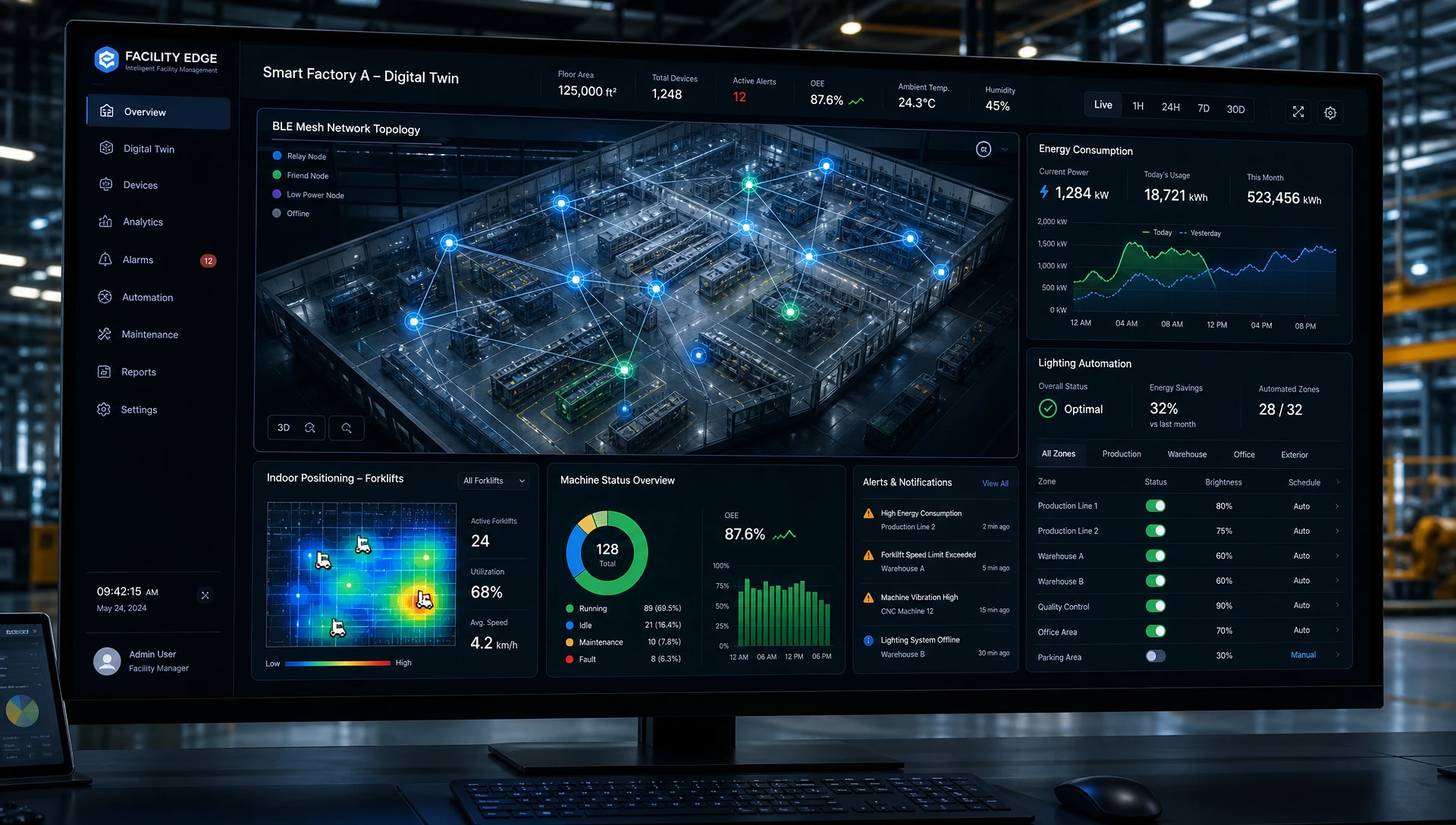
To evaluate the financial impact of upgrading to a ble bluetooth mesh control network, consider a standard manufacturing plant layout:
Plant Floor Area: 20,000 square meters (215,000 sq. ft).
Existing Lighting: 1,000 units of legacy 400W Metal Halide high bays.
Operating Schedule: 24 hours per day, 365 days per year (8,760 operating hours/year).
Electricity Tariff: $0.12 per kWh.
Legacy Metal Halide (400W) : $4,625,000
Uncontrolled LED (150W) : $1,577,000
BLE Mesh Smart LED (150W) : $657,000 [75% Savings vs. Legacy]
| Cost Metric | Legacy Metal Halide | Uncontrolled LED High Bays | BLE Bluetooth Mesh Smart LED |
| System Power per Fixture | 440 Watts (with ballast) | 150 Watts | 150 Watts (Avg. 40W with dimming) |
| Total Plant Connected Load | 440 kW | 150 kW | 40 kW (Effective Duty Cycle) |
| Annual Energy Consumption | 3,854,400 kWh | 1,314,000 kWh | 350,400 kWh |
| Annual Electricity Cost | $462,528 | $157,680 | $42,048 |
| Annual Maintenance Cost | $25,000 | $5,000 | $1,000 |
| Total 10-Year Operating Cost | $4,875,280 | $1,626,800 | $430,480 |
| 10-Year Net Cost Savings | Baseline | $3,248,480 | $4,444,800 |
By deploying ble bluetooth low energy controls with dynamic occupancy sensing and daylight harvesting, energy consumption is reduced by 75% compared to legacy lighting and 70% compared to uncontrolled LED systems. The typical simple payback period for the smart control upgrade is under 11 months.
LumiEasy ble bluetooth mesh controllers use Adaptive Frequency Hopping across 40 physical channels in the 2.4 GHz band. When high-voltage machinery or Wi-Fi networks generate noise on specific frequencies, the nodes automatically re-route data packets across clear channels and adjacent relay fixtures, guaranteeing signal delivery.
Yes. LumiEasy ble bluetooth low energy mesh networks connect to enterprise BACnet/IP, Modbus, or MQTT management platforms via edge gateways. This allows plant engineers to monitor real-time energy telemetry, temperature alarms, and occupancy trends on their main control room dashboards.
Because ble bluetooth mesh operates on a decentralized, multi-hop topology, there is no single point of failure. If an individual fixture or sensor is damaged, neighboring nodes automatically re-mesh and re-route control messages around the offline unit without interrupting lighting across the rest of the facility.
Transitioning your manufacturing or warehousing facility to an intelligent ble bluetooth mesh control system drastically reduces energy overhead while providing the digital infrastructure needed for modern industrial automation.
To review technical product specifications, request custom project photometric layouts, or consult with our lighting automation engineers,


)
)
)
)

+86 15899791249

+86 755 2955 3313


Address: Huafeng No.1 Science and Technology Park, Sanwei, Bao'an District, Shenzhen, Guangdong, China.
