

Time:2026-08-04
Industrial facilities, heavy manufacturing plants, and high-bay logistics centers are undergoing a rapid technological transformation. Plant managers, facility engineering directors, and operational technology (OT) leads face compounding pressures: escalating industrial electricity tariffs, strict corporate net-zero carbon mandates, and increasingly complex energy efficiency building codes such as ASHRAE 90.1, Title 24, and IECC standards.
While upgrading legacy high-intensity discharge (HID) or fluorescent fixtures to modern solid-state LED luminaires delivers an immediate baseline energy reduction of 40% to 50%, physical fixture retrofits alone capture only a fraction of potential savings. Achieving maximum operational efficiency requires granular, automated control—dynamically adjusting light output based on real-time occupancy patterns, daylight contribution, and production scheduling.
Historically, implementing networked lighting controls across factory floors meant running miles of physical control wiring (such as DALI-2 or 0-10V lines) through elevated structural trusses, high-voltage busways, and active production bays. The associated labor expense, conduit material costs, and operational downtime often rendered wired control retrofits financially unfeasible.
Wireless controls eliminate these installation bottlenecks. Among available wireless communications architectures, Bluetooth Low Energy (BLE) Mesh has established itself as the global open standard for industrial wireless controls. Deploying ble for smart buildings provides industrial facility owners with an uncompressed, highly reliable, and scalable communication grid that transforms lighting fixtures into an intelligent industrial Internet of Things (IoT) backbone.
To evaluate why Bluetooth Low Energy Mesh excels in industrial environments, facility engineers must understand the fundamental divergence between traditional consumer Bluetooth and industrial-grade Bluetooth Mesh standardized by the Bluetooth Special Interest Group (SIG).
Traditional wireless networks, such as standard Bluetooth or Wi-Fi, rely on point-to-point or star topologies where every field device must maintain a direct connection to a central access point or master hub. In a 200,000-square-foot manufacturing plant filled with steel machinery, high-density pallet racks, and electrical noise, star topologies suffer from severe signal attenuation, radio dead zones, and single-point-of-failure risks.
In contrast, BLE Mesh utilizes a peer-to-peer, decentralized architecture. Every wireless luminaire controller, sensor module, and wall switch acts as a node within the network. Nodes can relay messages to adjacent nodes, extending the wireless coverage area far beyond the physical range of a single radio transmitter.
Managed Flooding Routing: BLE Mesh utilizes a managed flooding mechanism to transmit control messages across the network. Unlike complex routing-table protocols that can collapse when a single node goes offline, managed flooding broadcasts messages over multiple redundant paths simultaneously. This guarantees that control commands—such as occupancy-triggered lighting group adjustments—reach their destination with sub-100-millisecond latency, even if several intermediate luminaires are powered down for maintenance.
Scale and Node Density: A single BLE Mesh network can theoretically support up to 32,767 nodes without requiring centralized hardware controllers. In industrial smart buildings, this allows an entire manufacturing complex, including production halls, assembly lines, administrative offices, and exterior loading docks, to operate as a unified, cohesive wireless ecosystem.
Zero Single Point of Failure: Because intelligence is distributed natively to every edge node, the failure or removal of a single fixture, sensor, or gateway has zero impact on the rest of the operational network. Surrounding nodes automatically re-route messages around physical obstructions or damaged hardware.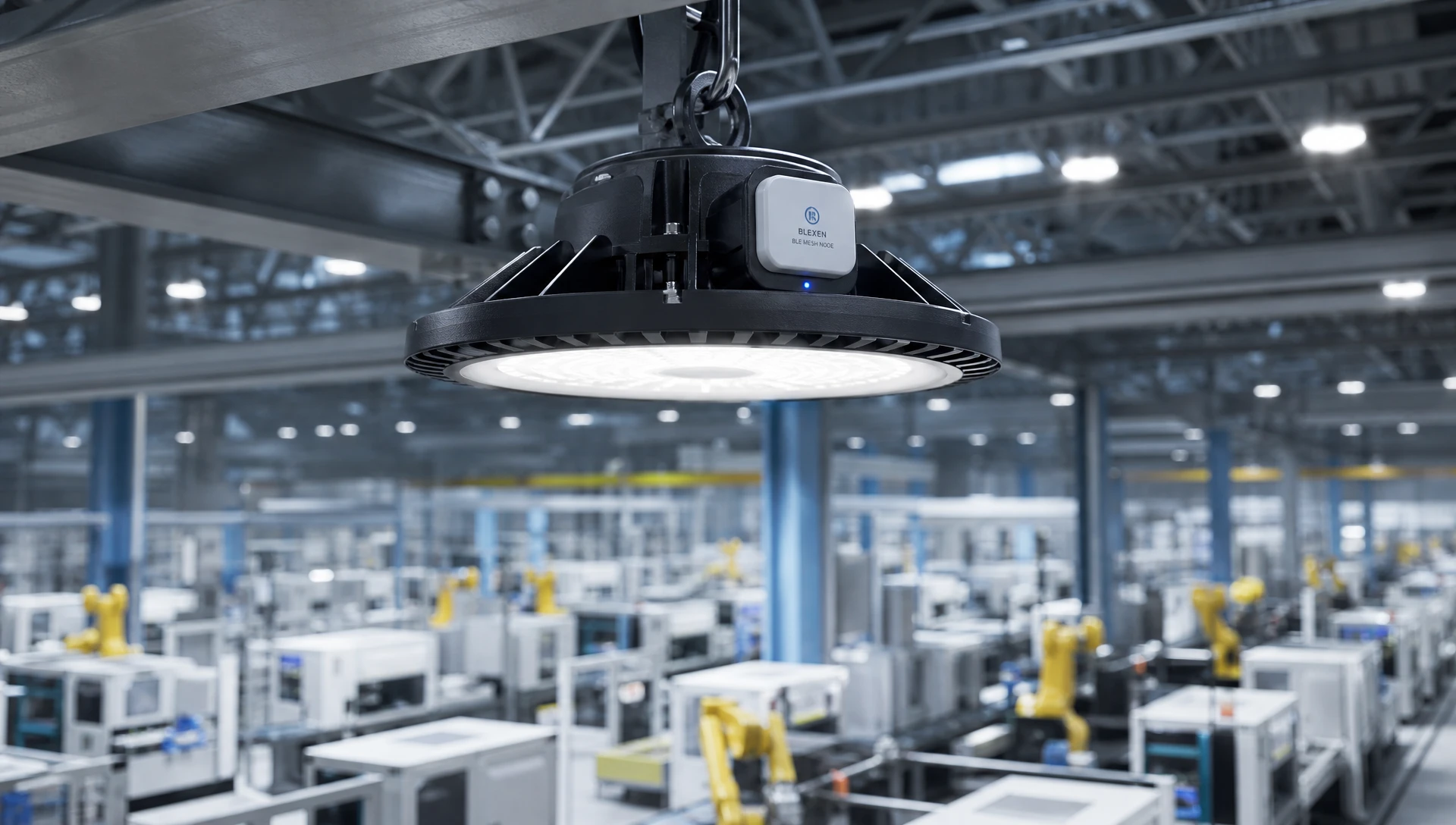
A common concern among industrial electrical contractors and IT directors is radio frequency (RF) reliability. Modern manufacturing floors are hostile RF environments containing high-power electrical machinery, variable frequency drives (VFDs), heavy arc welding equipment, microwave drying systems, and dense Wi-Fi enterprise networks.
BLE Mesh incorporates multiple physical layer and protocol-level mechanisms specifically engineered to maintain robust communication in noisy electromagnetic environments:
+-----------------------------------------------------------------------------------+
|                  BLE MESH RADIO FREQUENCY RESILIENCE MECHANISMS                   |
+-------------------+---------------------------------------------------------------+
| Mechanism         | Operational Function in Industrial Environments               |
+-------------------+---------------------------------------------------------------+
| Adaptive Frequency| Automatically identifies and dodges crowded 2.4 GHz channels  |
| Hopping (AFH)     | used by Wi-Fi access points and heavy industrial equipment.   |
+-------------------+---------------------------------------------------------------+
| Dedicated Advert. | Transmits control packets across 3 dedicated advertising      |
| Channels          | channels (37, 38, 39) situated between major Wi-Fi bands.     |
+-------------------+---------------------------------------------------------------+
| Message Re-       | Configurable frame re-transmissions ensure packet delivery    |
| Transmission      | through temporary physical or RF obstructions.                |
+-------------------+---------------------------------------------------------------+
| Dual-Layer AES-128| Cryptographic authentication prevents packet tampering,       |
| Encryption        | signal replay attacks, and unauthorized RF injection.         |
+-------------------+---------------------------------------------------------------+
Operating in the globally license-free 2.4 GHz ISM (Industrial, Scientific, and Medical) band, BLE continuously monitors spectrum availability. Through Adaptive Frequency Hopping, BLE devices automatically detect RF interference and dynamic noise floors caused by heavy machinery or Wi-Fi traffic. The network dynamically switches transmission across 40 dedicated channels, isolating communications to clear spectrum slices without human intervention or signal degradation.
BLE Mesh control packets are broadcast across three designated advertising channels—Channels 37, 38, and 39. These specific frequencies were deliberately selected by the Bluetooth SIG to sit in the spectral gaps located between the primary non-overlapping Wi-Fi channels (Channels 1, 6, and 11 in 2.4 GHz spectrum). This frequency separation prevents industrial smart lighting controls from competing with high-bandwidth corporate Wi-Fi network traffic, ensuring zero mutual interference.
The primary economic driver for adopting BLE for smart buildings often begins with lighting control and energy savings. However, specifying a BLE Mesh network provides plant managers with a high-density physical communications infrastructure capable of supporting advanced Industrial IoT (IIoT) applications.
Lighting fixtures possess distinct spatial advantages over other building systems:
Ubiquitous Coverage: Luminaires are uniformly distributed across every square foot of an industrial facility, eliminating operational blind spots.
Permanent Line Power: Unlike battery-powered standalone sensors that require periodic maintenance, lighting-integrated BLE nodes draw continuous AC power from the fixture's internal driver auxiliary supply (e.g., 12V DC aux output).
Elevated Mount Positions: Mounted on high ceilings (ranging from 15 to 45 feet), lighting-integrated BLE nodes enjoy unobstructed, line-of-sight RF propagation across open manufacturing bays and warehouse storage aisles.
In large manufacturing facilities and logistics distribution centers, significant time is lost searching for mobile assets such as forklift trucks, automated guided vehicles (AGVs), specialized tooling, custom assembly jigs, and high-value materials.
Luminaires equipped with BLE nodes function as an indoor positioning receiving network. By affixing low-cost BLE asset tags to mobile tools, machinery, or inventory pallets, the smart lighting grid tracks asset locations in real time using Received Signal Strength Indicator (RSSI), Angle of Arrival (AoA), or Angle of Departure (AoD) techniques. Location data is aggregated across the lighting mesh, routed through BLE edge gateways, and rendered on enterprise facility management software—delivering sub-meter indoor positioning accuracy without requiring a separate physical tracking hardware overlay.
Industrial BLE nodes can interface with auxiliary environmental sensors directly or receive data wirelessly from surrounding battery-operated BLE sensor pods. This enables continuous monitoring of:
Ambient Facility Climate: Tracking temperature and humidity gradients across large-scale food processing, pharmaceutical, or cold-storage manufacturing zones.
Occupational Air Quality: Measuring volatile organic compounds (VOCs), carbon dioxide , and airborne particulate density near chemical processing or welding bays.
Condition-Based Machinery Health: Capturing vibration and acoustic telemetry from motors, pumps, and conveyor lines. Machine learning platforms analyze these BLE sensor streams to identify bearing wear or thermal anomalies, enabling predictive maintenance before catastrophic equipment failure occurs.
Selecting the correct wireless or wired control framework is a critical capital expenditure decision for industrial engineering teams. The following comparison matrix evaluates ble for smart buildings against alternative industrial control protocols across core operational parameters:
| Performance / Feature Metric | BLE Mesh (Bluetooth SIG) | Zigbee 3.0 (IEEE 802.15.4) | Industrial Wi-Fi 6 (IEEE 802.11ax) | DALI-2 / D4i Hardwired |
| Network Topology | Decentralized Peer-to-Peer Mesh | Hybrid Star / Tree Mesh | Centralized Star Topology | Linear Bus / Ring Topology |
| Native Mobile Commissioning | Yes (Built into all smartphones/tablets) | No (Requires specialized hardware bridges) | Yes (Requires network credential provision) | No (Requires dedicated handheld programmer) |
| Max Network Node Limit | 32,767 nodes per sub-network | ~240 nodes per coordinator | ~250 devices per Access Point | 64 addresses per DALI line |
| Latency (Command Response) | < 15 to 50 ms (Low latency managed flooding) | 100 to 300 ms (Depends on mesh hop counts) | Variable (10 to 100 ms, subject to congestion) | < 100 ms (Limited by wire length) |
| RF Noise Immunity | High (AFH + Dedicated channels 37/38/39) | Moderate (Fixed 16 channels, vulnerable to Wi-Fi) | Moderate (High co-channel interference risk) | N/A (Physical wired copper line) |
| Multi-Service IoT Integration | Native (Lighting + RTLS + Sensor Fusion) | Limited (Lighting focused) | High (Consumes significant bandwidth) | Strictly Lighting Controls |
| Physical Wiring Installation Cost | Zero control wiring (Mains power to fixture only) | Zero control wiring (Mains power to fixture only) | Zero control wiring (Requires power drop) | Extensive (Dedicated 2-wire polar-free cable) |
| Cybersecurity Framework | Dual-layer AES-128 CCM (Network + Application) | AES-128 (Single network layer key) | WPA3 Enterprise | Physical security only (No wire encryption) |
For industrial facility projects to secure capital expenditure approval, proposed controls must deliver verifiable energy reductions and qualify for electric utility rebate incentives.
The DesignLights Consortium (DLC) sets performance metrics for commercial and industrial lighting across North America. Under the DLC Networked Lighting Controls (NLC) Technical Requirements Version 5.1, smart lighting platforms must demonstrate verified capabilities across specific functional areas:
Luminaire Level Lighting Control (LLLC): Integrating an occupancy sensor, daylight harvesting sensor, and wireless BLE control node directly into individual high-bay fixtures. LLLC configurations deliver maximum energy savings by enabling each fixture to operate autonomously based on localized physical conditions.
High-End Trim (Task Tuning): Establishing maximum power output caps (e.g., capping fixture output at 70% or 80% of rated wattage) across specific factory bays. High-end trim eliminates over-illumination while drastically reducing continuous baseline energy consumption and extending LED driver operating lifespan.
Energy Telemetry Reporting: Capturing granular power and energy usage metrics (kWh) directly from smart LED drivers via standard digital interfaces like DALI-2 / D4i (DALI Part 252). BLE Mesh nodes transmit this real-time power telemetry across the wireless mesh to edge gateways for reporting and utility verification.
While BLE Mesh operates autonomously at the field level, industrial smart buildings rely on centralized Building Management Systems (BMS) or Supervisory Control and Data Acquisition (SCADA) platforms to manage heating, ventilation, air conditioning (HVAC), compressed air, power distribution, and life safety systems.
BLE Mesh smart building networks bridge this gap using hardware edge gateways. These edge devices translate localized BLE mesh messages into standard industrial automation protocols:
BACnet/IP: Exposing lighting control points, occupancy states, energy metering data, and fault status registers directly to central BMS platforms (such as Niagara 4, Johnson Controls Metasys, or Honeywell Forge).
MQTT / RESTful APIs: Publishing encrypted JSON payloads to cloud analytics platforms or enterprise resource planning (ERP) databases for facility-wide energy management and predictive maintenance modeling.
To learn more about the engineering specifics and practical applications of wireless industrial controls, read our technical overview of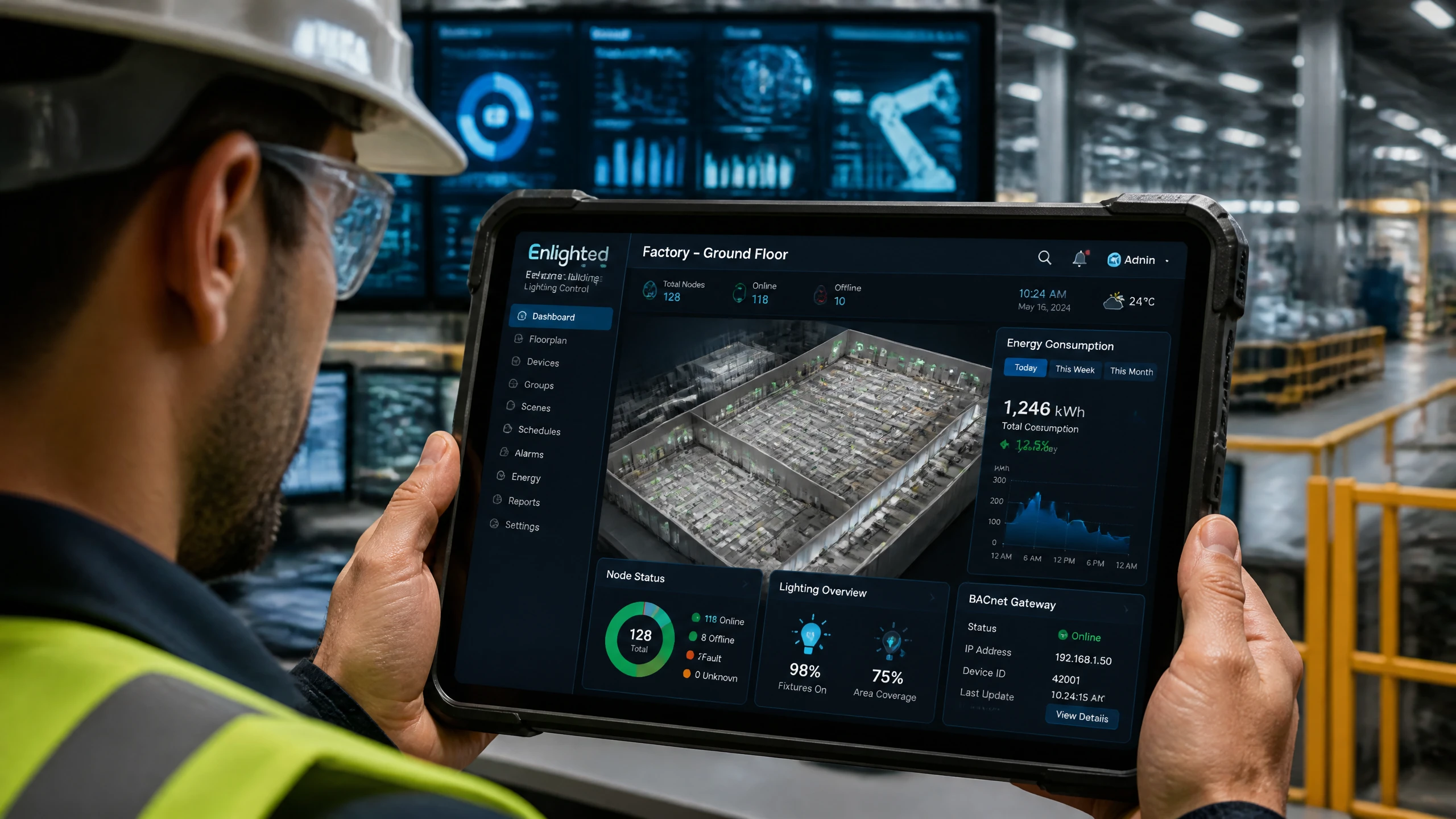
Deploying a modern BLE wireless lighting control network across a live industrial manufacturing or warehousing facility requires a structured execution strategy to guarantee zero operational interruption. The following 5-phase roadmap outlines best-practice implementation procedures:
Phase 1: Facility RF Audit & Baseline Energy Evaluation
  ├── Measure baseline energy consumption (kWh) across manufacturing zones
  └── Perform RF noise spectrum analysis in high-frequency machinery bays
                                 │
                                 ▼
Phase 2: Luminaire Specification & Topology Design
  ├── Specify DLC V5.1 LLLC high-bay luminaires with integrated BLE nodes
  └── Define lighting control zones (high-end trim, motion timeouts, daylight curves)
                                 │
                                 ▼
Phase 3: Physical Installation & One-Touch Power-Up
  ├── Mount luminaires on ceiling trusses and connect line voltage power
  └── Verify fixtures power up in default autonomous safety lighting mode
                                 │
                                 ▼
Phase 4: Mobile App Mesh Provisioning & Zoning
  ├── Provision nodes into BLE Mesh groups via iOS/Android tablet app
  └── Configure task tuning parameters, motion groupings, and daylight thresholds
                                 │
                                 ▼
Phase 5: BMS Gateway Integration & Utility Rebate Verification
  ├── Connect BLE-to-BACnet/IP gateways to enterprise IT/OT network
  └── Export energy monitoring logs (DALI Part 252) for utility rebate payout
Before procuring hardware, facility engineering teams should conduct a site audit. Document baseline energy usage (kWh) across operational areas. Measure existing light levels (lux/fc) at working planes to identify areas suffering from under-illumination or unnecessary over-illumination. Perform a quick RF noise spectrum scan in high-frequency machinery bays to confirm clean spectrum availability across BLE advertising channels.
Select industrial-grade LED high-bays, low-bays, or linear fixtures equipped with factory-integrated BLE control nodes and multi-sensors (PIR or Microwave motion combined with daylight sensing). Ensure all control hardware carries active DLC V5.1 Networked Lighting Control listings to maximize electric utility cash rebates. Define control zones, such as forklift travel corridors, assembly stations, packing lines, and automated storage areas.
Electrical contractors install luminaires and connect standard mains power AC wiring. Because BLE Mesh requires no dedicated control wiring, installation times are reduced by up to 70% compared to hardwired DALI or 0-10V systems. Upon initial power-up, high-quality BLE nodes operate in an autonomous out-of-the-box safety mode, illuminating the facility instantly before digital network provisioning begins.
Commissioning engineers utilize standard Bluetooth-enabled mobile tablets or smartphones to provision nodes into the secure network. Using visual floorplan overlays, engineers organize luminaires into functional lighting groups, adjust motion detector hold times (e.g., 5-minute timeout for active warehouse aisles), set daylight harvesting dimming curves for perimeter skylights, and apply high-end trim power caps.
Install BLE edge gateways near local network drop points to bridge the wireless mesh with the facility’s corporate OT network via BACnet/IP or MQTT. Verify that occupancy registers, energy consumption meters, and diagnostic alert pipelines sync accurately with the central BMS dashboard. Compile system commissioning reports and telemetry logs to submit to local electric utility providers for full rebate payout disbursement.
Transitioning industrial facility infrastructure to ble for smart buildings represents a transformative step toward sustainable, low-carbon manufacturing operations. By eliminating expensive control wiring, overcoming complex industrial RF interference through adaptive mesh routing, and providing a scalable physical grid for advanced IoT applications—such as asset tracking and environmental monitoring—BLE Mesh delivers unprecedented operational flexibility and financial return on investment.
Operating fully certified, DLC V5.1 compliant control solutions ensures facility owners capture maximum utility rebates, drastically accelerating capital project payback periods while ensuring long-term operational resilience.
Ready to optimize your facility's energy efficiency, slash operating overhead, and future-proof your building infrastructure? Connect with our team of experienced industrial smart lighting control engineers today to review your plant floorplans, request custom BLE control design specifications, or arrange an onsite demonstration. Contact us directly via our
A1: BLE Mesh utilizes Adaptive Frequency Hopping (AFH) across 40 channels and transmits control packets over dedicated advertising channels (Channels 37, 38, and 39) situated between standard Wi-Fi bands. Combined with a decentralized managed-flooding routing architecture, control signals automatically bypass electromagnetic interference, physical steel obstructions, and heavy machinery noise floors with sub-100ms response times.
A2: Yes. BLE Mesh networks interface seamlessly with existing enterprise Building Management Systems (BMS) using industrial edge gateways. These gateways translate local BLE wireless mesh data into standard BACnet/IP, Modbus TCP, or MQTT protocols, allowing central platforms like Niagara, Johnson Controls Metasys, or Schneider Electric to monitor energy usage, occupancy states, and system diagnostics in real time.
A3: LumiEasy provides factory-pre-configured BLE controllers, LLLC sensor modules, and intuitive mobile commissioning app software tailored specifically for industrial environments. By enabling visual floorplan mapping, automated node discovery, bulk grouping features, and pre-tested DLC V5.1 control templates, LumiEasy slashes on-site setup time by up to 80% compared to traditional hardwired or complex wireless control platforms.


)
)
)
)

+86 15899791249

+86 755 2955 3313


Address: Huafeng No.1 Science and Technology Park, Sanwei, Bao'an District, Shenzhen, Guangdong, China.
