

Time:2026-08-28
Industrial manufacturing facilities, automated warehousing operations, and processing plants are accelerating their transition toward smart building management and Industrial Internet of Things (IIoT) architectures. Modern plant managers face escalating energy costs, strict carbon neutral compliance mandates, and the operational necessity for continuous real-time monitoring across vast physical floor spaces.
Deploying bluetooth low energy networks allows factory operators to establish low-latency, scalable wireless automation environments that drastically reduce energy consumption while unlocking actionable facility intelligence.
Evaluating industrial wireless infrastructure requires a clear engineering understanding of what is bluetooth low energy and how its protocol stack operates within harsh manufacturing settings.
Standardized by the Bluetooth Special Interest Group (SIG) starting with Bluetooth 4.0 and expanded significantly through Bluetooth 5.x specifications, bluetooth low energy technology (frequently designated as bluetooth low energy ble) was designed from the ground up for ultra-low power consumption, deterministic radio frequency (RF) propagation, and low-cost deployment.
The industrial Bluetooth Low Energy architecture consists of six structured operational layers working in tandem:
Application Layer: Executes custom factory automation rules, automated lighting scene profiles, and real-time sensor telemetry reporting.
GATT Layer (Generic Attribute Profile): Defines standard data structures and organizes device communication into distinct services and characteristics.
ATT Layer (Attribute Protocol): Controls low-level attribute read/write requests and client/server command routing across connected nodes.
SMP / L2CAP Layer: Combines Security Manager Protocol (SMP) for cryptographic key generation with Logical Link Control and Adaptation Protocol (L2CAP) for data packet multiplexing.
Link Layer (LL): Governs hardware radio states, controlling broadcast advertising, scanning sequences, and connection state machine transitions.
Physical Layer (PHY): Operates across 40 physical channels in the 2.4 GHz ISM spectrum using Gaussian Frequency Shift Keying (GFSK) modulation.
To understand how bluetooth low energy works, plant engineers must look at its event-driven communications model. Unlike legacy Bluetooth Classic—which establishes continuous, power-intensive synchronous connection links—a bluetooth low energy system remains in a dormant sleep state for over 99% of its operational cycle.
Advertising State: A slave node (such as a wireless sensor or asset tag) wakes up periodically to broadcast short data packets across three dedicated primary advertising channels (Channels 37, 38, and 39).
Scanning State: Master gateways or lighting nodes continuously scan these advertising channels to detect incoming sensor broadcasts or node commissioning requests.
Connection & Data Transfer: Once a connection is established, data packets are exchanged over 37 adaptive data channels using GFSK modulation at data rates up to 2 Mbps (under Bluetooth 5.0 High Speed PHY).
Immediate Sleep Return: Upon packet acknowledgement, the radio transceiver instantly powers down to microamp-level sleep currents.
For technical teams analyzing foundational RF protocol differences, reviewing our guide on
Industrial plant facilities deploy diverse categories of bluetooth low energy devices to create an interconnected physical mesh network. Each device type fulfills a distinct operational role within the broader automation topology.
In a typical industrial plant setup, an Edge Gateway connects to the Central Control Room or Enterprise Cloud via IP networks. On the shop floor, line-powered Smart High Bay LEDs serve as continuous Relay and Router Nodes using 2.4 GHz BLE wireless signals. These relay fixtures communicate directly with edge nodes—such as low-power battery Environmental Sensors, machine Vibration Monitors, and mobile Asset Tags attached to forklifts and pallets—ensuring seamless multi-hop coverage across the entire plant floor.
| Device Category | Primary Function | Power Source | Typical Battery Life | Operating Temp Range | IP Enclosure Rating |
| Smart LED Luminaires | Lighting & Mesh Relay | AC Line Power (100–480V) | Continuous (Line Powered) | -40°C to +60°C | IP65 / IP67 |
| PIR / Microwave Motion Nodes | Occupancy Detection | Line Power / DALI Bus | Continuous | -20°C to +50°C | IP54 / IP65 |
| Environmental Beacons | Temp, Humidity, Pressure | CR2477 / LiSOCl2 Battery | 5 to 10 Years | -30°C to +70°C | IP67 |
| Machine Vibration Sensors | Predictive Maintenance | ER14505 Li-Ion Battery | 3 to 7 Years | -40°C to +85°C | IP68 / NEMA 4X |
| Industrial Asset Tags | Pallet & AGV Tracking | Coin Cell / Rechargeable | 2 to 5 Years | -20°C to +60°C | IP67 |
| BLE-to-Ethernet Gateways | Edge Data Protocol Bridge | PoE (802.3af) / 24V DC | Continuous | -20°C to +60°C | IP30 / IP66 |
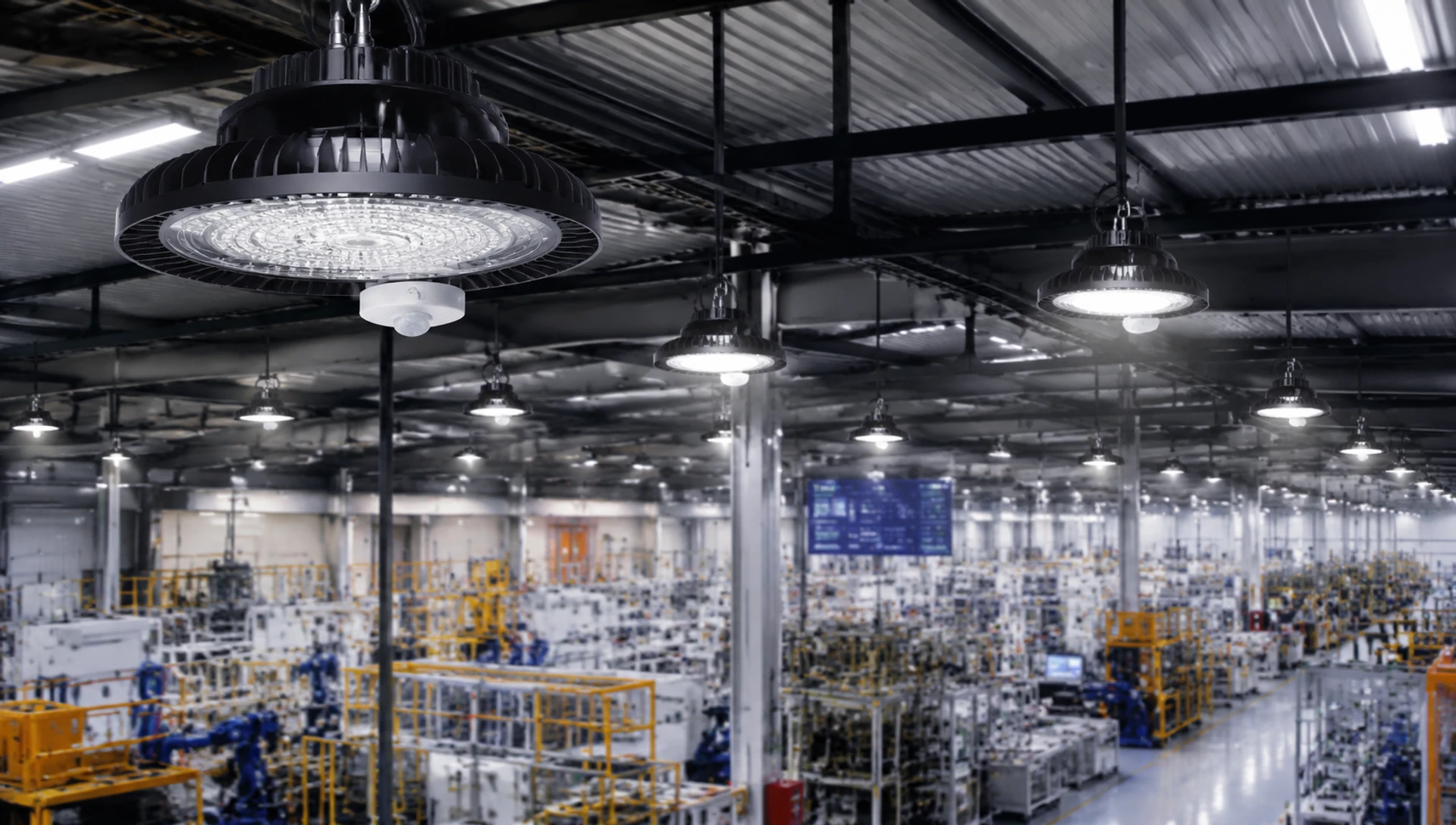
A critical concern for industrial procurement officers is determining the effective bluetooth low energy range inside environments dominated by structural steel, heavy machinery, high-voltage conduits, and concrete firewalls.
While consumer Bluetooth devices typically operate within a 10-meter radius, industrial bluetooth low energy technology utilizes long-range Coded PHY modes (Bluetooth 5.0 LE Coded) and optimized antenna design to achieve line-of-sight range exceeding 500 meters, and indoor factory ranges of 50 to 100 meters per node link.
RF system integrators calculate wireless coverage on factory floors using the text-based log-distance path loss model:
Formula: PL(d) = PL(d0) + 10 * n * log10(d / d0) + X_sigma
Where:
PL(d): Total path loss at distance d in decibels (dB).
PL(d0): Reference path loss measured at distance d0 (typically 1 meter, baseline -40 dBm).
n: Path Loss Exponent (n = 2.0 in free space; n = 3.0 to 4.5 in heavy metal fabrication plants).
d: Distance between transmitter and receiver nodes (in meters).
X_sigma: Zero-mean Gaussian random variable representing shadow fading caused by machinery structures (typically 6 to 12 dB in industrial environments).
To ensure reliable packet transmission without dropouts, the system link budget must exceed the calculated path loss:
Formula: Link_Budget = P_tx - P_rx + G_tx + G_rx
Where:
P_tx: Transmit Power of the BLE node (+8 dBm to +20 dBm for industrial power amplifiers).
P_rx: Receiver Sensitivity (-97 dBm for 1 Mbps PHY; -105 dBm for LE Coded PHY).
G_tx: Transmitter Antenna Gain (+2.0 dBi omnidirectional dipole).
G_rx: Receiver Antenna Gain (+2.0 dBi).
Example Calculation:
Link_Budget = (+8 dBm) - (-105 dBm) + (2 dBi) + (2 dBi) = 117 dB
With a total link budget of 117 dB, bluetooth low energy range easily penetrates structural obstacles, maintaining robust node-to-node mesh routing across extensive industrial facilities.
The core commercial value of bluetooth low energy ble lies in its ultra-low power footprint. To evaluate device longevity, hardware engineers calculate average current draw across active, advertising, and sleep operational states.
The electrical current consumption of a BLE node oscillates predictably between active and sleep phases. During the active phase (lasting approximately 2.5 ms), the device experiences a brief 12.5 mA transmit (TX) burst followed by an 8.2 mA receive (RX) listening window. Immediately after data exchange, the node transitions back into deep sleep mode for approximately 1 second, reducing current draw to a baseline of 1.2 uA.
Formula: I_avg = (I_active * t_active + I_sleep * t_sleep) / T_period
Where:
I_avg: Average current draw over time (in microamperes, uA).
I_active: Peak current consumption during radio transmission/reception (typically 10 mA to 15 mA).
t_active: Time duration of active event (typically 1.5 ms to 3.0 ms).
I_sleep: Deep sleep state current (typically 1.0 uA to 2.5 uA with real-time clock running).
t_sleep: Time duration spent in sleep state between advertising events (e.g., 997.5 ms for a 1-second beacon interval).
T_period: Total period duration (T_period = t_active + t_sleep).
Sample Calculation:
I_avg = (12 mA * 0.0025 s + 0.0015 mA * 0.9975 s) / 1.0 s = 0.0315 mA (31.5 uA)
Using a standard industrial 2400 mAh LiSOCl2 battery, a sensor drawing an average of 31.5 uA operates continuously for over 7.5 years without maintenance interventions.
Selecting the ideal wireless standard for factory control networks requires comparing bandwidth, latency, battery impact, and topology resilience.
| Feature Parameter | Bluetooth Low Energy Mesh | Zigbee (802.15.4) | Wi-Fi 6 (802.11ax) | WirelessHART |
| RF Frequency Band | 2.4 GHz ISM | 2.4 GHz ISM | 2.4 GHz / 5 GHz / 6 GHz | 2.4 GHz ISM |
| Network Topology | Managed Flooding Mesh | Tree / Star-Mesh | Star (AP Dependent) | Time-Synchronized Mesh |
| Protocol Overhead | Extremely Low | Moderate | High | Moderate |
| Average Node Power | Ultra-Low (uA Range) | Low (mA Range) | High (Continuous mA) | Low (uA Range) |
| Native Mobile Access | Yes (Direct Smartphone/Tablet) | No (Requires Dongle/GW) | Yes | No (Industrial Only) |
| Coexistence Mechanism | Adaptive Frequency Hopping | Channel Selection | CSMA/CA | TDMA / Channel Hopping |
| Security Architecture | 128-bit AES-CCM Dual Layer | 128-bit AES Single Layer | WPA3 Enterprise | 128-bit AES Encryption |
Deploying bluetooth low energy devices on the factory floor creates an intelligent data bridge into enterprise infrastructure. Multi-protocol edge gateways translate local BLE advertising packets and mesh frames into standard industrial software protocols.
Factory BLE mesh sensors send 2.4 GHz wireless telemetry signals directly to a local LumiEasy Edge Gateway. The gateway translates these mesh packets into standard enterprise data streams: pushing MQTT and JSON-LD protocols to enterprise cloud analytics platforms for predictive maintenance, while simultaneously routing BACnet/IP and Modbus protocol frames directly to on-premise SCADA systems for real-time facility lighting and HVAC control.
Industrial network security is paramount. Bluetooth low energy mesh implements mandatory security at both the network layer and application layer:
Network Key (NetKey): Encrypts all internal mesh communication, ensuring data passing through relay nodes cannot be intercepted or spoofed by rogue devices.
Application Key (AppKey): Protects specific functional data payloads (e.g., lighting commands vs. security access badges), preventing unauthorized cross-departmental data readouts.
Device Key (DevKey): Secures point-to-point node provisioning during initial network commissioning.
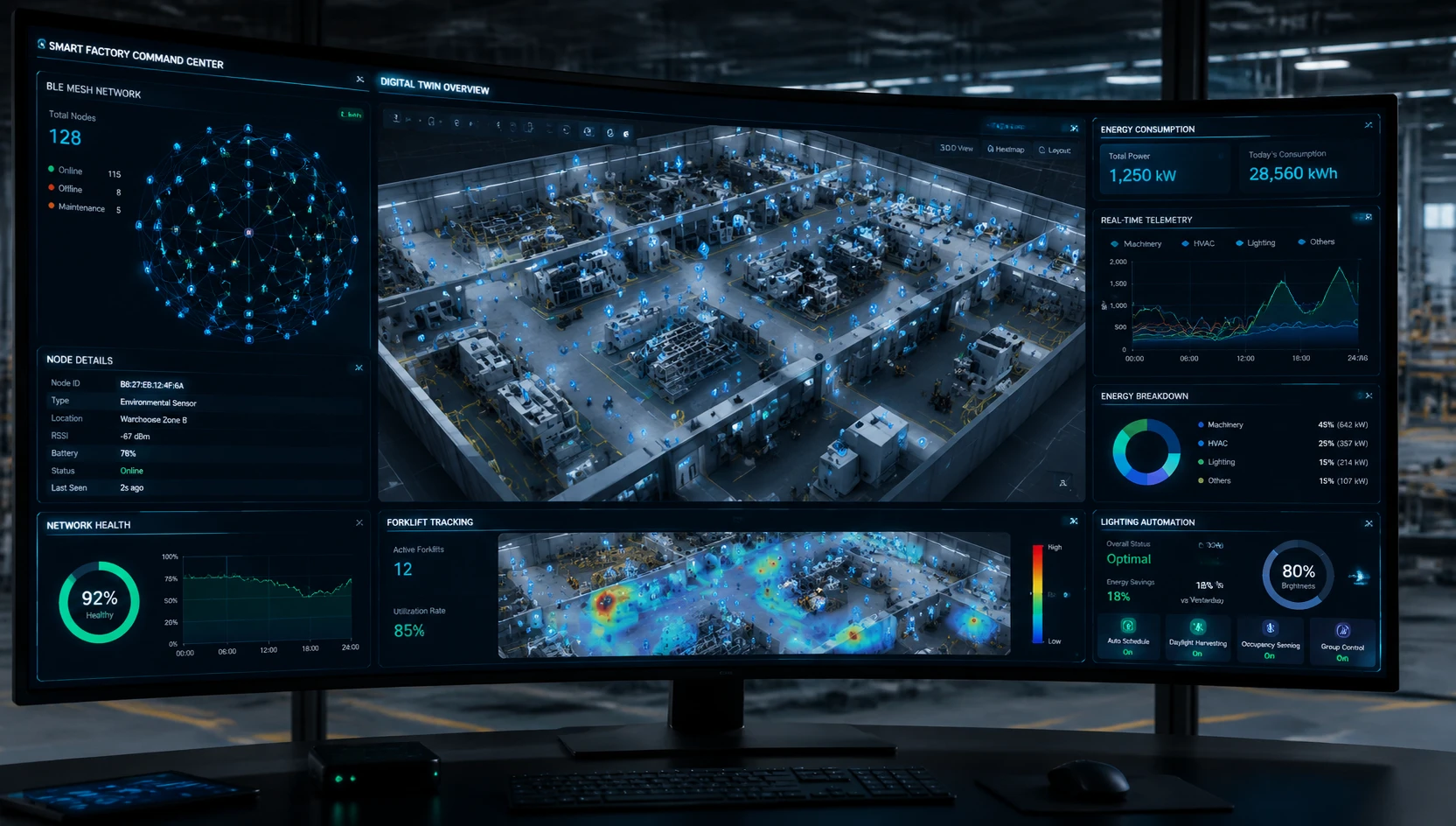
Implementing a high-reliability bluetooth low energy technology infrastructure across a manufacturing facility follows an established 5-phase engineering protocol:
Step 1: RF Field Survey and Noise Baseline Assessment
Engineers perform spectrum analysis across the 2.4 GHz band to identify existing Wi-Fi channel density and localized RF noise from induction heaters or motor drives. Node spacing is mapped according to calculated link budgets.
Step 2: Hardware Installation and Power Provisioning
Mount industrial high bays, smart sensors, and edge gateways. Line-powered luminaires act as fixed relay nodes, forming the primary structural backbone of the mesh network.
Step 3: Network Provisioning and Cryptographic Key Assignment
Using a dedicated mobile commissioning tool, field technicians scan local Bluetooth advertising beacons. Nodes are assigned network security keys (NetKey, AppKey) and enrolled into encrypted sub-networks.
Step 4: Control Grouping and Automated Logic Setup
Configure operational zones (e.g., machining bays, high-density pallet racking, loading docks). Assign specific daylight harvesting thresholds, PIR occupancy hold-times, and automated task-tuning dimming curves.
Step 5: Gateway Synchronization and SCADA Mapping
Map gateway outputs to BACnet/IP points or MQTT topics, enabling real-time telemetry streaming into central building management systems.
To demonstrate the commercial payback of upgrading plant lighting and sensing to smart bluetooth low energy controls, review the 10-year Total Cost of Ownership (TCO) model below:
Facility Surface Area: 30,000 square meters.
Lighting Infrastructure: 1,500 units of 400W legacy Metal Halide fixtures.
Facility Operating Schedule: 24/7 continuous operation (8,760 hours/year).
Electricity Cost: $0.14 per kWh.
| Financial Metric | Legacy Metal Halide | Standard Uncontrolled LED | BLE Smart Controlled LED |
| Connected Wattage per Fixture | 440 Watts (with ballast) | 150 Watts | 150 Watts (45W effective via dimming) |
| Total Facility Load | 660 kW | 225 kW | 67.5 kW (Effective Load) |
| Annual Electricity Usage | 5,781,600 kWh | 1,971,000 kWh | 591,300 kWh |
| Annual Electricity Cost | $809,424 | $275,940 | $82,782 |
| Annual Relamping / Maintenance | $35,000 | $7,500 | $1,500 |
| Total 10-Year Operating Cost | $8,444,240 | $2,834,400 | $842,820 |
| 10-Year Net Cost Reduction | Baseline | $5,609,840 | $7,601,420 |
Integrating bluetooth low energy mesh controls delivers a 72% cost reduction compared to uncontrolled LED systems and over 90% savings compared to legacy lighting, yielding full capital investment payback within 9.5 months of installation.
LumiEasy bluetooth low energy controllers and smart lighting drivers are built with industrial-grade components, solid-state capacitors, and IP67 ruggedized housings rated for continuous operation from -40°C up to +60°C ambient temperatures. Integrated thermal fold-back mechanisms safeguard internal electronics against thermal degradation.
Yes. All operational control logic—including occupancy sensing, daylight harvesting, manual wall switch overrides, and scheduled dimming—is executed locally across decentralized bluetooth low energy nodes. Cloud gateway connections are required only for remote telemetry reporting and off-site data analytics.
LumiEasy bluetooth low energy technology uses Adaptive Frequency Hopping (AFH) across 40 physical channels. The nodes continuously detect RF spectrum congestion and automatically route communication packets around active Wi-Fi channels, preserving robust wireless performance without impacting enterprise Wi-Fi networks.
Modernizing your manufacturing facility with intelligent wireless controls reduces energy overhead, lowers maintenance expenses, and builds a robust digital infrastructure for Industrial IoT capabilities.
To review technical product specifications, request photometric layout designs, or consult directly with our technical automation engineers,


)
)
)
)

+86 15899791249

+86 755 2955 3313


Address: Huafeng No.1 Science and Technology Park, Sanwei, Bao'an District, Shenzhen, Guangdong, China.
