

Time:2026-07-10
The rapid evolution of Industrial Internet of Things (IIoT) platforms has fundamentally elevated how modern manufacturing complexes evaluate operational efficiency. For facility engineers, systems integrators, and IT architects steering large-scale production sites, managing thousands of isolated illumination nodes via fragmented applications is no longer viable. Achieving true synchronization across diverse enterprise environments requires executing a seamless central lighting management software platform integration matrix. This technical manual details the foundational protocols, software interface tiers, and physical-to-digital layer engineering required to connect intelligent lighting telemetry with enterprise-level industrial automation frameworks.
By establishing an interoperable software architecture, multinational manufacturers shift lighting from a static utility into a dynamic, data-generating asset class that actively responds to factoryfloor automation cues and grid-level demand changes.
A successful software platform fusion avoids direct, messy point-to-point connections. Instead, it relies on an organized three-tier infrastructure designed to handle high-frequency data streams from thousands of heavy-industrial devices simultaneously without introducing network lag.
Integrating enterprise automation components requires managing data flow across three critical distinct layers:
The Southern Device Acquisition Layer: Interfaces natively with raw field hardware—including DALI-2 sub-routers, PoE gateway drivers, and digital sensor arrays—to collect raw telemetry at the edge.
The Central Normalization and Logic Layer: Processes, cleans, and translates disparate device languages into a single, standardized data format, resolving communication differences between varying hardware generations.
The Northern Enterprise Service Layer: Uses standardized developer tools to securely pass processed lighting profiles, occupancy logs, and power-consumption telemetry directly to upper-tier building systems.
The absolute prerequisite for a stable enterprise level lighting control systems integration framework is native protocol compatibility. Industrial environments operate on highly structured fieldbuses that require precise protocol mapping at the software gateway interface.
For deep integration into standard Building Management Systems (BMS) like Honeywell or Siemens, the central platform must act as a native BACnet/IP server. The software automatically maps internal lighting status registers into standardized BACnet objects (Analog Inputs for lux levels, Binary Outputs for relay states). Similarly, for integration with factory-floor programmable logic controllers (PLCs) via Modbus TCP, the software maintains deterministic holding registers to ensure sub-10ms response times when emergency factory-wide shutdown commands are triggered.
When routing lighting data directly to cloud-based energy management portals or customized corporate analytics screens, the platform uses lightweight communication channels. By employing a built-in MQTT broker, the system publishes real-time power metrics whenever changes occur, avoiding the network congestion caused by old-fashioned continuous polling methods. Concurrently, a robust, token-authenticated RESTful API allows enterprise software developers to pull historic run-time charts using simple, standard JSON payloads.
The following specification ledger defines the architectural translation benchmarks required to execute a reliable, high-performance software integration over enterprise production networks.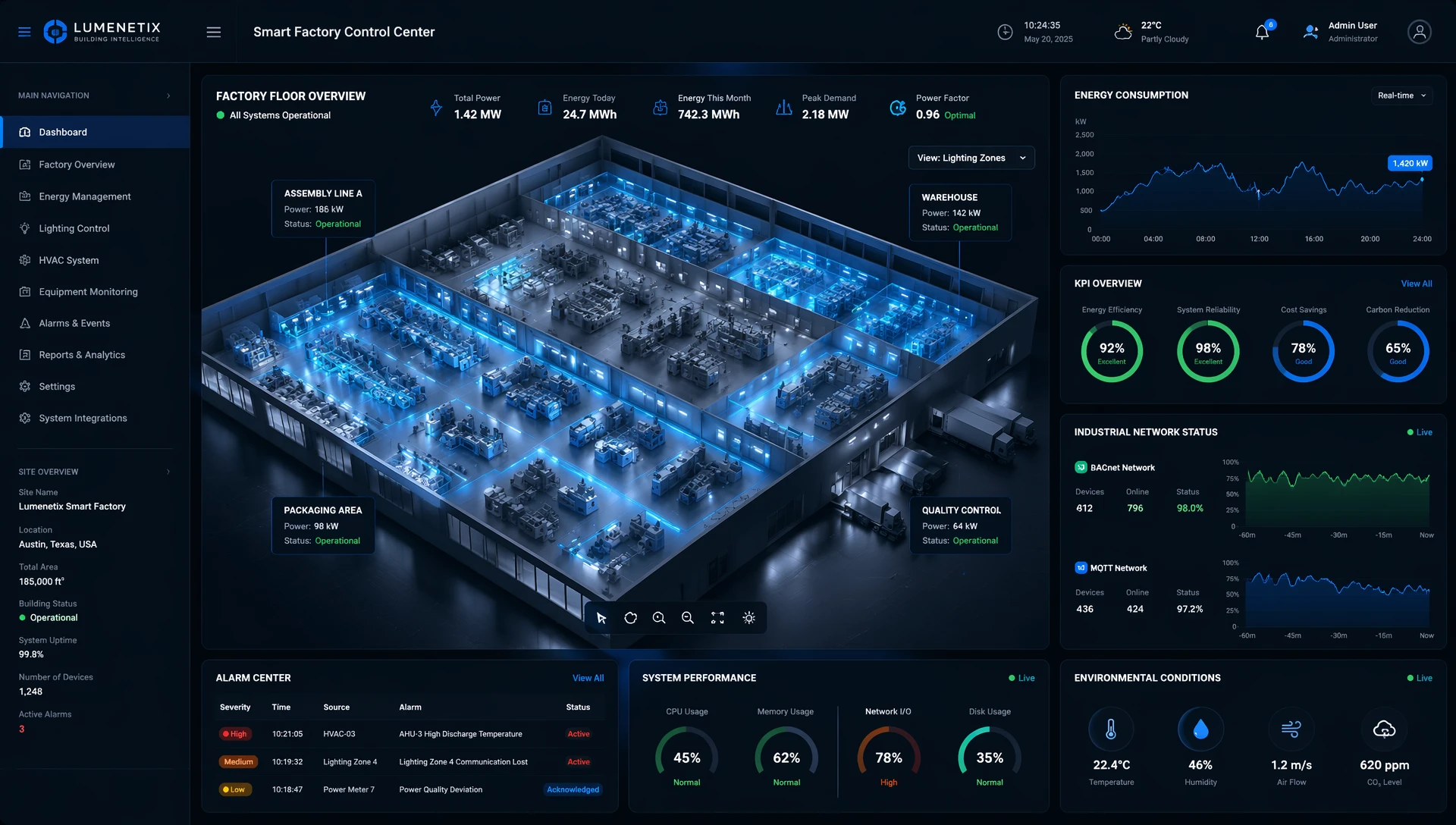
| Integration Layer / Tier | Target Technical Standard (IIoT Compliance) | LumiEasy Native Software Implementation | Field Operational & Data Integrity Benefit |
| API Architecture | RESTful API over HTTPS using JSON Web Tokens (JWT). | OAuth 2.0 secured Northbound open-access gateway. | Prevents unauthorized system cross-talk; safeguards internal corporate networks. |
| BMS Communication | B-BUMS profile certified under BACnet/IP standard. | Automated virtual object mapping and discovery profiles. | Eliminates manual point-creation workflows; cuts commissioning timelines in half. |
| Message Queueing | MQTT v3.1.1 or v5.0 with TLS 1.3 encryption. | Optimized edge-to-cloud telemetry publisher arrays. | Dramatically slashes network bandwidth consumption in massive multi-site rollouts. |
| Database Structure | Time-series optimized database framework. | High-ingestion data architecture for continuous telemetry. | Delivers millisecond-accurate tracking for comprehensive carbon reporting. |
Developing an enterprise-ready software ecosystem demands robust stress-testing long before deploying code to an active factory floor. Within the specialized digital testing laboratories at LumiEasy, our software engineers evaluate system performance using simulated, high-volume data networks that mimic real-world manufacturing conditions.
50,000 Concurrent Node Data Ingestion Simulation: We test our core software platform against massive virtual hardware networks. This ensures that database writes, state changes, and automated tracking profiles execute flawlessly during high-density communication surges.
Network Interruption Cache and Sync Verification: Our engineers simulate complete backbone network failures. The testing verifies that our edge gateways safely store local sensor logs and power data, automatically syncing records with the central database the moment connections are restored.
Automated BMS/SCADA Multi-Protocol Handshake Auditing: We conduct continuous testing loops with major industrial software ecosystems to guarantee that cross-system control commands execute within strict, millisecond-grade performance tolerances.
By deploying highly scalable software backbones, complex industrial sites can seamlessly unify their physical assets into an efficient, interactive ecosystem. Choosing pre-validated software structures drastically reduces software errors during field deployment. To discover how centralized controls optimize asset visibility across heavy-production facilities, check out our technical analysis on
In modern manufacturing environments, connecting lighting systems to enterprise networks requires meeting strict corporate cybersecurity standards. A truly professional efficient central lighting management software solutions layout must treat security as a core architectural requirement.
To prevent lighting control components from becoming potential targets for corporate network intrusions, the software architecture supports complete Virtual Local Area Network (VLAN) segregation. The central platform operates safely across split-network configurations, collecting low-voltage lighting data through a dedicated IoT VLAN while securely exposing its north-facing API endpoints through a separate, firewalled corporate IT network zone.
All internal data transmissions—whether running from edge gateways to the central server or across administrative browser interfaces—utilize industry-standard HTTPS and TLS 1.3 encryption protocols. Furthermore, the software features native Active Directory and LDAP integration. This allows corporate IT departments to manage user permissions centrally via Role-Based Access Control (RBAC), ensuring that every single lighting adjustment or configuration change is logged to a secure, permanent audit trail.
The ultimate objective of pursuing a deep central lighting management software platform integration is to build a responsive, highly efficient manufacturing environment. When lighting data flows freely across enterprise management platforms, it unlocks automated operating efficiencies that traditional, isolated systems simply cannot match.
When an automated assembly line receives a production start command from the central ERP system, the factory's core automation network immediately alerts the integrated lighting platform. The system adjusts corresponding workspace zones to precise, task-appropriate brightness levels while keeping inactive warehouse areas in energy-saving modes. This integrated data workflow maximizes energy savings, minimizes manual operational overhead, and delivers the deep technical foundation required for modern, sustainable industrial facilities. To explore the high-level planning frameworks needed to manage these large-scale technology deployments, review our comprehensive implementation guide on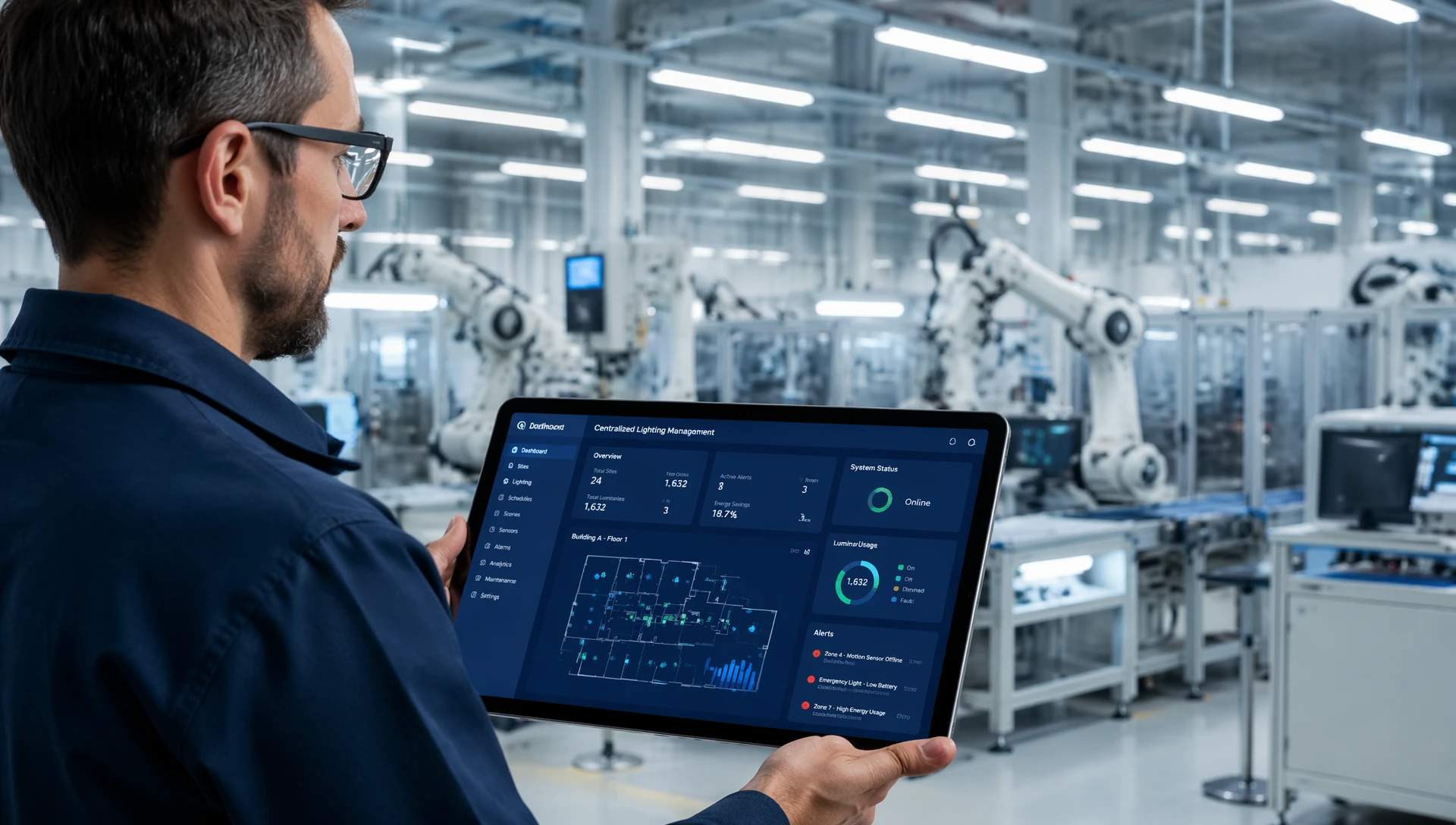
A1: Yes. The LumiEasy central platform connects with legacy hardware through our smart field gateways. These devices translate standard analog 0-10V or digital DALI signals into enterprise-ready IP protocols, allowing older fixtures to integrate seamlessly into a modern, centralized software network.
A2: Every LumiEasy edge gateway includes local storage capabilities to maintain system uptime during network disconnects. If the connection to the central server drops, edge nodes continue executing local automated schedules and store all telemetry locally, syncing the data automatically once network access returns.
A3: Absolutely. The LumiEasy software features a comprehensive north-facing webhook engine. When a driver reports a component fault or sudden power drop, the platform instantly generates an automated JSON alert, routing it directly into your team's existing computerized maintenance management system (CMMS).
Unifying your plant's data systems shouldn't require balancing multiple incompatible software applications or managing complex integration risks. Partnering with an engineering-focused industrial technology manufacturer like LumiEasy gives your organization access to robust, high-interoperability software backbones and rugged hardware built from the ground up for modern enterprise networks. Streamline your facility's data collection, protect your software investments, and engineer a highly responsive industrial environment that minimizes operational waste.
Don't let rigid, isolated hardware platforms limit your factory's digital transformation. Contact our enterprise systems division today to evaluate your current network layouts, set up software sandbox testing environments, and secure competitive volume hardware pricing.


)
)
)
)

+86 15899791249

+86 755 2955 3313


Address: Huafeng No.1 Science and Technology Park, Sanwei, Bao'an District, Shenzhen, Guangdong, China.
