

Time:2026-07-01
In the commercial smart lighting industry, ensuring total hardware interoperability is the backbone of any successful deployment
As a leading smart lighting solutions provider, LumiEasy has conducted rigorous interoperability testing with global controller ecosystems. This comprehensive guide breaks down the technical parameters of protocol matching and provides an engineering blueprint for integrating universal controller compatible sensors into your next-generation fixtures
When engineering commercial smart lighting control systems, a single communication glitch between an occupy sensor and a dimming pack can compromise an entire building node
Cross-brand integration typically introduces severe integration bottlenecks:
Dimming Discontinuity: Micro-flickering during low-end continuous dimming cycles.
Signal Latency: Delayed presence detection caused by long packet propagation times across unoptimized wireless lighting sensor arrays
Commissioning Gridlocks: Sensors failing to register on proprietary smartphone applications or centralized building management platforms
By utilizing a vetted, laboratory-tested hardware matrix, factory buyers eliminate these integration risks, streamlining their compliance pathways for nlc connected system certification and local utility rebate programs
To build a reliable controller sensor compatibility list, we must separate smart lighting infrastructure into three core control methodologies
Despite the rise of IoT, analog 0-10V dimming remains a standard for industrial warehouse smart lighting and high-bay retrofits due to its cost-efficiency and simplicity
The Compatibility Focus: Sinking vs. Sourcing current. The 0-10v controller sensors must match the exact milliampere (mA) drive capacity of the LED driver's control circuit
LumiEasy Solution: Our sensor line features automated voltage threshold detection, making them highly adaptive to varying legacy analog controllers.
For premium architectural layouts and modern office indoor lighting sensors, digital addressable lighting interfaces offer unprecedented granularity
The Compatibility Focus: Standardized memory banks and bus power limits. True dali controller compatible sensors must strictly adhere to IEC 62386 parts 101, 103, and 303/304
LumiEasy Solution: LumiEasy designs advanced dali d4i sensor ready interfaces that extract real-time diagnostic data collection and power monitoring metrics directly onto the shared data bus
Wireless control has revolutionized rapid commercial installations
The Compatibility Focus: Firmware-level stack interoperability. A silvair-compatible sensor ensures that peer-to-peer communication requires no external gateway for basic operations like localized daylight harvesting
LumiEasy Solution: Incorporating certified Bluetooth SIG mesh stacks guarantees cross-vendor operation with battery-free switches, dimmers, and third-party controllers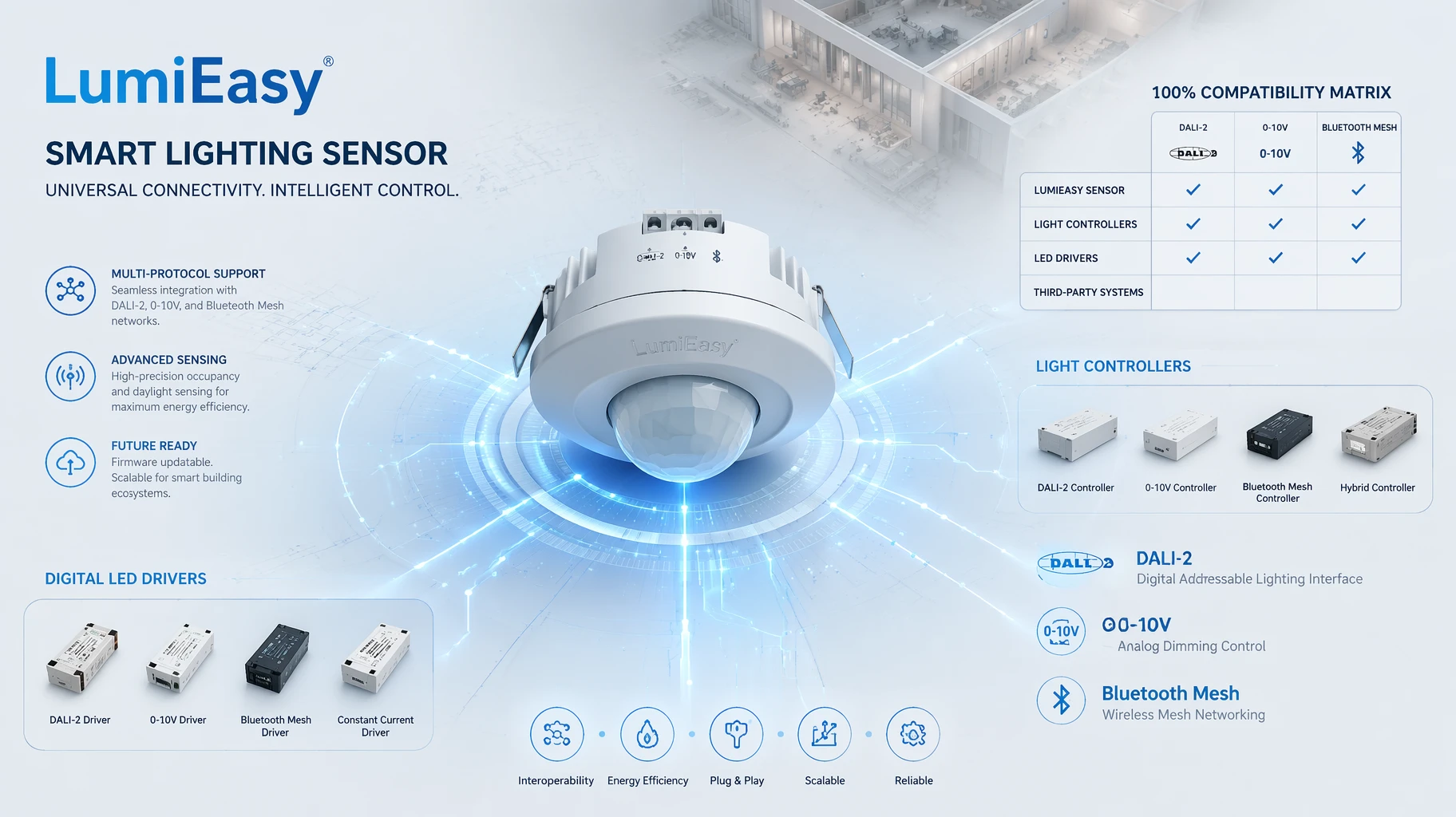
The following matrix represents verified laboratory test data combining LumiEasy's advanced sensor platforms with mainstream global commercial controller systems.
| Controller / Driver Brand | Protocol Platform | Compatible LumiEasy Sensor Model | Plug-and-Play Rating | Verified Features | Certifications Met |
| Lutron EcoSystem | Digital Protocol | LE-DS-DALI Series | 5/5 Stars | Continuous Dimming, Fault Diagnostics | UL, CE |
| Casambi Eco-System | BLE Mesh | LE-WS-BLE Wireless | 5/5 Stars | App Grouping, Wireless Scene Control | FCC, Bluetooth SIG |
| Silvair Platform | Standard BLE Mesh | LE-SS-SIL Linear Sensor | 5/5 Stars | Daylight Harvesting, OTA Updates | DLC Premium, NLC |
| Osram Optotronic | DALI-2 / D4i | LE-MS-D4i Microwave | 4.8/5 Stars | Asset Tracking, Power Data Bus | DALI-2 Certified |
| Mean Well HLG/ELG | Analog 0-10V | LE-PIR-010V Analog | 5/5 Stars | Bi-Level Dimming, Ambient Photocell | RoHS, CE |
Note: For the full electrical engineering specifications regarding specific controller model revisions, please consult our engineering team during the layout planning phase.
At LumiEasy, our industrial grade testing procedures validate our authority as a Tier-1 smart component manufacturer. Every line-item added to our compatibility matrix undergoes a strict three-phase validation sequence in our ISO-certified facilities.
Using high-frequency digital logic analyzers, our firmware engineers verify that every command packet sent by a third-party controller is interpreted accurately by our sensors. This guarantees that advanced functions, such as high-bay motion sensor sensitivity adjustments or scheduled holiday dimming modes, perform without signal degradation
Industrial smart lighting demands components that withstand extreme environments
We simulate real-world building installations by testing up to 100 sensors networked simultaneously onto a single controller configuration. This tests the limits of the plug-and-play sensor compatibility under high-density data traffic, ensuring smooth performance across entire corporate networks
For deeper insights into how advanced sensor hardware integration is transforming modern smart facility management architectures, review our industry-wide technical brief on
When manufacturing smart-ready commercial luminaires, factory engineers should adhere to a strict integration protocol to maximize field reliability:
Isolate High-Voltage Lines: Ensure that AC power lines do not run parallel to sensitive low-voltage 0-10V or digital DALI bus lines within the fixture housing to avoid electromagnetic noise interference.
Verify Bus Power Supply (BPS) Capacity: In DALI networks, always calculate the total milliampere draw of your connected peripherals. If your sensor requires 10mA and the controller can only supply 50mA, you must cap total device allocation appropriately.
Optimize Antenna Placement for Wireless Sensors: For Bluetooth Mesh or wireless lighting control hardware, ensure the sensor's RF antenna section extends beyond any metal enclosure shielding to maximize connection range and reliability
Explore our complete production-ready inventory of certified component shapes and sensing optics by browsing our specialized
A1: Yes. The LumiEasy controller sensor compatibility list features global brands including Lutron, Casambi, Helvar, and Mean Well
A2: LumiEasy develops structural form-factors ranging from micro-recessed optics to integrated linear smart sensors
A3: Absolutely. Our wireless sensor series is built on open architecture protocols, allowing seamless integration with standard ble network commissioning tools like Casambi, Silvair, and Tuya commercial software platforms
Sourcing components shouldn't involve guesswork. By aligning your manufacturing lines with an experienced IoT component partner, your factory can successfully launch high-end, intelligent lighting fixtures that satisfy global project specifications. Avoid field failures, streamline your supply chains, and unlock multi-tier utility incentives with zero system risk.
Ready to incorporate custom, high-compatibility smart components into your product line or commercial project?


)
)
)
)

+86 15899791249

+86 755 2955 3313


Address: Huafeng No.1 Science and Technology Park, Sanwei, Bao'an District, Shenzhen, Guangdong, China.
