

Time:2026-07-17
The global commercial and industrial lighting landscape is undergoing a profound paradigm shift. Simple transitions from legacy high-intensity discharge (HID) lamps to standalone Light Emitting Diode (LED) fixtures are no longer sufficient to meet modern energy efficiency mandates, corporate sustainability goals, and stringent building codes. Today, industrial facilities demand intelligent, data-driven environments where lighting assets act as interconnected nodes within a broader internet-of-things (IoT) ecosystem.
For commercial luminaire manufacturers, original equipment manufacturer (OEM) designers, factory procurement managers, and facility engineers, navigating this transition requires absolute alignment with standardized regulatory frameworks. In North America and across expanding global markets, the primary benchmark governing this space is the DesignLights Consortium (DLC) Technical Requirements for Networked Lighting Controls (NLC).
Deploying nlc certified lighting controls is no longer a luxury for progressive facility managers; it is a baseline commercial requirement. Systems meeting these rigid standards ensure future-proof building interoperability, unlock access to thousands of dollars in institutional utility rebates, and deliver verified energy savings that directly optimize a factory's bottom line.
To understand why network certification is vital, engineers must first understand what differentiates a standardized Networked Lighting Control system from a collection of isolated smart fixtures. The DesignLights Consortium maintains the NLC Qualified Products List (QPL) to establish a clear baseline of performance, security, and capability for networked architectures.
According to the latest DLC NLC5 specifications, a certified control platform must possess a series of mandatory core capabilities that operate natively across the system architecture:
Individual Addressability: Every control node, sensor, and integrated driver must be uniquely identifiable within the network software. This allows facility operators to map, configure, and re-zone specific fixtures without changing physical electrical wiring.
Occupancy Sensing: The system must dynamically adjust illumination levels based on real-time human or machine presence, dropping fixtures into deep energy-saving states when zones are vacant.
Daylight Harvesting: Integrated or network-connected photodiode arrays must measure ambient natural light entering through skylights or factory windows, automatically dimming the artificial LED output to maintain a constant, pre-configured lux level on the work surface.
Continuous Dimming: The control infrastructure must support smooth, granular dimming curves (typically using 0-10V, DALI-2, or digital wireless protocols) rather than simple on/off switching. This eliminates distracting step-attenuation for plant workers and extends driver lifespans.
Network Zoning: Operators must be capable of grouping individual luminaires into distinct functional zones via software control interfaces, enabling tailored lighting behaviors for specific manufacturing lines, storage areas, or pedestrian pathways.
Energy Monitoring: A critical pillar of the NLC5 specification is the requirement for automated energy telemetry. The system must record and report actual energy consumption data, providing the verification metrics needed for institutional green building certifications and utility rebate validation.
The capital expenditure (CapEx) required to upgrade a large manufacturing center or logistics hub to advanced smart lighting can be a hurdle for procurement teams. However, the deployment of certified components transforms this investment profile by enabling access to aggressive financial incentives from utility providers.
Utility companies across North America structure their commercial energy conservation incentives around the DLC Qualified Products List. When a factory installs hardware that is not listed on the QPL, they are forced to apply through complex "custom" rebate pathways. These pathways require expensive third-party engineering audits, lengthy approval periods, and offer no guarantee of a payout.
Conversely, specifying systems built on certified components unlocks "prescriptive" rebates. These are pre-approved, guaranteed financial payouts calculated directly on a per-fixture or per-node basis. Because the utility provider knows the certified hardware meets strict energy-saving performance baselines, the rebate processing pipeline is accelerated, often offsetting 30% to 70% of the total project hardware cost.
Standard LED Upgrade (Unmanaged Grid)
├── Average Utility Rebate: Base Tier Payout (Low Incentive)
└── Operational Profile: Static energy consumption, manual switches only

NLC Certified Wireless Mesh Upgrade (LumiEasy System)
├── Average Utility Rebate: Premium Tier Payout (Maximized Incentive)
└── Operational Profile: Dynamic scheduling, daylight harvesting, 75%+ energy reduction
Many forward-thinking utility programs offer a major premium incentive for projects that implement Luminaire Level Lighting Control (LLLC) configurations. LLLC is a specific subset of the NLC specification where every single fixture features its own embedded smart sensor and network node.
By decentralizing the intelligence down to the individual fixture level, the facility achieves maximum granular control. To evaluate how to successfully navigate this regulatory path and select compliant architectures for your manufacturing setup, refer to our comprehensive
To secure these top-tier financial paybacks, developers must pair certified controllers with compatible sensing hardware. For a deeper technical review of optimizing your components for these programs, explore our guide on utilizing
Industrial plants present incredibly challenging structural environments for communication networks. High-density steel racking, overhead traveling cranes, concrete reinforcement barriers, and pervasive electromagnetic noise from heavy motor drives will disrupt traditional wireless configurations and render low-grade consumer hardware useless.
Traditional wireless layouts rely on a centralized gateway communicating directly with peripheral devices in a star-shaped topology. In a massive manufacturing plant, if a fixture is mounted 150 meters away behind a thick metal mezzanine layer, the centralized signal will degrade, leading to dropped commands, sluggish response times, and localized network dropouts.
Modern industrial control networks resolve these structural challenges by utilizing decentralized, self-healing wireless mesh technologies, specifically those built on the standardized Bluetooth SIG Mesh protocol.
In a qualified wireless mesh ecosystem, every single control node acts as both a receiver and a signal repeater. Data packets containing control commands do not need to make a massive jump from a central router to a distant fixture. Instead, they hop across adjacent fixtures, working their way around physical obstacles and steel structures with ease.
If a maintenance crane moves into a production bay and blocks the direct line-of-sight between two nodes, the self-healing mesh algorithm instantly detects the path disruption. It automatically recalculates the optimal data path, rerouting the command packets through alternative surrounding fixtures in milliseconds. This structural redundancy ensures the plant's lighting control layer achieves a industrial-grade reliability level exceeding 99.9%.
For commercial lighting OEMs and ODM factories, integrating network capabilities directly into existing product lines is essential for winning large institutional contracts. Embedding these capabilities requires close attention to structural standardized component form factors and modern driver interfaces.
To build future-proof, network-ready luminaires, manufacturers must incorporate standardized receptor sockets that allow field installers to easily snap in external control nodes or sensor modules:
ANSI C136.41 (NEMA Sockets): Historically the standard for outdoor and industrial high-bay fixtures, the 7-pin NEMA twist-lock receptacle provides robust mechanical attachment and handles both line-voltage routing and 0-10V dimming lines. However, its large physical size makes it bulky for modern architectural or slim industrial profiles.
Zhaga Book 18 Sockets: The modern preferred standard for smart commercial fixtures. Zhaga connectors use a compact, 4-pin push-and-twist interface that provides a clean, low-profile footprint. It operates exclusively on low-voltage DC power lines, separating sensitive communication interfaces from high-voltage mains wiring.
The internal control node must communicate cleanly with the LED driver inside the fixture housing. Manufacturers typically utilize one of three primary driver interfaces:
Analog 0-10V Control: The traditional approach. The control node sends an analog voltage signal between 0V (minimum light or off) and 10V (maximum light output) along a pair of dedicated control wires. While simple and reliable, 0-10V is a one-way communication path; it cannot pass diagnostic data or actual energy consumption metrics back from the driver to the network.
DALI-2 (Digital Addressable Lighting Interface): A true digital protocol allowing bi-directional communication. DALI-2 drivers can transmit exact error codes, lamp operation hours, and thermal metrics back to the network node, enabling predictive maintenance schedules.
D4i Standards: The ultimate iteration of the digital driver standard for smart luminaires. D4i drivers feature integrated power supplies that deliver dedicated low-voltage DC power directly to the attached Zhaga control node, while storing standardized data banks for asset tracking, energy reporting, and real-time diagnostics natively inside the driver memory.
For an extensive architectural blueprint detailing how to structure your commercial fixture catalog around these component rules, download our guide on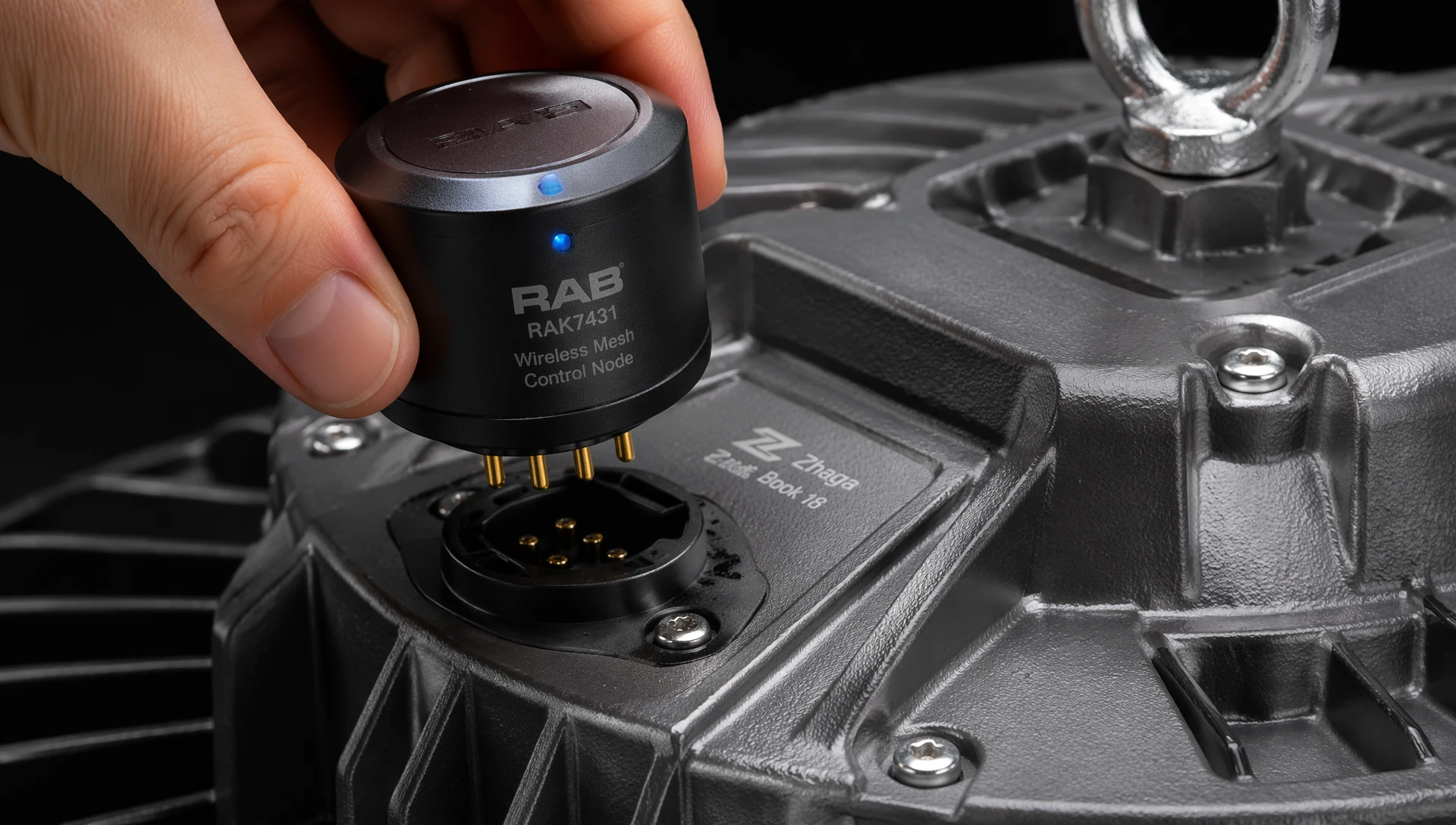
When procurement teams evaluate control platforms, they must look past basic software features and check the raw hardware tolerances. The table below outlines the minimal performance thresholds required for long-term survival on an industrial factory floor:
| Architectural Parameter | Standard Commercial Controls | Industrial-Grade NLC Hardware |
| Operating Temperature Range | 0°C to 40°C | -40°C to +85°C (Extended Component Rating) |
| Surge Immunity Level | 1 kV to 2 kV | 6 kV to 10 kV (Integrated Component Suppression) |
| Environmental Ingress Rating | IP20 (Indoor Open-Frame Only) | IP66 / IP67 (Dust-Tight & High-Pressure Waterproof) |
| Network Node Capacity | Up to 50 nodes per gateway | Unlimited via Decentralized Mesh Topologies |
| Security Standards | Basic WPA2 Passwords | AES-128 Bit Encryption + Per-Device Security Keys |
| Dimming Resolution | Standard 8-bit (Visible Steps) | Advanced 16-bit (Ultra-Smooth Visual Fading) |
Once a factory establishes a stable, certified wireless control network, the lighting infrastructure ceases to be a simple operational utility and becomes a high-value data generation asset.
In many heavy industrial spaces, fixtures are over-specified to guarantee adequate lighting levels at the end of their operational lifespans as the LED diodes naturally degrade. This means brand-new fixtures often run significantly brighter than necessary, wasting energy and creating glare for floor workers.
Certified software allows operators to apply a "high-end trim" or "task tuning" policy across specific production zones. For example, high-bay lights over a raw material storage area might be capped at 60% maximum power output, while fixtures over a high-precision electronics inspection bench are set to 90%. This software adjustment is invisible to the human eye but immediately cuts energy usage by 10% to 30%.
Unlike commercial offices where lights switch off instantly when a room is vacant, industrial areas require conservative delay strategies for worker safety. Advanced control platforms use multi-stage delay decay profiles:
[Zone Occupied] ───> Maintain 100% Target Illumination Level
                         │
                         ▼ (10 Minutes of Continuous Vacancy Detected)
[First Decay Stage] ───> Gracefully dim fixtures down to 30% Standby Safety Level
                         │
                         ▼ (An Additional 15 Minutes of Continuous Vacancy)
[Final Safe Stage]  ───> Completely extinguish zone or hold low ambient visibility line
This multi-stage transition eliminates sudden blackouts, ensuring that if a forklift operator turns into a quiet storage aisle, they are never plunged into darkness unexpectedly.
The success of a network installation depends heavily on the execution of its field commissioning phase. A poorly configured software layer will lead to network dropouts and worker complaints, regardless of the quality of the hardware.
Modern installation teams commission systems using mobile tablet applications that connect directly to the wireless mesh network over a secure Bluetooth interface. The commissioning engineer walks the factory floor, visualizes each node as it responds to the software, assigns it a permanent location tag on the building's digital architectural blueprint, and uploads the baseline operational parameters.
Phase 1: OTA Provisioning & Visual Floor Mapping
         (Nodes discovered via secure Bluetooth and tagged to digital blueprints)
               │
               ▼
Phase 2: Cryptographic Security Authentication
         (Enforce AES-128 encryption keys and revoke default setup codes)
               │
               ▼
Phase 3: Sensor Calibration & Daylight Tuning
         (Record ambient lux levels and lock internal photodiode curves)
               │
               ▼
Phase 4: Utility Integration & Compliance Reporting
         (Enable energy monitoring telemetry and export validated logs)
Industrial control infrastructure must be protected against malicious cyber interference. During deployment, the engineering team must change all default factory passwords and generate unique, device-specific cryptographic security keys. All data passing across the mesh network must use AES-128 bit encryption protocols, preventing unauthorized access to the network or building automation loops.
The final setup step requires calibrating the integrated photodiode sensors for daylight harvesting. The field engineer takes manual lux readings at the workspace surface using a calibrated light meter under both bright daylight and full darkness conditions. These real-world values are programmed into the control software, locking in the sensor's automatic dimming curves to prevent continuous light cycling on partly cloudy days.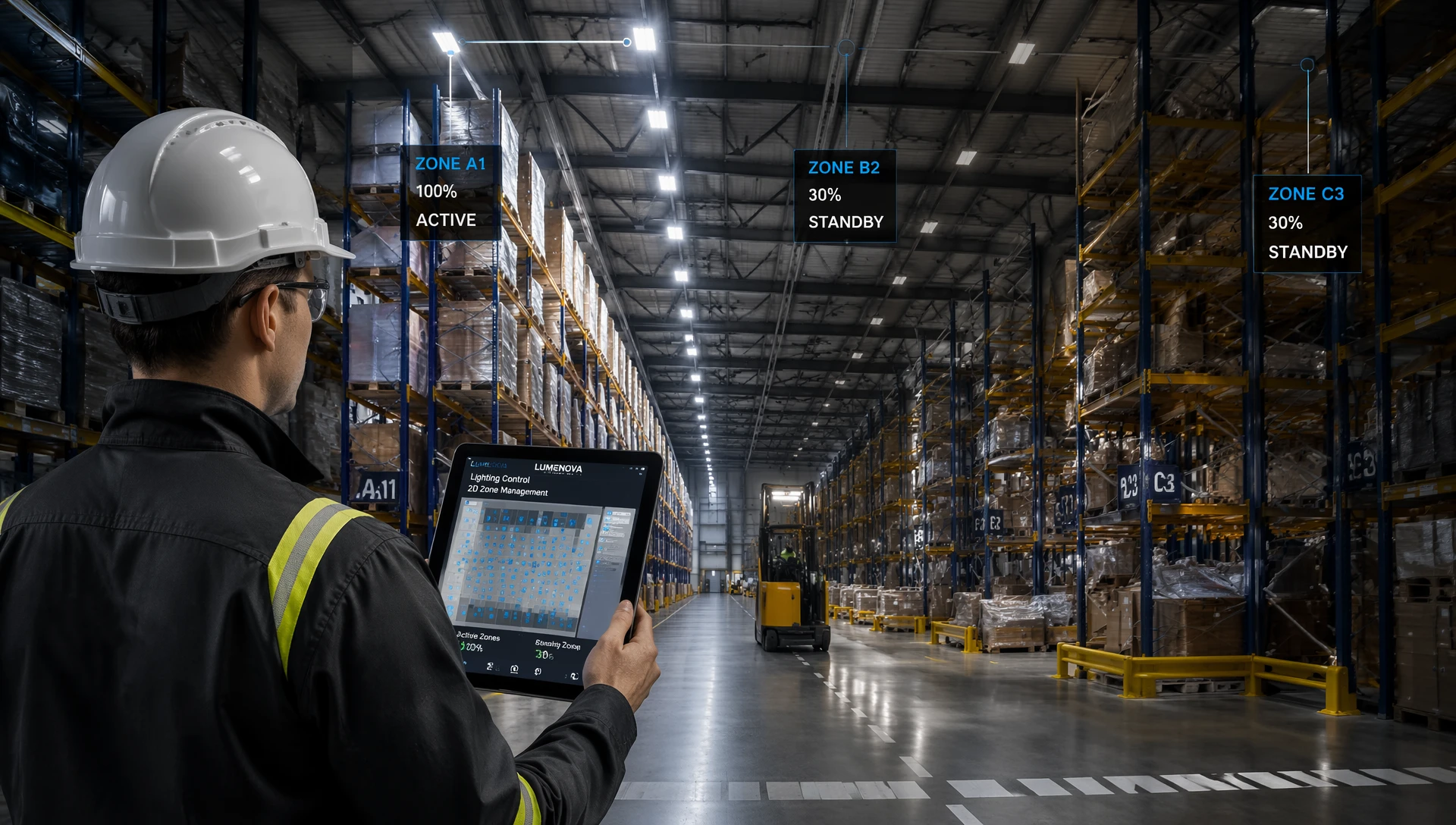
A1: An NLC certified system must meet strict DesignLights Consortium performance, security, and energy reporting standards. Unlike basic commercial wireless controls, certified platforms require mandatory bi-directional data telemetry, individual node addressability, continuous dimming, and verified energy monitoring capabilities. This certification guarantees long-term system interoperability and qualifies the hardware for premium utility company rebates.
A2: Industrial-grade Bluetooth Mesh systems utilize a decentralized, self-healing network layout operating across multiple distinct frequency channels. If heavy machinery or high-voltage lines generate electromagnetic interference that blocks a local wireless pathway, the mesh software automatically reroutes data packets through adjacent fixtures. This ensures uninterrupted communication across the plant floor.
A3: Yes. LumiEasy universal control nodes provide dual-protocol compatibility, allowing direct integration with legacy 0-10V analog dimming lines as well as modern digital DALI-2 and D4i internal communication networks. This flexibility allows luminaire OEMs and facility engineers to easily upgrade existing analog fixtures into fully managed smart network nodes.
Building a fully compliant, future-proof industrial lighting infrastructure requires premium components, field-tested wireless networking, and a thorough understanding of global efficiency standards. Settling for uncertified components leaves your project exposed to component failures, system integration issues, and eliminates access to thousands of dollars in utility energy rebates.
LumiEasy develops advanced, industrial-grade network control systems, certified wireless mesh components, and integrated smart sensors tailored specifically for global luminaire OEMs, ODM factories, and large-scale industrial facility upgrades. Our hardware platforms feature extended operating temperature windows, high surge protection, and full compliance with the latest DLC NLC5 technical requirements.
Do not leave your facility's energy efficiency or rebate potential to chance. Contact our technical applications team today to review your project blueprints, evaluate hardware compatibility, or request a comprehensive custom project quotation. Visit the official




+86 15899791249

+86 755 2955 3313


Address: Huafeng No.1 Science and Technology Park, Sanwei, Bao'an District, Shenzhen, Guangdong, China.
