

Time:2026-07-24
In modern heavy industrial manufacturing, logistics complexes, and automated processing plants, building management infrastructure is undergoing a rapid transition toward sustainable, maintenance-free automation. As industrial facility directors and Environmental Health and Safety (EHS) officers strive to reduce operational expenditure, traditional wired lighting control systems—which require extensive copper conduit runs, specialized high-voltage wiring, and heavy labor—are increasingly viewed as obsolete capital burdens.
Simultaneously, first-generation wireless lighting control systems introduced a hidden maintenance pitfall: battery reliance. In large-scale industrial facilities featuring ceiling heights from 8 to 15 meters, servicing thousands of battery-powered wireless wall switches, occupancy sensors, and daylight harvesting nodes creates an ongoing operational hazard. Replacing depleted lithium coin cells requires specialized scissor lifts, certified electrical labor, and temporary shutdowns of production bays.
To overcome these operational bottlenecks, plant engineers are turning to energy-harvesting, self-powered wireless lighting controls. These devices capture ambient mechanical, solar, or thermal energy from their surrounding environment to generate sufficient micro-joules of electricity to transmit secure radio telegrams, completely eliminating batteries and external power wiring.
However, introducing wireless radio frequency (RF) transmitters and energy harvesting hardware into high-EMI (electromagnetic interference) industrial environments requires strict regulatory and operational compliance. Deploying uncertified wireless hardware risks severe electromagnetic interference with automated machinery, fire safety non-compliance, and forfeiture of municipal energy rebates. Navigating self powered wireless lighting control certifications is a fundamental prerequisite for plant managers, electrical contractors, and OEM lighting specifiers prior to industrial deployment.
To evaluate certification standards effectively, facility engineers must first understand the electro-mechanical principles that drive battery-free wireless control nodes. Self-powered lighting switches and industrial sensors harvest ambient energy through three primary physical mechanisms:
+-----------------------------------------------------------------------------------+
|                        ENERGY HARVESTING MECHANISMS                              |
+------------------------------------+----------------------------------------------+
| Kinetic Energy Harvesting          | Converts physical press force (2-5 Newtons)  |
| (Electromagnetic Induction)        | into electro-dynamic micro-pulses.           |
+------------------------------------+----------------------------------------------+
| Photovoltaic Energy Harvesting     | Captures ambient indoor light (100-300 lux)  |
| (Indoor Amorphous Silicon)         | to trickle-charge ultra-capacitors.          |
+------------------------------------+----------------------------------------------+
| Thermal Energy Harvesting          | Uses temperature differentials across heat   |
| (Peltier / Seebeck Effect)         | sinks to power wireless telemetry nodes.     |
+------------------------------------+----------------------------------------------+
Kinetic switches utilize a miniature electro-dynamic energy generator. When an operator depresses a mechanical rocker switch, the physical downward movement (typically 2 to 5 Newtons of press force) moves a permanent magnet through a high-density copper wire coil. This mechanical displacement induces a magnetic flux change, generating a transient burst of electrical energy (approximately 100 to 300 microjoules at 3 to 5 Volts DC).
This energy pulse instantly wakes an ultra-low-power micro-controller, encodes a secure radio telegram containing unique device ID addresses and switch state commands, and broadcasts the signal over sub-1GHz or 2.4GHz RF bands—all within a duration of less than one millisecond.
For continuous monitoring nodes—such as overhead daylight harvesting sensors, passive infrared (PIR) occupancy detectors, and ambient temperature sensors—kinetic actuation is impractical. These devices utilize specialized indoor amorphous silicon or dye-sensitized solar cells optimized to harvest energy from low-lux artificial LED or fluorescent lighting (100 to 300 lux).
The harvested micro-watts are managed by an onboard energy management integrated circuit (EMIC) and stored in low-leakage solid-state supercapacitors. This stored charge allows the wireless sensor to operate continuously in total darkness for up to 48 to 120 hours without interruption.
In heavy industrial environments featuring high-temperature machinery, steam pipes, or heat-treatment furnaces, thermoelectric generators (TEGs) leverage the Seebeck effect. By bridging a thermal gradient between a hot industrial surface and an ambient heat sink, TEGs generate continuous DC voltage to power wireless industrial monitoring and lighting control nodes without chemical batteries.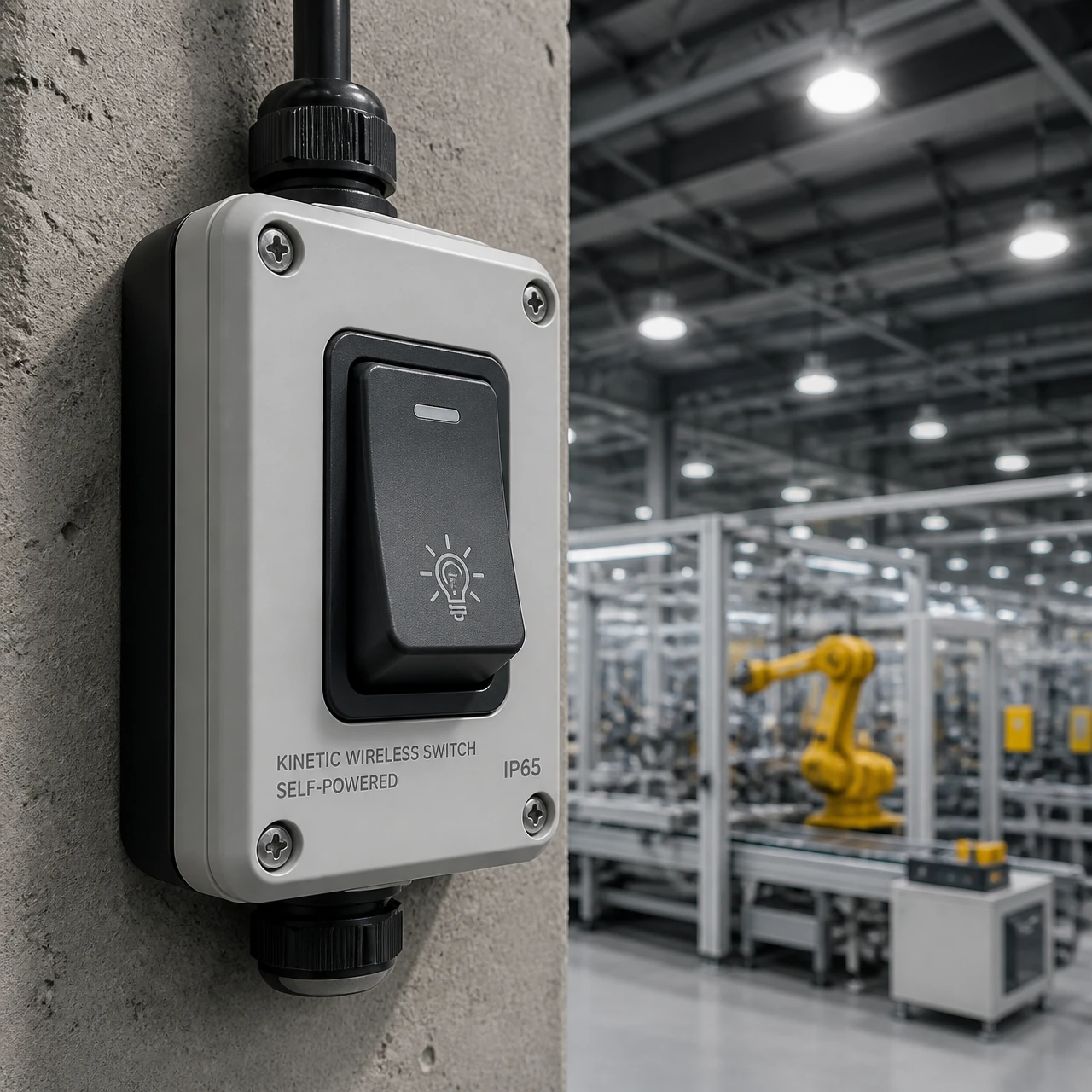
Because self-powered wireless switches function as intentional radio frequency radiators, they must comply with global telecommunication and radio spectrum regulations. In industrial plants filled with variable frequency drives (VFDs), high-voltage arc welders, and heavy electric motors, RF compliance ensures that lighting control signals do not disrupt automated machinery or suffer packet corruption.
+-----------------------------------------------------------------------------------+
|                     GLOBAL REGULATORY RF & EMC COMPLIANCE                         |
+-------------------+--------------------+------------------------------------------+
| Region            | Standard / Agency  | Focus Area                               |
+-------------------+--------------------+------------------------------------------+
| North America     | FCC Part 15 / IC   | Unintentional/Intentional Radiators      |
| European Union    | CE / RED 2014/53/EU| Spectrum Efficiency & EMC Immunity       |
| International     | IEC/EN 61000-4     | Industrial Surge & ESD Tolerance         |
+-------------------+--------------------+------------------------------------------+
In the United States, the Federal Communications Commission (FCC) regulates all RF devices under Title 47 of the Code of Federal Regulations (CFR). Self-powered wireless lighting controls fall under two distinct categories:
Unintentional Radiators (FCC Part 15 Subpart B): Covers the digital logic circuitry within receivers, gateways, and energy management controllers. Industrial facilities require Class A digital device certification, which permits higher electromagnetic noise thresholds suitable for industrial zones while ensuring the device does not interfere with commercial communications.
Intentional Radiators (FCC Part 15 Subpart C): Covers the active wireless radio transmitters operating on unlicensed ISM (Industrial, Scientific, and Medical) bands, such as 902-928 MHz or 2.4 GHz. Testing evaluates Effective Isotropic Radiated Power (EIRP), occupied bandwidth, and field strength of fundamental and spurious emissions.
Devices passing these tests receive a unique FCC ID, which must be clearly stamped on the physical housing and documented in plant compliance filings. In Canada, Innovation, Science and Economic Development (ISED) enforces parallel requirements under RSS-210 and RSS-GEN.
For industrial equipment installed across the European Economic Area (EEA), self-powered wireless controls must demonstrate compliance with the Radio Equipment Directive (RED 2014/53/EU) to affix the CE mark. RED compliance requires rigorous laboratory verification across three key pillars:
Effective Use of Radio Spectrum (ETSI EN 300 220 for Sub-1GHz / ETSI EN 300 328 for 2.4GHz): Ensures radio bursts do not exceed duty cycle limits or splatter noise into adjacent frequency bands.
Electromagnetic Compatibility (ETSI EN 301 489-1/-3/-17): Verifies that the control hardware resists high-voltage electrical fast transients (EFT), electrostatic discharge (ESD) up to 8kV contact / 15kV air discharge, and radiated RF fields up to 10 V/m.
Electrical Safety (EN 62368-1 / EN 61010-1): Guarantees electrical insulation integrity and thermal safety during prolonged operational exposure.
To explore how international regulatory frameworks align with commercial smart lighting controls, read our technical compliance review on
While wireless switches operate on ultra-low internal voltages, the receiving gateways, relay packs, and wireless-to-DALI controllers interface directly with 120V to 480V AC industrial mains. Consequently, safety certifications are mandatory to mitigate electrical fire risks and shock hazards.
+-----------------------------------------------------------------------------------+
|                        INDUSTRIAL SAFETY & MATERIAL RATINGS                       |
+-------------------+--------------------+------------------------------------------+
| Standard          | Governing Body     | Operational Objective                    |
+-------------------+--------------------+------------------------------------------+
| UL 916            | Underwriters Lab   | Energy Management Equipment Safety       |
| UL 2043           | Underwriters Lab   | Low Smoke & Heat Release in Plenums      |
| RoHS 3 & REACH    | EU / Global        | Elimination of Toxic Heavy Metals        |
+-------------------+--------------------+------------------------------------------+
UL 916 is the primary safety benchmark for commercial and industrial energy control systems in North America. Certification involves rigorous testing of internal transformer isolation, flame-retardant enclosure plastics (UL 94 V-0 rating), short-circuit endurance, and thermal rise under continuous maximum load.
In industrial environments where line voltage fluctuations and transient voltage spikes are common, UL 916 listed controllers ensure that internal component failure will not propagate an external electrical fire.
In many industrial plants, wireless receivers, power packs, and sensor gateways are installed above dropped ceilings or inside architectural air plenum spaces that transport circulating air throughout the facility.
Plenum-installed hardware must achieve UL 2043 certification. This fire safety standard measures heat release rates, peak optical smoke density, and flame spread parameters when the device is subjected to direct flame exposure. Certified devices utilize halogen-free, self-extinguishing polymers that prevent the release of toxic, corrosive smoke into the facility's air circulation system during a structural fire.
Modern industrial procurement standards strictly enforce environmental compliance for electronic assemblies:
RoHS 3 (Directive 2015/863): Restricts ten hazardous substances in electrical equipment, including lead, mercury, cadmium, hexavalent chromium, and specific phthalate plasticizers (DEHP, BBP, DBP, DIBP) to concentrations below 0.1% (1000 ppm).
REACH (EC 1907/2006): Regulates Substances of Very High Concern (SVHC) across the entire product supply chain, ensuring that piezoelectric elements, kinetic coils, and printed circuit boards do not outgas toxic compounds over their 15-to-20-year service life.
Achieving regulatory RF compliance and electrical safety is only half the equation for industrial facilities. To ensure long-term operational flexibility, self-powered wireless controls must interoperate seamlessly with multi-vendor lighting fixtures, central Building Management Systems (BMS), and utility energy-efficiency rebate programs.
+-----------------------------------------------------------------------------------+
|                   INTEROPERABILITY & UTILITY CERTIFICATIONS                       |
+-------------------+--------------------+------------------------------------------+
| Certification     | Standard Body      | Core Technical Value                     |
+-------------------+--------------------+------------------------------------------+
| DLC Premium V5.1  | DesignLights Cons. | Unlocks 30%-70% Capital Utility Rebates  |
| EnOcean Alliance  | ISO/IEC 14543-3-10 | Multi-Vendor Self-Powered Profile Sync   |
| Zigbee Green Power| Connectivity Stds. | IEEE 802.15.4 Energy Harvesting Frames   |
| Bluetooth Mesh    | Bluetooth SIG      | Standardized Decentralized Mesh Profile  |
+-------------------+--------------------+------------------------------------------+
For plant managers in North America, DLC qualification is the single most important factor for financial project justification. Municipal electric utilities rely on the DLC NLC Qualified Products List (QPL) to award substantial capital rebates for commercial and industrial lighting retrofits.
Under DLC NLC Technical Requirements V5.1, self-powered wireless control networks qualify for rebates by satisfying core functional criteria:
Continuous Daylight Harvesting: Automated dimming of perimeter luminaire rows based on ambient daylight sensor telemetry.
High-End Trim (Task Tuning): Establishing maximum power output caps across specific manufacturing zones to eliminate unnecessary lumen over-provisioning.
Occupancy & Vacancy Sensing: Rapid motion detection and auto-off/partial-off dimming during non-shift hours.
BMS Integration (BACnet / Modbus): Bi-directional data exchange with central plant automation platforms over BACnet/IP or Modbus TCP.
Deploying DLC-qualified self-powered lighting controls can offset 30% to 70% of initial equipment procurement costs through utility incentive checks, dramatically shortening the project payback period to under 18 months.
The EnOcean Alliance governs the international standard for wireless energy harvesting communication in building automation. Certified devices adhere to standardized EnOcean Equipment Profiles (EEPs), which dictate exact data payload formats:
EEP F6-02-01 / F6-02-02: Standardized data frames for light switch rockers (reporting top/bottom button presses, mechanical release events, and double-rocker states).
EEP A5-07-01 / A5-07-02: Standardized telemetry packets for self-powered solar occupancy sensors (reporting lux levels, motion detection events, and capacitor voltage health).
By enforcing strict EEP compliance, an industrial facility can pair a self-powered kinetic switch from one manufacturer with a wireless receiver gateway from a different vendor without custom driver programming.
Beyond sub-1GHz EnOcean protocols, self-powered technology is heavily integrated into 2.4 GHz global mesh networking ecosystems:
Zigbee Green Power (ZGP): A specialized feature of the Zigbee PRO standard designed for ultra-low-power nodes. ZGP compresses standard Zigbee network frames into short, 7-byte "stub" packets that can be transmitted using the tiny electrical charge generated by a single kinetic switch press.
Bluetooth Mesh Energy Harvesting: Utilizes standard Bluetooth Low Energy (BLE) advertising channels (Channels 37, 38, and 39) to broadcast un-connected control packets across a decentralized mesh network. Certified BLE self-powered switches allow field technicians to commission lighting scenes directly via standard industrial mobile tablets.
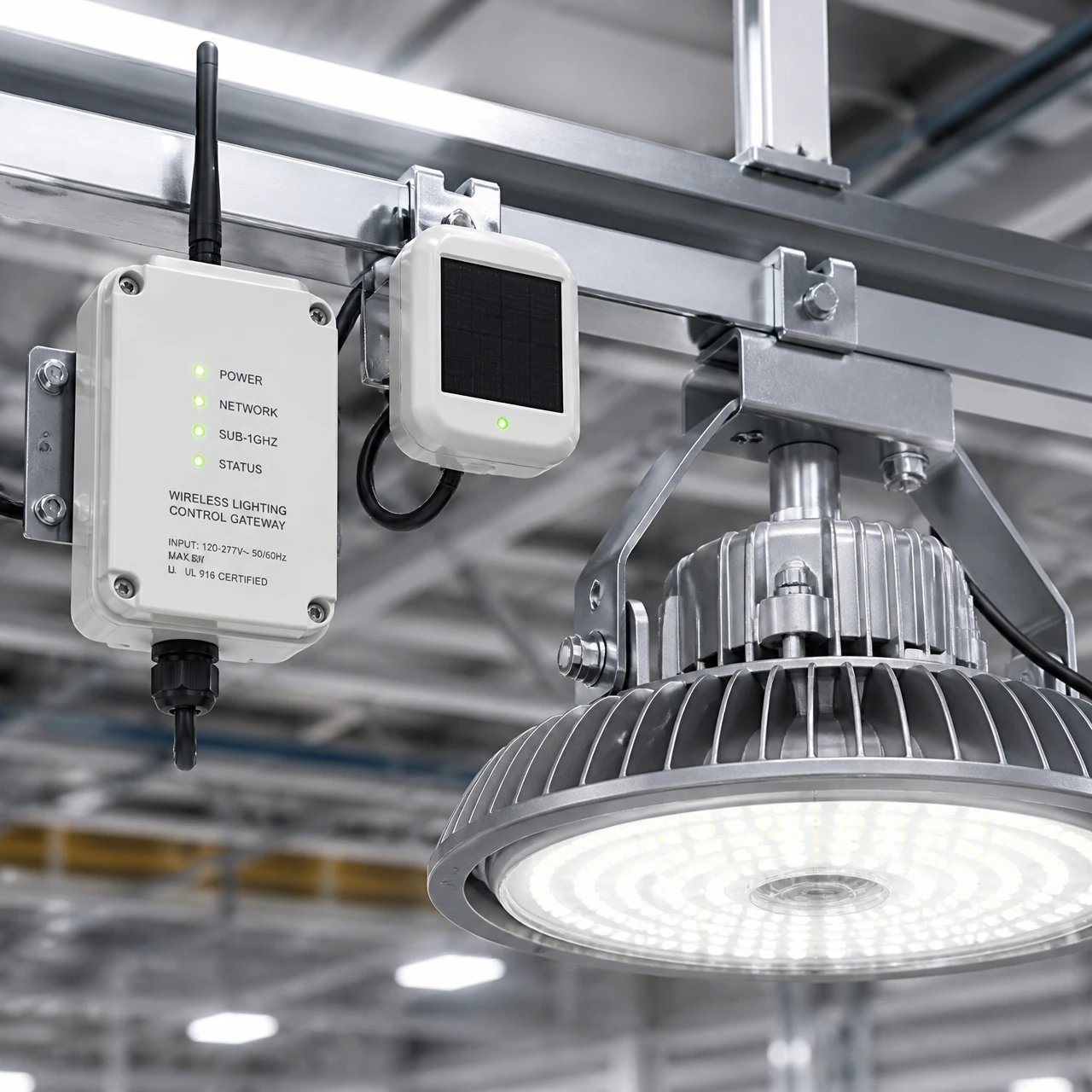
When evaluating self-powered wireless controls for factory retrofits, procurement teams must systematically compare certification requirements against operating environments. The following matrix details key compliance standards across core evaluation metrics:
| Certification Standard | Regulatory vs Voluntary | Scope & Testing Body | Primary Industrial Benefit | Plant ROI & Liability Impact |
| FCC Part 15 Class A | Mandatory (USA) | Federal Communications Commission | Prevents radio frequency interference with industrial control gear | Eliminates plant downtime caused by corrupted control signals |
| CE / RED 2014/53/EU | Mandatory (Europe) | European Telecommunications Standards Institute | Guarantees RF spectrum efficiency and high ESD/EMI immunity | Ensures legal compliance across European facilities |
| UL 916 | Mandatory / Recommended | Underwriters Laboratories | Verifies electrical safety and flame-retardant enclosure integrity | Prevents electrical fire hazards and satisfies property insurance audits |
| UL 2043 | Mandatory (Plenums) | Underwriters Laboratories | Measures smoke optical density and heat release in air ducts | Protects worker safety and satisfies municipal building codes |
| DLC Premium V5.1 | Voluntary (Rebate) | DesignLights Consortium | Qualifies networked controls for utility rebate incentive programs | Unlocks 30%–70% capital rebates, accelerating project payback |
| EnOcean ISO/IEC 14543 | Voluntary (Protocol) | EnOcean Alliance & ISO | Standardizes energy-harvesting radio profile structures | Ensures multi-vendor hardware interoperability and zero vendor lock-in |
| RoHS 3 / REACH | Mandatory (EU / Global) | Environmental Protection Agencies | Restricts toxic heavy metals in circuit boards and plastics | Prevents hazardous waste liability and supports corporate ESG targets |
Deploying self-powered wireless controls in heavy manufacturing spaces involves navigating specific environmental challenges that do not exist in standard commercial office buildings.
Heavy manufacturing plants contain high-power electronics—such as Variable Frequency Drives (VFDs) controlling large pumps, arc welding stations, and induction furnaces—that generate severe electromagnetic noise across both power lines and surrounding airspace.
If uncertified wireless controls are installed, high-voltage electrical fast transients (EFT) can induce voltage noise into control receivers, causing missed switch commands or ghost switching events. Certified industrial controllers counteract this by incorporating galvanic optocoupler isolation rated up to 2,500V AC, transient voltage suppression (TVS) diodes, and digital pulse filtering algorithms. This hardware architecture ensures that radio signals are decoded accurately even in extreme noise environments.
In massive logistics warehouses with metal racking structures or manufacturing floors filled with heavy steel machinery, 2.4 GHz radio signals can suffer from severe line-of-sight attenuation and multipath reflections.
Sub-1GHz self-powered wireless controls (operating at 868 MHz in Europe or 902 MHz in North America) offer superior physical radio propagation characteristics:
Longer Wavelengths: Sub-1GHz radio waves bend around structural steel columns and penetrate dense concrete walls far more effectively than 2.4 GHz signals.
Reduced Frequency Overcrowding: Sub-1GHz bands avoid the heavily congested 2.4 GHz spectrum shared by plant Wi-Fi networks, Bluetooth audio, and microwave equipment.
For complex facility layouts, certified mesh repeaters and gateways receive low-energy kinetic bursts and re-transmit them across the plant network, maintaining 99.99% packet delivery reliability.
To understand the financial rationale behind self-powered control retrofits, facility managers must analyze total operational expenditure over a standard 15-year plant lifecycle:
Across a facility containing 1,000 wireless switches and sensors, replacing batteries every 3 to 5 years requires substantial capital for replacement cells, safety rigging, lift rentals, and technician labor. Self-powered controls eliminate maintenance expenses entirely, generating tens of thousands of dollars in net operational savings.
To keep track of emerging industry trends, standards updates, and product innovations, visit the official
To ensure a flawless implementation of self-powered wireless controls across an industrial campus, engineering teams should follow a structured four-phase engineering deployment protocol.
Phase 1: Environmental Assessment & Spectrum Audit
  ├── Conduct site survey for high-voltage EMI sources (VFDs, welders)
  └── Map physical ceiling heights, wall density, and metal obstructions
                                 │
                                 ▼
Phase 2: Certificate Verification & Test Report Scrutiny
  ├── Verify official FCC ID, CE RED test reports, and UL 916 listing files
  └── Confirm DLC V5.1 QPL listing status for utility rebate eligibility
                                 │
                                 ▼
Phase 3: Pilot Deployment & Signal Stress Testing
  ├── Install test pilot in highest-EMI manufacturing bay
  └── Verify signal transmission latency (<50ms) during active machine operation
                                 │
                                 ▼
Phase 4: Full Scale Installation & BMS Integration
  ├── Mount self-powered kinetic switches directly to industrial surfaces
  └── Connect gateways to BACnet/IP network & submit utility rebate paperwork
Before selecting hardware, field engineers perform a comprehensive site survey. Portable spectrum analyzers measure ambient background RF noise across the 868 MHz, 902 MHz, and 2.4 GHz bands to identify potential frequency conflicts. High-voltage machinery zones are mapped to determine optimal gateway placement.
Procurement teams verify that all candidate hardware possesses valid, verifiable certification documentation. Test reports from accredited third-party laboratories (such as Intertek, TÜV Rheinland, or UL) are reviewed to confirm:
Official FCC ID numbers match the specific product model.
UL 916 and UL 2043 safety certificates are active and searchable in online databases.
The product family is explicitly listed on the DLC Networked Lighting Controls QPL.
A pilot control zone is established in the plant's most challenging operational environment—such as a heavy stamping line or welding bay. Field technicians test kinetic switch responsiveness, sensor energy storage retention during weekend dark periods, and gateway packet reception under full operational loads.
Once pilot performance is validated, full-scale deployment proceeds rapidly. Self-powered kinetic switches are surface-mounted onto concrete pillars, glass partitions, or mobile machinery frames using industrial-grade adhesives or mounting screws without running electrical conduit. Gateway controllers are wired into overhead power lines, commissioned via tablet, and interfaced with the central BMS. Finally, engineering documentation is submitted to the local electric utility to collect rebate funds.
A1: Self-powered wireless lighting controls must hold FCC Part 15 certification (Class A or Class B) for radio frequency compliance and UL 916 listing for electrical safety. If receiving gateways or power packs are installed inside ceiling air plenum spaces, they must also carry UL 2043 fire safety certification. Furthermore, DLC V5.1 qualification is strongly recommended to qualify the installation for municipal utility energy rebates.
A2: LumiEasy self-powered controls utilize advanced micro-energy harvesting technology. Kinetic switches incorporate electro-dynamic micro-generators that harvest energy directly from the physical press force of a user's finger. LumiEasy wireless sensors use high-efficiency indoor solar cells that harvest ambient artificial light. This captured energy is managed by onboard ultra-low-power circuits, allowing the devices to transmit secure, long-range wireless commands without batteries.
A3: LumiEasy industrial wireless gateways and controllers are engineered specifically for high-EMI manufacturing environments. They feature galvanically isolated inputs rated to 2,500V AC, integrated transient voltage suppression (TVS) protection, and sub-1GHz frequency options that bypass crowded 2.4 GHz spectrums. These hardware protections prevent electrical noise from heavy electric motors and variable frequency drives from corrupting lighting control data.
Upgrading industrial plant infrastructure requires control solutions that deliver long-term reliability, zero maintenance overhead, and total regulatory compliance. Relying on legacy wired switches increases installation costs, while battery-powered wireless sensors create endless maintenance hazards in high-bay factory ceilings.
LumiEasy is a premier global manufacturer of advanced industrial lighting control systems. Our complete portfolio of self-powered kinetic switches, energy-harvesting daylight/occupancy sensors, and multi-protocol smart gateways carries full international compliance credentials—including FCC, CE RED, UL 916, UL 2043, RoHS/REACH, and DLC V5.1 Networked Lighting Control qualifications.
Whether you are retrofitting an existing automotive assembly plant, outfitting a sprawling logistics distribution hub, or designing an OEM industrial luminaire line, LumiEasy provides the certified hardware and engineering support required to ensure project success.
Take control of your facility's energy efficiency and eliminate maintenance downtime. Contact our senior industrial application engineering team today to review your project blueprints, verify rebate eligibility, or request a custom deployment quote. Visit the official


)
)
)
)

+86 15899791249

+86 755 2955 3313


Address: Huafeng No.1 Science and Technology Park, Sanwei, Bao'an District, Shenzhen, Guangdong, China.
