

Time:2026-07-21
The fast-paced evolution of Industry 4.0 has fundamentally transformed how manufacturing facilities, logistics hubs, and processing plants manage their operational infrastructure. Historically, industrial building sub-systems—such as primary illumination, heating, ventilation, and air conditioning (HVAC), facility access control, and fire safety networks—operated as isolated physical islands. Each domain maintained its own dedicated cabling, proprietary communication protocols, and standalone management consoles.
In modern high-bay manufacturing environments, maintaining fragmented, standalone control systems creates massive operational inefficiencies. Facility managers face ballooning energy bills, elevated maintenance overhead, and disjointed diagnostic data streams that hinder proactive decision-making.
To overcome these operational barriers, industrial facilities are transitioning to unified automation platforms. At the core of this infrastructure revolution is smart controller integration—the deliberate engineering process of linking lighting, environmental, and facility control hardware into a cohesive, bi-directional data ecosystem.
This comprehensive technical guide evaluates the architectural principles, protocol translation mechanics, hardware interface engineering, and field commissioning workflows required to execute seamless control integration across modern industrial plants.
To build a truly intelligent facility, engineers must move past basic standalone control hardware. In heavy manufacturing, lighting represents both a major electrical load and a dense, evenly distributed spatial grid. Every light fixture sits above a working area, making luminaires ideal mounting locations for network nodes, edge processing hardware, and multi-sensor arrays.
When a factory operates isolated lighting networks, the valuable sensory data collected by overhead motion or daylight sensors remains trapped within the lighting system. A smart controller bridging the lighting grid to the main Building Management System (BMS) allows an overhead motion sensor to perform multiple roles simultaneously:
Primary Lighting Control: Automatically energize localized high-bay LED fixtures when workers enter a production aisle.
HVAC Optimization: Signal the regional VAV (Variable Air Volume) damper controller to ramp up ventilation in active manufacturing zones while throttling airflow in vacant warehouse aisles.
Physical Security Enhancement: Trigger automated CCTV camera presets toward unexpected movement within restricted storage vaults outside normal shift hours.
Achieving a unified control architecture requires integration across two distinct operational levels:
The Hardware Layer: Involves physical signal conditioning, wire-level voltage matching, and hardware interface standardization (e.g., converting analog 0―10Ⅴcontrol loops into digital serial signals or tapping into D4i driver auxiliary power supplies).
The Software Layer: Focuses on protocol translation, register mapping, and API abstraction. This enables raw data packets generated by low-level sensor nodes to be converted into standardized BACnet objects or Modbus registers that a facility-wide SCADA (Supervisory Control and Data Acquisition) system can process.
Industrial plants rarely feature uniform, single-vendor electrical setups. A typical facility expansion often places modern digital LED luminaires alongside legacy high-intensity discharge (HID) circuits, analog dimming banks, and proprietary serial control lines. A core objective of intelligent controller design is executing real-time protocol translation across these varied hardware generations.
Legacy commercial lighting relies heavily on analog 0–10V dimming interfaces. In this setup, a controller varies a DC voltage signal between 0V (minimum light level or off) and 10V (maximum illumination). While simple and reliable, analog wiring is strictly one-way and cannot return operational feedback, diagnostic codes, or energy consumption metrics to the control room.
Modern smart integration gateways bridge this gap by converting analog control lines into intelligent digital network nodes. The gateway continuously monitors incoming 0-10V lines using high-precision Analog-to-Digital Converters (ADC), maps the measured voltage to a digital control value (0-255), and broadcast that value across a digital bus like DALI-2 or Bluetooth Mesh.
Digital Addressable Lighting Interface (DALI-2) protocols (governed by IEC 62386) provide the digital foundation for modern smart lighting networks. DALI-2 introduces standardized device types that ensure hardware interoperability across different manufacturers:
DALI Part 101/102: Defines general system requirements and LED driver control gear parameters.
DALI Part 103: Specifies control devices, including push-button modules, occupancy sensors, and centralized intelligence nodes.
D4i Specifications (DALI Alliance): Extends DALI-2 into luminaire-level IoT applications. D4i drivers store standardized asset management data (Part 251), energy consumption telemetry (Part 252), and real-time operational metrics (Part 253) directly inside memory banks on the driver.
To connect lighting assets with plant-wide automation systems, smart controllers translate lighting-level protocols into industrial fieldbus standards:
Modbus RTU (over RS-485): A compact, register-based serial protocol widely used in industrial PLC (Programmable Logic Controller) environments. Modbus assigns lighting parameters (e.g., target lux levels, relay switching states, driver temperature readings) to specific 16-bit holding registers.
BACnet/IP (over Ethernet): The global standard for building automation. BACnet organizes control points into standardized "Objects" (such as Binary Outputs for relay states, Analog Values for dimming percentages, and Multi-State Inputs for sensor profiles). A smart gateway presents complex lighting arrays to the BMS as a simple list of BACnet objects, simplifying system setup.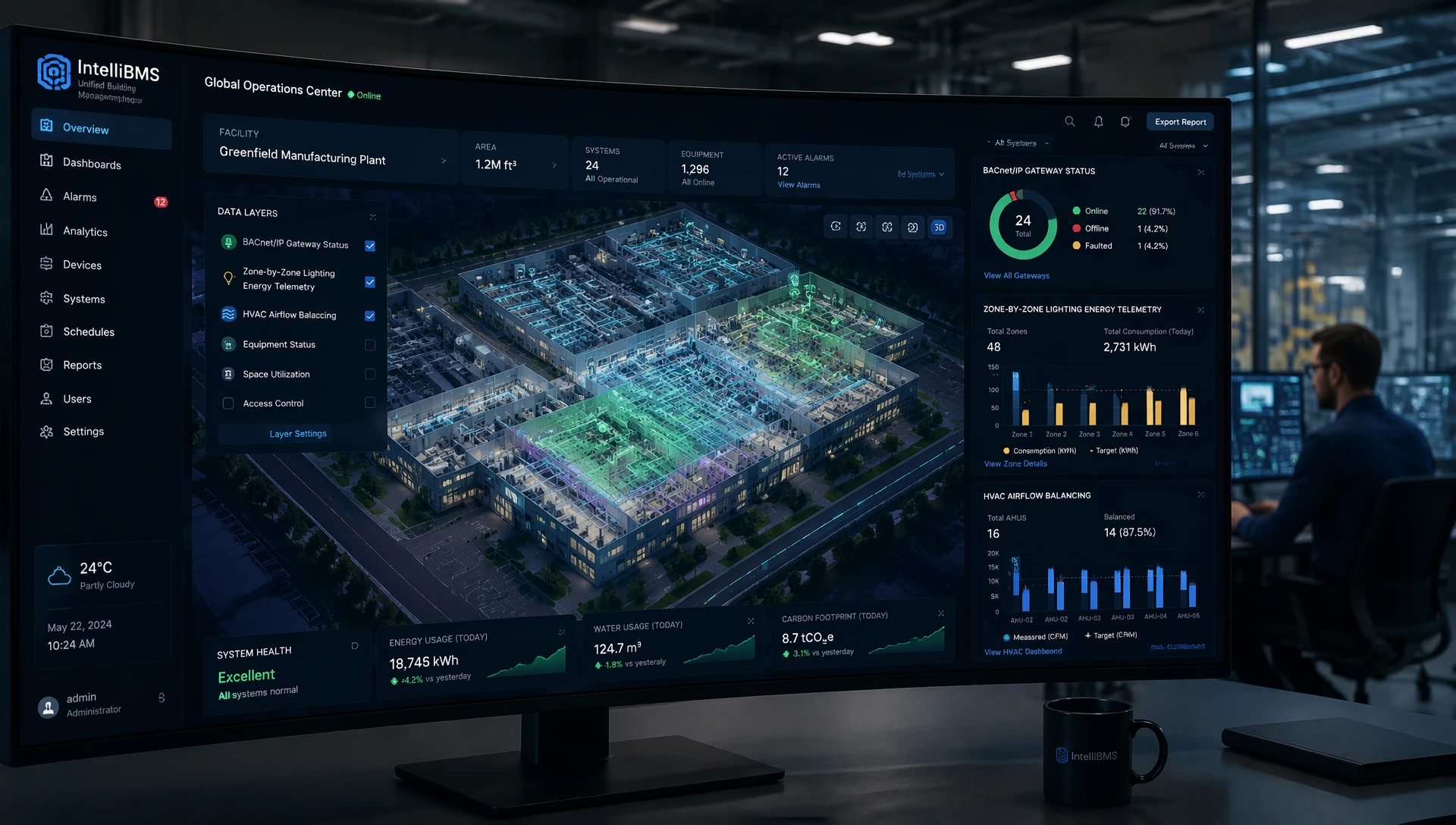
A software integration strategy will fail if the underlying hardware cannot withstand the harsh physical and electrical conditions of an active factory floor. High ambient operating temperatures, heavy conductive dust, strong electromagnetic interference (EMI), and long cable runs require ruggedized physical interface engineering.
Selecting the right physical connection interface is critical for luminaire OEMs and plant upgrade teams:
ANSI C136.41 (7-Pin NEMA Receptacles): Long established in outdoor and high-bay industrial installations. NEMA sockets feature a twist-lock mechanical design that carries high-voltage AC mains lines along with low-voltage dimming contacts. While highly durable, their physical size makes them bulky for modern, slim industrial luminaire profiles.
Zhaga Book 18 Sockets: The modern standard for compact, smart commercial and industrial luminaires. Zhaga Book 18 uses a small 4-pin push-and-twist socket operating exclusively on low-voltage DC power (24V). By eliminating AC high-voltage lines from the sensor socket, Zhaga simplifies field maintenance, improves worker safety, and prevents electrical noise from bleeding into sensitive sensor circuits.
Modern smart controllers draw low-voltage DC power directly from intelligent LED drivers equipped with integrated Auxiliary Power Supplies (AUX). The D4i standard mandates that the driver deliver a steady 24V DC supply capable of delivering at least 3W of power to drive connected wireless mesh nodes, edge processors, and sensor arrays.
Additionally, when interfacing with analog 0-10V dimming drivers, engineers must confirm whether the controller acts as a current source or a current sink. A standard 0-10V LED driver sources a small current (typically 0.5 mA to 2.0 mA ) along its dimming wires. The smart controller must cleanly sink this current to ground to lower the voltage signal and dim the fixture smoothly without overloading internal switching transistors.
Heavy industrial equipment—such as variable frequency drives (VFDs), arc welders, and large electric motors—injects strong electromagnetic noise and high-frequency harmonics into surrounding power lines and control conduits.
To prevent data corruption, false sensor triggers, or fried microprocessors, industrial-grade smart controllers include robust hardware protection layers:
Optocoupler Isolation: Galvanically isolates internal control microchip logic from external fieldbus cabling, withstanding voltage differentials exceeding 2,500V AC.
Differential Signaling Filters: Uses common-mode chokes and transient voltage suppression (TVS) diodes along RS-485 and DALI control lines to suppress high-voltage spikes and electrical noise.
Shielded Twisted-Pair Cabling (STP): Requires low-voltage control lines to run through shielded, twisted-pair cables, keeping the shield grounded at a single point to prevent ground loops.
| Architectural Metric | Analog 0-10V Control | Digital DALI-2 / D4i | Modbus RTU (RS-485) | BACnet/IP (Ethernet) |
| Data Direction | One-Way (Controller to Driver) | Bi-Directional | Bi-Directional | Bi-Directional |
| Diagnostic Feedback | None (Blind Switching) | Full (Driver, Lamp, Energy) | Full (Custom Register Map) | Full (Standardized Objects) |
| Max Network Nodes | Unlimited (Parallel Wiring) | 64 Nodes per Bus Loop | 32 to 247 Nodes per Segment | Thousands per Subnet |
| Wiring Topology | Point-to-Point / Daisy Chain | Star, Bus, or Daisy Chain | Strict Line Daisy-Chain | Star / Tree (Ethernet Switches) |
| Noise Immunity | Moderate (Susceptible to Drops) | High (Digital Differential) | High (RS-485 Differential) | Maximum (Isolated Ethernet) |
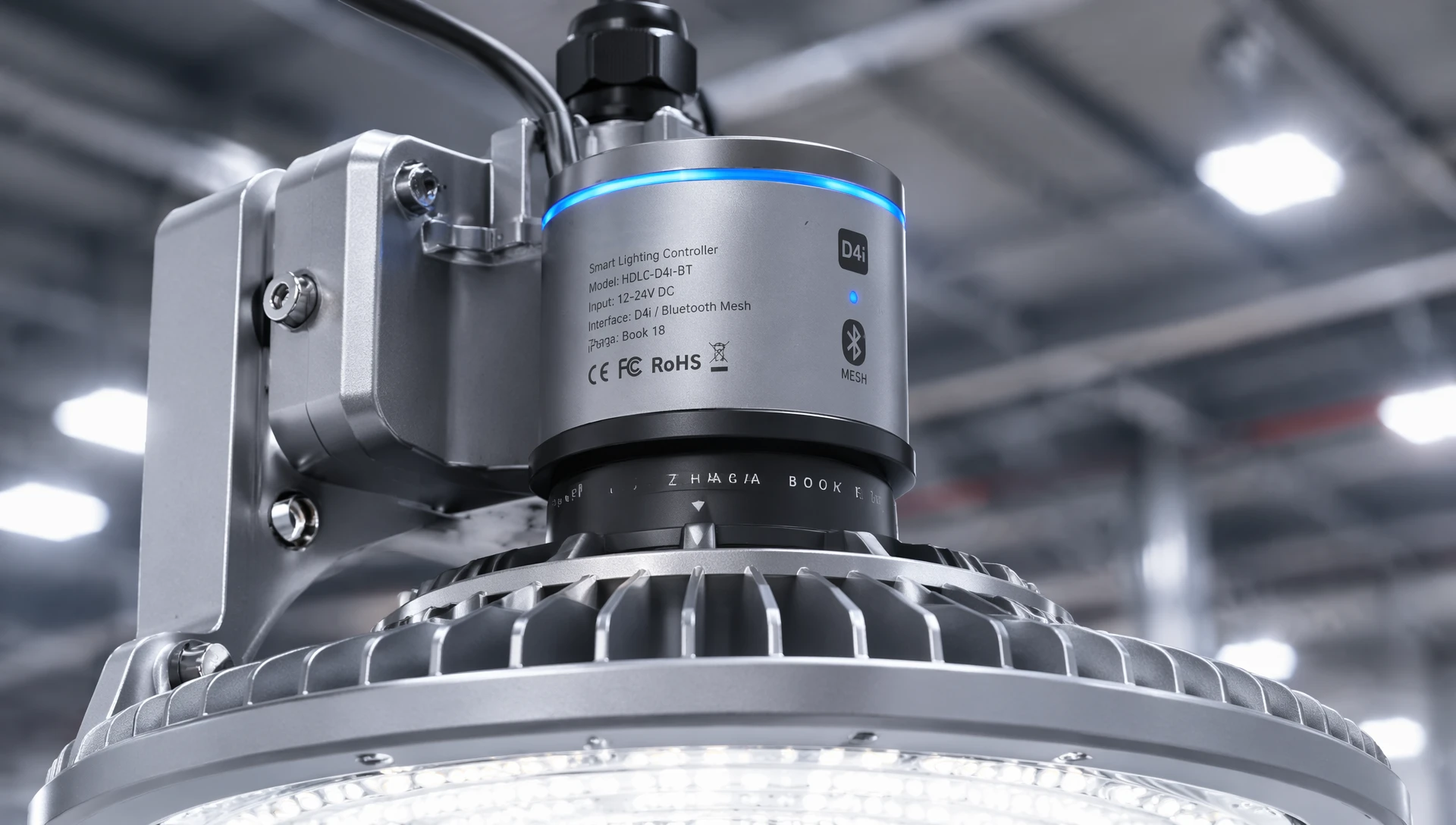
A smart controller relies on real-time inputs from its surrounding environment to make intelligent automation decisions. In heavy industrial environments, achieving reliable sensor-to-controller interoperability requires pairing advanced multi-sensor hardware with intelligent controller logic.
Modern high-bay factory floors require integrated sensor modules capable of monitoring multiple environmental conditions at once:
Motion and Occupancy Sensing: Uses Passive Infrared (PIR) or high-frequency Microwave radar arrays engineered with narrow-angle optical lenses. This focuses the sensor's detection field precisely on active floor aisles while ignoring adjacent conveyor belts or moving cooling fans.
Daylight Harvesting (Lux Tracking): Employs silicon photodiode arrays filtered to match the CIE photopic human eye response curve. The controller evaluates incoming natural sunlight through skylights and dims artificial LED output to maintain a constant target illuminance on the factory floor.
Environmental Telemetry: Incorporates temperature, humidity, and volatile organic compound (VOC) sensors into the lighting node, sending ambient air quality data directly to the HVAC system.
For a detailed evaluation of hardware parameters, lens optics, and field integration guidelines for sensor arrays, read our detailed guide on
Transitioning from simple, centralized control routines to distributed edge computing is a key benchmark of modern industrial control systems. Instead of streaming every raw data packet back to a distant central server, intelligent controllers process telemetry locally at the device level.
In large industrial facilities, relying entirely on cloud processing to handle basic motion-activated lighting introduces noticeable latency delays and creates a single point of failure. If the main facility network drops, an unmanaged system can plunge an active production line into darkness.
Smart integration controllers feature embedded edge microprocessors that handle local control routines independently:
Low-Latency Control: Motion-to-light response times are processed locally in under 50 milliseconds, ensuring instant illumination as forklifts turn into high-bay aisles.
Autonomous Fail-Safe Modes: If connection to the central BMS fails, the edge controller automatically drops back to an internal fail-safe program, keeping local daylight harvesting and motion sensing fully operational.
Unplanned downtime on a busy manufacturing floor can cost thousands of dollars per hour. Integrated D4i control nodes continuously collect operational health metrics directly from connected LED drivers, converting raw operational values into actionable predictive maintenance alerts:
By tracking driver operating temperatures , cumulative burn hours, input line voltage variations, and LED driver capacitor wear, the edge controller predicts component failures before they occur.
If a high-bay fixture's internal operating temperature exceeds safe limits due to dust build-up on its heatsink, the smart controller sends a warning alert to the facility maintenance dashboard while automatically dimming the fixture by 20% to prevent thermal damage.
Successfully deploying an integrated control network across a large industrial plant requires a structured, step-by-step engineering and commissioning process. Skipping validation steps during setup often leads to difficult troubleshooting issues later on.
Before purchasing hardware or routing control wiring, conduct a comprehensive site survey to evaluate existing infrastructure:
Measure true-RMS line voltages, phase-to-neutral balances, and total harmonic distortion (THD) across all lighting panelboards.
Identify sources of high electromagnetic interference (such as heavy electric motors or induction furnaces) and plan control cable paths away from these high-noise zones.
Audit existing luminaire driver specs to confirm control interface compatibility (e.g., 0-10V, DALI-2, or D4i).
Install industrial control gateways inside clean, accessible electrical panels or IP66-rated field enclosures. Route communication lines using high-grade Shielded Twisted-Pair (STP) cabling, adhering strictly to protocol layout limits:
RS-485 / Modbus Runs: Use a strict daisy-chain layout, placing 120Ω termination resistors across the signal pair at both ends of the run to prevent signal reflections.
DALI-2 Bus Lines: Ensure total bus length does not exceed 300 meters using 1.5m㎡ copper conductors, keeping total bus current under 250mA.
Using specialized commissioning software, run an automated bus scan to locate every node connected to the network. Assign each device a unique digital address and map its internal parameters to the master automation table:
Map light control channels to corresponding BACnet Binary/Analog objects or Modbus holding registers.
Group luminaires into logical zones aligned with physical production bays, evacuation routes, and shift schedules.
Set up daylight harvesting dimming curves and occupancy delay timers.
Industrial control networks must include hardwired safety interlocks that override normal automated schedules during emergencies:
Wire the central Fire Alarm Control Panel (FACP) dry contact output directly to an isolated priority input on the smart controller.
Program a high-priority system override: if the fire alarm activates or primary grid power drops, the controller instantly forces all emergency lighting zones to 100% brightness, ignoring any local dimming commands or energy-saving modes.
Modern integrated control systems connect directly to corporate Ethernet networks, making cybersecurity hardening a critical final step:
Change all default manufacturer passwords on gateways, router nodes, and commissioning apps.
Activate AES-128 bit encryption across all wireless mesh control communications and secure network connections using TLS/SSL protocols.
Back up the completed site configuration database to a secure local server and export digital system schematics for the facility maintenance team.
A1: LumiEasy smart integration gateways combine high-precision Analog-to-Digital Converters (ADC) with onboard protocol conversion software. The gateway measures the physical analog 0-10V voltage levels from legacy drivers and maps those values directly into standardized BACnet objects (such as Analog Values). This allows a central BACnet BMS platform to monitor, dim, and manage legacy analog fixtures alongside modern digital devices over a unified Ethernet network.
A2: Yes. LumiEasy industrial controllers are engineered specifically for harsh manufacturing environments. They feature galvanic optocoupler isolation rated to 2,500V AC, integrated transient voltage suppression (TVS) diodes, and differential signal filtering. These hardware protections prevent high-voltage electrical noise from heavy factory equipment, variable frequency drives, and electric motors from corrupting control data or damaging internal microchips.
A3: LumiEasy integration hardware applies multi-layered cybersecurity protection across both hardware and software layers. All wireless communication traffic uses end-to-end AES-128 bit cryptographic encryption with device-specific security keys. At the IP network level, gateways support TLS/SSL secure communication, require role-based user authentication, and allow network administrators to isolate lighting management traffic onto dedicated Virtual Local Area Networks (VLANs).
Unifying complex industrial operations requires robust, reliable hardware and intelligent control software. Continuing to rely on fragmented, unmanaged building sub-systems wastes energy, increases maintenance costs, and hides critical operational data from facility management teams.
LumiEasy manufactures high-performance industrial lighting controllers, multi-protocol integration gateways, and smart sensor nodes designed specifically for demanding factory and logistics environments. Our hardware solutions support seamless conversion across 0-10V, DALI-2, D4i, Modbus RTU, and BACnet/IP protocols, providing the flexible backbone needed to transform your lighting grid into an integrated data network.
Eliminate operational silos and maximize your facility's energy efficiency. Partner with our application engineering team to evaluate your plant layouts, optimize hardware compatibility, or develop custom OEM control solutions. Visit the official


)
)
)
)

+86 15899791249

+86 755 2955 3313


Address: Huafeng No.1 Science and Technology Park, Sanwei, Bao'an District, Shenzhen, Guangdong, China.
