

Time:2026-07-23
As modern industrial manufacturing facilities, automotive assembly lines, and global logistics hubs accelerate their digital transformation under Industry 4.0 paradigms, building management systems (BMS) are undergoing a structural evolution. Historically, lighting control across multi-building industrial campuses relied on centralized, wall-mounted touch panels, hardwired switch banks, or clunky, desktop-bound SCADA interfaces. These legacy systems lacked mobility, required extensive electrical conduit routing, and offered minimal granular control for field maintenance personnel.
Today, enterprise facility managers, IT security officers, and luminaire original equipment manufacturers (OEMs) demand direct, secure, and mobile access to lighting infrastructure. However, consumer-grade smart lighting mobile applications—designed for residential or light commercial spaces—fall drastically short when introduced to heavy industrial plants.
Executing reliable mobile lighting management in a factory environment requires deploying smart lighting app control enterprise grade features. This whitepaper examines the software engineering frameworks, multi-tenant security architectures, mobile provisioning workflows, and field telemetry protocols required to operate enterprise-level mobile control suites across large-scale industrial plants.
The technical divergence between consumer-grade lighting apps and enterprise industrial mobile management platforms lies in system scale, network topology, security models, and data throughput.
In a residential or small retail setting, a mobile app typically connects to a central home Wi-Fi router or directly pairs via basic point-to-point Bluetooth with a handful of smart bulbs. This consumer-grade architecture relies heavily on constant internet availability and cloud server routing. If the local Wi-Fi router goes offline, or if an unauthorized user gains access to the local network credentials, the entire system is compromised or rendered unresponsive.
Conversely, an enterprise-grade industrial facility contains thousands of high-bay luminaires, linear sensors, emergency units, and environmental controllers distributed across multiple production bays and storage vaults. An enterprise mobile management platform must interface directly with a decentralized wireless mesh network while enforcing strict enterprise cybersecurity standards across four core operational criteria:
Node Scaling: Enterprise mobile applications must handle up to 10,000 individual nodes per facility across multiple physical floorplans without experiencing application freeze, UI lag, or memory leakage.
Decentralized Offline Mesh Control: The mobile suite communicates directly with local Bluetooth SIG Mesh or Zigbee PRO nodes via direct RF signals. This guarantees that lighting adjustments, scene changes, and sensor re-zoning execute reliably even if the plant’s wide area network (WAN) or internet connection is completely severed.
Latency Thresholds: Critical industrial operations require sub-50ms execution latency from the moment an operator taps a mobile screen to the physical response of high-bay LED drivers across a massive plant floor.
Zero-Trust Security Framework: The software operates under a strict zero-trust model. Every command transmitted from a mobile device is cryptographically signed, timestamped, and verified against centralized user access tokens before execution.
In a heavy manufacturing environment, uncoordinated lighting adjustments can disrupt automated assembly lines, create safety hazards for heavy forklift operators, or violate OSHA lux level mandates. Therefore, enterprise mobile applications must incorporate sophisticated Role-Based Access Control (RBAC) systems that strictly govern what each user can see, adjust, and reconfigure.
An enterprise mobile lighting suite enforces granular access tiers to prevent accidental system misconfiguration or unauthorized tampering:
Super Administrator (Corporate IT / HQ Engineering): Holds absolute system authority. Manages multi-site facility tenants, revokes user access credentials, pushes security patches, exports plant-wide compliance logs, and configures primary network encryption keys.
Plant Facility Manager: Oversees local campus operations. Configures primary lighting schedules, adjusts high-end trim caps, manages daylight harvesting setpoints, and delegates temporary access rights to internal maintenance staff.
Environmental Health & Safety (EHS) Officer: Possesses dedicated overrides for emergency exit routes, lighting audit reporting tools, and immediate 100% illumination emergency flood controls across production floors.
Field Maintenance Technician: Granted temporary access to perform individual device replacement, run Over-The-Air (OTA) diagnostic routines, read DALI-2 and D4i driver health metrics, and recalibrate occupancy sensor ranges.
Shift Line Operator: Restricted strictly to localized spatial zones. Can adjust task-specific dimming levels or trigger temporary extended work-hour timers within their immediate physical workstation using geofenced mobile credentials.
To establish robust governance over your facility's software controls and prevent operational disruptions, implement a structured
To prevent man-in-the-middle attacks or unauthorized mobile packet injection over the factory floor, the application exchanges security tokens with the local mesh network using advanced cryptographic standards.
When a user logs into the app, the central server authenticates credentials via JSON Web Tokens (JWT) or OAuth 2.0 protocols. Once validated, the app receives a short-lived cryptographic session key encrypted via 128-bit Galois/Counter Mode (AES-128 GCM). The application combines the target command payload, the verified session key, and a unique initialization vector to mathematically sign every radio packet. This ensures that even if a rogue device sniffs raw radio signals transmitted between a smartphone and an overhead luminaire, the data cannot be decrypted, replayed, or altered.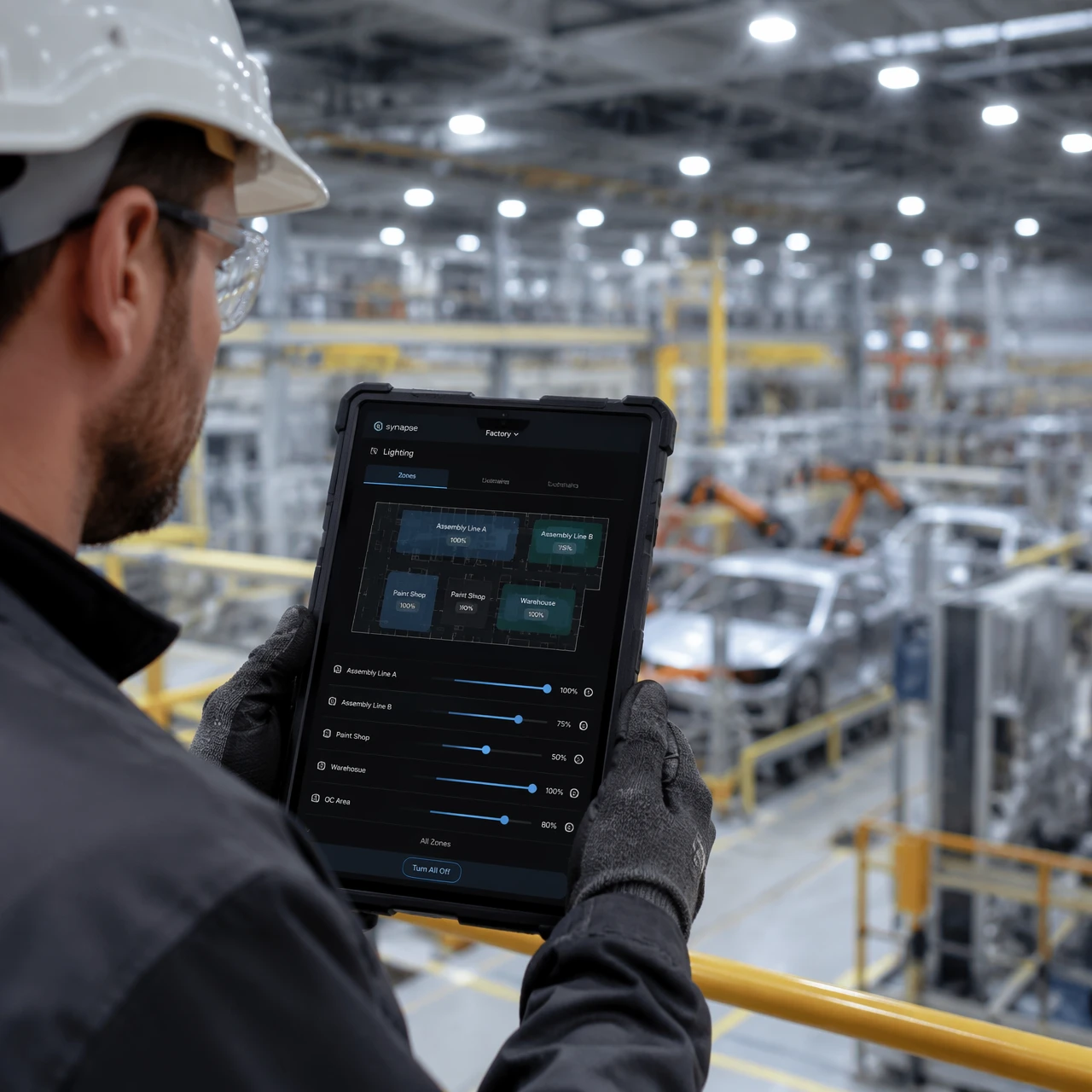
Commissioning thousands of individual lighting control nodes across a newly constructed factory using manual, one-by-one pairing methods can take weeks of field engineering labor. Enterprise mobile applications streamline this process through automated fleet provisioning tools, spatial mapping utilities, and Over-The-Air (OTA) firmware update engines.
During initial site commissioning, field engineers utilize the mobile app's built-in camera and high-speed Bluetooth transceiver to execute rapid batch onboarding:
QR-Code Spatial Mapping: Engineers scan physical QR codes printed on luminaire housings or Zhaga Book 18 sensor modules. The app instantly cross-references the scanned hardware MAC address with the building's digital CAD floorplan, placing the fixture at its exact spatial coordinates.
RSSI Proximity Triangulation: By evaluating the Received Signal Strength Indicator (RSSI) of surrounding Bluetooth signals, the app automatically identifies neighboring fixtures and arranges them into logical rows, storage aisles, or assembly zones.
For an in-depth analysis of how mobile applications streamline commercial and industrial commissioning workflows, explore our technical breakdown on
Industrial lighting assets remain in operation for 10 to 15 years. Over this operational lifespan, wireless microcontrollers inside sensors and smart drivers require firmware updates to add new control algorithms, patch security vulnerabilities, or update protocol standards.
Enterprise apps handle this via background OTA differential patching. Instead of transmitting an entire multi-megabyte firmware binary to every individual node over a slow radio link, the app pushes only the delta code blocks to primary mesh gateway nodes. The gateway then distributes the patch across adjacent fixtures in the background. The lighting system remains fully operational at 100% output while the update executes silently in the background, eliminating costly factory downtime.
When evaluating commercial lighting software platforms, procurement managers and plant engineers must compare feature sets to ensure the selected mobile app can handle complex industrial demands:
| Software Feature Capability | Standard Consumer App | Commercial Pro App | LumiEasy Enterprise Mobile Suite |
| Max Network Node Capacity | 30 to 50 Devices | 250 Devices per Gateway | 10,000+ Multi-Site Campus Nodes |
| User Access Hierarchy | Single Admin / Shared Password | 2-Tier (Admin / Guest) | Multi-Level Granular RBAC + SSO |
| Offline Command Execution | No (Requires Active Cloud) | Partial (Basic Scenes Only) | Full (Direct Bluetooth SIG Mesh Execution) |
| Data Security Encryption | Standard WPA2 / Basic BLE | AES-128 Security Keys | AES-128 GCM + OAuth2 + Dynamic JWT |
| Driver Telemetry & Health | None (On/Off Status Only) | Basic Fault Indicators | Real-time D4i / DALI-2 Diagnostic Readouts |
| Commissioning Speed | Manual (1-by-1 Pairing) | Semi-Automated Grouping | Batch QR Mapping + RSSI Auto-Triangulation |
| Multi-Site Cloud Syncing | Not Supported | Optional Add-on | Standard (Centralized Enterprise Portal) |
| Industrial UI Ergonomics | Bright Standard UI | Standard Light/Dark Mode | High-Contrast Industrial Dark Mode (Glove Touch) |
Modern industrial enterprise apps go far beyond simple dimming sliders and scheduling buttons. They function as comprehensive operational telemetry dashboards, rendering complex raw data from overhead luminaires into intuitive, visual insights for facility executives.
In accordance with DALI-2 Part 252 specifications, intelligent LED drivers record exact energy consumption metrics natively inside internal memory registers. The enterprise mobile app periodically pulls these data packets across the wireless mesh network, aggregating energy telemetry across specific manufacturing lines or entire building wings:
Active Power Consumption: Tracks instantaneous real power draw in kilowatts across high-bay lighting grids.
Apparent Power and Power Factor: Monitors electrical quality and driver efficiency by calculating the ratio of active real power to total apparent power in kilovolt-amperes. This alerts engineers if harmonic distortion or low power factor risks trigger utility penalty surcharges.
Because occupancy sensors are evenly distributed across the facility ceiling grid, the mobile app aggregates raw motion-detection event logs to render color-coded spatial heatmaps across the plant layout:
High-Density Zones (Red Overlay): Indicates primary packaging bays or active assembly lines with heavy traffic, prompting the system to prioritize maximum ventilation and full task lighting.
Medium-Density Zones (Yellow Overlay): Identifies raw material aisles with moderate activity, applying standard motion-based scheduling.
Low-Density Zones (Blue Overlay): Highlights seasonal storage vaults with minimal human presence, triggering deep energy standby modes with a 30% trim.
Facility directors can view their plant floor plan within the app to optimize inventory layouts, adjust worker workflows, and eliminate unnecessary energy consumption in idle zones.
To learn how integrating these software capabilities can modernize your building operations, review our research on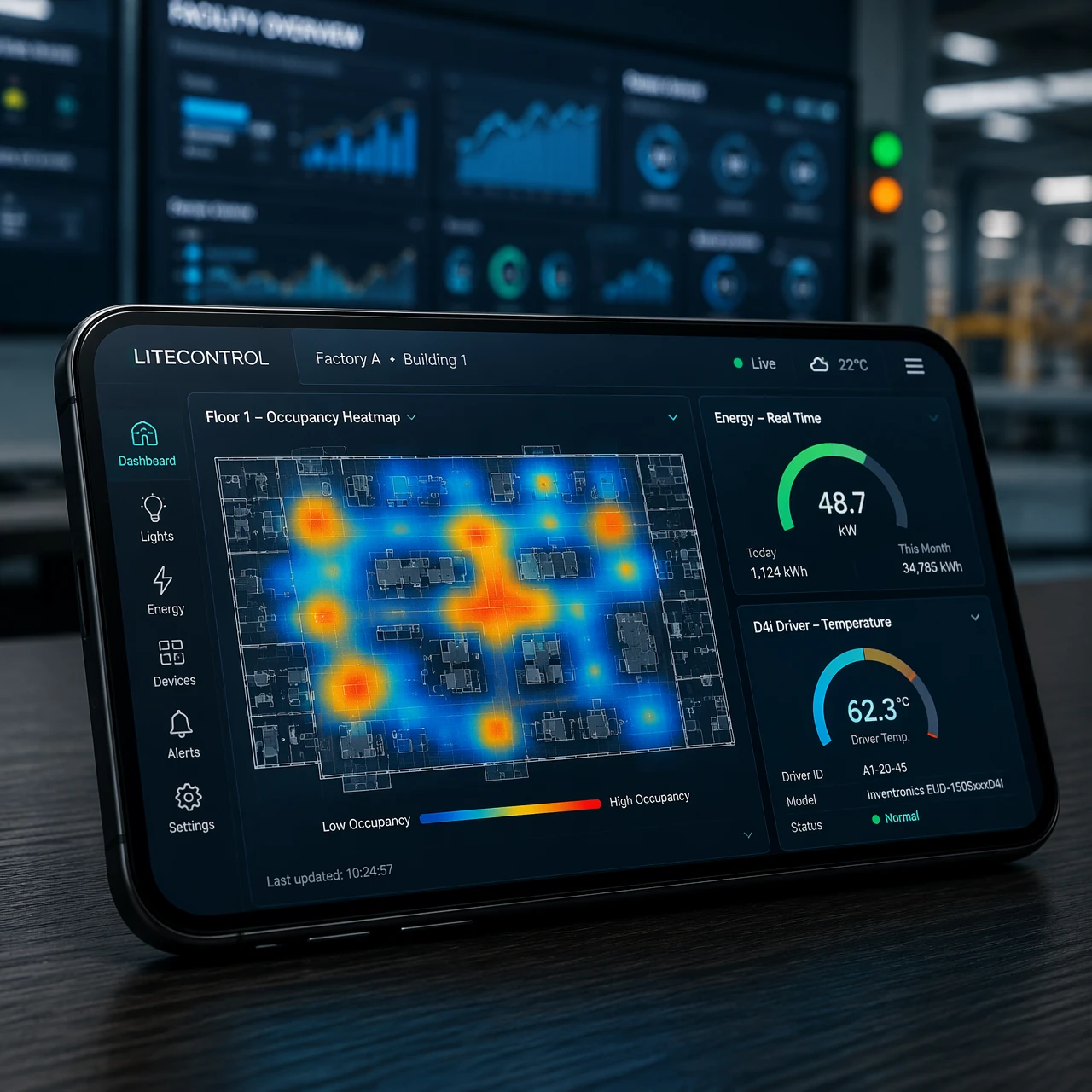
A mobile application designed for clean office environments will fail quickly on a chaotic manufacturing floor. Industrial plant workers, electrical contractors, and maintenance teams operate under demanding physical conditions that require specialized UI/UX software design choices.
Maintenance technicians frequently wear thick protective work gloves while performing field inspections. Standard small drop-down menus and tiny touch icons cause constant false inputs and user frustration.
Enterprise industrial apps feature high-contrast dark mode interfaces with enlarged touch-target zones exceeding 48 by 48 display pixels, tactile haptic feedback loops, and gesture-based controls. Prominent emergency buttons allow operators to trigger instant 100% illumination overrides across specific bays with a single tap, while stepped tactile sliders enable precise task lighting adjustments without requiring technicians to remove their protective gear.
Factory floors are notoriously hostile to cellular and Wi-Fi signals. Thick reinforced concrete walls, heavy metal storage racking, and high-power electromagnetic machinery often create complete wireless dead zones.
An enterprise mobile application utilizes an offline-first data architecture:
Local Command Queue: When an operator executes a command in a wireless dead zone, the app writes the encrypted packet to a local SQLite database on the mobile device.
Direct Mesh Execution: The app transmits the command directly over local Bluetooth RF frequencies to the nearest lighting node, executing the physical lighting adjustment immediately without waiting for cloud server confirmation.
Background Synchronization: Once the mobile device reconnects to the plant Wi-Fi network or cellular data, the app automatically syncs its local transaction logs back to the central enterprise cloud server, preserving data integrity across the organization.
To ensure a seamless rollout of an enterprise mobile control suite across a multi-site manufacturing complex, engineering teams follow a disciplined, five-phase deployment protocol:
Phase 1: Cloud Tenant Provisioning & Single Sign-On (SSO) Integration
The enterprise IT department creates the primary company tenant on the secure cloud administration portal. The portal connects directly with the enterprise's existing Identity Provider—such as Microsoft Azure Active Directory, Okta, or Ping Identity—via SAML 2.0 or OpenID Connect protocols. This ensures that revoking a departing employee's main corporate account instantly terminates their access to the plant lighting app.
Phase 2: Mesh Network Commissioning and Gateway Setup
Field engineers install industrial-grade edge gateways across the plant floor. Using the mobile commissioning app, engineers map out primary mesh subnetworks, assign radio frequency channels to avoid local 2.4 GHz industrial Wi-Fi interference, and configure network encryption keys.
Phase 3: Spatial Map Vector Import and Batch Node Assignment
High-resolution architectural vector floorplans are uploaded into the mobile suite. Commissioning technicians walk the plant floor, using batch QR code scanning to link physical luminaires to their exact digital coordinates on the interactive floorplan map.
Phase 4: Role Allocation and Spatial Geofencing
The facility manager assigns specific user roles across the organizational hierarchy. Spatial geofences are configured using Bluetooth low-energy (BLE) beacons, granting shift workers lighting control access only when their mobile device is physically located within their assigned work bay.
Phase 5: Security Validation and Offline Audit
Before final system sign-off, the engineering team stress-tests the network by manually disconnecting the primary WAN connection to verify that local mobile app commands execute across the Bluetooth mesh within sub-50ms latency windows. System audit logs are then verified to confirm that all historical mobile commands, override events, and driver diagnostic warnings are accurately logged and timestamped.
A1: Yes. The LumiEasy enterprise mobile suite uses a decentralized, offline-first Bluetooth SIG Mesh architecture. When a user sends a command from the app, it communicates directly with local lighting nodes via direct radio frequencies. All scene adjustments, dimming commands, and sensor overrides execute locally with sub-50ms latency, even if the plant’s wide area network (WAN) or internet connection is completely offline.
A2: LumiEasy incorporates strict Role-Based Access Control (RBAC) and spatial BLE geofencing technology. Plant administrators assign granular permission tiers that restrict users to specific zones. Furthermore, geofencing rules ensure that shift operators can only adjust lighting levels for the specific physical bay where they are currently standing, preventing unauthorized remote adjustments across other production lines.
A3: LumiEasy enterprise gateways support multi-protocol translation and cloud synchronization. Operational telemetry collected by the mobile app—such as real-time kWh consumption, driver temperature metrics, and occupancy heatmaps—is securely synchronized via encrypted MQTT or RESTful APIs directly into central enterprise Building Management Systems (BMS), including BACnet/IP and Modbus networks.
Managing complex industrial lighting infrastructure requires software tools that match the durability and precision of your physical plant machinery. Continuing to rely on outdated wall switches, unencrypted consumer mobile apps, or rigid proprietary software limits operational agility, increases security risks, and hides valuable energy data from plant management.
LumiEasy delivers complete, end-to-end industrial smart lighting control solutions—combining DLC-qualified wireless controllers, heavy-duty sensor hardware, and an enterprise-grade mobile application suite. Our platforms feature multi-tenant RBAC security, automated batch commissioning, real-time D4i telemetry monitoring, and full compliance with global industrial automation standards.
Transform your facility’s lighting infrastructure into an intelligent, data-driven operational network. Partner with our application software engineering team to review your floorplans, schedule a live software demonstration, or request a custom deployment quotation. Visit the official


)
)
)
)

+86 15899791249

+86 755 2955 3313


Address: Huafeng No.1 Science and Technology Park, Sanwei, Bao'an District, Shenzhen, Guangdong, China.
