Time:2026-10-16
📌 Key Takeaways for Luminaire OEMs & System Integrators:
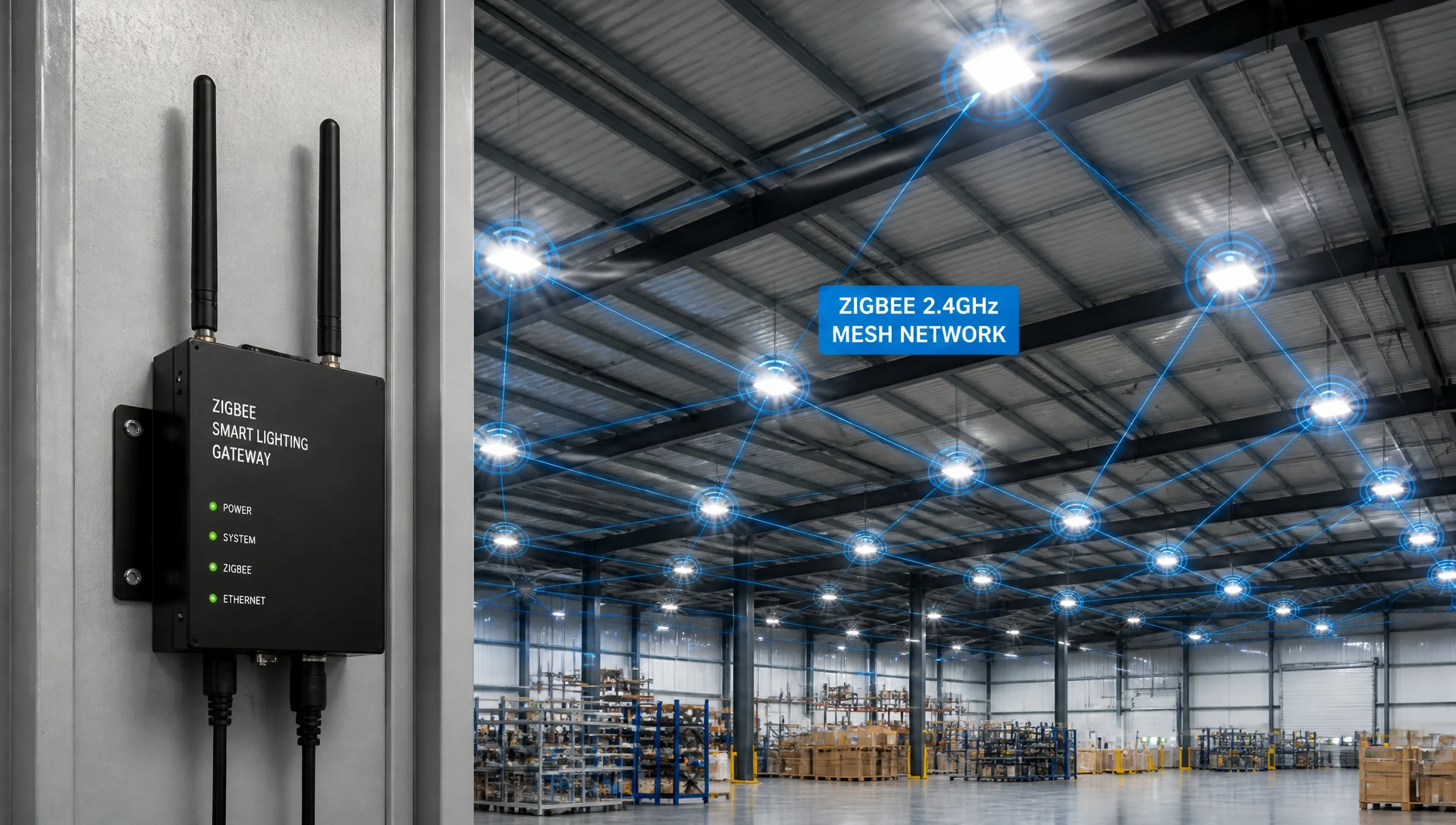
Interoperable Wireless Protocol: A zigbee smart lighting gateway enables seamless mesh networking across thousands of indoor LED drivers, sensors, and wall controllers using standard IEEE 802.15.4 specifications.
Low Latency & High Node Density: Supports decentralized self-healing mesh topology capable of routing messages across 250+ local nodes per gateway coordinator with minimal signal attenuation.
Interference Suppression: Utilizes dynamic clear channel assessment (CCA) and channel agility (Channels 11–26 in the 2.4 GHz spectrum) to prevent co-channel interference with corporate Wi-Fi networks.
Commercial Building Compliance: Facilitates strict energy code compliance (DLC 5.1 NLC, ASHRAE 90.1, and Title 24) through automated daylight harvesting and occupancy sensor schedules.
For commercial fixture OEMs, electrical contractors, and industrial lighting factories, transitioning traditional luminaire portfolios into connected IoT solutions requires a robust communication backbone. While localized RF controls handle individual room dimming, large-scale commercial facilities—such as logistics warehouses, multi-story office towers, and educational campuses—demand centralized management.
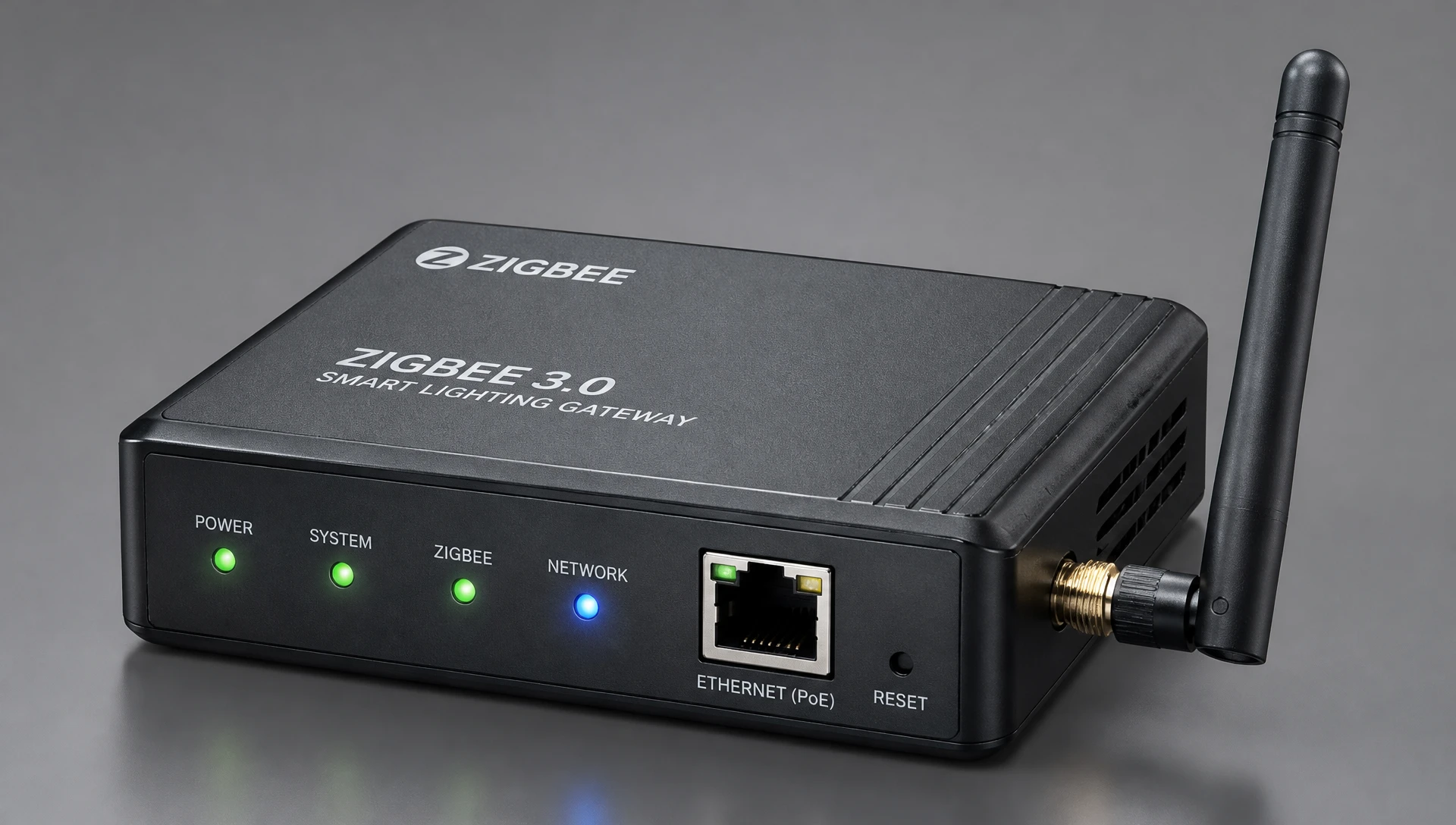
Deploying a high-performance zigbee smart lighting gateway bridges the gap between low-power local mesh networks and high-level enterprise building management systems (BMS). By translating Zigbee 3.0 cluster commands into IP-based web protocols, facility managers achieve full operational visibility and granular energy control without installing expensive control cabling.
A commercial Zigbee gateway acts as the network coordinator ($ZC$) within a wireless personal area network (WPAN). Unlike proprietary RF protocols that lock OEMs into single-vendor ecosystems, the Zigbee 3.0 standard unifies application profiles, ensuring seamless device interoperability across diverse component vendors.
+-----------------------------------------------------------------------+
          Cloud Management Platform / Enterprise BMS System
+----------------------------------+------------------------------------+
                                   | (MQTT / HTTPS over Ethernet or 4G)
                                   v
+-----------------------------------------------------------------------+
                LumiEasy Zigbee Smart Lighting Gateway
  - Network Coordinator (ZC) & Edge Automation Logic
  - Protocol Translation (Zigbee 3.0 to Modbus TCP / BACnet IP / JSON)
+----------------------------------+------------------------------------+
                                   | (2.4 GHz IEEE 802.15.4 Mesh)
                                   v
+----------------------------------+------------------------------------+
   Zigbee Router Node (LED Driver) |  Zigbee End Device (PIR Sensor)
+----------------------------------+------------------------------------+
In a Zigbee lighting architecture, mains-powered devices (such as luminaire controllers and intelligent LED drivers) function as Zigbee Routers ($ZR$). The central zigbee smart lighting gateway acts as the Coordinator ($ZC$), managing network security keys and device address tables.
If a specific fixture node is blocked by temporary structural shielding or machinery in an industrial plant, the Zigbee mesh automatically reroutes communication packets through neighboring luminaires. This self-healing mesh capability guarantees uninterrupted operational command transmission across vast commercial floor plans.
High-grade industrial gateways incorporate onboard microprocessors that store localized scheduling, daylight harvesting curves, and emergency overrides. Even during a complete loss of internet backhaul or local LAN connectivity, the gateway’s edge automation engine executes occupancy timeouts and scheduled dimming profiles without operational downtime.
To understand how multi-protocol gateways interface with broader IoT management systems, read our technical breakdown on
A frequent concern among industrial IT directors during a zigbee smart lighting gateway deployment is potential frequency overlap with corporate Wi-Fi (802.11 b/g/n) networks, which share the 2.4 GHz ISM spectrum.
2.4 GHz ISM Spectrum Channel Overlap Topology:

Wi-Fi Ch 1 (2412 MHz)                Wi-Fi Ch 6 (2437 MHz)                Wi-Fi Ch 11 (2462 MHz)
[====================]       [====================]       [====================]
   |     |    |     |     |     |                            |    |     |     |     |    |                             |     |     |      |     |      |
  11 12 13 14 15 16                        17 18 19 20 21 22                         23 24 25   26
  [Zigbee Primary Channels]    [Zigbee Secondary Channels]  [Preferred Guard Band: Ch 25/26]
To eliminate packet collision and latency in heavy wireless environments, commercial Zigbee gateways utilize three primary RF engineering safeguards:
Preferred Channel Allocation: Standard Wi-Fi channels (1, 6, and 11) leave clear frequency gaps. Industrial Zigbee gateways are typically pre-configured to operate on Channels 15, 20, 25, or 26, avoiding main Wi-Fi spectral peaks.
Clear Channel Assessment (CCA): Prior to transmitting a command packet, the gateway scans the local RF channel. If Wi-Fi traffic is detected, the gateway waits a randomized back-off interval before broadcasting, preventing packet corruption.
Dynamic Channel Agility: If severe co-channel interference occurs, the gateway coordinator can automatically migrate the entire lighting mesh to a clean Zigbee channel without requiring manual re-commissioning.
Selecting the optimal control architecture for commercial retrofits and OEM fixture lines depends on installation speed, hardware costs, and site infrastructure:
| Engineering Parameter | Industrial Zigbee 3.0 Gateway | Bluetooth Mesh Gateway | DALI-2 Hardwired System |
| Communication Medium | 2.4 GHz Wireless Mesh | 2.4 GHz Wireless Mesh | Dedicated 2-Wire Control Bus |
| Wiring Requirements | Zero Control Wires | Zero Control Wires | Polarized Bus Cabling Required |
| Node Scaling per Gateway | Up to 250+ Nodes | Up to 100+ Nodes | 64 Nodes per DALI Sub-unit |
| Network Security | AES-128 Bit Encryption | AES-128 Bit Encryption | Physical Wire Security |
| Retrofit Suitability | Excellent (Reuses AC Power) | Excellent (Reuses AC Power) | Poor (High Cable Pulling Cost) |
| International Standard | IEEE 802.15.4 / Zigbee Alliance | Bluetooth SIG | IEC 62386 Standard |
Deploying a commercial zigbee smart lighting gateway across a manufacturing plant or office building follows a structured engineering workflow:
Placement: Mount the gateway centrally within the facility at an elevated location (2.5–4 meters above floor level) to optimize line-of-sight RF propagation. Avoid placing units inside sealed metal distribution cabinets.
Network Backhaul: Connect the gateway to the facility’s local network via PoE (Power over Ethernet IEEE 802.3af) for simultaneous power delivery and high-speed LAN connectivity.
Power up the target Zigbee LED drivers, occupancy sensors, and daylight harvesting modules.
Put the zigbee smart lighting gateway into Permit Join mode via its Web GUI or mobile commissioning application.
The gateway scans the surrounding RF environment, authenticates new devices using install codes, and assigns short network addresses (NwkAddr).
Zone Assignment: Group luminaire nodes into discrete operational zones (e.g., Zone 1: Main Storage Aisles, Zone 2: Loading Dock Bay).
Sensor Binding: Bind PIR occupancy sensors directly to target luminaire clusters to enable fast, low-latency (<50ms) local hardware switching without requiring round-trip cloud communication.
Energy Management Integration: Map system data outputs to standard BMS protocols (such as BACnet IP or Modbus TCP) to export energy consumption metrics to central facility management software.
Industrial lighting fixtures operate under challenging thermal and electrical conditions. To ensure 10+ years of continuous service life, commercial Zigbee gateways undergo rigorous qualification testing:
Thermal Shock Cycling: Operational testing across extreme temperature ranges (-20°C to +65°C) inside environmental stress chambers to verify component tolerance.
Electromagnetic Compatibility (EMC): High-voltage surge testing (IEEE C62.41 2kV/4kV combo wave) and ESD protection validation (8kV Contact / 15kV Air Discharge) to prevent field failures from electrical grid transients.
RF Sensitivity & Transmit Power Validation: High-gain antenna testing delivering up to +20 dBm transmit power and -100 dBm receiver sensitivity for long-distance signal penetration through commercial walls.
Commercial Zigbee smart lighting gateways operate on the 2.4 GHz ISM band but utilize narrow 5 MHz channel allocations (IEEE 802.15.4). To avoid interference with high-traffic Wi-Fi networks, gateways are configured to primary guard-band channels (such as Channel 15, 20, 25, or 26). Additionally, built-in Clear Channel Assessment (CCA) and dynamic channel agility automatically shift lighting traffic away from active Wi-Fi frequencies.
The gateway features an onboard micro-processor that executes local edge computing. All pre-programmed scheduled events, sensor occupancy timeouts, and daylight harvesting automation logic are saved in local flash memory. If the cloud backhaul or local network switches go offline, the lighting mesh continues to function locally without interruption.
While the Zigbee 3.0 protocol theoretically supports thousands of device addresses, an industrial gateway typically manages 200 to 250 direct router nodes per subnet to maintain fast latency (<50ms). For massive warehouse complexes or high-rise office towers, multiple gateways can be deployed across different floor subnets and unified through a central IP-based Building Management System (BMS).
Integrating a high-performance zigbee smart lighting gateway into your commercial fixture portfolio enhances product functionality, streamlines field commissioning, and unlocks new recurring value in energy management.
To download technical datasheets, request OEM evaluation kits, or consult directly with our wireless IoT engineering team, Contact the LumiEasy Technical Support Team target link in a new window.


)
)
)
)

+86 15899791249

+86 755 2955 3313


Address: Huafeng No.1 Science and Technology Park, Sanwei, Bao'an District, Shenzhen, Guangdong, China.