

Time:2026-06-26
According to the DALI Alliance, D4i is an extension of DALI-2 for intelligent, IoT-ready luminaires. It defines requirements for power supply, control devices and standardized luminaire, energy and diagnostics data.
A D4i sensor ready lighting control solution is a commercial lighting control approach built around D4i LED drivers, luminaire-mounted sensors, control devices and optional wireless gateways. It helps luminaires support occupancy sensing, daylight harvesting, dimming, energy data, diagnostics and future connected services. The main value is not only sensor integration, but a more standardized foundation for smart, upgradeable and data-ready luminaires.
A D4i sensor ready lighting control solution helps commercial luminaires work more easily with sensors, D4i LED drivers, wireless controllers and lighting management systems.
For lighting manufacturers, contractors and system integrators, the key value is not only adding a sensor to a luminaire. It is about creating a more standardized foundation for occupancy sensing, daylight harvesting, digital control, energy data and future connected services.
Before choosing a solution, buyers should check driver compatibility, sensor power supply, mounting interface, control logic, wireless network support and gateway requirements.
A D4i sensor ready lighting control solution is a lighting control system designed around D4i-ready luminaires, D4i LED drivers, sensors and luminaire-mounted control devices.
In practical commercial lighting projects, this solution may support:
Occupancy-based lighting control
Daylight harvesting
Luminaire-level dimming
Sensor and control device integration
Energy and diagnostics data
Wireless lighting control
Gateway and cloud platform connection
This makes D4i especially useful for sensor-ready luminaires, where the luminaire is designed to accept sensors, wireless nodes or communication modules from the beginning.
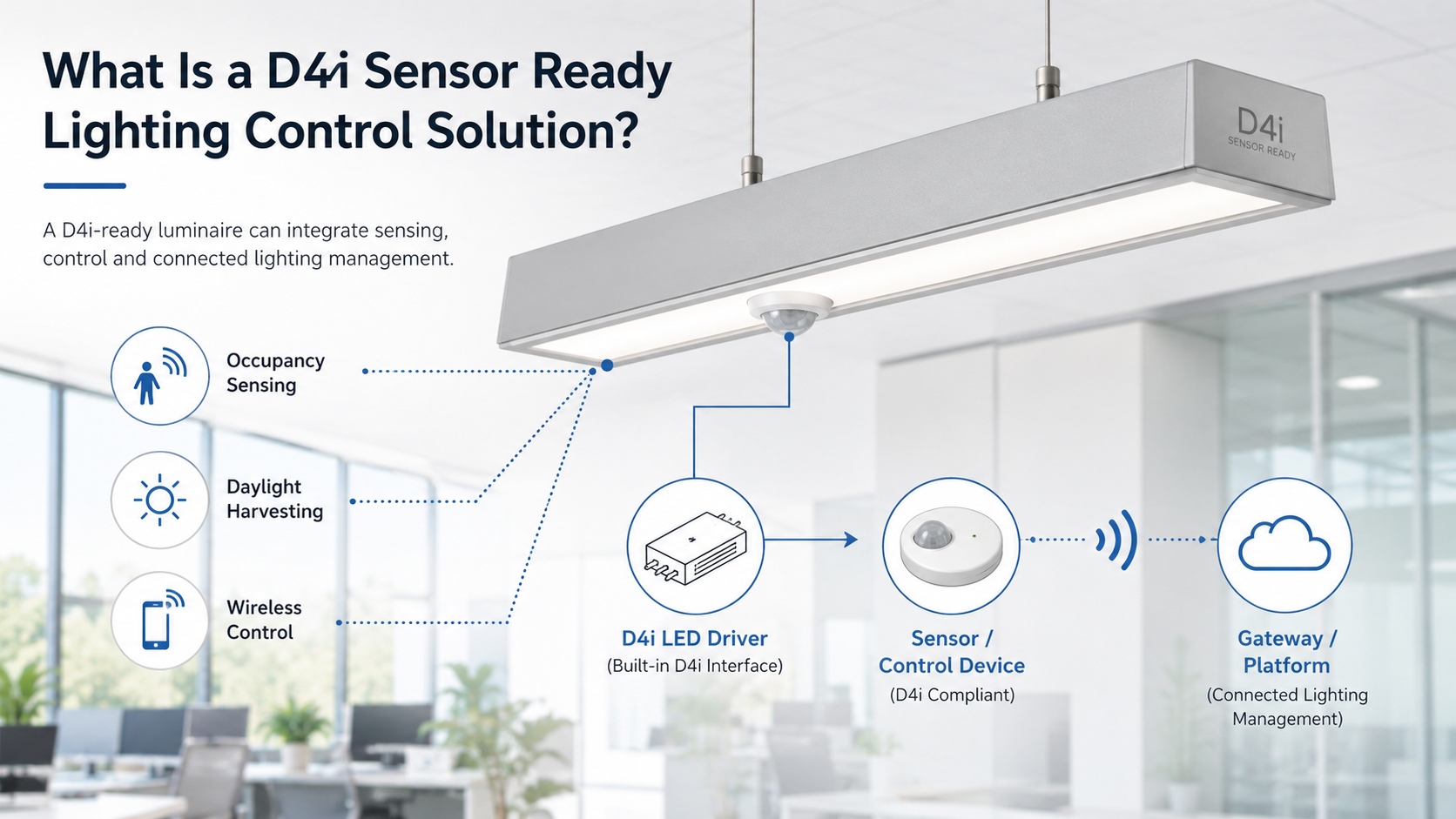
D4i sensor ready lighting control solution diagram showing a commercial luminaire connected with D4i LED driver, sensor control device, occupancy sensing, daylight harvesting, wireless control and gateway platform.
Sensor integration can become complicated in commercial lighting projects. Different LED drivers, sensors, connectors, control protocols and power requirements may create compatibility issues.
D4i helps reduce this problem by providing a more structured approach inside the luminaire. It supports digital communication, power supply requirements and useful luminaire data, making smart lighting control easier to plan and maintain.
For project teams, this can help with:
| Project Need | How a D4i-Ready Solution Helps |
Sensor integration | Supports sensors and luminaire-mounted control devices |
Driver compatibility | Creates a clearer foundation for D4i LED driver selection |
Energy management | Enables access to energy-related data |
Maintenance | Supports diagnostics and luminaire information |
Future upgrades | Makes it easier to add sensors or wireless nodes |
Smart building connection | Supports gateway and platform integration |
The main benefit is not just smarter switching or dimming. The bigger value is that the luminaire can become a more useful control and data point inside the building.
A typical D4i sensor ready lighting control solution includes several key parts:
D4i LED driver
Provides digital control capability and supports communication with control devices.
Sensor or luminaire-mounted control device
May include an occupancy sensor, daylight sensor, wireless node or control module.
D4i sensor ready interface
Supports communication and power connection between the driver and the control device.
Wireless controller or gateway
Connects the luminaire to a wider lighting control network or management platform when required.
A simple system path looks like this:
Occupancy / daylight input → D4i sensor or control device → D4i LED driver → luminaire response → gateway or platform
Not every project needs a gateway. For basic automatic control, local sensor logic may be enough. For remote monitoring, scheduling, energy data or multi-site management, a gateway becomes more important.
Many buyers search for D4i and Zhaga-D4i together, but they are not the same.
Term | Meaning | Why It Matters |
DALI | A digital lighting control protocol | Used for lighting communication |
DALI-2 | An improved certification program | Helps improve interoperability |
D4i | A DALI-2 extension for intelligent luminaires | Supports intra-luminaire power, control and data |
Zhaga-D4i | A combination of Zhaga interface requirements and D4i | Supports plug-and-play sensors and communication nodes |
A simple explanation:
D4i focuses on the digital, electrical and data side of the luminaire. Zhaga-D4i adds a standardized mechanical interface for replaceable sensors and communication modules.
For lighting manufacturers, Zhaga-D4i can be useful when the luminaire needs a plug-and-play sensor or wireless node. For contractors and system integrators, it can reduce uncertainty during installation and replacement.
D4i sensor ready solutions are suitable for commercial and industrial lighting projects where luminaires need sensor integration, digital control and future management capability.
Common applications include:
Offices: occupancy sensing, daylight harvesting and zone-based control
Warehouses: high bay control, aisle sensing and wireless commissioning
Parking garages: motion-based dimming and energy saving
Retail stores: flexible scenes, schedules and lighting zones
Schools and public buildings: energy control and easier maintenance
Industrial facilities: luminaire-level control and centralized monitoring
The best application is not defined only by the building type. It depends on whether the project needs sensor-ready luminaires, driver compatibility, control flexibility and long-term data visibility.
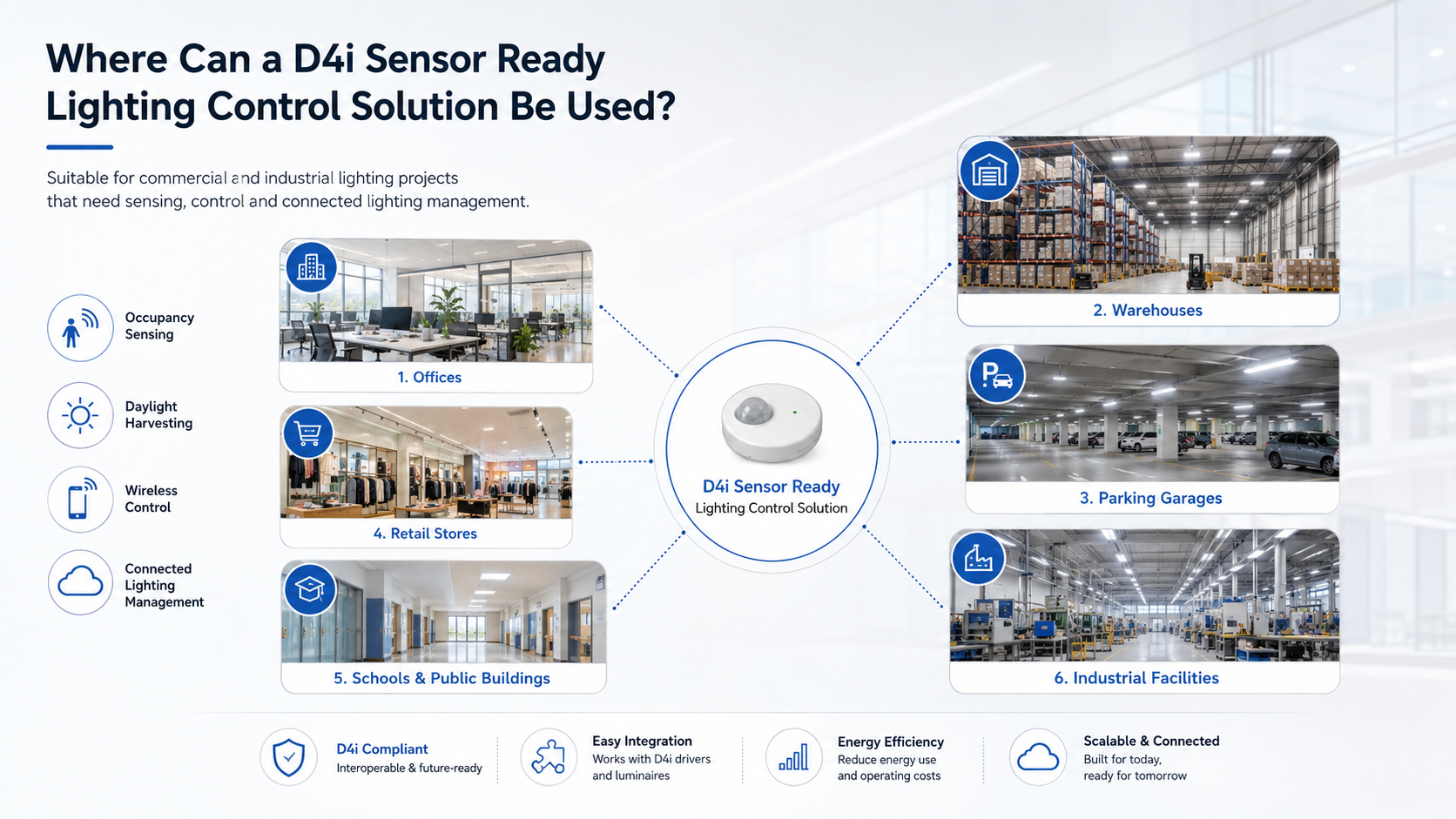
D4i sensor ready lighting control solution application diagram for offices, warehouses, parking garages, retail stores, schools and industrial facilities with occupancy sensing, daylight harvesting, wireless control and connected lighting management.
Before selecting a D4i sensor ready lighting control solution, buyers should check more than the product label.
Use this checklist during product selection or supplier evaluation:
Question | Why It Matters |
Is the LED driver D4i-compatible? | The driver is the foundation of the system |
Does the sensor match the driver and luminaire design? | Prevents compatibility issues |
Is the control device suitable for luminaire mounting? | Affects installation and reliability |
Does the solution support occupancy sensing? | Important for automatic control |
Does it support daylight harvesting? | Useful for energy optimization |
Are power supply requirements clear? | Avoids installation problems |
Is the mechanical interface defined? | Important for Zhaga-D4i or socketed designs |
Can it connect to wireless lighting control? | Needed for flexible commissioning |
Is a gateway required? | Needed for remote management and data visibility |
Does the supplier provide wiring and commissioning support? | Reduces project risk |
This checklist is especially important for lighting manufacturers, electrical contractors, ESCOs and system integrators working on commercial lighting projects.
For OEM luminaire projects, retrofit projects or commercial lighting upgrades, compatibility should be checked before installation. LumiEasy can help review driver type, sensor mounting method, wireless control requirements, gateway needs and commissioning logic.
Send your luminaire type, driver model and project scenario for a compatibility check.
A reliable supplier should provide more than a sensor or controller. The supplier should help buyers evaluate the complete system.
Key support should include:
D4i LED driver compatibility review
Sensor and control device matching
Wiring and interface guidance
Occupancy and daylight control logic
Wireless controller or gateway planning
Commissioning support
Datasheets, wiring diagrams and application examples
For B2B lighting projects, this support can directly affect installation efficiency and long-term system performance.
A D4i sensor ready lighting control solution is a lighting control system designed around D4i-ready luminaires, D4i LED drivers, sensors and control devices. It helps luminaires support occupancy sensing, daylight harvesting, digital control, data access and gateway connection.
No. D4i is related to DALI-2 but focuses more on intelligent, sensor-ready luminaires. It adds requirements for power, control and data inside the luminaire.
D4i focuses on digital control, electrical requirements and data. Zhaga-D4i combines D4i with a standardized mechanical interface, making it easier to use plug-and-play sensors and communication nodes.
Yes. D4i-ready luminaires can work with occupancy sensors or luminaire-mounted control devices, but buyers should confirm driver compatibility, power requirements and control logic.
Not always. Local sensor-based control may not need a gateway. A gateway is more useful when the project needs remote monitoring, scheduling, energy data, cloud platform access or multi-site management.
It depends on the existing luminaires and drivers. If the project uses compatible D4i drivers or plans to replace luminaires, D4i can be a strong option. If not, compatibility should be checked first.
A D4i sensor ready lighting control solution helps commercial luminaires become easier to connect, control and manage.
For projects involving occupancy sensors, daylight harvesting, wireless lighting control or lighting management platforms, D4i can provide a more reliable foundation than a fragmented sensor-and-driver setup.
The most important step is to check compatibility early.
Need help choosing a D4i sensor ready lighting control solution for your project? Contact LumiEasy for compatibility review, system planning and commercial lighting control support.
Related news
DALI D4i Compatibility Sensor Ready Standards
Harnessing DALI D4i Data for Industrial Lighting Performance | LumiEasy
DALI D4i Sensor Ready Interfaces: Smart Lighting Revolution


)
)
)
)

+86 15899791249

+86 755 2955 3313


Address: Huafeng No.1 Science and Technology Park, Sanwei, Bao'an District, Shenzhen, Guangdong, China.
