

Time:2026-10-29
For OEM luminaire manufacturers, facility managers, and industrial IoT system integrators, transitioning to intelligent wireless lighting infrastructure is no longer an optional upgrade—it is a baseline requirement. Modern factory floors, multi-building industrial parks, and high-bay logistics warehouses demand granular automation, real-time telemetry, and energy optimization. However, traditional wired control buses (like DALI or 0-10V) incur extreme installation labor costs, while high-bandwidth wireless protocols deplete energy reserves and create complex commissioning bottlenecks.
Bluetooth low energy solves these fundamental operational challenges. By pairing an asynchronous packet structure with standardized mesh topologies, BLE enables seamless wireless device communication, indoor asset tracking, and daylight harvesting across large-scale industrial spaces. This technical guide examines protocol architecture, physical range parameters, mesh topology design, and factory QA implementation for industrial BLE deployments.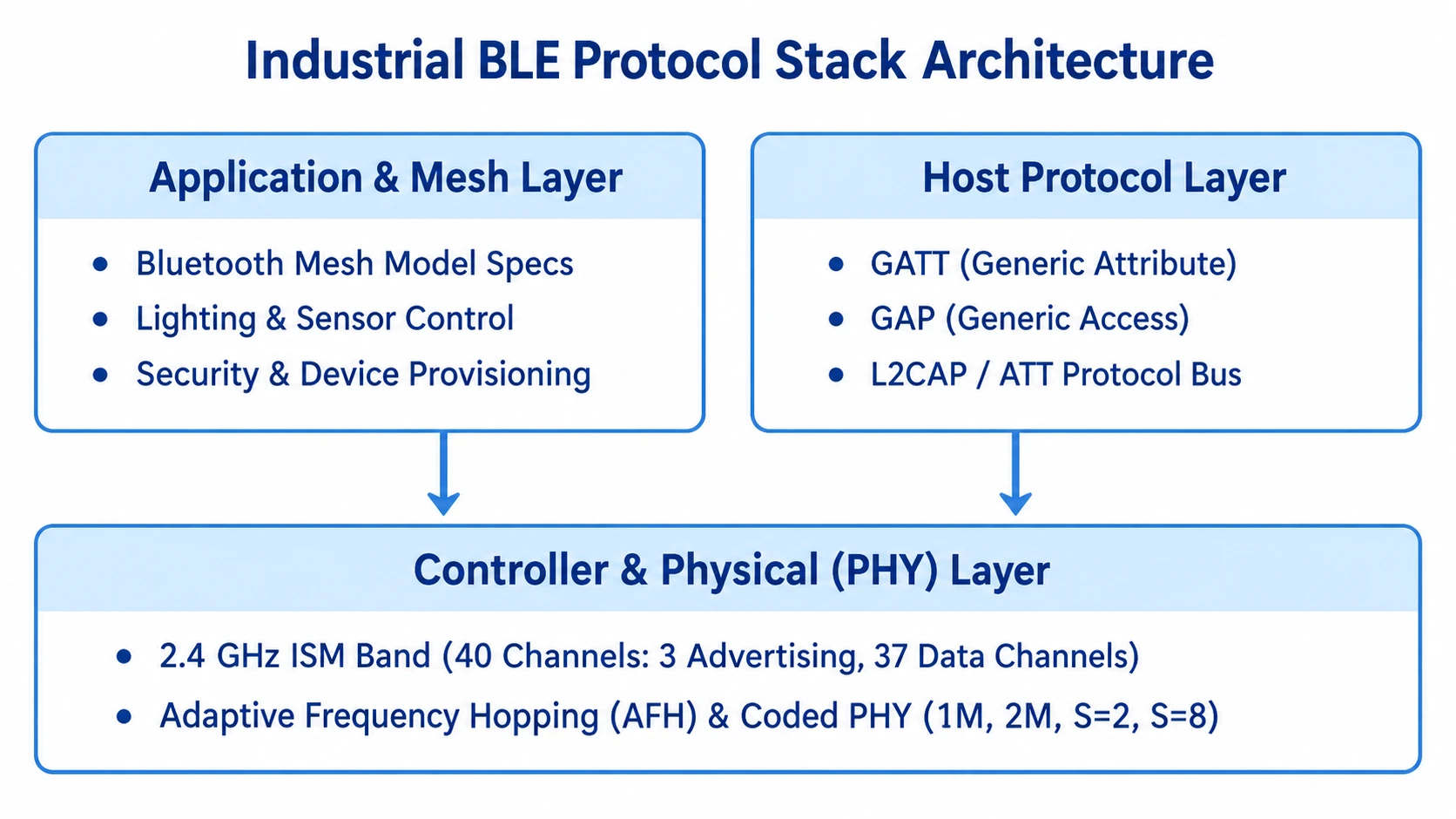
Understanding bluetooth low energy technology requires analyzing how its lean protocol stack optimizes energy efficiency while delivering sub-20ms latency across dense RF environments.
+-----------------------------------------------------------------------------------+
|                     Industrial BLE Protocol Stack Architecture                    |
+-----------------------------------------------------------------------------------+
                                          |
     +------------------------------------+------------------------------------+
     |                                                                         |
     v                                                                         v
+-----------------------------------+                     +-----------------------------------+
|    Application & Mesh Layer       |                     |     Host Protocol Layer           |
|  - Bluetooth Mesh Model Specs     |                     |  - GATT (Generic Attribute)       |
|  - Lighting & Sensor Control      |                     |  - GAP (Generic Access)           |
|  - Security & Device Provisioning |                     |  - L2CAP / ATT Protocol Bus       |
+-----------------------------------+                     +-----------------------------------+
                                          |
                                          v
+-----------------------------------------------------------------------------------+
|                          Controller & Physical (PHY) Layer                        |
|  - 2.4 GHz ISM Band (40 Channels: 3 Advertising, 37 Data Channels)                |
|  - Adaptive Frequency Hopping (AFH) & Coded PHY (1M, 2M, S=2, S=8)                |
+-----------------------------------------------------------------------------------+
Unlike legacy Bluetooth Classic—which maintains continuous connection channels—bluetooth low energy ble devices remain in a deep sleep state until triggered by timed intervals or sensor events. Upon activation, a BLE node wakes up, transmits small data packets across 3 dedicated advertising channels (Channels 37, 38, and 39) within milliseconds, and immediately returns to sleep mode. This architecture reduces active radio current draw to microamps.
Factory floors present harsh radio frequency (RF) challenges, including electromagnetic interference (EMF) from heavy motors, arc welders, and dense 2.4 GHz Wi-Fi networks. The bluetooth low energy protocol mitigates interference by dynamically scanning 37 data channels and hopping away from congested frequencies thousands of times per second.
To explore deeper insights into core RF specifications, read our technical breakdown on
A common misconception among industrial buyers is that BLE is restricted to short-range consumer applications. In reality, modern industrial bluetooth low energy range performance is engineered specifically for massive factory facilities.
+-----------------------------------------------------------------------------------+
|               Industrial Bluetooth Low Energy Range Profile Matrix                |
+-----------------------------------------------------------------------------------+
  |-- Standard 1M PHY (Indoor Partitioned Office): 15m - 30m Effective Range
  |-- Standard 1M PHY (Open Factory / Warehouse Aisle): 50m - 100m Line-of-Sight
  |-- Coded PHY S=8 (Industrial High-Bay / Outdoor): 200m - 400m Extended Coverage
+-----------------------------------------------------------------------------------+
LE 1M PHY: Standard 1 Mbps physical layer balancing energy efficiency and data throughput for basic sensor telemetry.
LE 2M PHY: Doubles throughput to 2 Mbps, reducing on-air time by 50% to conserve battery life during firmware-over-the-air (FOTA) updates.
LE Coded PHY (Bluetooth 5.0+): Uses Forward Error Correction (FEC) with S=2 or S=8 coding schemes to boost receiver sensitivity by up to 12 dB, enabling reliable transmission across distances exceeding 300 meters without increasing RF power output.
| Industrial Environment | Primary RF Obstacles | Typical Attenuation Loss | Mitigated Effective Range |
| Open Assembly Floor | Steel Trusses, Machinery | Low (-3 dB to -6 dB) | 60m – 90m Node Spacing |
| High-Bay Warehouse | Metal Shelving, Pallets | Moderate (-10 dB to -15 dB) | 30m – 50m Aisle Spacing |
| Concrete Plant Facilities | Reinforced Walls, Rebar | High (-18 dB to -25 dB) | 15m – 25m Partition Spacing |
| Exterior Industrial Docks | Atmospheric Humidity, Rain | Variable (-2 dB to -8 dB) | 150m – 300m (Coded PHY) |
To cover multi-story facilities, commercial setups rely on decentralized Bluetooth Mesh networks rather than point-to-point connections.
+-----------------------------------------------------------------------------------+
|                      Decentralized Bluetooth Mesh Architecture                    |
+-----------------------------------------------------------------------------------+
       [BLE Sensor] ----> [Luminaire Node A (Relay)] ----> [Luminaire Node B (Relay)]
                                   |                                  |
                                   v                                  v
                       [Luminaire Node C (Relay)] ----> [BLE Edge Gateway / BMS]
+-----------------------------------------------------------------------------------+
Unlike traditional routing-table networks—which fail if a single router node drops offline—Bluetooth Mesh uses a managed flood routing architecture. Every mains-powered bluetooth low energy devices node acts as a signal relay. When an occupancy sensor detects movement, it broadcasts an encrypted message that hops across adjacent luminaires in sub-20ms intervals, ensuring automatic self-healing routes across active factory zones.
Security is paramount in industrial IoT. Bluetooth Mesh implements true two-layer AES-128 encryption:
Network Key (NetKey): Secures communication across all nodes within the facility subnet.
Application Key (AppKey): Encrypts specific functional payloads (e.g., lighting control vs. asset tracking telemetry), preventing unauthorized access even if a network node is physically compromised.
Deploying bluetooth low energy controls across commercial and industrial lighting infrastructure delivers quantifiable operational and financial returns.
Integrating BLE-enabled occupancy sensing, daylight harvesting, and automated scheduling cuts lighting energy consumption by 50% to 75%. Furthermore, qualified Bluetooth Mesh architectures satisfy strict energy standards such as ASHRAE 90.1, IECC, and DLC NLC 5.1 rebate criteria.
Networked luminaires provide a continuous grid of powered nodes across factory ceilings. By utilizing bluetooth low energy technology, facility operators can deploy:
Real-Time Location Services (RTLS): Tracking BLE beacons attached to forklifts, high-value tooling, and inventory pallets with sub-meter accuracy.
Environmental Condition Monitoring: Collecting temperature, humidity, and vibration telemetry from battery-powered BLE sensors without pulling secondary data lines.
To ensure zero-defect field reliability when integrating bluetooth low energy nodes into commercial luminaires, OEM factories execute a rigorous 4-step quality assurance process:
| QA Test Stage | Engineering Test Name | Verification Procedure & Acceptance Standard |
| Step 1 | RF Output Power & Frequency Offset | Spectrum analyzers verify 2.4 GHz transmit power (+4 dBm to +8 dBm) and carrier frequency drift limits inside anechoic chambers. |
| Step 2 | Receiver Sensitivity & RSSI Calibration | Measures packet error rate (PER < 0.1%) at -95 dBm input levels to guarantee robust reception across noisy RF environments. |
| Step 3 | Multi-Hop Mesh Latency & Stress Test | Simulates a 100-node mesh cluster inside a shielded enclosure to verify command propagation delays remain below 20ms across 6 hops. |
| Step 4 | Unprovisioning & Cryptographic Key Reset | Restores nodes to unprovisioned factory states while confirming unique QR codes and 128-bit device keys for secure site commissioning. |
Bluetooth Classic was designed for high-throughput, continuous data streaming (such as audio calls or file transfers), requiring high power consumption and continuous channel connections. In contrast, bluetooth low energy is optimized for transmitting small data packets intermittently at ultra-low power levels, allowing battery-powered sensors and embedded lighting nodes to operate for years without maintenance.
Industrial BLE devices employ Adaptive Frequency Hopping (AFH) across 37 data channels within the 2.4 GHz ISM band. If heavy electrical machinery or Wi-Fi routers create noise on specific frequencies, the BLE stack automatically identifies congested channels and hops data transmissions to clear channels in real time, maintaining reliable communication.
Yes. Because modern smartphones, tablets, and mobile computers natively support the bluetooth low energy protocol, field technicians can commission, reconfigure, and update luminaire networks directly via mobile applications without requiring specialized proprietary handheld programming tools.
Integrating certified bluetooth low energy controls into your luminaire product lines or factory infrastructure maximizes operational energy efficiency, reduces installation labor, and creates a scalable IoT backbone for industrial automation.
To download technical datasheets, order OEM evaluation samples, or consult with our engineering team on custom BLE integration,




+86 15899791249

+86 755 2955 3313


Address: Huafeng No.1 Science and Technology Park, Sanwei, Bao'an District, Shenzhen, Guangdong, China.
