

Time:2026-05-25
The management of commercial outdoor lighting is changing fast. In 2026, smart cities and smart industrial parks demand strict energy efficiency. Property developers and facility directors cannot rely on outdated light switches anymore. They need high-precision automation across their entire enterprise.
At the center of outdoor security and parking lot lighting is the photocell sensor. However, traditional outdoor light controllers face a major problem. They drop in accuracy over time. Dealing with manual fixes creates a massive drain on maintenance budgets.
Executing a modern outdoor photocell sensor calibration routine has shifted from a manual chore to a software-driven process. By moving away from physical hardware adjustments, engineering teams can calibrate an advanced smart lighting system instantly. This clean tech upgrade cuts high-cost labor and optimizes energy use across the entire property.
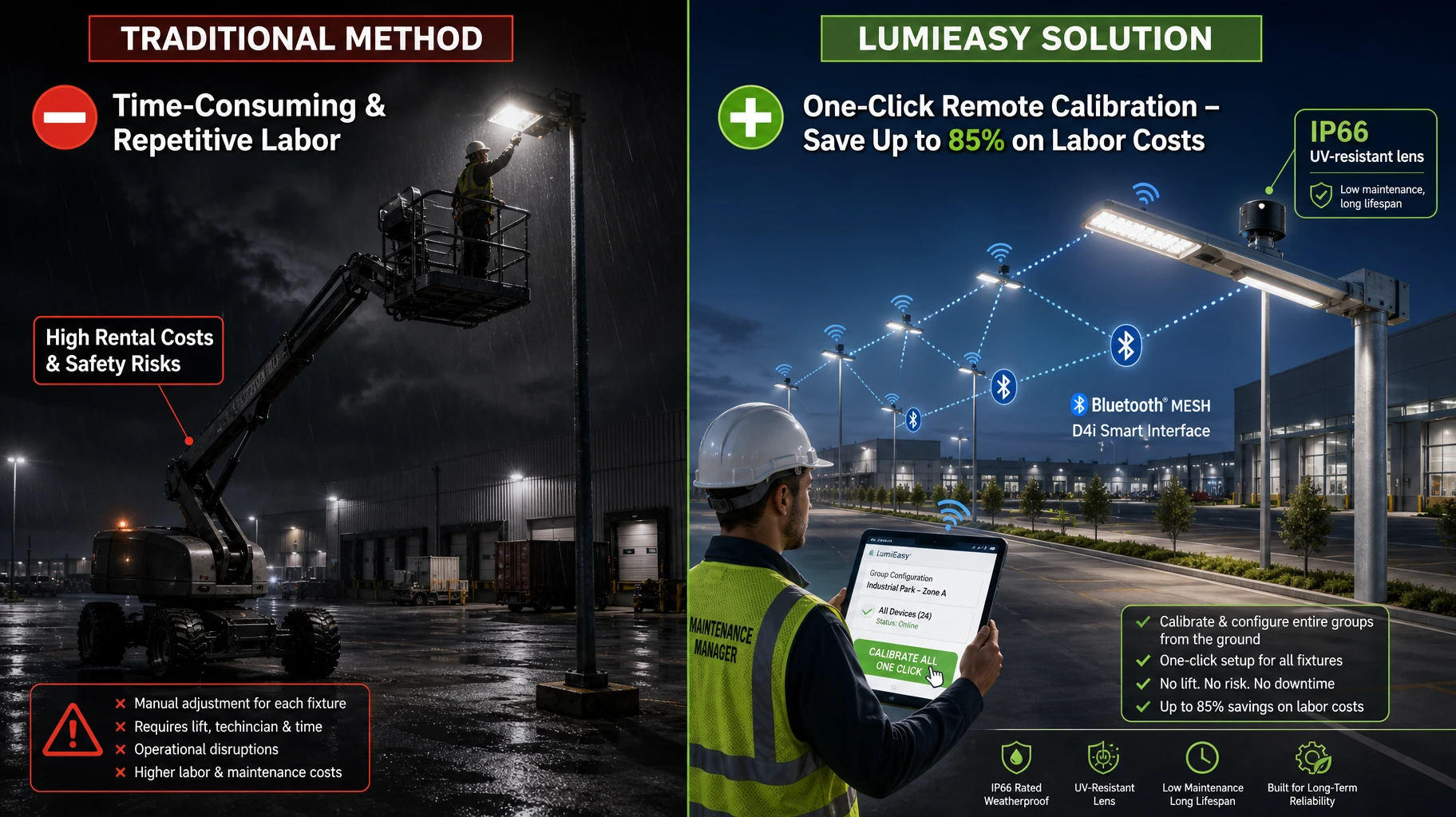
Outdoor sensors live in brutal physical environments. They must survive changing seasons, heavy rain, and extreme temperature shifts. These variable conditions create major operational issues for standard sensors. Traditional setups fail primarily due to three environmental factors:
Seasonal Light Shifts: As days get shorter in winter, fixed mechanical timers fail to keep up with actual sunset times. This timing gap leaves facilities dark when workers are still active.
Lens Dust Buildup: Fine dust, pollen, and salt film build up on the sensor lens over time. This layer blocks incoming ambient sunlight. The sensor thinks it is dark outside when it is actually a bright afternoon. As a result, the outdoor lights turn on hours too early, wasting massive amounts of power.
Architectural Shadows: New building construction or changing seasons alter how shadows fall across a facility. A sensor placed in an open area in spring might sit in a deep shadow by late autumn.
Traditional hardware cannot adapt to these shifts automatically. Without an easy way to execute outdoor photocell sensor calibration, an energy manager must dispatch field crews frequently to reconfigure the hardware.
Older photocell networks required physical adjustments. A technician had to climb a ladder, open a plastic casing, and manually turn a small mechanical dial. This old process is slow and expensive.
Modern smart platforms replace mechanical dials with software intelligence. Today's commercial photocell sensors use advanced internal microprocessors. These smart devices do not just read light levels in a basic way. Instead, they use smart algorithms to analyze light trends over time.
If dirt slowly builds up on the lens over six months, the software logic recognizes this gradual drop in light transmission. The internal program adjusts its baseline calculation automatically. This intelligent self-calibration prevents false triggers. It keeps the core lighting control system running cleanly without manual maintenance.
For outdoor sensors to integrate with modern building networks, they must utilize robust, low-voltage electronic designs and reliable wireless communication protocols.
Modern outdoor photocell sensors are built to support clean Low-Voltage (12V/24V DC input) system loops. Traditional high-voltage AC sensors require heavy metal conduit and thick copper wiring. They also present high electrical shock risks for field crews.
Low-voltage hardware eliminates these material costs and safety hazards. Running a 12V/24V DC input line is fast and safe. This makes it an ideal option for any extensive commercial lighting retrofit project.
A smart sensor must share its environmental data with the rest of the facility network. Using a secure Bluetooth Mesh network, individual outdoor photocells transmit real-time ambient light data seamlessly to a centralized Smart Gateway.
This wireless structure removes the need for long, low-voltage control lines. When a sensor records a change in daylight, it sends a wireless signal to nearby light fixtures instantly. This creates a highly responsive, self-healing iot lighting control web.
Older lighting systems used sudden, jarring on-and-off switches. Modern systems use advanced 0-10V Dimming protocols to deliver a smooth linear dimming experience.
When the sun begins to set, the outdoor photocell does not just snap the lights to full power. It tells the system to bring the LED fixtures up slowly from 10% to 100% over thirty minutes. This slow transition protects worker eyesight and reduces peak electrical power surges.
An accurate outdoor photocell sensor calibration routine does more than just lower your monthly power bill. It transforms your outdoor lighting layout into a valuable source of facility operational data.
When your outdoor sensors are perfectly calibrated, they provide a clean stream of environmental information. This data feeds directly into a broader Space Utilization Data Collection framework.
By analyzing when and where ambient light drops—and combining that with motion tracking data—a central controller can build detailed facility maps.
Smart Campus Logistics: This application tracks how vehicle parking density changes based on evening light and weather patterns.
Predictive Security Logic: The system automatically increases lighting levels in dark corners before a security team begins their physical foot patrol.
Asset Health Monitoring: Technicians can identify failing LED fixtures instantly by cross-referencing photocell lux reads with the actual power draw of the local circuit.
This rich analytics pipeline gives smart cities and modern business parks the clear proof they need to optimize their spatial layout and improve occupant safety.
The real financial return of software-driven outdoor photocell sensor calibration is found in the massive reduction of maintenance labor. High-voltage outdoor maintenance is an expensive operational bottleneck.
| Operational Factor | Traditional Manual Photocells | Intelligent Software Mesh |
| Physical Tools Required | High ladders, bucket trucks, screwdrivers | Mobile smartphone, tablet, or web dashboard |
| Adjustment Time Per Node | 30 to 45 minutes per location | Under 10 seconds via software commands |
| Safety Risk Level | High (Working near high-voltage lines) | Zero (Wireless software tweaks from the ground) |
| Calibration Precision | Approximate (Coarse mechanical dials) | Exact (Precise numerical lux thresholds) |
If a sensor fails or drifts off-target on a 30-foot parking lot pole, the repair bill grows fast. An energy manager cannot just send a technician with a standard ladder. The company must rent a specialized bucket truck, block active driving lanes, and pay high labor rates for field troubleshooting.
By choosing advanced smart devices configured via wireless ble commissioning tools, you avoid these expensive maintenance traps completely. Field teams handle all calibration tasks remotely from the safety of the ground.
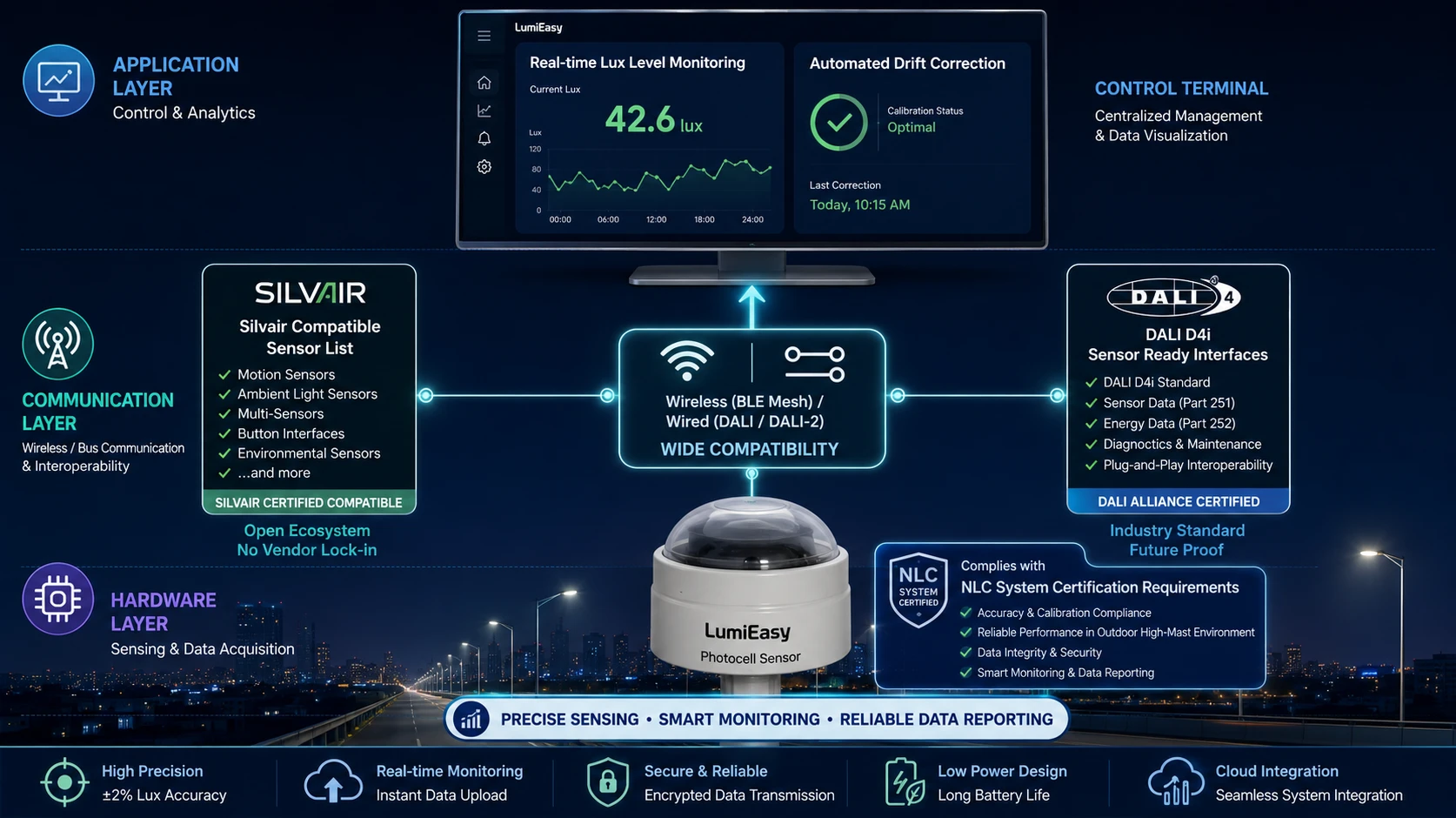
When building consultants design commercial outdoor spaces, they must select hardware that meets high technical standards. Sourcing your components from a trusted ecosystem ensures that your sensors, controllers, and gateways work together perfectly.
Using professional wireless setup apps allows field installers to discover and group hundreds of outdoor fixtures in a few minutes. If your facility layout changes next year, you do not need to pull new low-voltage wires through concrete poles. A technician simply updates the software groupings using lumieasy tools, keeping your infrastructure adaptable and ready for future upgrades.
Q: Are LumiEasy outdoor photocell sensors compatible with existing 0-10V dimming drivers?
A: Yes. LumiEasy outdoor sensors are engineered to interface directly with industry-standard 0-10V Dimming power packages. They deliver smooth, linear dimming adjustments based on live ambient lux levels within the wider smart lighting system.
Q: How does the LumiEasy system handle sudden light flashes, like lightning or car headlights?
A: Our smart sensors do not react to sudden, brief changes in light. The internal algorithm uses a time-delay filter. It requires a steady light change for at least 60 seconds before telling the central controller to alter the brightness. This prevents unnecessary light cycling.
Q: Can we perform an outdoor photocell sensor calibration if the Smart Gateway goes offline?
A: Yes. LumiEasy sensors use standard Bluetooth Mesh architecture. You can connect to an individual sensor locally using our ble commissioning tools on a mobile tablet. You can update calibration targets and hold times even if the main building gateway is temporarily down for IT updates.
Q: What voltage inputs do LumiEasy outdoor photocell sensors support?
A: We offer a versatile line of low-voltage sensors that support Low-Voltage (12V/24V DC input) systems. This low-voltage architecture improves field installation safety and reduces code-compliance hurdles during large commercial retrofits managed by our lighting control system.
Q: Can these outdoor photocells feed data into an enterprise iot lighting control platform?
A: Yes. Because every LumiEasy photocell acts as a native network node via the Smart Gateway, it continuously pushes lux readings and operational status logs to your cloud dashboard. This makes it a perfect fit for multi-site industrial monitoring.
Related new
Calibrating Outdoor Photocell Sensors: A Guide


)
)
)
)

+86 15899791249

+86 755 2955 3313


Address: Huafeng No.1 Science and Technology Park, Sanwei, Bao'an District, Shenzhen, Guangdong, China.
